Combining programs
About half of the restaurants (49%) run two or more programs. In those, 15% of customers earn a reward, against 5% in restaurants with a single program – the largest gap among the industries with enough data on BonusQR.
There are many ideas for a restaurant loyalty program. Here is what the restaurants that actively run theirs on BonusQR actually set up – how many stamps, what cashback rate, what to combine – and what their numbers show.
From anonymous BonusQR app data, 2026. Shares of customers are medians across businesses: a typical business, not a total.
The stamp card is the main loyalty program in 49% of the active restaurants on BonusQR and cashback in 29%; the typical restaurant stamp card asks for 9 stamps.
In restaurants with a 9- or 10-stamp card, 43% of customers come back and 17% earn a reward, against 36% and 11% in the typical restaurant.
Restaurants that run two or more loyalty programs see 15% of customers earn a reward, against 5% with a single program.
About 46% of restaurant welcome coupons are redeemed, so something small and pleasant, such as a free espresso, is enough; the stamp card or cashback is what brings guests back.
Quote these figures with a link to this page: BonusQR (2026): Restaurant Loyalty Program Ideas, Backed by Data bonusqr.com/p/restaurant-loyalty-program-setup
The stamp card is the main program in 49% of the active restaurants on BonusQR; cashback in 29%, a reward for spend in 26% and a reward for visits in 20%. This is how long their stamp cards are, and how stamp cards of each length do across all businesses.
The most common card lengths among the restaurants with a stamp card.
Half of the restaurants ask for 8 to 10 stamps; the median is 9.
All active BonusQR businesses with a stamp card, grouped by the number of stamps the card needs.
| Stamps needed | Customers who came back | Customers who earned a reward | Coupons redeemed |
|---|---|---|---|
| 6 or fewer | 32% | 17% | 50% |
| 7–8 | 40% | 25% | 68% |
| 9–10 | 48% | 18% | 63% |
| 11 or more | 45% | 16% | 35% |
Medians across businesses. A shorter card is not automatically better: the 7–8 group sees the most rewards earned and redeemed, while very short cards see the fewest customers come back.
A restaurant card of 9 or 10 stamps is the norm: in restaurants with such a card, 43% of customers come back and 17% earn a reward, against 36% and 11% for the typical restaurant. Restaurants that run cashback mostly give 10% or 5% of the bill (the median is 7.5%).
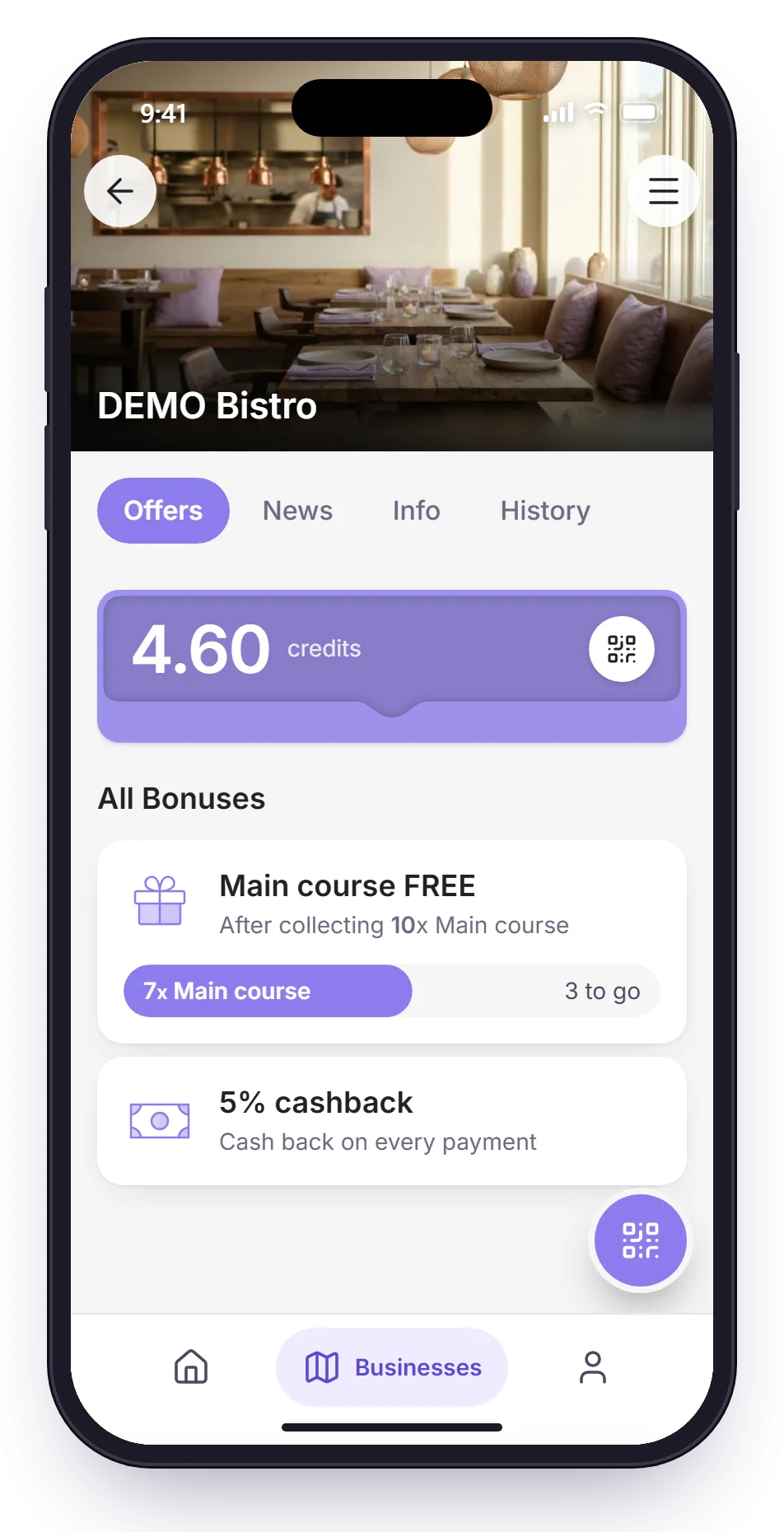
For a restaurant, this is the combination to set up in BonusQR, setting by setting, with the figure behind each one. On the right, what a regular with 7 of 10 stamps and some cashback credit sees in the app.
In restaurants with a 9- or 10-stamp card, 43% of customers come back and 17% earn a reward, against 36% and 11% in the typical restaurant.
Restaurants that run two or more programs see 15% of customers earn a reward, against 5% with one. 5% and 10% are the most common rates; the rate cannot be changed once saved.
About 46% of restaurant welcome coupons are redeemed, so a small, pleasant one is enough.
The stamp card and cashback are both in the free plan, free forever, with unlimited customers.

The typical restaurant customer comes back about every 14 days – a little less often than in a café, more often than in a shop or a salon.
If a regular earns one stamp a visit, a 10-stamp card takes about four and a half months to fill. If guests earn a stamp for each main course, a family table fills it much faster – set the goal with that in mind.
Median of the average gap between a customer’s first and last visit, per business.
Among restaurants, combining programs goes with the biggest difference in this data – and here is what the welcome coupon does.
About half of the restaurants (49%) run two or more programs. In those, 15% of customers earn a reward, against 5% in restaurants with a single program – the largest gap among the industries with enough data on BonusQR.
31% of the restaurants give a welcome coupon, mostly a free item. About 46% of them are redeemed, so something small and pleasant is enough – the stamp card or cashback stays the reason to return.
The setup above, step by step, on the free plan.
Type your restaurant’s name as it appears on Google Maps and choose “Restaurant / Cafe”. BonusQR fills in the name, address and photo and creates a starter program that you can change.
Add a stamp card with 10 stamps and a free main course as the reward. Staff add the stamps when they scan the guest’s code at the till.
Cashback on the bill, or a percentage off in the hours you choose, such as 15:00–17:00 every day. The starter’s 5% cashback cannot be changed once saved, so replace it if you want another rate.
Print the free table stand or sticker. Guests join from the QR code and keep the card in Apple Wallet, Google Wallet or the BonusQR app.
Anonymous data from the BonusQR app, 2026: active restaurants, classified by the Google Maps category they chose or, without one, by their name.
What owners ask before they set up their card.
A stamp card – the main program in 49% of active restaurants on BonusQR – with a free main course after 10 stamps, plus a second program such as cashback or a happy-hour discount. Restaurants that combine programs see 15% of customers earn a reward, against 5% with one program.
Most restaurants on BonusQR ask for 8 to 10 stamps (the median is 9; 10 is the most common). In restaurants with a 9- or 10-stamp card, 43% of customers come back and 17% earn a reward.
Among the restaurants on BonusQR that run cashback, the median rate is 7.5%; 10% and 5% are the most common. Choose it carefully: the rate of a saved cashback cannot be changed.
The typical restaurant on BonusQR sees its returning customers about every 14 days, and 36% of its customers come back at least once.
Yes – something small and pleasant, such as a free espresso or dessert, is enough: about 46% of restaurant welcome coupons are redeemed. The stamp card or cashback is what brings guests back.
From the BonusQR app, anonymised, 2026: restaurants with at least 10 customers and a scan in the last 12 months. Every figure is a median across restaurants, and no single restaurant can be identified.