Special occasion rewards are personalised incentives tied to customer or employee milestones, such as birthdays, anniversaries, and seasonal celebrations, designed to deepen loyalty and drive repeat engagement. Businesses that understand why offer special occasion rewards as part of their loyalty strategy gain a measurable advantage: birthday rewards alone can increase monthly revenue by 84% to 208% by converting a single additional visit. Brands including Starbucks, Sephora, and The Body Shop have built entire loyalty tiers around occasion-based incentives, and the results consistently outperform generic discount campaigns. This article explains the business case, the psychology, and the practical steps to get it right.
Why do special occasion rewards improve customer loyalty and retention?
Special occasion reward programmes work because they shift the customer relationship from transactional to personal. When a customer receives a birthday offer or an anniversary discount, the message is clear: your business remembers them as an individual, not just a revenue line. That distinction matters enormously to repeat purchase behaviour.
The revenue impact is well documented. One extra monthly visit driven by a birthday reward raises monthly revenue by 84% to 208%, depending on average spend. This figure is striking because it comes from a single behavioural nudge, not a full campaign overhaul. It also highlights a structural problem: 60% of uncommitted customers fail to return after their first month, and occasion rewards are one of the most cost-effective tools for closing that gap.
The psychological mechanism behind this is equally important. Unexpected rewards generate a positive prediction error in the brain, releasing dopamine and creating a strong association between the brand and a good feeling. Formal recognition increases feelings of appreciation by 355%, which means a well-timed birthday voucher does far more than drive one purchase. It builds the kind of emotional connection that sustains long-term loyalty.
The difference between one-time buyers and loyal customers often comes down to whether they feel seen. Occasion rewards are one of the few loyalty mechanics that directly address this. Rather than rewarding spend alone, they reward the relationship itself.
| Impact area | Data point | What it means |
|---|---|---|
| Revenue uplift | 84%–208% increase from one extra visit | Birthday rewards pay back quickly even at low redemption rates |
| Customer appreciation | 355% increase in feelings of appreciation | Occasion rewards create emotional loyalty, not just transactional loyalty |
| First-month churn | 60% of uncommitted customers do not return | Occasion rewards are a targeted tool to convert early visitors into regulars |
| Positive brand association | 94% of recipients report improved brand perception | Even small rewards (£5–£10) shift how customers view your business |
Pro Tip: Set up a birthday reward that triggers automatically 7 days before the customer’s birthday. This gives them time to plan a visit and increases redemption rates compared to same-day delivery.
You can explore how retail customer engagement strategies use occasion rewards to build consistent footfall and repeat visits.
How do occasion rewards affect employee engagement and retention?
The importance of rewards for occasions extends well beyond customers. Employees who receive formal recognition on birthdays and work anniversaries are significantly more likely to stay with their employer. Automated milestone rewards produce an 85% employee retention rate, compared to just 62% where no recognition programme exists. That 23-percentage-point gap represents real cost savings, given that replacing a single employee typically costs between 50% and 200% of their annual salary.
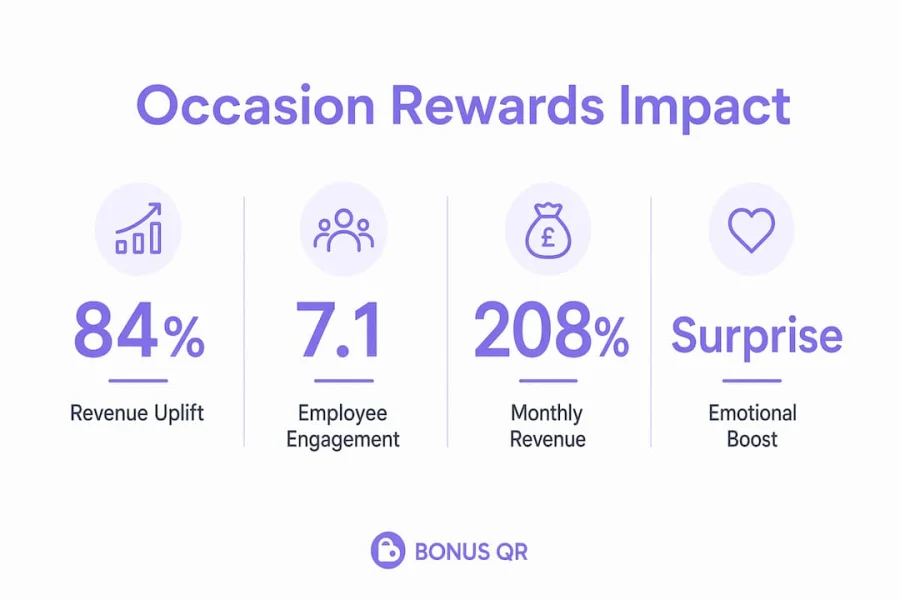
The engagement data is equally compelling. Formal recognition programmes score employee engagement at up to 7.1 out of 10 when both birthdays and work anniversaries are automated. Companies that rely on manual recognition, by contrast, frequently miss celebrations entirely, which actively damages trust. Employees notice when a milestone passes without acknowledgement, and the negative effect on morale is disproportionate to the effort it would have taken to recognise it.
Recognition also changes how employees perceive their value within an organisation. Formal recognition increases feelings of appreciation by 355%, a figure that applies to employees just as much as to customers. When people feel genuinely valued, discretionary effort increases, absenteeism falls, and team culture improves.
Here are the most effective reward ideas for special events in an employee context:
- Birthday rewards: A personalised gift card, an extra day of annual leave, or a team acknowledgement in a company meeting
- Work anniversary recognition: A tiered reward that grows with tenure, such as a gift at year one, a larger experience at year five, and a meaningful personal gift at year ten
- Milestone bonuses: A financial or experiential reward tied to completing a major project or reaching a performance target
- Peer-nominated occasion awards: Allowing colleagues to nominate each other for recognition on personal milestones, which builds culture alongside the reward itself
- Surprise appreciation moments: Unscheduled recognition for effort during a difficult period, which triggers the dopamine response associated with positive prediction error
Pro Tip: Automate birthday and anniversary alerts in your HR system so that line managers receive a reminder two weeks in advance. This gives them time to personalise the recognition rather than sending a generic message on the day.
What types of rewards work best for special occasions?
Not all rewards carry equal weight, and the type you choose has a direct bearing on how long the positive effect lasts. Experience-based rewards create more enduring happiness than physical gifts because they avoid hedonic adaptation, the psychological process by which people quickly return to their baseline satisfaction level after receiving a material object. An experience, by contrast, becomes a story. It forms part of the recipient’s identity and remains associated with your brand long after the event.
Physical gifts still have a place, particularly when they are personalised and high quality. The key variable is choice. Employees and customers who are given a choice of reward report higher satisfaction and stronger retention outcomes than those who receive a pre-selected item, regardless of the item’s monetary value. This finding has practical implications: a reward catalogue or a digital voucher that allows the recipient to choose their own gift often outperforms a single curated item.
Monetary rewards, such as cash bonuses or account credits, are the most straightforward option but tend to produce the weakest emotional response. They are quickly absorbed into general spending and rarely create a memorable association with the brand. Non-cash occasion rewards outperform cash bonuses in both brand perception and long-term engagement, which is why most well-designed loyalty programmes use points, experiences, or exclusive access rather than direct discounts.
The most effective approach combines predictable and surprise elements. Customers expect a birthday reward if your programme has always offered one, and meeting that expectation builds trust. Adding an occasional unannounced reward on top of the expected one triggers a stronger dopamine response and generates the kind of goodwill that drives word-of-mouth referrals.
| Reward type | Strengths | Weaknesses | Best used for |
|---|---|---|---|
| Experiential rewards | Long-lasting emotional impact, builds brand identity | Higher cost, harder to scale | High-value customers, employee milestones |
| Physical gifts | Tangible, visible, easy to personalise | Subject to hedonic adaptation | Anniversaries, onboarding gifts |
| Monetary or credit rewards | Simple to deliver, universally valued | Weak emotional association, quickly forgotten | Low-margin businesses, high-volume programmes |
| Choice-based vouchers | High satisfaction, respects individual preference | Requires platform or catalogue management | Broad customer bases, diverse employee teams |
| Surprise rewards | Strong dopamine response, generates goodwill | Unpredictable cost, harder to plan | Retention campaigns, loyalty tier upgrades |
Pro Tip: When designing occasion rewards, offer a choice between two or three options rather than a single gift. This small change consistently improves satisfaction scores without significantly increasing programme cost.
You can also compare coupon versus cashback approaches to understand which non-cash reward format suits your customer base best.
How to implement a special occasion rewards programme effectively
Designing occasion rewards that actually work requires more than choosing a gift and sending it on the right date. The execution determines whether the reward feels personal and timely or generic and forgettable. Follow these steps to build a programme that delivers consistent results.
-
Collect the right data at the right moment. You cannot personalise occasion rewards without knowing your customers’ or employees’ key dates. Build data collection into your onboarding process: ask for birthdays during account registration, capture work start dates in your HR system, and record purchase anniversaries automatically. The earlier you collect this data, the more time you have to plan meaningful recognition.
-
Automate delivery to guarantee consistency. Manual recognition leads to missed milestones, and missed milestones actively damage trust. Set up automated triggers so that rewards are sent at the right time without relying on anyone to remember. Automation also allows you to scale the programme across hundreds or thousands of customers without additional administrative effort.
-
Personalise the message, not just the reward. A birthday discount sent with the customer’s name and a reference to their favourite product category lands very differently from a generic “Happy Birthday” email. Use the data you have to tailor the communication. Even small personalisation signals, such as referencing a recent purchase or acknowledging a loyalty tier milestone, significantly increase the emotional impact of the reward.
-
Layer predictable rewards with surprise moments. Customers who expect a birthday reward will be satisfied when it arrives, but they will not be delighted. Hybrid programmes that combine expected occasion rewards with occasional surprise bonuses produce the strongest engagement outcomes. Plan your surprise rewards in advance, even if the recipient does not know they are coming, so that delivery remains consistent and on-brand.
-
Integrate occasion rewards into your broader loyalty strategy. Occasion rewards work best when they sit within a larger loyalty programme rather than operating in isolation. A customer who earns points on every purchase and then receives a birthday bonus feels a continuous relationship with your brand. Platforms like Bonusqr allow you to connect special occasion incentives with points, stamp cards, and cashback modules so that every touchpoint reinforces the same loyalty narrative.
-
Measure and refine. Track redemption rates, revenue per reward, and customer retention rates for those who receive occasion rewards versus those who do not. This data tells you which reward types and delivery timings produce the best return. Adjust your programme every quarter based on what the numbers show, not on assumptions about what customers prefer.
Pro Tip: Start with birthday rewards before expanding to other occasions. They are the easiest to collect data for, the most universally appreciated, and the most straightforward to automate. Once your birthday programme is running well, add work anniversaries, purchase anniversaries, and seasonal occasions progressively.
Automating your rewards delivery is one of the most direct ways to boost customer retention without increasing your marketing headcount.
Key takeaways
Special occasion rewards drive measurable loyalty gains because they combine personalisation, timely recognition, and emotional engagement in a single customer or employee interaction.
| Point | Details |
|---|---|
| Revenue impact is immediate | Birthday rewards can increase monthly revenue by 84%–208% from a single additional visit. |
| Employee retention improves significantly | Automated milestone recognition raises retention to 85%, compared to 62% with no programme. |
| Experience rewards outlast physical gifts | Experiential incentives avoid hedonic adaptation and create lasting brand associations. |
| Automation prevents missed milestones | Manual recognition leads to inconsistency; automated triggers guarantee timely, trust-building delivery. |
| Choice increases reward satisfaction | Giving recipients two or three options consistently outperforms a single pre-selected reward. |
Why I think most businesses are leaving occasion rewards on the table
Most businesses I have observed either ignore occasion rewards entirely or implement them so inconsistently that the effect is worse than doing nothing at all. A birthday email that arrives three days late, or a work anniversary that passes without any acknowledgement, signals to the recipient that the gesture was an afterthought. That perception is harder to recover from than simply not having a programme in the first place.
The businesses that get this right share one characteristic: they treat occasion rewards as a system, not a gesture. They automate the delivery, personalise the message, and measure the outcome. They do not rely on a manager remembering to send a card or a marketing team manually pulling a birthday list each month.
What I find most underappreciated is the compounding effect of consistent recognition over time. A customer who receives a well-timed birthday reward for three consecutive years does not just feel appreciated in the moment. They begin to associate your brand with reliability and care, which is a far more durable form of loyalty than any points balance can create. The same applies to employees: a team member who has been recognised on every work anniversary for five years has a fundamentally different relationship with their employer than one who has never been acknowledged.
The other mistake I see regularly is treating all rewards as equivalent. A £5 discount code and a personalised experience are not interchangeable, even if their cost to the business is similar. The research on experiential rewards and hedonic adaptation is clear: experiences become stories, and stories stay with people. If your occasion rewards programme consists entirely of discount codes, you are missing the most powerful part of what these incentives can do.
My practical advice is to start small and automate early. Pick one occasion, build the automation, test the message, and measure the result. Then expand. Businesses that try to launch a full occasion rewards calendar on day one almost always struggle with execution. Those that start with a single well-run birthday programme and build from there consistently outperform them.
— Michal
How Bonusqr supports your occasion rewards strategy
Bonusqr is built to handle the automation and personalisation that make occasion rewards work at scale. The platform lets you set up birthday, anniversary, and milestone reward triggers across your entire customer base without manual intervention. Push notifications, mobile wallet integration, and real-time analytics mean you can deliver the right reward at the right moment and track exactly how it performs. Whether you run a single retail location or a multi-site operation, Bonusqr’s loyalty system functions include the occasion reward modules, points collection, and cashback tools you need to build a programme that grows with your business. Setup requires no POS integration, and the free tier lets you test the core features before committing to a paid plan.
FAQ
What are special occasion rewards in a loyalty programme?
Special occasion rewards are personalised incentives delivered to customers or employees on key dates such as birthdays, purchase anniversaries, or work milestones. They are designed to strengthen loyalty by making the recipient feel individually recognised rather than part of a generic campaign.
How much can birthday rewards increase revenue?
Birthday reward programmes can increase monthly revenue by 84% to 208% by driving one additional visit from customers who might otherwise have lapsed. The return is high relative to the cost because the reward targets a specific behavioural gap.
Are experience rewards better than cash for special occasions?
Experience-based rewards consistently outperform cash in emotional impact and long-term brand association because they avoid hedonic adaptation. Cash is absorbed into general spending quickly, while an experience becomes a memory linked to your brand.
Why does automation matter for occasion rewards?
Automated milestone recognition ensures that no occasion is missed, which is critical because a missed milestone actively damages trust. Automation also scales the programme across large customer or employee bases without additional administrative cost.
How do I start a special occasion rewards programme?
Begin by collecting birthday or anniversary data during customer onboarding, then set up an automated trigger to deliver a reward seven to ten days before the occasion. Start with one occasion type, measure redemption and retention rates, and expand to additional milestones once the first programme is running consistently.


