
 Deutsch
 Español
 Français
 Italiano
 Magyar
 Polski
 Slovenčina
 Čeština
Most small business owners reach for coupons almost automatically when they want to bring customers back. It feels like the obvious move. But cashback loyalty research shows cashback produces a loyalty coefficient of 0.58 compared to just 0.42 for traditional discounts, meaning that coupon-first instinct might actually be leaving repeat revenue on the table. This guide breaks down both strategies clearly, compares their real-world impact on retention and lifetime value, and helps you decide which one, or which combination, fits your goals and customer base.
Key Takeaways
| Point | Details |
|---|---|
| Cashback drives loyalty | Cashback incentives typically strengthen customer loyalty more than coupons due to their ongoing value. |
| Coupons boost retention quickly | Coupons increase retention and lifetime value, especially for new or lapsed customers. |
| Align incentives with goals | Choose your incentive based on whether your priority is immediate sales or long-term loyalty. |
| Avoid common pitfalls | Prevent costly mistakes by keeping program rules clear and not over-discounting. |
| Blending works best | A smart combination of coupon and cashback strategies often delivers stronger results than choosing one alone. |
What are coupons and cashback? Key definitions and use cases
To make smart retention decisions, it helps to clarify exactly what coupons and cashback mean in modern retail.
A coupon is a voucher, code, or digital offer that gives a customer a price reduction at the point of sale. Coupons come in many formats: printed flyers, digital codes sent via email, QR codes at checkout, in-app offers, and buy-one-get-one promotions. The discount is applied immediately and the customer sees the savings right away.
Cashback works differently. Instead of reducing the price upfront, cashback returns a portion of the money spent after the purchase is completed. This might mean crediting a loyalty account, sending a payment to a digital wallet, or adding redeemable points. The reward is delayed, which changes how customers experience it psychologically.
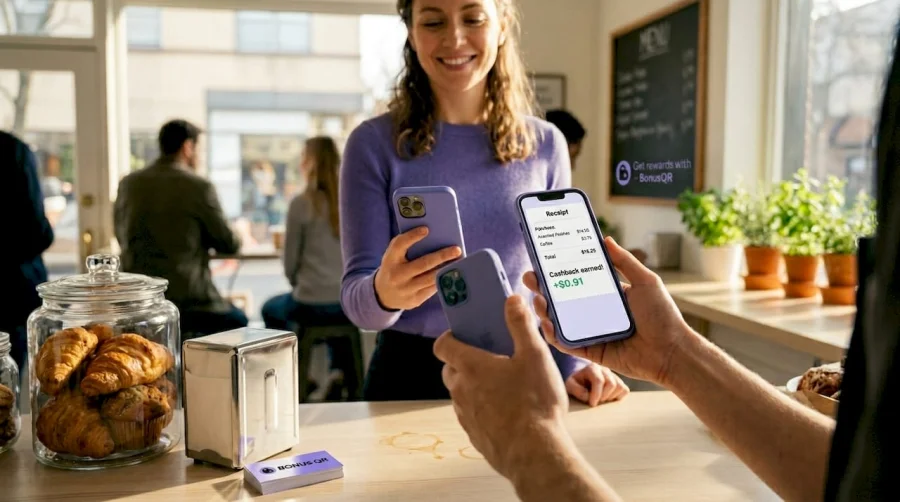
Understanding cashback in retail goes beyond the basic definition. The deferred nature of cashback keeps customers engaged with your brand between purchases, whereas a coupon completes its job the moment it’s redeemed. That behavioral difference has real implications for how often customers return.
Common use cases for coupons:
- Launching a new product or menu item and driving first-time trials
- Clearing excess inventory quickly before seasonal turnover
- Rewarding one-time email subscribers to convert them to buyers
- Running a time-sensitive promotion around a holiday or event
- Attracting price-sensitive shoppers who respond to visible savings
Common use cases for cashback:
- Onboarding new customers and giving them a reason to return for a second visit
- Encouraging larger basket sizes by rewarding higher spend thresholds
- Building a habit of repeat visits with accumulated rewards
- Premium positioning where instant discounting would cheapen brand perception
- Differentiating from competitors who already rely heavily on coupons
Studies show that brands using coupons see a 15% boost in customer retention and a 20% higher customer lifetime value, which proves coupons work. But the method you use to apply them matters enormously. You can also explore proven coupon strategies that local businesses use to get the most from their promotions.
Pro Tip: Discount fatigue is real. If you run coupons too often, customers learn to wait for the next offer before buying. That pattern erodes your margins and trains your audience to devalue your regular pricing. Space out coupon campaigns and always attach them to a specific reason or event.
Solid customer retention strategies treat incentives as one tool in a larger retention system, not a standalone fix.
Performance showdown: Customer loyalty, retention, and lifetime value
Understanding the basics lets us dig into the real-world numbers: which incentive delivers better results for your bottom line?
The data paints a clear picture. Cashback outperforms discounts in loyalty impact with a coefficient of 0.58, compared to 0.42 for coupon-style discounts. That gap might look small in isolation, but across hundreds of customer interactions it translates into meaningfully higher repeat visit rates and stronger emotional connection to your brand. Meanwhile, coupons still boost retention by 15% and lift customer lifetime value by 20%, so neither strategy should be dismissed outright.
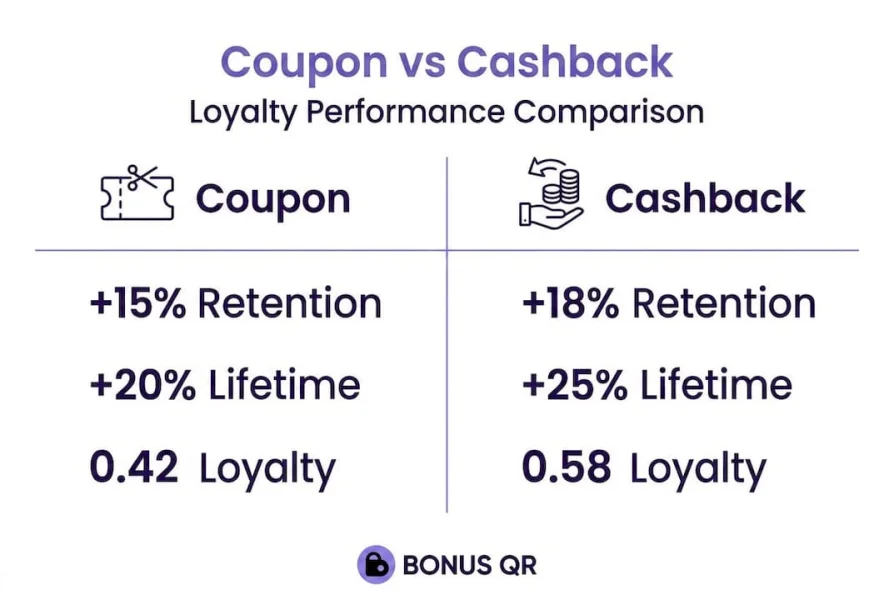
Here is a side-by-side comparison of how both incentives typically perform:
| Metric | Coupons | Cashback |
|---|---|---|
| Loyalty coefficient | 0.42 | 0.58 |
| Customer retention lift | Up to 15% | Higher long-term repeat rates |
| Customer lifetime value | 20% higher with coupons | Sustained growth with repeat visits |
| Speed of impact | Immediate, short-term | Slower but more durable |
| Perceived brand value | Can erode with overuse | Tends to preserve premium perception |
| Operational complexity | Lower, easy to run one-off | Requires tracking system |
| Best for | Sales spikes, product launches | Long-term loyalty building |
“Cashback consistently outperforms direct discounts in building the kind of loyalty that keeps customers returning without requiring ever-larger discounts to motivate the next visit.”
For small businesses specifically, this data carries extra weight. You have fewer resources than large retailers to absorb margin losses from aggressive discounting. A cashback program may cost a similar percentage of revenue but produces more durable loyalty in return. That makes cashback loyalty and growth a particularly attractive model for SMBs that want measurable ROI without a large marketing budget.
Restaurants and food businesses see this dynamic play out clearly. Cashback rewards for restaurants work well because the reward naturally brings customers back for a future meal, rather than simply reducing tonight’s check. The visit pattern gets reinforced through the reward structure itself.
For a practical breakdown of what these numbers mean for your operation, the discount offers guide covers how local businesses can structure their offers to protect margins while still driving traffic. You can also apply the data from small business retention strategies to decide where either tool fits into your existing efforts.
How to choose: Matching incentive to business goals and audience
Seeing the numbers, you still need to personalize the strategy. Here’s how to decide what’s actually best for your customers and your goals.
There is no universal answer. The right incentive depends on where you are in your business cycle, who your customers are, and what result you need right now versus six months from now. Research on discount versus cashback effectiveness confirms that discounts perform better for immediate revenue needs, while cashback is superior for building loyalty and protecting margins over time, even if the results arrive more slowly.
Follow this step-by-step process to make the call:
-
Define your retention goal. Are you trying to get first-time buyers to return, or keep existing loyal customers from drifting to competitors? New customer activation often benefits from a coupon. Strengthening an existing relationship favors cashback.
-
Know your audience. Price-sensitive shoppers respond strongly to visible, upfront savings. They want to see the discount clearly at checkout. Higher-income or brand-loyal customers often respond better to cashback because it feels like a reward rather than a markdown.
-
Assess short-term vs. long-term needs. If you need to move inventory this week, a coupon campaign will produce results faster. If you want to increase your average customer visit frequency over the next quarter, a cashback program will serve you better.
-
Consider your tech and operations setup. Coupons can be run manually or through simple tools. Cashback requires a tracking system that records purchases and issues rewards. If you don’t have that infrastructure yet, start with coupons while you build toward a more structured loyalty program.
When coupons are the right choice:
- You’re launching a product and need fast trials
- You have excess inventory with a clear expiry date
- Your audience is highly price-sensitive and compares offers actively
- You need a quick revenue injection during a slow period
When cashback is the right choice:
- You’re building a long-term habit of repeat visits
- You want to avoid competing on price and protect your brand positioning
- Your customers already like you and just need a reason to stay exclusive
- You have or plan to have a digital loyalty system in place
Choosing a loyalty strategy is also about understanding the trade-offs at the program level. If you run a cafe, the stamp card vs cashback comparison is worth reading before you decide on a format.
Pro Tip: Many successful SMBs run both, but they assign each to a specific role. Coupons bring new customers in the door. Cashback converts those new customers into regulars. The key is making sure the two programs don’t undercut each other, so avoid running both simultaneously on the same product or service.
Common mistakes and hidden pitfalls to avoid
Choosing the right incentive is just the starting point. Here are common mistakes to sidestep so your program succeeds long term.
Even the best strategy fails if the execution is flawed. Small business owners often make a handful of predictable errors when launching coupon or cashback programs, and most of them are easy to avoid once you know what to look for.
Brands that use coupons effectively see 15% higher retention rates and a 20% lift in customer lifetime value, but only when the coupon strategy is structured and targeted, not scattered.
Common mistakes that hurt coupon and cashback programs:
-
Over-discounting without a ceiling. Offering too-frequent coupons reduces your average selling price permanently in customers’ minds. They stop seeing your standard price as fair and only buy during sales. Set a cap on how many times any customer can use a discount offer per month.
-
Making rules too complicated. If a customer has to read three paragraphs to understand how to earn or redeem their cashback, they’ll give up. Simplicity is a feature. One clear rule, such as “earn 5% back on every purchase,” outperforms a tiered system that takes effort to understand.
-
Failing to track and measure. Running a promotion without tracking redemption rates, average spend per visit, and customer return frequency means you have no idea if it’s working. Every campaign should have at least one measurable outcome tied to it.
-
Not targeting the right customer segment. Sending a coupon to your most loyal customers can actually reduce their perceived value of their relationship with you. Reserve aggressive discounts for lapsed customers or new prospects. Use cashback to reward your regulars instead.
-
Refusing to test and adjust. A coupon that worked in December might perform poorly in March. Test different offer types, amounts, and timing. Treat your loyalty program as a living system that you refine based on real results.
Real-world example: A clothing boutique runs a “20% off everything” coupon every month for six months. Sales spike briefly, but the average transaction value drops, margins shrink, and customers stop buying at full price entirely. Switching to a cashback program that returns 8% as store credit after each purchase restores margin while still rewarding loyalty. For more ways to protect your program from these errors, review actionable retention strategies designed for SMBs.
The local coupon marketing guide also covers targeting and segmentation tactics that help smaller businesses avoid these common pitfalls.
Our take: Why blending both incentives often outperforms picking one
You’ve seen the stats, strategies, and mistakes. Here’s what most guides don’t tell you about winning the retention game.
The conventional advice is to pick one strategy and stick with it for consistency. We disagree, and the results we see from businesses that blend both methods support a different approach. The most effective retention systems we’ve observed don’t treat coupons and cashback as competing options. They treat them as different tools for different stages of the customer relationship.
Think about what a customer actually experiences. They discover your business, maybe through a referral or social media. A well-timed coupon for their first purchase removes the risk of that first transaction. They try you, they like you, and now the real work of retention begins. That’s where cashback takes over. A cashback reward earned on that first purchase gives them a direct financial reason to come back and use it. The second visit becomes almost automatic.
The timing of each incentive matters more than the incentive itself. Coupons work best at the awareness and acquisition stage. Cashback works best at the activation and loyalty stage. Mixing them up, such as offering cashback to brand-new customers or sending coupons to your most loyal regulars, often produces weaker results from both tools.
One caution worth taking seriously: blending both can attract “deal junkies,” customers who are motivated only by promotions and have no real connection to your brand. They redeem everything, spend minimally beyond the offer, and churn when the deals stop. Protect against this by setting eligibility rules. For example, cashback might only apply after a second visit, or coupons might require a minimum spend.
Offering cashback for SMBs is more accessible than ever with today’s digital tools, and when paired with a smart coupon strategy, it creates a retention system that grows with your business rather than burning through your margin.
Pro Tip: Map every incentive you offer to a specific stage of the customer journey. Acquisition, first purchase, second purchase, regular customer, lapsed customer. Each stage has different needs, and the right incentive at the wrong stage rarely produces the results you expect.
Ready to design a smarter loyalty program?
If these strategies sound compelling but the execution feels complex, you’re not alone. Most small business owners know what they want to achieve but need the right platform to make it happen without a full-time marketing team.
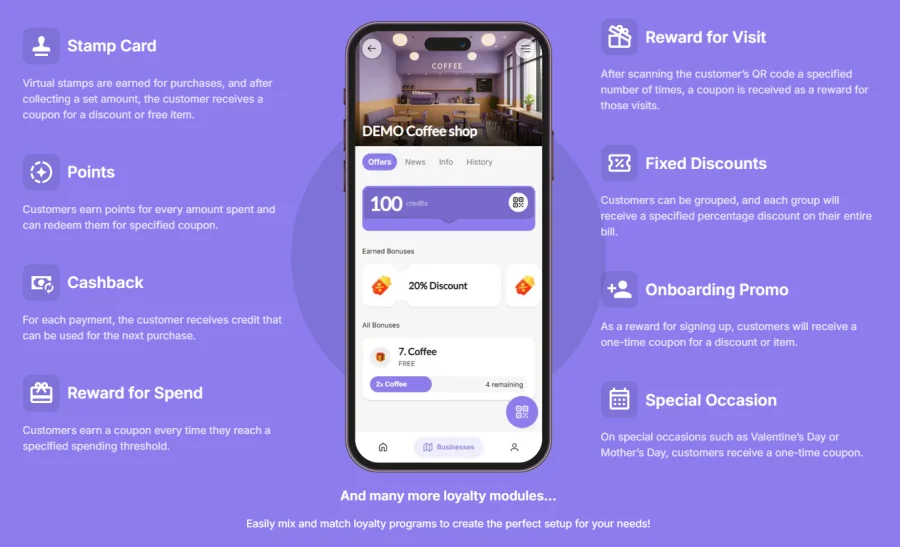
BonusQR gives you a flexible, easy-to-launch platform where you can run coupon campaigns, set up cashback reward structures, or combine both in a single loyalty program tailored to your customers. You don’t need a POS integration or technical expertise to get started. You can also add a stamp card program alongside cashback for even more engagement options. Most importantly, BonusQR’s built-in analytics and reporting let you track exactly what’s working, so you can refine your incentive mix based on real customer behavior rather than guesswork. Start building a program that turns new buyers into loyal regulars.
Frequently asked questions
Which incentive builds loyalty faster: coupon or cashback?
Cashback typically builds loyalty faster, with research showing a 0.58 loyalty coefficient for cashback compared to 0.42 for discounts, making it the stronger long-term retention tool.
Do coupons still work for increasing customer retention?
Yes. Coupons can lift retention by 15% and often raise customer lifetime value by 20%, making them effective when used strategically rather than continuously.
When should a small business use cashback instead of coupons?
Use cashback when your goal is building repeat visit habits and long-term loyalty, since cashback outperforms discounts for loyalty and margins, though results take more time to appear.
Can coupons and cashback work together in one program?
Yes, and many businesses get the best results by doing exactly that. Use coupons to bring new customers in for a first purchase, then activate cashback to convert those buyers into loyal regulars who return on their own.