
 Deutsch
 Español
 Français
 Italiano
 Magyar
 Polski
 Slovenčina
 Čeština

Keeping customers coming back is tough. Many small and medium businesses struggle to create loyalty programs that truly stick. Automating customizable rewards can solve this challenge, driving measurable increases in retention and sales. This guide walks you through the essential prerequisites, stepwise setup, common pitfalls to avoid, and realistic outcomes you can expect when implementing automated rewards programs that keep your customers engaged and loyal.
Key Takeaways
| Point | Details |
|---|---|
| Automated rewards increase retention rates by up to 30%. | Programs integrated with marketing automation deliver measurable loyalty gains. |
| SaaS platforms enable program launch in under 7 days without POS integration. | Rapid deployment accelerates time to business benefits. |
| Customizable rewards tailored to customer behavior maximize engagement. | Segmentation drives personalized experiences that resonate with different customer groups. |
| Marketing automation integration is essential for timely communication. | Push notifications, email, and SMS must trigger automatically at reward milestones. |
| Monitoring and adjusting program rules is key for long-term success. | Real-time analytics allow continuous optimization of reward strategies. |
Prerequisites: What You Need Before Starting Your Automated Rewards Program
Before launching your automated rewards program, you need to lay solid groundwork. Rushing into implementation without proper preparation wastes time and money.
Start by understanding your customer purchase behavior and identifying distinct segments. Are your customers frequent visitors with small transactions, or occasional buyers with higher spend? This insight shapes which rewards will resonate most. Next, start a rewards program by selecting a customizable SaaS loyalty platform with automation capabilities that match your business model.

You also need marketing automation tools ready for notifications and campaigns. Email, SMS, and push notification channels must integrate seamlessly with your loyalty platform. Set clear business goals upfront. Do you want to increase visit frequency by 20%? Boost average transaction value by 15%? Define these targets and allocate budget accordingly.
Here’s your essential preparation checklist:
- Analyze customer data to identify behavioral segments and purchase patterns
- Choose a SaaS platform supporting multiple reward types and automation
- Verify marketing channel readiness for email, SMS, and push notifications
- Establish measurable program goals tied to retention and revenue metrics
- Budget for both platform subscription and customer communication costs
With these prerequisites handled, you’re ready to move into platform selection and program design. Skipping this foundation leads to misaligned rewards and poor adoption rates.
Step 1: Selecting the Right Automated Loyalty Platform
Choosing the right platform determines whether your program succeeds or stalls. Not all loyalty solutions offer the flexibility and automation capabilities small businesses need.
Look for platforms supporting diverse reward mechanisms like points system options, tiered cashback programs, coupons, and visit-based incentives. This variety lets you match rewards to different customer preferences. According to How to Quickly Launch a Loyalty Program Without POS Integration, small businesses can launch without POS integration in under one week using modern SaaS platforms.
Prioritize solutions offering rapid deployment without mandatory point of sale system connections. This removes technical barriers and accelerates your go-live date. Branding customization matters too. White-label mobile and web apps build customer trust by presenting rewards under your business identity rather than generic third-party branding.
Marketing automation features separate basic platforms from powerful ones. Real-time analytics dashboards show which rewards drive engagement, helping you automate loyalty campaigns effectively. Compare pricing tiers carefully. Many platforms offer free starter plans with premium options for scaling as your program grows.
Pro Tip: Request demo accounts from three platforms and test the customer experience yourself. Walk through enrollment, earning rewards, and redemption. This hands-on evaluation reveals usability issues that spec sheets hide.
| Platform Feature | Why It Matters | What to Look For |
|---|---|---|
| Multiple reward types | Matches diverse customer preferences | Points, cashback, coupons, stamps, visit rewards |
| No POS requirement | Speeds deployment | QR code or mobile app-based tracking |
| Branding options | Builds trust and recognition | White-label apps, custom colors, logo placement |
| Automation capabilities | Reduces manual work | Trigger-based rewards, scheduled campaigns |
| Analytics dashboard | Enables data-driven decisions | Real-time metrics, segment performance, ROI tracking |
The right platform becomes your retention engine. Choose wisely based on your specific business model and customer behavior patterns.
Step 2: Customizing Rewards and Defining Program Rules
Generic rewards bore customers. Customization drives engagement by matching incentives to what your specific customers actually value.
Start by segmenting customers based on purchase behavior and visit frequency. Your high-value regulars deserve different treatment than occasional shoppers. Create targeted reward tiers that acknowledge and encourage each group’s preferred behaviors. This approach boosts loyalty by making customers feel recognized.
Set up multiple reward types simultaneously. Offer points for purchases, stamps for visits, cashback on high-value transactions, and coupons for specific products. This variety ensures every customer finds something appealing. Add onboarding promotions to hook new members immediately. Birthday and special occasion rewards create emotional connections that transcend transactional relationships.
Define clear thresholds that trigger rewards automatically. Reward for spend options might activate at $50, $100, and $250 milestones. Reward for visit options could kick in after 5, 10, and 20 check-ins. Clarity prevents confusion and encourages customers to reach the next level.
Branded white-label apps enhance the entire experience. When customers see your logo and colors throughout the rewards journey, trust increases. They perceive the program as a core part of your business, not an afterthought.
Pro Tip: Survey your top 50 customers about their reward preferences before finalizing program rules. Their input often reveals unexpected insights about what truly motivates your specific audience.
Key customization elements:
- Segment customers by purchase frequency, average transaction value, and product preferences
- Deploy points, stamps, cashback, and coupons simultaneously for variety
- Create generous onboarding bonuses that demonstrate immediate value
- Set milestone thresholds at psychologically motivating intervals
- Use branded apps to reinforce your business identity throughout the experience
Customization transforms a standard program into a competitive advantage. Generic approaches yield generic results. Tailored rewards drive measurable loyalty gains.
Step 3: Implementing Automation and Marketing Integration
Manual reward management kills productivity. Automation scales your program without multiplying your workload.
Integrate reward triggers with customer actions. When someone hits a spend threshold or completes their tenth visit, the system allocates rewards instantly without staff intervention. This speed delights customers and reduces administrative burden. According to How to Use Marketing Automation to Improve Customer Retention, automated loyalty programs integrated with marketing automation for retention increase customer retention rates by up to 30%.
Connect push notifications, email, and SMS campaigns to reward milestones. When customers earn points or unlock new tiers, they should receive immediate acknowledgment through their preferred channel. This reinforcement strengthens the behavior you want to encourage. Real-time analytics dashboards show which rewards and messages drive the best response rates.
Schedule regular automated marketing for small business campaigns that keep your program top of mind. Monthly point balance reminders, expiration warnings, and personalized offers maintain engagement between purchases. Set these campaigns once and let automation handle execution.
Adjust rules based on data insights. If analytics reveal that customers rarely reach a particular reward tier, lower the threshold or increase the incentive. Continuous optimization based on actual performance beats static programs every time.
Follow this automation sequence:
- Configure reward triggers tied to specific customer actions and milestones
- Connect marketing channels so notifications fire automatically when triggers activate
- Set up analytics tracking to monitor program performance across segments
- Schedule recurring campaigns for consistent engagement throughout the customer lifecycle
- Review performance data monthly and adjust automation rules to improve ROI
Automation turns your loyalty program into a 24/7 retention machine. Manual processes simply can’t match this efficiency or consistency.
Common Mistakes to Avoid and Troubleshooting Tips
Even well-designed programs fail when execution stumbles. Knowing common pitfalls helps you steer clear of expensive mistakes.
Unclear communication torpedoes adoption. Customers won’t engage if they don’t understand how to earn and redeem rewards. Explain benefits clearly during onboarding with simple language and visual examples. Avoid jargon. Show, don’t just tell.
Generic rewards that ignore segmentation waste budget. A discount on products someone never buys generates zero value. Customize incentives to match actual purchase patterns within each customer group. Review retention workflow tips for detailed guidance on matching rewards to behaviors.
Automation bugs delay reward delivery, destroying trust. Test every trigger and notification flow thoroughly before launch. Send test transactions through the entire system. Verify rewards appear correctly and notifications fire on schedule. Nothing frustrates customers faster than earning rewards that never materialize.
Overly complex rules confuse participants. If customers need a manual to understand your program, you’ve already lost them. Keep earning and redemption pathways straightforward. Simple beats sophisticated when it comes to mass adoption.
Neglecting marketing integration leaves rewards in the dark. Customers forget about programs they rarely see. Leverage automated notifications to maintain visibility. Regular touchpoints remind people to return and engage.
Key mistakes to avoid:
- Failing to explain reward mechanics clearly during customer onboarding
- Offering identical rewards to all segments regardless of preferences
- Launching without comprehensive testing of automation workflows
- Creating complicated rule structures that confuse rather than motivate
- Underutilizing marketing channels to keep the program visible
Anticipating these issues saves time and preserves customer goodwill. Simple, well-communicated, thoroughly tested programs outperform complex alternatives.
Expected Results and Measuring Success
Realistic expectations prevent disappointment. Understanding typical outcomes helps you gauge whether your program performs as intended.
Initial setup success arrives quickly with modern SaaS platforms. Most businesses complete deployment in under one week without POS integration requirements. This speed means you start capturing retention benefits almost immediately.
Within the first few months, expect to see 20 to 30% increases in customer retention and engagement metrics. According to How to Use Marketing Automation to Improve Customer Retention, programs utilizing customer retention improvement strategies with automation deliver measurable loyalty gains. ROI can improve up to 18% when you implement segmented reward strategies that match incentives to behaviors.
Sign-up rates typically increase by 15% when you deploy branded loyalty apps. Customers trust programs that carry your business identity more than generic third-party solutions. Customer satisfaction scores often rise by 20% when you offer diverse reward options that cater to different preferences.
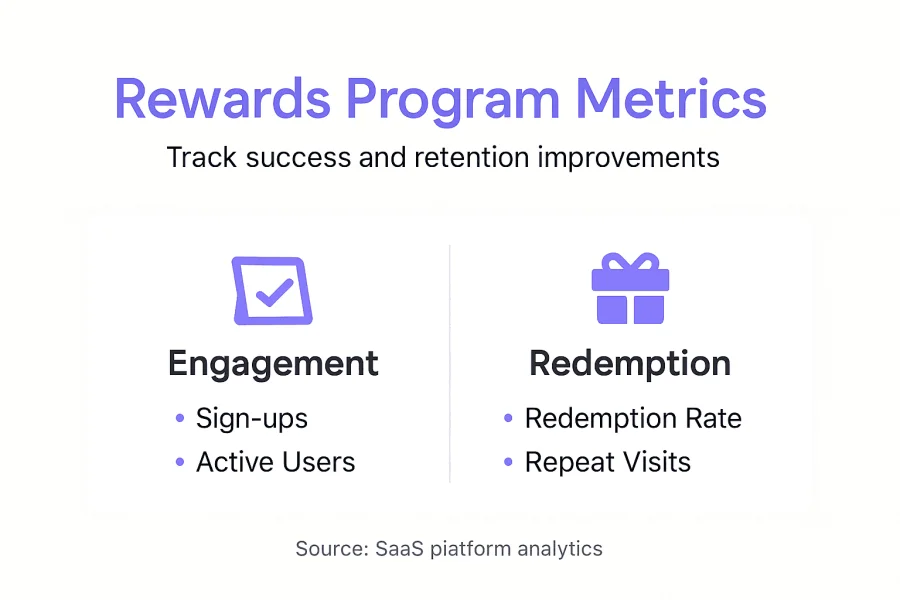
Track these metrics to measure program effectiveness. Monitor enrollment rates, active participation percentages, redemption frequency, average transaction value changes, and visit frequency improvements. Compare performance across customer segments to identify which groups respond best to specific reward types.
Use these insights to refine your automated loyalty campaigns continuously. Programs that adapt based on data outperform static implementations.
| Metric | Expected Timeframe | Typical Improvement | How to Measure |
|---|---|---|---|
| Program deployment | Week 1 | Complete setup | Platform configuration status |
| Customer enrollment | Months 1 to 3 | 15% increase in sign-ups | New member registrations |
| Retention rate | Months 3 to 6 | 20 to 30% improvement | Repeat purchase frequency |
| Transaction value | Months 3 to 6 | 10 to 15% lift | Average order size comparison |
| Program ROI | Months 6 to 12 | Up to 18% gain | Revenue increase vs program costs |
| Customer satisfaction | Months 3 to 6 | 20% score increase | Survey responses and NPS |
These benchmarks provide realistic targets. Your specific results depend on program design quality, reward relevance, and marketing execution. Consistent monitoring lets you spot underperformance early and correct course.
Discover BonusQR: Your Partner in Automated Customer Rewards
Ready to transform customer retention with automated rewards? BonusQR delivers SaaS loyalty solutions purpose-built for small and medium businesses seeking measurable growth. Our customizable platform supports points, cashback, coupons, and visit-based incentives with seamless marketing automation integration. Deploy rapidly without complex POS requirements and start boosting retention within days. Explore our loyalty program benefits to see how businesses like yours achieve results. Check out our complete features of loyalty system or discover specialized loyalty application for services designed for your industry.
FAQ
What is the typical setup time for an automated customer rewards program?
Most small and medium businesses deploy SaaS-based automated rewards programs in less than 7 days without requiring POS integration. According to How to Quickly Launch a Loyalty Program Without POS Integration, rapid setup with modern platforms accelerates your time to retention benefits significantly.
How can I customize rewards to fit my different customer segments?
Use purchase behavior data and visit frequency patterns to create targeted rewards for each segment. Offer multiple reward types including points, cashback, stamps, and special occasion bonuses that match what specific groups value most. Segmentation ensures every customer finds relevant incentives.
What are common pitfalls to avoid when automating rewards programs?
Avoid unclear communication about how customers earn and redeem rewards, which kills adoption. Test automation workflows thoroughly to prevent reward delivery delays that destroy trust. Monitor program performance regularly and adjust rules based on actual engagement data rather than assumptions.
How soon can I expect to see measurable results from my automated rewards program?
You can observe initial engagement and retention increases within the first few months of launch. According to How to Use Marketing Automation to Improve Customer Retention, ROI improvements up to 18% typically develop as you optimize reward strategies and scale participation.
Recommended
- Loyalty application - Rewards & Loyalty Programs | BonusQR
- Loyalty application - Rewards & Loyalty Programs | BonusQR
- Practical Guide to Customer Retention Strategies for SMBs | BonusQR
- Top Customer Service Retention Strategies to Boost Loyalty | BonusQR
- MaxCloudON Affiliate Program - Earn Up to 40% commission
- Site à Forte Conversion : Clé Pour Les Experts Premium - Vamyr Studio