If you are replacing Fivestars, the right alternative depends on three things: whether you want a loyalty tool that works without a POS, whether you sell online as well as in-store, and how much you want to pay each month. For most small businesses that want to launch quickly, a QR-based platform such as BonusQR is the simplest fit. Online-first brands will look at Smile.io, omnichannel shops at Marsello, and Square merchants at Square Loyalty.
This guide compares the realistic options, shows what each one is built for, and gives you a checklist to run before you switch.
Key Takeaways
- Fivestars is now part of SumUp, so owners who signed up for the original standalone product should re-check how their loyalty setup fits the current offering.
- POS-bound loyalty (Square Loyalty) is convenient if you already run that POS and a poor fit if you do not. QR-based tools work alongside whatever register you have.
- Published entry prices in this category run from free tiers to roughly $60 a month and up, so compare per-location and per-order pricing, not just the headline number.
- Before you choose, check signup friction for customers, contract terms, hardware needs and whether the vendor serves your country.
- BonusQR starts with a Free plan, then moves to Basic at 19 EUR per month and Premium at 69 EUR per month.
Why businesses look beyond Fivestars
Fivestars built its name on helping neighborhood merchants run a points-based program through a POS integration and a shared consumer network. Payments Dive reported in October 2025 that SumUp acquired Fivestars for $317 million in 2021, that Fivestars had about 12,000 small-business POS customers and a loyalty network of 70 million consumers, and that it had since been integrated into SumUp.
That context matters when you evaluate a replacement. A product folded into a payments company tends to be built around that company’s hardware and payment flow. If you want loyalty that stands apart from your payment processor, or you simply want to see what else is out there, you have good reasons to compare.
Typical reasons owners start the search:
- Tied to a processor. You want loyalty to keep working if you change your POS or card reader later.
- Cost and contracts. You want a free tier or a monthly plan you can cancel, and a price that does not climb with every location.
- Customer friction. You want customers to join in seconds, ideally with a QR scan or a wallet pass, not a long signup.
- Wider marketing. You want push or email notifications, referral and review tools, and analytics in the same place.
If you are still deciding what kind of program suits your shop, our guide to loyalty card ideas for small business walks through stamp, points and cashback mechanics before you pick software.
Fivestars alternatives at a glance
| Option | Best for | Rewards model | Needs a specific POS? | Published entry price |
|---|---|---|---|---|
| BonusQR | Small businesses wanting QR-based loyalty without POS changes | Stamps, points, tiered cashback, discounts | No | Free plan; Basic 19 EUR/month |
| Smile.io | Online stores | Points, referrals, VIP tiers | Built for e-commerce | Free up to 200 orders/month, paid from $15/month |
| Marsello | Shops selling online and in person | Points, rewards, loyalty-triggered messages | Integrates with commerce systems | From $60/month |
| Stamped Loyalty | Online brands wanting reviews plus loyalty | Points and rewards | E-commerce focus | From $23/month |
| Square Loyalty | Businesses already on Square | Points | Yes, Square | Per-location monthly fee |
| Loopy Loyalty | Stamp-card-only programs in wallets | Digital stamps | No | Check vendor |
Prices come from the sources linked in each section and were published in 2026; confirm current figures on each vendor’s page, because loyalty vendors change plans often.
BonusQR: QR-based loyalty with no POS required
BonusQR is a digital loyalty platform designed for small businesses. Customers earn rewards by scanning a QR code, so you do not need a new POS system or integration to start. That is the main difference from a processor-linked program like Fivestars.
What you can run:
- Digital stamp cards, points systems, tiered cashback and fixed discounts
- Onboarding promotions and special occasion rewards
- Coupon and reward management
- Automated marketing with push and email notifications
- Referral and review modules
- Analytics on customer behavior
- Brand and app customization, mobile and web app integration, and Apple and Google Wallet support
Pricing as published on the BonusQR pricing page:
- Free: no published price
- Basic: 19 EUR per month
- Premium: 69 EUR per month
For larger businesses that want their own branded app, BonusQR offers white-label setup at 690 EUR one-off, with a 69 EUR monthly subscription. Custom app development starts from 1500 EUR one-off, with maintenance from 69 EUR per month, listed on the custom app page. Custom builds can include e-shop and booking widget features.
Best for: cafes, restaurants, retailers, gyms and wellness centers, hotels, grocery stores, gas stations and service businesses that want to launch fast and keep their existing checkout untouched.
Worth knowing: because rewards are collected by QR code rather than through a register integration, the setup is light. The platform is designed to automate reward distribution and customer messages, so staff spend less time managing the program.
Smile.io: points and referrals for online stores
Smile.io is a leading e-commerce loyalty platform. According to Shopify’s 2026 roundup of loyalty software, it has a free plan for up to 200 orders per month, with paid plans scaling from $15 to $999 per month depending on order volume. Its focus is points, referrals and VIP tiers.
Best for: a store that sells mostly online and wants a points program that follows order volume.
Consider carefully: because pricing scales with orders, a growing store will move up the plan ladder. A walk-in cafe with no online shop gets less from a tool designed around online checkout.
Marsello: loyalty, email and SMS for omnichannel shops
Marsello serves businesses that sell both online and in physical locations, combining loyalty with email and SMS. Shopify lists it from $60 per month as of August 2026.
Klaviyo describes how customers join, earn points and manage rewards through branded portals or Apple and Google Wallet cards, with automated messages triggered by loyalty activity. That linkage between loyalty data and messaging is what you are paying for.
If your business spans store, website and email, it helps to think of the customer journey as one system. This overview of omnichannel marketing and unified customer experience explains why that matters when you compare tools like Marsello with simpler single-channel programs.
Best for: retailers already running email and SMS campaigns who want loyalty data to drive them.
Consider carefully: the entry price is higher than most small-shop tools, so it makes sense once you will use the messaging side.
Stamped Loyalty: reviews and rewards together
Stamped Loyalty starts at $23 per month, and its Premium plan is $59 per month, according to April 2026 pricing reported by ITQlick. It suits online brands that want to collect reviews and reward customers in one tool.
Best for: e-commerce stores where reviews drive sales as much as repeat purchases.
LoyaltyLion: custom earn rules for online brands
Klaviyo describes LoyaltyLion as offering integrated loyalty pages and custom earn rules, and as using buying behavior to improve programs. It is another e-commerce-first choice, better for stores that want to tailor how customers earn points than for a corner shop that wants stamps at the counter.
Square Loyalty: convenient only if you already use Square
Square Loyalty is a loyalty add-on for Square POS users. Third-party comparisons put it at roughly $45 to $49 per month per location. The upside is that points are tracked at checkout inside a system you already use.
Best for: a single-location business that already runs Square and wants zero extra setup.
Consider carefully: a per-location fee grows with every site, and the program is tied to one POS. If you may switch registers, a POS-independent option keeps your customer base portable.
Other names you will see
Searches for Fivestars competitors also turn up Loopy Loyalty (digital stamp cards in wallets), Loyalzoo, Kangaroo Rewards, Punchh (aimed at larger restaurant chains), TapMango and Antavo. They serve different slices of the market: single-purpose stamp cards, POS-based programs, and enterprise restaurant platforms. Get a current quote from each before comparing, since several sell on custom or per-site pricing.
If you run a restaurant, our comparison of restaurant loyalty software and the best restaurant rewards systems go deeper on that segment. Gym and studio owners can start with loyalty tools for fitness businesses.
How to choose: a five-point checklist
A comparison of independent-restaurant options advises checking POS compatibility, hardware, signup methods, contract terms and geographic availability before you commit. Turn that into a short routine:
- Check your register. If the tool needs a particular POS, confirm your current one is supported, and ask what happens if you change later.
- Ask about hardware. Some programs need a tablet or terminal at the counter. QR-based tools use the customer’s own phone.
- Test customer signup. Join your own program as a customer. If it takes more than about a minute, expect fewer sign-ups.
- Read the contract. Look for term length, cancellation terms and whether you can export your customer list.
- Confirm availability. Make sure the vendor supports your country and currency, and note whether messaging costs extra.
Then match the model to your business:
| If you are… | Look at |
|---|---|
| A cafe, salon or gym with walk-in regulars | QR-based stamps or points (BonusQR) |
| An online store | Smile.io, Stamped, LoyaltyLion |
| A store with both web and physical sales | Marsello or BonusQR with web app integration |
| A Square-only single location | Square Loyalty |
| A business wanting its own branded app | BonusQR white-label or custom app |
For a wider look at how loyalty fits with the rest of your retention work, see our guide to customer retention software and the practical guide to customer retention tools.
Our perspective: loyalty should not depend on your register
We built BonusQR around a simple idea: repeat customers are the lifeblood of a small business, and the tool that brings them back should be easy enough to start this week. That is why customers earn by scanning a QR code, not by waiting for your payment system to support a program.
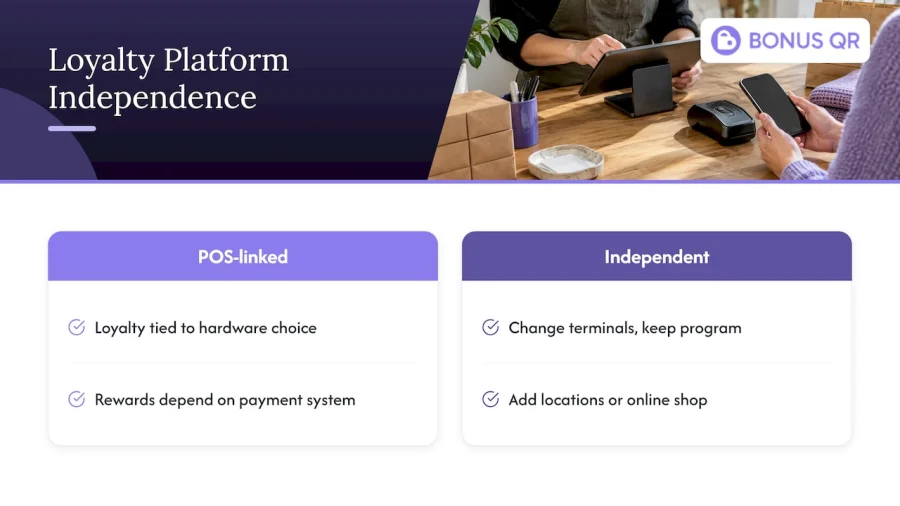
When loyalty lives inside a POS or processor, your customer data and your rewards are tied to a hardware and payment decision. When it lives in its own platform, you can change terminals, add a second location or open an online shop and keep the same program. We see that independence as the biggest practical advantage for a small business.
The second piece is automation. A loyalty program that needs a staff member to track cards or send reminders does not survive a busy Saturday. We designed the platform so rewards distribution, customer insights and promotional notifications run in the background, and so analytics show which offers bring customers back. Start with one mechanic, such as stamps or tiered cashback, watch the numbers, and add referral or review modules once the habit forms.
And when you are ready for something bigger, the path is there: the same loyalty engine can sit behind a white-label app with your own branding, or a custom build with e-shop and booking features.
— Michal Palus
Try BonusQR before you switch
If you want to test a QR-based program next to your current setup, start on the Free plan and move to Basic or Premium when you need more. See the options on the BonusQR pricing page, or explore the BonusQR homepage for a walkthrough of stamps, points and cashback.
Moving your customers from Fivestars
Switching does not have to mean starting from zero. A calm transition keeps your regulars on side:
- Announce early. Tell customers at the counter and on social media that you are moving to a new rewards program, and what they will gain.
- Honor existing balances. Decide how you will credit points customers earned before the change, and apply it as a welcome reward.
- Use an onboarding offer. A small first-visit reward gives people a reason to scan the new QR code straight away.
- Run both briefly. Keep the old program alive for a short overlap while you confirm the new one works at your checkout.
- Watch the first month. Track sign-ups, return visits and redemptions, then adjust the reward threshold.
For a repeatable process, the customer retention workflow for loyalty program success lays out the steps after launch, and seven customer retention strategies gives ideas to pair with your rewards.
FAQ
What happened to Fivestars?
SumUp acquired Fivestars in 2021 for $317 million, according to Payments Dive. The report says Fivestars has since been integrated into SumUp. If you rely on it, ask SumUp which features and plans apply to your account today.
What is the best Fivestars alternative for a small business without a POS?
A QR-based platform is the most direct fit, because customers earn rewards by scanning a code and you do not need a register integration. BonusQR works this way and offers a Free plan, so you can test it with real customers before paying.
Are there free Fivestars alternatives?
Yes. Smile.io has a free plan for up to 200 orders per month, according to Shopify, and BonusQR has a Free plan with no published price. Free tiers usually limit features or volume, so compare what you need before committing.
Which alternative is best for an online store?
Smile.io, Stamped Loyalty and LoyaltyLion are all designed around e-commerce checkout, with points, referrals, reviews and custom earn rules. If you sell both online and in person, Marsello or BonusQR with web app integration cover both channels.
Can I get my own branded loyalty app?
With BonusQR, yes. White-label setup costs 690 EUR one-off plus a 69 EUR monthly subscription, and custom app development starts from 1500 EUR one-off. Details are on the white-label page and the custom app page.


