Customer retention tools are software platforms that centralise customer data and automate personalised engagement to keep existing customers buying again. For small and medium-sized businesses, these platforms sit at the heart of any serious retention marketing strategy. Retaining a customer costs far less than acquiring a new one, yet most SMBs still rely on spreadsheets and manual follow-ups. The gap between knowing that and acting on it is exactly what the right retention software closes. This guide covers what these tools do, why they matter, how to choose one, and where the technology is heading.
What are the key features of customer retention tools?
Customer retention tools, also called customer loyalty software or retention marketing platforms, share a core set of capabilities that separate them from basic contact lists or email newsletters.
Centralised customer data
The foundation of any retention platform is a single digital profile for each customer. Consolidating customer data into one place enables real-time personalised engagement. Without that unified view, you are sending the same generic message to a first-time buyer and a loyal regular, which wastes both your budget and their attention.

Automated communications
Retention platforms automate emails, SMS messages, and push notifications based on customer behaviour. A customer who has not visited your shop in 30 days can receive a personalised offer without you lifting a finger. Automated workflows handle follow-ups, reminders, and nurturing sequences, saving time and increasing consistency across every customer touchpoint.
Loyalty and rewards programme management
Points collection, stamp cards, cashback, and spend-threshold rewards are all managed within this category of feature. Platforms like Bonusqr let you configure multiple reward types, including rewards for visits and rewards for spend, without needing a point-of-sale integration. That flexibility matters enormously for independent retailers, gas stations, supermarkets, and grocery businesses that run on tight margins and lean teams.
Behaviour tracking and segmentation
Good retention software tracks what customers buy, how often they visit, and which offers they respond to. It then segments your customer base so you can send the right message to the right group. A supermarket owner, for example, can target customers who buy fresh produce weekly with a different offer than those who only visit for household goods.
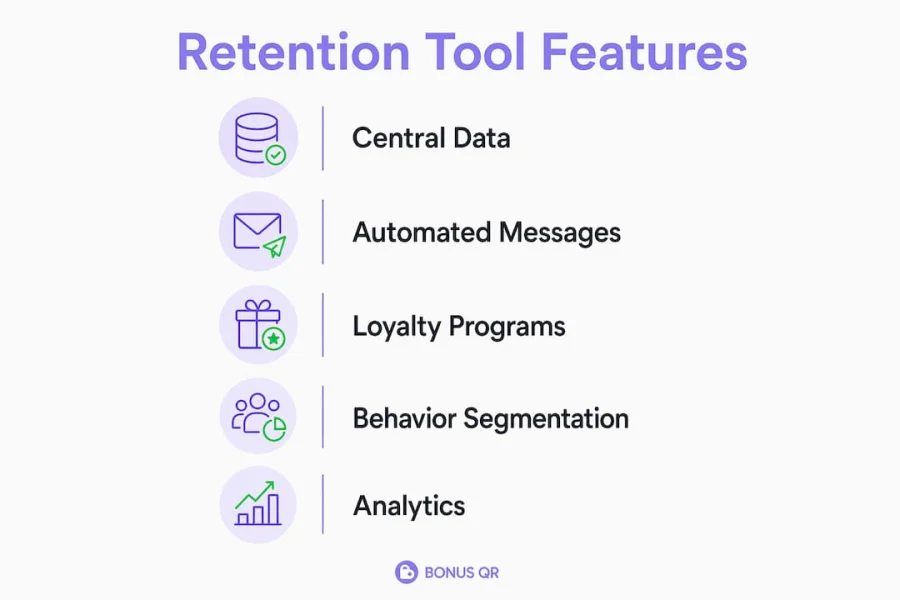
Analytics and reporting
Real-time dashboards show you which campaigns are working and which are not. You can track redemption rates, repeat visit frequency, and revenue generated per loyalty member. Without this data, retention becomes guesswork.
Pro Tip: Start by tracking just two metrics: repeat purchase rate and average time between visits. Those two numbers tell you more about retention health than a full dashboard of vanity metrics.
Cloud-based SaaS solutions have made omnichannel customer tracking accessible to businesses with no dedicated IT team. You log in via a browser, configure your programme, and the platform handles the technical side. That accessibility is the single biggest shift in the retention software market over the past five years.
Why customer retention tools matter for small and medium-sized businesses
The business case for retention is straightforward. Central European ecommerce growth now depends more on increasing purchase frequency from existing customers than on acquiring new ones. That pattern holds across most maturing markets, not just ecommerce.
Retention is a growing battleground in maturing markets. Companies are shifting investment from acquisition to increasing purchase frequency, because the economics of keeping a customer are fundamentally better than the economics of finding a new one.
Despite this, digital adoption among SMBs remains low. Only around 28.51% of EU small businesses use CRM software. That figure means the majority of small businesses are competing on price and product alone, without the data advantage that retention tools provide. The businesses that do adopt these platforms gain a measurable edge.
The challenges SMBs face without retention technology fall into three clear categories:
- Inconsistent follow-up. Manual processes mean customers fall through the cracks after their first or second purchase.
- No visibility into churn. Without tracking, you do not know a customer has stopped coming until months after the fact.
- Generic communications. Sending the same promotion to every customer reduces response rates and trains customers to ignore your messages.
- Missed loyalty opportunities. Customers who would respond to a simple reward programme never receive one because setting it up manually is too time-consuming.
- Wasted acquisition spend. Without retention data, you keep spending on new customer acquisition to replace customers who quietly left.
Retention tools solve each of these problems directly. They give you visibility, consistency, and personalisation without requiring a marketing team. For a gas station, a grocery shop, or a neighbourhood café, that combination is the difference between a customer who visits once and one who visits every week.
How to select and implement the right retention tools for your SMB
Choosing the right platform starts with an honest assessment of your business. Before you evaluate any software, answer three questions: What data do you currently collect about customers? What communication channels do your customers actually use? And what is your realistic monthly budget for a software subscription?
Once you have those answers, follow this process:
-
Define your retention goal. Are you trying to increase visit frequency, raise average spend, or reduce churn? Different goals point to different features. A café focused on visit frequency needs a stamp card or visit reward. A grocery business focused on spend needs a cashback or points programme.
-
Prioritise ease of use. Cloud SaaS platforms now let SMBs run retention campaigns without in-house technical knowledge. If the platform requires a developer to set up, it is the wrong platform for most small businesses.
-
Check localisation and integrations. Local market requirements matter. In some regions, local CRM platforms offer native integrations with invoicing systems and messaging apps like WhatsApp, which reduces friction significantly. Check whether the platform supports your language, currency, and any local compliance requirements.
-
Evaluate automation depth. A platform that only sends a birthday email is not a retention tool. Look for automated triggers based on behaviour: lapsed customer reactivation, post-purchase follow-up, and milestone rewards.
-
Test before committing. Most reputable platforms offer a free tier or a trial period. Run a small campaign with real customers before paying for a premium subscription. Bonusqr, for instance, offers a free plan that lets you launch a basic loyalty programme and test customer response before scaling up.
-
Plan your team adoption. The most common implementation failure is not technical. It is staff not understanding how to explain the programme to customers at the point of sale. Train your team before launch, not after.
Pro Tip: Set up your loyalty programme before you promote it. Enrol your ten most loyal customers first, gather their feedback, and fix any friction points. Then launch to everyone else.
Common pitfalls include choosing a platform with features you will never use, underestimating the time needed to migrate existing customer data, and failing to communicate the programme clearly to customers. Keep the initial setup simple. You can always add complexity later once you see what your customers actually respond to.
What trends are shaping retention platforms in 2026?
The retention technology market is moving fast. Five developments are reshaping what SMBs can expect from these platforms.
-
AI-driven personalisation. Alliances such as the Microsoft and Postel partnership show that AI-powered segmentation and automation are no longer reserved for enterprise budgets. SMBs can now access machine learning tools that predict which customers are at risk of churning and trigger the right offer automatically.
-
Multichannel engagement. Customers expect to hear from you on the channel they prefer, whether that is email, SMS, WhatsApp, or a branded mobile app. Platforms that support only one channel are losing ground to those that manage all of them from a single dashboard.
-
Omnichannel cloud platforms. Data-driven omnichannel retention powered by AI is becoming accessible even for SMBs without large teams or budgets. The shift to cloud delivery means you pay for what you use and scale as your customer base grows.
-
Data privacy and compliance. Customers are more aware of how their data is used. Platforms that offer transparent opt-in processes, clear data policies, and GDPR-compliant storage are becoming the standard, not the exception. Choosing a compliant platform protects both your customers and your business.
-
White-label and branded apps. Businesses that want a fully branded customer experience are moving beyond generic loyalty cards. Platforms like Bonusqr offer custom mobile app development so your loyalty programme lives inside your own branded app rather than a shared platform.
The direction is clear: retention technology is becoming more personal, more automated, and more accessible. SMBs that adopt these tools now will be significantly better positioned as competition for customer attention intensifies. For a deeper look at how loyalty programme technology is evolving, the principles behind effective programme design remain consistent even as the tools change.
Luxury retail offers a useful reference point here. The elite perks used in luxury fashion loyalty programmes, such as tiered rewards, exclusive access, and personalised communications, are now being adapted for everyday retail at a fraction of the cost. What was once reserved for high-end brands is now standard in well-designed SMB loyalty platforms.
Key takeaways
The most effective customer retention tools combine centralised data, automated communications, and loyalty programme management in a single platform that SMBs can operate without technical expertise.
| Point | Details |
|---|---|
| Centralised data is the foundation | A single customer profile enables personalised, timely engagement across every channel. |
| Automation replaces manual follow-up | Behaviour-triggered workflows handle lapsed customer reactivation and post-purchase nurturing automatically. |
| SMB digital adoption remains low | Only around 28.51% of EU small businesses use CRM software, creating a clear competitive advantage for early adopters. |
| Start simple, then scale | Launch with one reward type, measure response, and add complexity only when the basics are working. |
| AI and omnichannel are now accessible | Cloud-based platforms bring AI-driven personalisation and multichannel engagement within reach of small businesses. |
What I have learned from watching SMBs adopt retention tools
The most persistent myth I encounter is that retention software is complicated and expensive. Business owners picture a six-month implementation, a dedicated IT person, and a five-figure annual contract. That was true a decade ago. It is not true now.
The SMBs I have seen succeed with retention tools share one habit: they start with the simplest possible programme and resist the urge to add features before the basics are working. A stamp card that rewards every tenth visit is not glamorous, but it creates a habit loop. Once customers are enrolled and engaged, you have the data and the relationship to do something more sophisticated.
The businesses that struggle are the ones that buy a platform with twenty features and try to use all of them in the first month. They overwhelm their staff, confuse their customers, and conclude that “loyalty programmes do not work.” The programme did not fail. The implementation did.
The other lesson is that the comparison between digital and paper loyalty cards is not really about the format. It is about data. A paper stamp card tells you nothing. A digital card tells you who your best customers are, when they visit, and what makes them come back. That data is the real product you are buying when you invest in a retention platform.
My honest advice: pick a platform with a free tier, enrol your existing regulars, and spend 30 days watching what the data shows you. You will know within a month whether the tool is working and what to do next.
— Michal
How Bonusqr helps SMBs build lasting customer loyalty
Bonusqr is a loyalty platform built specifically for small and medium-sized businesses that want to run a professional retention programme without a large budget or a technical team. The platform supports points collection, stamp cards, cashback, coupon management, and rewards for spend, all configurable from a single dashboard. There is no POS integration required, setup takes hours rather than weeks, and a free plan is available for businesses that want to test before committing. For SMBs in retail, hospitality, grocery, or services, Bonusqr’s loyalty system features give you the tools to turn one-time buyers into regulars, with real-time analytics to show you exactly what is working.
FAQ
What are customer retention tools?
Customer retention tools are software platforms that centralise customer data, automate personalised communications, and manage loyalty programmes to reduce churn and increase repeat purchases.
How much do retention tools cost for small businesses?
Costs vary widely. Many platforms, including Bonusqr, offer free tiers for small businesses, with premium plans available as your customer base grows.
Do I need technical skills to use a loyalty platform?
No. Cloud-based SaaS platforms are designed for business owners without technical backgrounds. Setup typically requires no coding and no POS integration.
What is the difference between a CRM and a retention tool?
A CRM manages customer relationships and sales pipelines broadly. A retention tool focuses specifically on keeping existing customers engaged through loyalty programmes, automated campaigns, and behaviour-based triggers.
Which businesses benefit most from customer retention tools?
Any business with repeat customers benefits, including gas stations, supermarkets, grocery shops, cafés, and service businesses. The higher your potential visit frequency, the greater the return from a well-run retention programme.


