
 Deutsch
 Español
 Français
 Italiano
 Magyar
 Polski
 Slovenčina
 Čeština
Most business owners assume loyalty is built by handing out discounts and points. It isn’t. True customer loyalty is the result of consistent trust, genuine value, and experiences that make customers choose you over and over, even when a cheaper option exists nearby. The businesses that understand this distinction grow steadily, spend less acquiring new customers, and generate more revenue per transaction. This article walks you through what customer loyalty really means, the program types that deliver results, the digital tools available today, and the real-world examples that prove these strategies work.
Key Takeaways
| Point | Details |
|---|---|
| Customer loyalty clarified | Loyalty is more than repeat purchases; it’s a consistent preference and trust in your business. |
| Program models compared | Selecting the right loyalty program requires matching rewards to your customer needs and transparency. |
| Digital solutions matter | Modern platforms simplify engagement, automate rewards, and deliver valuable customer insights. |
| Transparency drives retention | Clear, easy-to-understand loyalty programs outperform those with hidden costs or unclear benefits. |
| Real examples inspire action | Case studies reveal practical ways small businesses can achieve higher retention and steady growth. |
Understanding customer loyalty: What it really means
Customer loyalty is not simply a customer returning to buy from you a second or third time. It is an ongoing preference for your business over all available alternatives, even when those alternatives are more convenient, less expensive, or more heavily promoted. A loyal customer is one who consciously chooses you, refers others to you, and forgives the occasional mistake because their overall experience with your business has earned that goodwill.
This distinction matters enormously for your business model. Repeat purchases can happen for many reasons: habit, location, price, or a current promotion. Loyalty, by contrast, is driven by trust and emotional connection. These two motivations produce very different business outcomes.
When you focus on building genuine loyalty rather than just driving repeat transactions, three things happen:
- Retention rates improve because customers stay even when competitors offer promotions.
- Average order value increases because loyal customers trust your recommendations and buy more.
- Customer acquisition costs drop because loyal customers refer others, reducing your dependence on paid advertising.
Many business owners confuse customer satisfaction with loyalty. A satisfied customer had a fine experience. A loyal customer had an experience worth talking about. Satisfaction is the baseline. Loyalty is what you build on top of it.
There’s also a widespread misconception that a rewards program alone creates loyalty. It doesn’t. Rewards can reinforce loyalty that already exists, but they cannot manufacture it from scratch. As research shows, points programs succeed by driving incremental purchases and off-peak demand, but they fail when they lack transparency and proper cost control. A confusing points structure or a reward that feels impossible to redeem damages trust rather than building it.
Understanding the loyalty program benefits that genuinely impact your bottom line starts with recognizing that loyalty is built through every interaction, not just through a rewards card.
“The fastest way to lose a loyal customer is to make them feel like they are playing a game they cannot win. Clarity, fairness, and easy redemption are the foundations of any program that earns long-term trust.” This principle applies directly to the transparency research cited above.
The businesses that get this right are the ones that invest in earning trust and loyalty from the first interaction, not just from the moment a customer signs up for a rewards card.
Now that you see how loyalty is more than a reward, let’s review the proven types of loyalty programs.
Types of customer loyalty programs: Pros, cons, and fit
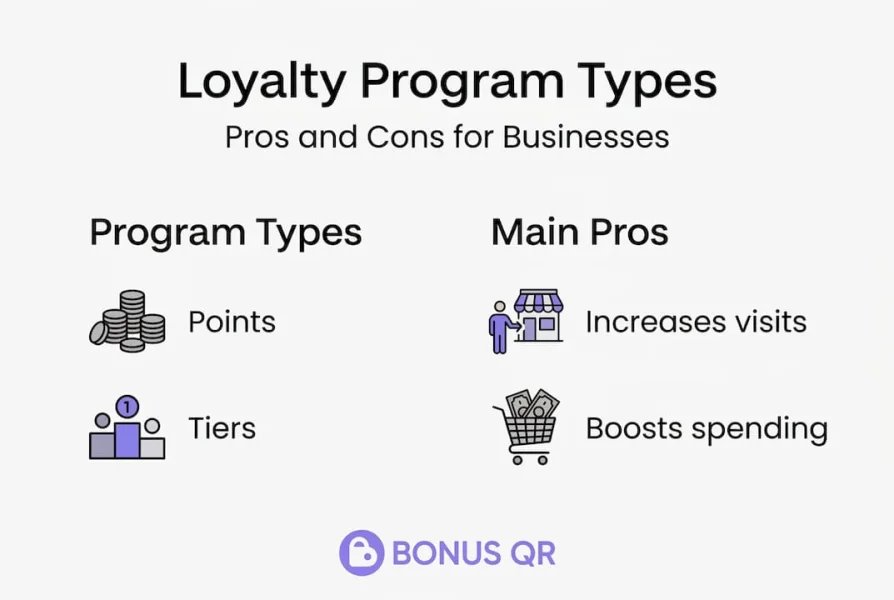
Different businesses attract different customers, and the program structure you choose should reflect both your customer profile and your sales cycle. Here is a comparison of the four most widely used loyalty program models:
| Program type | Best for | Key benefit | Main risk |
|---|---|---|---|
| Points-based | High-frequency, low-ticket | Encourages repeat visits | Costly if not managed carefully |
| Tiered rewards | Mid to high-ticket retail | Incentivizes larger spend | Complex to communicate |
| Cashback | Any sector with clear spend tracking | Simple and transparent | Lower perceived value than points |
| Digital stamp cards | Food, coffee, and service businesses | Easy to use, low friction | Limited data collection |
Each model has a place, but none of them works universally. Here is how to think through which one fits your business:
- Match your program type to your purchase frequency. If customers visit weekly, a stamp card or points system creates positive habits. If they visit quarterly, a tiered program rewards larger purchases rather than frequency.
- Consider your customer’s patience for complexity. A tiered program works well for a boutique clothing store where customers understand the relationship between spend and status. It fails for a neighborhood cafe where customers want a simple “buy 9, get 1 free” arrangement.
- Factor in your redemption timeline. High break-even thresholds require 12 to 18 months of retention before they become profitable, which means any program with a long path to reward risks losing customers before they ever redeem.
- Think about cashback as a transparency tool. Cashback programs tell customers exactly what they are earning. No math, no mystery. That clarity builds confidence faster than a complex points multiplier.
You can review some of the strongest retail loyalty programs operating today to see how leading businesses have structured their models for specific customer profiles.
The pitfalls to avoid are straightforward. Programs that require too much spending before any reward is earned feel punishing, not generous. Programs that change their rules without clear communication destroy trust overnight. And programs that collect customer data without using it to personalize the experience miss the entire point of going digital.
Pro Tip: Before choosing a program type, look at your average transaction value and visit frequency over the past 90 days. If average spend is above $50 and visits happen fewer than once a month, a tiered or cashback model will outperform a simple stamp card.
Understanding how customer loyalty in ecommerce and brick-and-mortar retail differs can also help you decide whether to run a purely digital program or a hybrid model. You can also find program examples from a wide range of industries to see these models in practice.
With clear knowledge of program types, let’s explore how digital technologies upgrade traditional loyalty approaches.
Digital loyalty strategies: Modern tools for customer retention
Digital loyalty platforms have changed what is possible for small and medium-sized businesses. You no longer need a physical punch card, a dedicated POS system, or a large marketing team to run a professional loyalty program. Today’s tools automate the tasks that used to require manual tracking, and they give you data that helps you make smarter decisions.
Here is what a strong digital loyalty platform should do for your business:
- Automate reward tracking and redemption so customers see their progress in real time and you spend no staff time managing it manually.
- Integrate with mobile and web apps so customers can access their rewards on any device without needing a separate app download.
- Connect with Apple Wallet and similar tools so rewards live where customers already keep their cards and passes.
- Send push notifications at the right moment, such as when a customer is close to a reward or when you are running an off-peak promotion.
- Generate real-time analytics so you can see which rewards drive visits, which customers are at risk of churning, and where your program needs adjustment.
The user experience impacts of a poorly designed digital loyalty tool are significant. If customers cannot easily check their balance, understand what they are earning, or redeem without friction, they disengage. And once they disengage from a loyalty program, bringing them back requires a much larger incentive than keeping them engaged in the first place.
| Digital feature | Business benefit | Engagement impact |
|---|---|---|
| Mobile and web access | No app download required | Higher enrollment rates |
| Push notifications | Timely, personalized reminders | Improved redemption rates |
| Real-time analytics | Identify at-risk customers early | Lower churn |
| Apple Wallet integration | Easy access for customers | Reduced friction at point of sale |
| Automated campaign triggers | Reward birthdays, milestones | Increased emotional connection |
Importantly, research confirms that digital points programs succeed at driving incremental purchases and managing off-peak demand, but only when they maintain transparency and cost control. Digital platforms make both of those things easier. A well-configured platform shows customers exactly what they have earned and exactly how to use it.
Common mistakes with digital tools include overcomplicating the structure (too many rules, too many tiers), under-communicating the value (customers forget they have rewards), and failing to act on the data the platform provides.
You can strengthen your approach by reviewing service retention strategies that combine digital tools with personal customer service touchpoints, and by exploring proven customer retention strategies tailored specifically for small businesses.
With the tools available, let’s move from theory to real examples of successful loyalty strategies.
Real-world examples: What successful customer loyalty looks like
The best way to understand how loyalty programs perform in practice is to look at the businesses that built them thoughtfully and the results they achieved.
Retail sector example: A specialty outdoor gear retailer implemented a tiered program with three levels based on annual spend. Customers in the top tier received early access to new product launches and free shipping on all orders. Within 18 months, top-tier customers were spending 34% more per transaction than they had before the program launched. The key factor was not the discount. It was the feeling of being recognized and valued.
Restaurant sector example: A regional fast-casual chain replaced its physical stamp cards with a digital program that tracked visits and sent personalized offers based on order history. Customers who ordered the same item repeatedly received a free upgrade rather than a generic discount. Redemption rates climbed significantly because the rewards felt personal, not formulaic. You can find detailed restaurant loyalty examples that show how this model works across different restaurant formats.
Grocery sector example: A small independent grocery store introduced a cashback program tied to weekly spending thresholds. Customers who spent over $75 in a single visit earned 5% back as store credit. The program was simple, transparent, and easy to explain at the register. Enrollment reached 60% of regular shoppers within six months.
The success factors across all three of these examples share a common pattern:
- Transparency: Customers understood exactly what they were earning and how to use it.
- Personalization: Rewards reflected actual customer behavior rather than generic offers.
- Memorable experience: The program added something meaningful beyond the transaction itself.
Statistic to note: Programs with high break-even thresholds require 12 to 18 months of sustained customer retention before becoming profitable. This means patience and program clarity are both essential from day one.
For your own business, the adaptation process starts with one honest question: what do your best customers value most? Not what you think they value, but what their behavior tells you they value. Start there, and build the reward structure around that reality.
Pro Tip: Review your top 20% of customers by purchase frequency and ask them directly what would make them feel more valued. Their answers will give you a better program design than any industry template.
You can also browse proven customer loyalty case studies and the best loyalty campaigns from 2026 for additional inspiration tailored to small business contexts.
Understanding these success stories sets the stage for a rethink: is loyalty really about rewards, or something more profound?
Why real customer loyalty goes beyond rewards
Here is an uncomfortable truth many businesses avoid: most loyalty programs are designed for the business’s convenience, not the customer’s experience. They collect data, drive short-term purchase frequency, and look good in a quarterly report. But they do not build genuine loyalty.
Real loyalty is built on trust. And trust is built through clarity, consistency, and the sense that your business respects the customer’s intelligence. Overly complicated point structures, expiring rewards, and rules buried in fine print communicate something clearly: this program is designed to minimize what you pay out, not maximize what customers receive.
The research is direct. Programs that lack transparency fail regardless of how generous the headline offer appears. And programs that require customers to stay engaged for 12 to 18 months before reaching a meaningful reward are fighting customer attention spans they will almost certainly lose.
Our perspective is this: start small, be clear, and listen. A simple program that delivers genuine value and communicates honestly will outperform a complex program with bigger promises every time. Build the emotional connection first. The repeat purchases follow naturally from that. Explore how boosting retention through loyalty starts with trust, not technology.
Take your loyalty program to the next level
The strategies in this article give you a clear path from confusion to confident action. Now it is time to put them to work with a platform built specifically for businesses like yours.
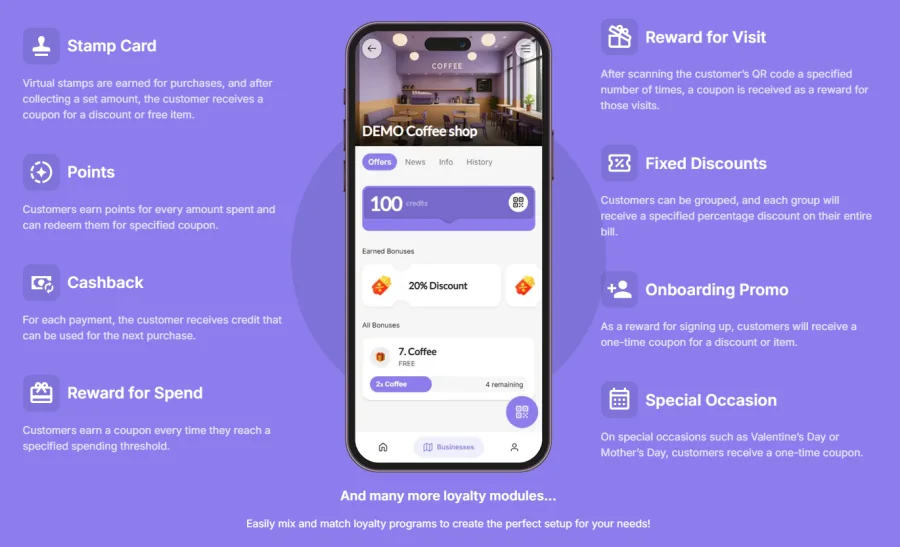
BonusQR makes it straightforward to launch a digital rewards platform that fits your business model and your customers’ expectations. Whether you want to run a points program, cashback system, or stamp card, you can configure it without a developer or a POS upgrade. Your customers access their rewards through mobile and web loyalty tools, and with wallet integration features, their rewards live right in their Apple Wallet for effortless access. Start building loyalty that lasts with BonusQR.
Frequently asked questions
How long does it take for a loyalty program to show results?
Most programs require 12 to 18 months to reach a break-even level of customer retention, so consistency and clear communication from the start are essential for meaningful impact.
What is the difference between repeat customers and loyal customers?
Repeat customers return out of convenience or price, while loyal customers choose you consistently because they trust your business and actively refer others to it.
How can digital loyalty programs improve retention?
Digital programs automate reward tracking and make redemption easier, which drives incremental purchases and keeps customers engaged between visits through timely notifications and personalized offers.
What mistakes should businesses avoid in loyalty programs?
Avoid unclear rewards structures, poor transparency, and high break-even thresholds that require too much from customers before they experience any real benefit, as these consistently drive disengagement.