Best Service Business Loyalty Software in 2026: 6 Options Compared
The best loyalty software for a service business is the one that rewards repeat bookings and visits without making you buy a POS system or hire a developer. For most small and mid-sized service providers, that means a QR-based platform that you can launch in an afternoon, such as BonusQR, which runs stamps, points and cashback with no POS required. Below, we compare it with five other approaches, with published prices and the situations each one fits.
Key Takeaways
- Service businesses win on rebooking, not basket size, so look for stamp cards, points, tiered cashback and automated win-back messages rather than ecommerce-style order discounts.
- BonusQR starts with a Free plan, then costs €19 per month (Basic) or €69 per month (Premium), and customers join by scanning a QR code, so no POS is needed.
- Other tools in this space are priced by tier, by location or by order volume. As listed in October 2026, entries ranged from $15 per month to enterprise contracts starting at $20,000 per month.
- Before signing with any vendor, check that it reports repeat visit rate and revenue per member, not only the number of sign-ups.
- Larger or multi-location providers can move to a branded white-label app (€690 one-off setup plus €69 per month) or a custom app (from €1,500 one-off).
What makes service business loyalty different
A coffee shop sells a product every few days. A salon, a gym, a spa, a repair shop or a physiotherapy clinic sells a time slot, and the customer decides whether to come back weeks later. Loyalty software for that kind of business has to do three jobs well.
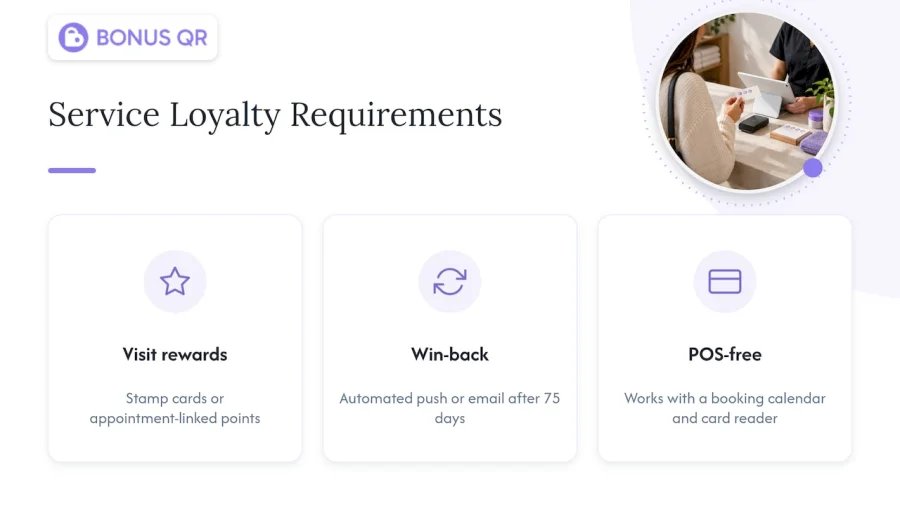
First, it has to reward the visit itself. A stamp card (“every sixth session is free”) or a points balance tied to each appointment gives the customer a reason to book the next one before leaving.
Second, it has to bring lapsed customers back. A client who last visited 75 days ago will not return on their own. An automated push or email message with a reward waiting, sent at the right moment, does the work you would otherwise forget to do.
Third, it has to be manageable by the owner or a front-desk employee. Many service businesses run on a booking calendar and a card reader, not a full retail POS. Software that only works when connected to a specific POS leaves them out, which is why the no-POS question matters so much on this list.
We cover the stamp and points mechanics in more detail in our loyalty program ideas for small businesses, and our digital loyalty card guide explains how a phone-based card replaces paper.
How to evaluate loyalty software for a service business
Use these criteria to build your shortlist. They matter more than the length of a feature list.
- Reward models. Can you run stamps, points, cashback and fixed discounts, and mix them? A yoga studio may want a punch card, a hotel may want tiers.
- Setup without hardware. Ask whether customers can join and collect rewards without a POS integration. If integration is required, count the cost of the POS too.
- Automation. Birthday rewards, welcome offers and win-back messages should run on their own. Check which channels are included: push, email, SMS.
- Referral and review tools. Service businesses grow by word of mouth, so a built-in referral module and a way to ask for reviews save you from stitching together extra tools.
- Analytics you can act on. You want to see visit frequency, returning customers and which rewards get redeemed.
- Branding. A card that carries your logo and colors, and ideally sits in Apple Wallet or Google Wallet, feels like part of your business.
- Price structure. Per month, per location, per order or per active member. The same business can pay very different amounts depending on the model.
On the analytics point, one 2026 platform guide argues that a loyalty program without attribution is just a cost center and suggests asking vendors about repeat purchase rate, lifetime value uplift and cohort comparisons. For a small business, the practical version is simple: pick a baseline month, then compare repeat visit rate and revenue per returning customer after launch. If you want a framework for judging whether a marketing investment really paid off, this piece on measuring ROI honestly applies the same logic of comparing results against a baseline.
If you are still choosing between program formats before choosing software, this overview of how to foster customer loyalty step by step is a good companion to the feature list above.
The shortlist at a glance
| Option | Best for | Reward models | POS required? | Entry price |
|---|---|---|---|---|
| BonusQR | Small and mid-sized service businesses, cafes, retail, hotels | Stamps, points, tiered cashback, fixed discounts | No | Free plan; Basic €19/month |
| RewardUp | Retailers, restaurants, salons, service businesses | Points, punch cards, cashback, VIP tiers | No extra hardware | Standard $69.99 |
| Loyaltty | Beauty, wellness, auto services, tutoring, pet care | Points, digital stamps, gift cards | Not stated | See Capterra listing |
| Square Loyalty | Businesses already on Square | Points-based | Square ecosystem | Square Plus $49/month per location |
| Smile.io and LoyaltyLion | Online stores | Points, referrals | Ecommerce platform | Free to 200 or 400 orders/month |
| Open Loyalty | Large brands with developers | Points, tiers, challenges, games | API integration | Platform fee plus active-member fee |
1. BonusQR: the pick for service businesses without a POS
BonusQR is a QR-based digital loyalty platform built for small businesses. A customer scans your QR code and starts earning, and you do not connect a POS to make it work. For a barber shop, a gym front desk or a spa reception, that is the difference between launching this week and launching after an IT project.
What you can run on it:
- Digital stamp cards, points systems, tiered cashback and fixed discounts
- Onboarding promos and special occasion rewards, such as birthdays
- Coupon and reward management
- Automated marketing with push and email notifications
- Referral and review modules
- Analytics on customer behavior, so you can see what drives repeat visits
- Brand and app customization, mobile and web app integration, and Apple and Google Wallet support
The platform automates rewards distribution, customer insights and promotional notifications, so the owner is not tracking balances by hand. That is the core of our approach: loyalty management should not become a second job.
Pricing (as published on the BonusQR pricing page): Free plan, Basic at €19 per month, Premium at €69 per month.
Growing into a branded app. Businesses that want their own app in the stores can use the white-label option: €690 one-off setup plus a €69 monthly subscription. Those who need something bespoke, including an e-shop or booking widget, can look at custom app development, from €1,500 one-off, with monthly maintenance from €69.
Best for: salons, gyms and wellness centers, cafes, grocery stores, hotels and gas stations that want a working program quickly and room to scale from a free start to a branded app.
2. RewardUp: points and win-back for salons and service shops
RewardUp is a loyalty, gift card and customer engagement platform aimed at small and midsize retailers, restaurants, salons and service businesses. According to its Capterra listing, updated 19 October 2026, it needs no extra hardware and offers points, digital punch cards, cashback, birthday rewards, VIP tiers, referrals and automated win-back by SMS, email and push. It connects with POS and ecommerce tools including Clover, Shopify and Lightspeed Retail, and its Standard plan is listed at $69.99.
Best for: businesses that want a broad feature set and already use one of the integrated systems.
3. Loyaltty: beauty, wellness and auto services
Loyaltty targets small and mid-sized businesses in retail, restaurants, beauty and wellness, automotive services, tutoring centers and pet care. Its Capterra profile describes reward points, gift card management, customer profiles and segmentation, digital stamp rewards, and communication by SMS, email and WhatsApp, with automated birthday perks and win-back campaigns. It operates without commissions. Check the listing for current plan pricing, since the profile states it by plan.
Best for: businesses that want WhatsApp as a contact channel alongside SMS and email.
4. Square Loyalty: for businesses already on Square
Square’s loyalty features sit inside its subscription tiers. A 2026 comparison on StatWharf, checked in October 2026, lists Square Loyalty as included in Square Plus at $49 per month per location and in Square Premium at $149 per month per location, with a 30-day free trial. Because the price is per location, the cost scales with every site you open.
Best for: a single-location business that already runs its payments and appointments on Square.
5. Smile.io and LoyaltyLion: built for online stores
These two are ecommerce loyalty apps, priced by monthly order volume. The same StatWharf comparison lists Smile.io as free up to 200 orders per month, with paid tiers of $15, $79 and $199 per month, and LoyaltyLion as free up to 400 orders per month, with a Classic plan at $199 per month including 500 orders. They suit a service business only when most of its revenue comes through an online shop. If your customers book and pay in person, a QR-based program matches how they actually visit.
6. Open Loyalty: enterprise, API-first
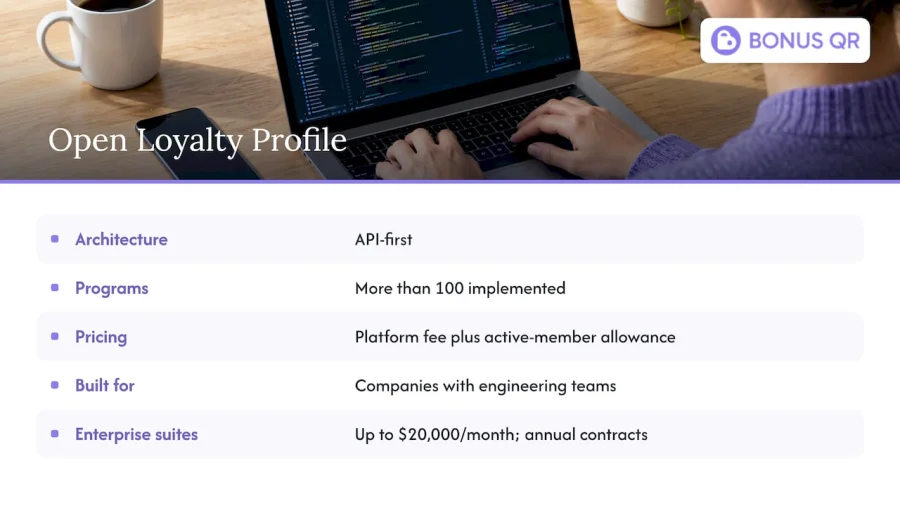
Open Loyalty is an enterprise loyalty technology partner with API-first architecture and more than 100 implemented programs, according to its Gartner Peer Insights profile. It offers points, tiers, referrals, challenges, leaderboards and games of chance, and its pricing combines a platform fee with an allowance fee based on monthly active members. It is built for companies with engineering teams. A 2026 platform map places it among API-first engines, alongside enterprise suites with pricing as high as $20,000 per month on annual contracts. That scale is far beyond what a neighborhood service business needs.
Pricing side by side
Prices below are the published figures from the sources linked above, as of October 2026 for third-party tools and as read from the BonusQR site for ours. Vendors change plans, so confirm on each pricing page before you commit.
| Option | Pricing model | Published entry points |
|---|---|---|
| BonusQR | Flat monthly plan | Free; Basic €19/month; Premium €69/month |
| BonusQR white-label | One-off setup plus monthly | €690 setup; €69/month |
| BonusQR custom app | One-off build plus maintenance | From €1,500; maintenance from €69/month |
| RewardUp | Plan | Standard $69.99 |
| Square Loyalty | Per location | $49/month (Plus), $149/month (Premium) |
| Smile.io | Order volume | Free to 200 orders; $15, $79, $199/month |
| LoyaltyLion | Order volume | Free to 400 orders; $199/month |
| Open Loyalty | Platform plus active members | Quote-based |
Flat plans are the easiest to budget for. Per-location and per-order pricing can climb as you grow, which is worth modeling for a gym with several sites or a salon group.
Which option fits which service business
Salons, barbers and spas. The natural mechanic is a stamp card tied to visits, plus birthday and win-back messages. A QR-based platform lets the receptionist point the client to a code at checkout. See our salon booking software guide for how booking and loyalty fit together.
Gyms and wellness centers. Points for attendance and referral rewards work well, because a referred friend is worth more than any ad. BonusQR’s referral module and tiered cashback cover both.
Cafes and restaurants adjacent to service businesses. If you also run a cafe corner or a restaurant, stamp cards and points are the proven starting point. Our restaurant loyalty program examples show seven formats.
Hotels. Tiered rewards and special occasion offers suit guests who return seasonally. A branded white-label app lets a hotel put its own name on the experience.
Grocery stores and gas stations. High frequency, low ticket. Cashback and fixed discounts, delivered through a wallet card, reduce friction at the counter.
Multi-site or growing brands. When you want your own app icon in the stores, plus an e-shop or booking widget, the white-label and custom app routes exist for exactly that.
Setting up without a POS system
Here is the routine for launching a QR-based program in a service business, and where it usually goes wrong.
- Choose one simple reward. Where it goes wrong: three overlapping offers confuse staff and customers. Start with a single stamp card or a points rate. Our loyalty card ideas for small business can help you pick.
- Create the program and brand it. Add your logo and colors. With BonusQR you can customize the look of the card and, with Apple and Google Wallet support, customers keep it on their phone.
- Place the QR code where the visit ends. Print it at the front desk, on the receipt holder or on a table card. Where it goes wrong: hiding it at the entrance, where customers are not yet thinking about rewards.
- Train one sentence. Staff should say, “Scan this and your next visit gets you closer to a free one.” That one line drives most of the adoption.
- Switch on automation. Turn on onboarding promos, birthday rewards and win-back notifications. BonusQR handles the distribution of rewards and sends push and email notifications for you.
- Review analytics monthly. Look at returning customers and redemptions, then adjust the reward threshold. Our guide to loyalty campaign automation explains which automated messages to prioritize.
When you are ready, it helps to understand which retention tools matter most for SMBs and what digital loyalty offers small businesses in 2026.
Start free, upgrade when it pays
BonusQR offers a Free plan, so you can launch your first stamp card or points program before you commit to a monthly fee. When you want more, Basic is €19 per month and Premium is €69 per month. If your own branded app is the goal, the white-label setup is €690 one-off with a €69 monthly subscription. See all plans on the BonusQR pricing page. For a deeper look at what each tier changes, read free vs premium loyalty programs.
Our view on choosing loyalty software
We built BonusQR around a simple observation: small service businesses do not fail at loyalty because they lack ideas. They stall because the program becomes one more task on a long list.
That is why we automate the repetitive parts: rewards distribution, customer insights and promotional notifications. The owner decides the reward. The system handles the rest. We also chose the QR approach on purpose, because requiring a POS system shuts out the many service providers who do not run one.
Our advice is to start with one reward, measure repeat visits for a few weeks, and only then add tiers, referrals and review requests. A program that customers understand in five seconds will always outperform a clever one they ignore.
As the business grows, the platform should grow with it: from a free plan, to Premium, to a branded white-label app, to a custom build when your needs are unique.
Michal Palus
FAQ
What is the best loyalty software for a small service business?
For most small service businesses, a QR-based platform with stamps, points and cashback, automated messages and no POS requirement is the best fit. BonusQR is built that way and starts with a Free plan, so you can launch before paying. Businesses that later want a branded app can move to the white-label option.
Do I need a POS system to run a loyalty program?
Not with BonusQR. Customers scan a QR code to earn rewards, so the program works without POS integration. This suits salons, gyms, spas and other providers that run on a booking calendar rather than a retail POS.
How much does loyalty software cost?
BonusQR costs nothing on the Free plan, €19 per month for Basic and €69 per month for Premium. Other tools price by location, order volume or enterprise contract, so published entry prices as of October 2026 ranged from $15 per month to $20,000 per month. Always compare the pricing page on the day you buy.
Which reward type works best for service businesses?
Stamp cards and points tied to visits are the easiest to explain and suit repeat appointments. Tiered cashback and referral rewards work well once you have a regular customer base. Start with one mechanic, then add others as you see how customers respond.
Can I get my own branded app?
Yes. BonusQR offers a white-label app for a €690 one-off setup and €69 per month, and custom app development from €1,500 one-off with maintenance from €69 per month. Custom builds can include an e-shop and a booking widget.


