
 Deutsch
 Español
 Français
 Italiano
 Magyar
 Polski
 Slovenčina
 Čeština
Running a loyalty program sounds straightforward until you’re actually in it. You pick a punch card, customers forget to bring it, and you’re left wondering why repeat visits aren’t climbing. The good news is that automated loyalty programs generate $5.80 in incremental revenue for every $1 invested, and businesses using structured loyalty systems see repeat rates climb 25 to 40% with average order values rising 12 to 18%. The challenge isn’t the idea. It’s choosing the right program model and launching it in a way that customers actually use. This article gives you the criteria, the options, a side-by-side comparison, and the practical steps to make your loyalty program genuinely work.
Key Takeaways
| Point | Details |
|---|---|
| Start simple | Simplicity in loyalty programs makes them easier for customers to use and boosts engagement. |
| Automation boosts ROI | Automating your program can yield over four times the return of manual efforts. |
| Mix and match types | Combining points, tiers, and referral incentives covers more customer needs and drives more retention. |
| Measure success | Track redemption, repeat rate, and ROI to ensure your program delivers measurable results. |
| Communication matters | Clear and ongoing communication of loyalty benefits keeps participation high. |
Criteria for choosing a winning small business loyalty program
Now that you’ve seen what impact is possible, let’s break down how to choose the right loyalty solution for your circumstances.
Not every loyalty program fits every business. A boutique coffee shop has different needs than a neighborhood salon or an online gift store. Before you select a model, you need a clear framework to evaluate your options.
Here are the core criteria to apply:
- Ease of enrollment for customers. If signing up requires downloading an app, filling out a form, and waiting for an email confirmation, many customers will drop off before they even earn their first point. The best programs take 30 seconds to join.
- Fit for your business size and resources. A small team cannot manage a complex tiered program manually. Choose a model that matches what you can actually maintain.
- Trackability and actionable data. You need to know who is redeeming rewards, when they’re coming back, and what they’re spending. Programs without data are guesses.
- Automation potential. Simple programs outperform complex ones for small and medium businesses because they are easier to communicate and enroll. Programs fail more from poor communication and enrollment friction than from weak mechanics. Automation yields roughly 4x the ROI compared to manually managed programs.
- Clear benefit communication. Customers need to understand what they’re earning and why it matters within the first interaction.
Looking at great loyalty campaign examples from successful small businesses shows one consistent pattern. The winners make participation obvious, rewarding, and frictionless from the very first visit.
Pro Tip: Start with a single reward mechanic, such as points or stamps, before adding layers. Communicate the benefit in one sentence: “Earn 1 point for every dollar you spend. Reach 100 points and get $10 off your next visit.” If you can’t say it that simply, simplify the program.
Top loyalty program ideas for small businesses
With the core evaluation criteria set, let’s break down the top loyalty program models you can launch and adapt today.
There are four main loyalty program models that work consistently well for small businesses. Each has a distinct mechanic, a clear ideal use case, and common pitfalls to avoid.
-
Points-based programs. Points-based programs are the most common and versatile loyalty mechanic for small businesses, and for good reason. Customers earn points for purchases, visits, or specific actions, then redeem those points for discounts or free products. The model works across retail, food service, personal care, and e-commerce. A coffee shop might offer 1 point per dollar, with a free drink at 50 points. A boutique might give double points on new arrivals. The pitfall is over-complicating the earn and redeem structure. If customers have to do math to figure out what they’re getting, engagement drops fast. Keep the ratio simple and make redemption automatic when possible. Explore the full range of types of loyalty programs to find the best fit for your sector.
-
Tiered or VIP programs. Tiered programs create aspiration with escalating perks like higher discounts, early access, or exclusive products based on spending levels. Think Bronze, Silver, Gold. These work best when your customer base makes repeated purchases over time, such as in beauty, fitness, or specialty retail. The key to success is making the first tier easy to reach and the jump to the next tier feel achievable. If Silver requires $500 spent and Gold requires $5,000, most customers will plateau at Silver and disengage. The spacing between tiers should feel motivating, not discouraging. Exclusivity and customer loyalty are closely linked. When customers feel they belong to a special group, they are more likely to stay loyal and spend more to maintain their status.
-
Referral incentive programs. Referral programs reward both the person who refers and the new customer who joins, and they generate 3.5 times more referrals when automated. For a local business, this is one of the most cost-effective acquisition strategies available. A pet grooming salon could offer a $10 credit to any existing customer who refers a friend, plus a $10 discount for the new customer on their first visit. The automation piece matters here. If referrals are tracked manually through paper coupons, it’s slow and error-prone. Digital referral tracking allows you to see exactly which customers are driving new business and reward them instantly. Check out specific referral program ideas that work for local and service-based businesses.
-
Paid membership programs. Paid membership models like Amazon Prime offer exclusive perks for a recurring fee, and scaled-down versions work well for small businesses too. A yoga studio might offer a $20 monthly membership that includes priority booking and a 15% discount on merchandise. A specialty food shop could charge $30 a year for member-only pricing on select products. The key caveat is that the value of the membership must obviously exceed the fee. If customers can’t immediately see the ROI in joining, they won’t. Transparency and a compelling welcome offer help membership programs gain traction quickly.
“The best loyalty programs are not the most elaborate ones. They are the ones customers actually use, consistently and without friction.”
Pro Tip: Combining a simple points mechanic with a referral reward creates a powerful one-two punch. Customers earn for their own purchases and earn bonus points for bringing in friends. This rewards both loyalty and advocacy without requiring two separate systems to manage. You can also find customer appreciation tactics that complement any of these program models.

Loyalty program comparison: Which is right for your business?
Since each approach has unique strengths, let’s compare them head-to-head so you can quickly filter by your needs.
The table below gives you a fast reference to match each program type with your business goals, budget, and operational capacity.
| Program type | Setup cost | Ease of use | Customer engagement | Automation potential | Best for |
|---|---|---|---|---|---|
| Points-based | Low | High | Medium to high | High | Retail, food service, e-commerce |
| Tiered or VIP | Medium | Medium | High | Medium | Beauty, fitness, specialty retail |
| Referral incentive | Low | High | Medium | Very high | Service businesses, local shops |
| Paid membership | Low to medium | Medium | Very high | Medium | Studios, subscription services |
The numbers behind these choices matter. Redemption rates between 25 and 40% indicate a healthy program. A repeat rate lift of 20 to 66% is achievable in the first year, and ROI ranges from 340% to 1,500% depending on the program design and how consistently you communicate with enrolled members. Tracking enrollment versus engagement is critical. You might have 200 people enrolled but only 80 who actively earn and redeem. That gap tells you something needs to improve in how you’re communicating or delivering value.
Checking out program examples for small business gives you real-world context to see how businesses similar to yours have structured their programs and what results they’ve seen. When matching program features to your goal, ask yourself one question first. Are you trying to increase visit frequency, raise average order value, or attract new customers? Each goal points to a different primary mechanic. Frequency responds to stamp cards and points. Higher order values respond to tiered programs with spend-based rewards. Acquisition responds to referral programs.
Making loyalty work: Automation and program performance tips
After comparing program types, let’s discuss how to ensure ongoing success and avoid the most common pitfalls.
Automation is the single biggest lever you can pull to improve loyalty program performance without increasing your workload. Here’s why. Loyalty programs reduce churn by 25 to 35% when automated win-back campaigns are included. A win-back campaign sends a message to customers who haven’t visited in 30, 60, or 90 days, reminding them of their points balance or offering a special incentive to return. Without automation, this kind of outreach requires manual list management and individual follow-up. That doesn’t happen at most small businesses. With automation, it runs on its own.
The most common reasons loyalty programs underperform are:
- Overcomplicated rules. If customers need to read a FAQ to understand how to earn or redeem, you’ve lost them. Keep the structure to one or two sentences.
- Poor onboarding. The moment a customer joins is your highest-engagement window. If you don’t immediately show them their balance, explain what they can earn, and give them a reason to return, that window closes fast.
- Lack of ongoing communication. Enrollment without follow-up is a wasted opportunity. Automated push notifications, email reminders of points balances, and birthday rewards keep your program top of mind without you having to do it manually each time.
- No performance tracking. If you’re not reviewing redemption rates and repeat visit data monthly, you can’t improve what isn’t working.
“Automation doesn’t replace the personal touch of a great small business. It handles the repetitive parts so you can focus on the interactions that actually matter.”
Best practices for ongoing engagement include sending a welcome message within 24 hours of enrollment, scheduling a “don’t lose your points” reminder at the 60-day inactivity mark, and running a double-points or bonus-stamp day once a quarter to spike visit frequency. Understanding the broader loyalty program benefits helps you see how each of these tactics compounds over time.
Pro Tip: Monitor three metrics every month: enrollment rate (new members divided by total new customers), active engagement rate (members who earned or redeemed in the last 30 days), and redemption rate (rewards claimed divided by rewards issued). These three numbers tell you whether your program is growing, engaging, and delivering value. Platforms listed among the best loyalty applications for small businesses typically surface these metrics in real-time dashboards, making monthly reviews fast and actionable.
Why simple loyalty programs win: A practical perspective
Here’s a perspective that might shift how you think about loyalty program design entirely.
Most small business owners approach loyalty programs the same way they approach a menu redesign. They want it to look impressive. They add tiers, bonus categories, expiration rules, referral bonuses, birthday rewards, and gamification features. And then they wonder why customers seem confused and staff can’t explain the program without checking a cheat sheet.
The evidence is clear, but the lesson isn’t obvious until you’ve seen it play out. Programs fail not because the mechanics are wrong, but because the execution is unclear. A single-mechanic program that every customer understands in 10 seconds will consistently outperform a sophisticated multi-feature program that requires a training session to explain. This is especially true for small businesses where you don’t have a marketing team to manage ongoing communication.
What separates the loyalty programs that actually move the needle is not the technology or the reward structure. It’s the clarity of the value proposition and the consistency of the communication. You need to be able to tell a customer, right at the point of sale, exactly what they earn and exactly what it’s worth to them. If you can’t do that in a single sentence, simplify.
The businesses that build real loyalty don’t do it with elaborate programs. They do it by showing customers they are remembered and valued repeatedly over time. A simple points system with a well-timed win-back message does more for customer retention than a complex tier system that nobody fully understands. If you want to see how this plays out in practice, the principles behind customer loyalty programs for success reinforce this same message. Start simple. Communicate clearly. Measure consistently. Then add complexity only when your customers and team are ready for it.
Boost retention with BonusQR loyalty solutions
If you’re ready to streamline loyalty and drive retention with proven tools, here’s where BonusQR can help.
BonusQR is built specifically for small and medium-sized businesses that want to launch effective loyalty programs without complicated integrations or large tech budgets. Whether you want to run an electronic rewards platform that automates points collection and win-back campaigns, a digital stamp card loyalty program that replaces paper punch cards entirely, or a system backed by real-time loyalty analytics features that show you exactly who is engaging and when, BonusQR covers all of it in one platform.
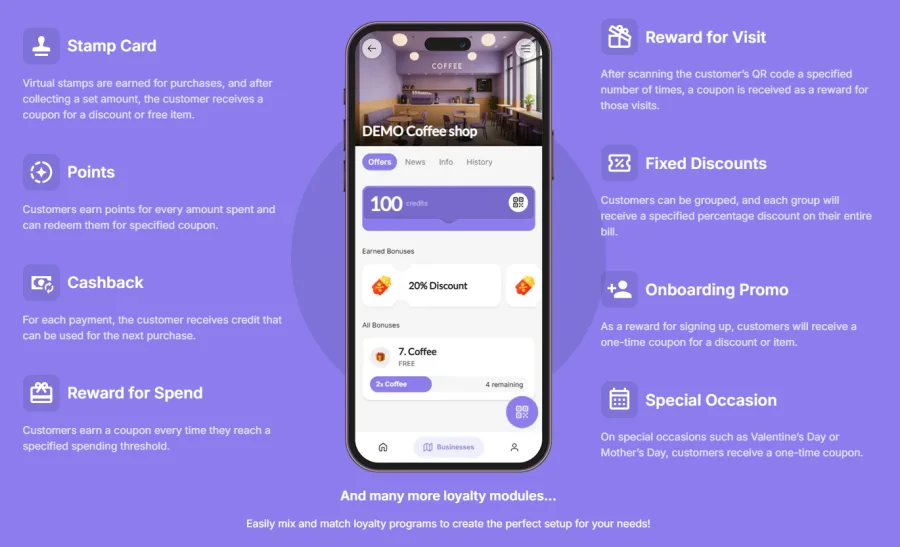
Setup requires no POS integration, and the free tier lets you start immediately. You can scale to premium features like branded apps, push notifications, and automated campaigns as your program grows. Everything you’ve read in this article about simplicity, automation, and clear communication is built directly into the BonusQR platform design.
Frequently asked questions
What is the easiest loyalty program to set up for a small business?
A points-based program is the simplest to start because it requires minimal technology and customers understand earning points per purchase. As research confirms, points-based programs are the most common and versatile mechanic for small businesses.
How much extra revenue can a loyalty program generate?
Automated loyalty programs can deliver significant returns. Automated programs generate $5.80 in incremental revenue for every $1 invested, driven by improved retention and consistent repeat sales.
Do referral reward programs work for small local businesses?
Yes, and they work especially well when automated. Referral programs generate 3.5 times more referrals when the tracking and reward delivery process is automated rather than handled manually.
How can I measure if my loyalty program is successful?
Track redemption rates, repeat customer lift, and overall ROI. Aim for redemption between 25 and 40% and a repeat rate improvement of 20 to 66% in your first year.
What common mistake causes loyalty programs to fail?
Programs most often fail due to unclear benefits and overly complex rules. Many programs fail from poor communication and enrollment friction, not from problems with the underlying reward structure itself.