A branded, SaaS-backed loyalty programme that centralises guest data and implements EDPB/GDPR-compliant profiling flows is the strongest route for Central European hotels in 2026. Your immediate next steps: choose a points ledger or digital stamp card as your MVP, run a quick legal check against GDPR Article 22 consent and disclosure requirements, and confirm your chosen vendor can integrate with your PMS to build a single guest profile. Bonusqr is the recommended deployable option, covered in full in the promo section below.
What goals and KPIs should your hotel rewards programme target?
Start with two or three clear business objectives before you configure a single earn rule. Common goals for Central European hotels include growing active membership, increasing cross-property repeat bookings, and lifting incremental food-and-beverage spend. RevPAR uplift from loyal members is the headline metric, but it only becomes meaningful once you have baseline data from your PMS and booking engine.
KPIs to track from day one:
- Active members (enrolled and transacted at least once in 90 days)
- Monthly active use rate (members who earned or redeemed in the month)
- Redemption rate (members who redeemed at least once in 12 months)
- Average revenue per member vs non-member
- Cross-property penetration (members who stayed at more than one property)
- Customer acquisition cost for members vs walk-ins
- ROI payback period (modelled over multiple intervals to assess financial return)
Set baselines before launch. Pull 12 months of PMS data to calculate your current repeat-guest rate and average revenue per returning guest. Those two numbers become your control group.
| Milestone | Target metric | Realistic timeframe |
|---|---|---|
| Pilot launch | enrolment rate at front desk within a reasonable expected range | Weeks 1–6 |
| Early traction | a notable share of enrolled members redeem at least once | Month 3 |
| Programme maturity | cross-property penetration reaches a measurable minority level | Month 12 |
| ROI positive | Member RevPAR shows a positive margin over non-member levels | Month 12–16 |
A multi-location loyalty programme built on a single customer record makes portfolio-level reporting straightforward from the start.
What should a hotel-branded rewards programme actually include?
The core feature set covers a points ledger or stamp card, a tiered status layer, a mobile and web member portal, coupons and hotel-credit redemptions, referral flows, and special-occasion rewards such as birthday credits. Partner benefits work particularly well in luxury segments: invitation-only partner frameworks that route benefits through travel agents can deliver predictable guest outcomes without a public points ledger.

Policy choices matter as much as features. Define your earn and burn rules precisely: how many points per euro spent, minimum redemption thresholds, expiry periods for dormant accounts, and blackout dates. Points carry a liability on your balance sheet as deferred revenue, so your finance team needs clear accounting rules from day one.
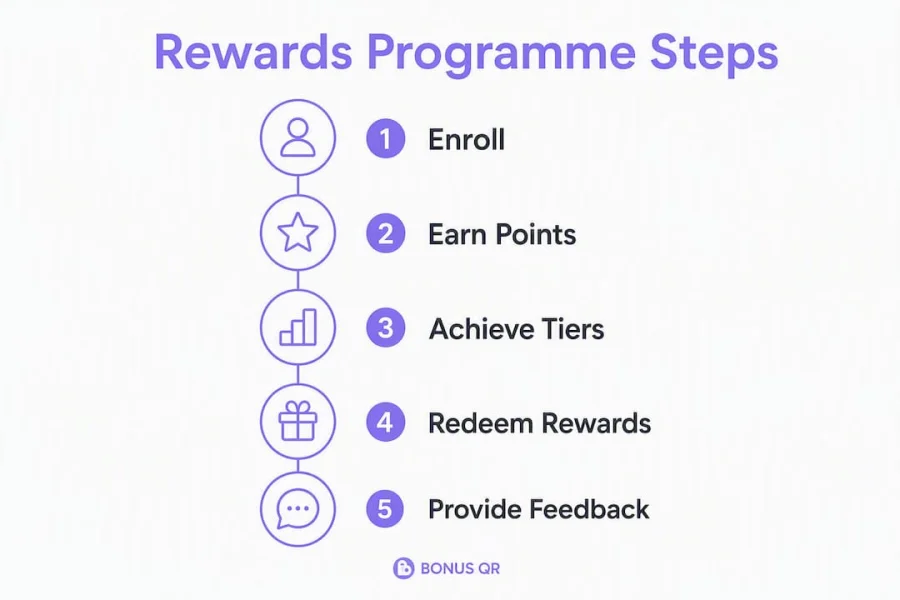
On user experience: a member should see their balance and the next available reward within 30 seconds of opening the app. Friction at check-in kills adoption faster than any earn-rate problem. Keep on-property redemptions simple, F&B credits and spa vouchers are the easiest wins.
Pro Tip: Start with a points or stamp-card MVP. A simple programme provides immediate telemetry for optimisation before you invest in tiers or personalised offers.
GDPR checklist for hotel loyalty profiling and automated decisions
Profiling for personalised marketing in a hotel loyalty programme requires explicit consent under Article 6(1)(a) of GDPR. The EDPB’s 2022 position is clear: legitimate interest cannot justify personalised marketing profiling. That distinction has direct operational consequences.
Consent mechanics:
- Use an unticked checkbox at registration; pre-ticked boxes are unlawful under GDPR consent rules.
- Separate consent for personalisation from consent for partner data sharing.
- Record a timestamp and consent version for every opt-in.
- Make withdrawal as easy as opt-in, one click in the member portal.
Article 22 obligations apply when automated decisions produce significant effects, including tier promotions or demotions and personalised pricing. You must disclose that automated decisions are in use, provide a right to human review, and build a dispute workflow. Many off-the-shelf loyalty engines lack these flows; insist your vendor can supply them or provide compensating processes.
Vendor contract requirements (Article 28 DPA):
- Processing purpose limitations and data minimisation commitments
- Security measures and breach notification timelines
- Retention schedules and deletion procedures
- Assistance with data subject access requests (DSARs)
Your privacy notice must list processing purposes, data categories, third-party recipients, retention periods, and DSAR procedures, including DPO contact details where applicable.
Pro Tip: Audit your consent records quarterly. Regulators have pursued enforcement actions against hotels for undisclosed programme devaluations and opaque rule changes; proactive member notification is your best protection.
How do you balance brand standards with property-level flexibility?
The governance model that works for Central European hotel groups separates central controls from local leeway. Central rules cover earn and burn rates, core tier benefits, legal disclosures, and data processing agreements. Individual properties get delegated authority to run tactical seasonal offers and local F&B promotions within defined spend thresholds.
Approval workflows should require central sign-off for any change to tier criteria or global benefits. Local promos below a defined budget threshold can be approved at property level, but they must be logged centrally for compliance audits. Liability accounting for points stays central: one finance team, one ledger.
Assign clear operational ownership. One team manages DSARs and consent records. One team handles customer service escalations above property level. Local managers run day-to-day enrolment and redemption but escalate disputes. This structure prevents the fragmented local-only programmes that create inconsistent guest experiences and compliance gaps.
Step-by-step rollout plan with realistic timelines and costs
- Discovery and data audit (weeks 1–2). Export 12 months of PMS data, map existing guest contact records, identify data quality gaps, and confirm GDPR consent status for any existing list.
- Vendor selection and legal review (weeks 2–4). Evaluate platforms against the technology checklist below. Sign Article 28 DPAs. Confirm Article 22 disclosure and human-review workflows exist.
- Pilot configuration (weeks 4–8). Configure one property: one or two earning actions, a basic redemption catalogue, consent flow, and staff training. Bonusqr’s hotel loyalty template reduces this phase to roughly six to ten weeks.
- Pilot live and measurement (weeks 8–16). Track enrolment rate, redemption activity, and staff adoption. Go/no-go criteria: 15% enrolment, at least one redemption per 30 active members, zero critical GDPR non-compliance findings.
- Regional roll-out (months 4–9). Extend to additional properties. PMS complexity is the main variable; allow three to six months depending on integration depth.
- Portfolio scale and optimisation (month 10 onwards). Activate tiers, referral flows, and personalised offers for consenting members. Run A/B tests on redemption thresholds and email cadence.
Cost shapes: A freemium or entry-level subscription suits independent properties testing the concept. Multi-property groups typically move to a per-property or per-active-member subscription. White-label app setup carries a one-off implementation fee; custom app development adds further cost for groups needing bespoke booking widget integration.
What technical integrations should you require from a loyalty vendor?
Your vendor must connect to your PMS to create a single guest profile. Without that integration, tier portability, consistent recognition across properties, and portfolio reporting all fail. Beyond PMS, require:
- CRS or booking engine integration for enrolment prompts and points accrual on direct bookings
- POS connection for F&B redemptions
- Payment provider link for paid reward redemptions
- Email, SMS, and push notification channels for marketing automation
- Apple Wallet and Google Wallet support for frictionless member access
- Exportable transaction logs for accounting and audit
- Role-based admin console with property-level and portfolio-level access
- Clear API documentation and webhooks for event-driven flows
- Offline fallback for properties with intermittent connectivity
Bonusqr’s platform features cover mobile and web member portals, push notifications, coupon management, analytics, and modular reward types. For the pilot, configure two earning actions, one redemption option, and the consent flow before adding complexity.
How do you recruit members and drive early usage?
On-property enrolment at check-in is the fastest membership seed. Pair it with booking-engine prompts and targeted email campaigns in the first 30 days.
30/60/90-day launch plan:
- Days 1–30: Front-desk enrolment push, QR code at check-in, booking confirmation email with join link, welcome bonus (first-stay points or stamp credit).
- Days 31–60: F&B redemption incentive to drive on-property spend, birthday credit activation for enrolled members, travel agent or corporate booker activation for luxury or group segments.
- Days 61–90: Referral bonus campaign, limited-time double-points weekend, segmented re-engagement email for members who enrolled but have not redeemed.
Staff enablement is the variable most hotels underestimate. Give reception and F&B teams a two-minute script, a visual prompt in the PMS, and a small internal incentive tied to enrolment numbers in the first month. A gamified staff launch challenge, tracking which shift or property signs up the most members, generates genuine momentum.
How do you measure impact and spot fraud?
| KPI | What it tells you | Review cadence |
|---|---|---|
| Active member rate | Programme health and engagement | Monthly |
| Redemption rate | Whether rewards are compelling | Monthly |
| Incremental RevPAR from members | Direct revenue impact | Quarterly |
| Cross-property penetration | Portfolio loyalty depth | Quarterly |
| CAC payback period | Programme efficiency | Bi-annually |
A/B test ideas: onboarding opt-in placement (registration vs first stay), redemption thresholds (lower vs standard), personalised vs generic offers for consenting members, and email send-time experiments.
Fraud signals to monitor: sudden bulk redemptions from a single account, multiple accounts sharing contact details or device IDs, abnormal points accrual from a single POS terminal, and suspicious partner redemption patterns. Set automated alerts for redemptions above a defined threshold and review flagged accounts within 48 hours.
How do you protect guest data beyond GDPR compliance?
GDPR sets the legal floor; operational security goes further. Encrypt guest data at rest and in transit. Apply role-based access controls so front-desk staff cannot export member lists. Run quarterly access reviews to remove departed employees. Use multi-factor authentication on the admin console. Require your vendor to provide penetration test summaries and SOC 2 or ISO 27001 documentation. Log all admin actions with timestamps for audit trails. Store consent records separately from transactional data so a breach of one does not expose the other.
How do you train staff and keep them engaged with the programme?
Training works best when it is brief, practical, and repeated. A 20-minute onboarding session at launch, a one-page reference card at the front desk, and a monthly five-minute update in team briefings covers most needs. Focus on three things: how to enrol a guest in under 60 seconds, how to answer the two most common member questions (balance and next reward), and what to do when the system is offline.
Internal communication should treat the programme as a live product. Share monthly enrolment and redemption numbers with all property teams. Celebrate milestones publicly. When rule changes happen centrally, brief property managers before members are notified, never after.
How do you collect guest feedback and improve the programme?
Post-stay surveys with one loyalty-specific question (“Did your membership benefit your stay?”) generate usable data without survey fatigue. Monitor redemption drop-off points in your analytics dashboard: if members earn but never redeem, the redemption catalogue or threshold is the problem, not awareness. Review member service contacts monthly for recurring complaints about earn rules or expiry.
Run a quarterly programme review with data from the KPI dashboard, member feedback, and staff observations. Adjust one variable at a time so you can attribute changes in behaviour to specific decisions.
What loyalty trends matter most for Central European hotels?
Central European travellers show strong preference for direct booking incentives over third-party OTA points. Mobile-first member portals are now expected, particularly among guests aged 25–45. Wallet-based membership cards (Apple Wallet, Google Wallet) reduce app download friction significantly in markets where storage space and data costs remain a consideration.
Sustainability rewards are gaining traction: points for opting out of daily housekeeping or choosing lower-carbon transport options resonate with urban business travellers in cities like Prague, Vienna, and Warsaw. Local partner benefits, restaurant credits, cultural event access, and spa partnerships with non-hotel providers, add perceived value without increasing room-rate pressure.
What scalability factors matter as your programme grows?
The architecture decisions you make at pilot stage determine how easily you scale. A single customer record in a cloud-based platform scales to hundreds of properties without re-engineering. Flat-file or spreadsheet-based member lists do not. Confirm your vendor’s API rate limits, data export capabilities, and multi-currency support before you commit.
Tier rules engines must handle increasing complexity without manual intervention. As you add properties, the number of earn scenarios multiplies: direct bookings, OTA bookings, F&B, spa, events. Automate as many accrual rules as possible from the start. Manual points adjustments are a fraud risk and an operational cost that compounds quickly at scale.
Key takeaways
A branded, GDPR-compliant loyalty programme built on a single guest profile and a SaaS platform is the most practical and legally defensible route for Central European hotels to drive repeat bookings and incremental revenue.
| Point | Details |
|---|---|
| Start with an MVP | Launch a points ledger or stamp card at one property before adding tiers or personalisation. |
| GDPR consent is non-negotiable | Use unticked checkboxes, separate consents per purpose, and timestamp every opt-in record. |
| Single guest profile first | Integrate your loyalty platform with your PMS before configuring any earn or redemption rules. |
| Measure from day one | Set PMS baselines pre-launch and track active member rate, redemption rate, and RevPAR impact monthly. |
| Bonusqr for deployment | Bonusqr’s hotel template, stamp-card and points modules, and PMS integration support cover the full checklist above. |
Why a single guest profile changes everything
The most common mistake I see Central European hotels make is launching a loyalty scheme before sorting out their data architecture. A property collects email addresses at check-in, another runs a WhatsApp group for regulars, and a third uses a paper stamp card. Each list is locally useful and collectively worthless for building a programme that recognises a guest across properties, personalises an offer, or produces a reliable ROI figure.
The fix is not complicated, but it requires a decision before configuration begins: one platform, one guest record, one source of truth. When a pilot hotel commits to that principle early, the operational benefits compound quickly. Staff stop asking guests whether they are “already in the system.” Finance gets a clean points liability figure. Marketing can segment by actual stay behaviour rather than guesswork.
The governance lesson is equally practical. Central earn and burn rules with locally configurable reward offers are the model that works. Properties that try to run entirely independent schemes within a group programme create compliance gaps and guest confusion. The ones that accept central data standards but keep local promotional flexibility tend to hit their 12-month KPIs.
You can find more of my hotel loyalty guides and the full author bio on the Bonusqr hotel resources page.
Bonusqr: a deployable loyalty platform built for Central Europe hotels
Bonusqr gives Central European hotel owners a faster path from decision to live programme than building from scratch or commissioning a bespoke system. The platform covers the full checklist: stamp-card and points modules, tiered status, coupons, mobile and web member portals, Apple and Google Wallet support, push and email notifications, and real-time analytics. PMS integration supports the single guest profile requirement that makes portfolio reporting and consistent guest recognition possible.
For independent properties, the freemium tier lets you test the concept with no upfront cost. Multi-property groups can move to a per-property subscription or commission a white-label app with your hotel’s branding, booking widget, and custom reward catalogue. The hotel-specific template on the Bonusqr hotels page reduces pilot configuration to six to ten weeks. To see the full feature set or start a trial, visit bonusqr.com/functions.
Useful sources and recommended reading
- EDPB guidance on hotel loyalty GDPR, profiling and Article 22 obligations — covers lawful bases, consent mechanics, and automated decision-making requirements directly relevant to Central European operators.
- Bonusqr: multi-location loyalty programme governance — implementation guidance for portfolio-wide programmes and the single customer record requirement.
- Bonusqr: customer retention strategies in hospitality — tactical member acquisition and on-property enrolment playbook.
- Bonusqr: hybrid loyalty programme models — guidance on combining points, stamp cards, and tiers for hotel MVPs and scale plans.
This article provides general information about loyalty programme design and GDPR obligations. It is not legal advice. Confirm your specific compliance requirements with a qualified data protection professional and consult the relevant supervisory authority in your jurisdiction.


