
 Deutsch
 Español
 Français
 Italiano
 Magyar
 Polski
 Slovenčina
 Čeština

Most businesses believe multi-location loyalty programs are too complex to manage effectively, leading to fragmented customer experiences and operational headaches. This misconception prevents many retailers and service businesses from unlocking significant revenue opportunities. The reality is that well-designed multi-location programs can boost member revenue by 10-25% and improve retention by up to 20%, all while maintaining operational simplicity. This guide reveals proven strategies to overcome common challenges, balance corporate control with local flexibility, and implement programs that deliver measurable ROI across all your locations.
Key Takeaways
| Point | Details |
|---|---|
| Revenue uplift 10-25% | Multi location loyalty programs can lift member revenue by 10 to 25 percent across locations. |
| Retention gains 5-20% | Retention can improve by 5 to 20 percent, boosting long term profitability. |
| Control and local flexibility | Organizations must balance centralized governance with local autonomy to tailor offers without fragmenting the program. |
| AI driven personalization | Artificial intelligence and analytics personalize rewards to individuals, driving engagement rates up to 70 percent. |
Understanding the impact of multi-location loyalty programs
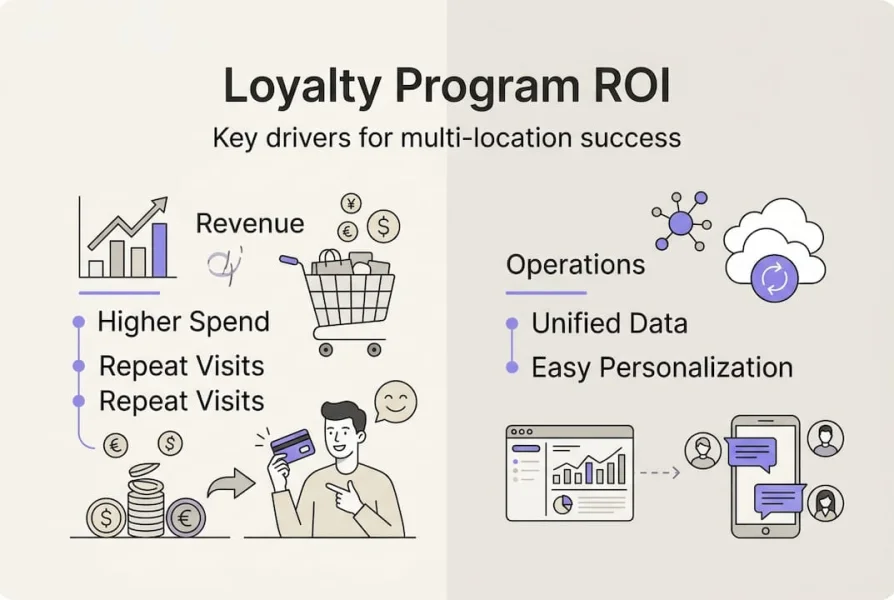
The financial case for multi-location loyalty programs is compelling when you examine real-world performance data. Member revenue uplift ranges from 10-25% while retention improvements typically fall between 5-20%, creating a powerful compound effect on profitability. These aren’t theoretical projections but actual benchmarks from businesses that have implemented structured loyalty systems across multiple locations.
The return on investment tells an even more impressive story. Most programs achieve ROI between 3-10x with payback periods spanning just 6-18 months. Restaurant operators see particularly strong results, with some reporting ROI performance between 150-300% in their first year of operation. Retail establishments also benefit significantly, especially when they integrate digital rewards with in-store experiences.
Engagement rates separate high-performing programs from mediocre ones. Traditional programs might see 15-25% active participation, but sophisticated multi-location systems using gamification and tiered rewards achieve 40-70% engagement rates. This dramatic difference stems from personalized experiences that make customers feel recognized regardless of which location they visit.
“The most successful multi-location programs treat each customer interaction as part of a unified journey, not isolated transactions at different stores.”
Consider these proven performance drivers:
- Unified customer profiles that track behavior across all locations create personalized reward opportunities
- Tiered membership structures motivate customers to increase spending to reach higher benefit levels
- Location-specific bonuses encourage customers to explore different stores while maintaining consistent brand experience
- Real-time reward redemption eliminates friction and increases perceived value
The data clearly shows that loyalty program ROI justifies the initial investment and ongoing operational costs. The key is implementing systems that scale efficiently while maintaining the personal touch customers expect.
Common challenges and nuances in multi-location loyalty programs
Operational complexity creates the biggest barrier to multi-location loyalty success. Reporting systems must aggregate data for corporate oversight while providing granular insights for individual location managers. When POS integration fails or creates data inconsistencies, the entire program foundation becomes unstable. Many businesses discover too late that their technology stack can’t handle the demands of unified customer tracking across dozens or hundreds of locations.

The franchise versus corporate control dynamic adds another layer of difficulty. Corporate teams want standardized programs that maintain brand consistency and enable meaningful data analysis. Franchise owners demand flexibility to respond to local market conditions and competitive pressures. This tension often results in high failure rates from complexity and inconsistent rewards that confuse customers and dilute program effectiveness.
Customer confusion emerges when reward structures vary significantly between locations. A customer earning points at one store expects the same earning rate and redemption options at another location in the same chain. Inconsistent experiences erode trust and reduce program participation. Some customers simply give up trying to understand the rules, defeating the entire purpose of building loyalty.
Data silos obstruct the unified customer view essential for effective personalization. When each location maintains separate customer records, identifying high-value customers becomes nearly impossible. Point balance discrepancies create customer service nightmares, with frustrated customers caught between locations that can’t access complete transaction histories.
Security vulnerabilities in card-based systems expose businesses to fraud and abuse. Loyalty program anomalies including point manipulation and unauthorized redemptions require sophisticated detection systems. Without clear dispute workflows, businesses waste resources investigating claims while customers experience delays in resolution.
Here are critical steps to minimize these challenges:
- Establish clear governance frameworks that define corporate standards and acceptable local variations
- Implement unified technology platforms that sync data in real-time across all locations
- Create comprehensive training programs ensuring staff at every location understand program mechanics
- Develop escalation procedures for handling point disputes and technical issues quickly
- Conduct regular audits comparing program performance across locations to identify inconsistencies
Pro Tip: Start with a pilot program at 3-5 locations representing different market conditions before rolling out system-wide. This approach reveals operational issues and technology gaps while limiting risk exposure.
Understanding loyalty program module types helps businesses choose appropriate features for their specific operational model. The goal is creating customer loyalty programs for restaurants and retail that balance sophistication with simplicity.
Designing and executing effective multi-location loyalty programs
Balancing uniformity and localization represents the central design challenge for multi-location programs. Successful programs balance central governance with local execution flexibility, creating frameworks that maintain brand consistency while allowing relevant customization. Corporate teams should control core elements like brand identity, earning rates, and redemption values while empowering locations to run targeted promotions and recognize local customer preferences.
| Approach | Characteristics | Advantages | Disadvantages |
|---|---|---|---|
| Centralized control | Uniform rules, corporate management, standardized rewards | Brand consistency, simplified training, easier data analysis | Limited local relevance, slower response to market changes |
| Localized flexibility | Location-specific rules, manager autonomy, varied rewards | Market responsiveness, higher local engagement | Brand inconsistency, complex reporting, customer confusion |
| Hybrid model | Core standards with local options, tiered approval process | Balance of consistency and flexibility, scalable customization | Requires sophisticated technology, more complex governance |
AI and advanced analytics transform multi-location programs from transactional to truly personalized experiences. Predictive algorithms identify which customers are at risk of churning and automatically trigger retention offers. Machine learning systems analyze purchase patterns across all locations to recommend rewards that individual customers actually value. These technologies enable the 40-70% engagement rates that separate exceptional programs from average ones.
Simplifying program mechanics prevents the customer overwhelm that kills participation. Avoid creating different point values, earning rates, or redemption rules across locations. Customers should never need to calculate whether they’re getting a fair deal. Clear communication using simple language ensures everyone understands how to earn and redeem rewards regardless of their location preference.
High-performing programs leverage these proven engagement drivers:
- Gamification elements like progress bars and achievement badges create emotional investment
- Tiered membership structures with clearly defined benefits motivate customers to increase spending
- Surprise rewards for unexpected behaviors delight customers and encourage exploration
- Birthday and anniversary bonuses make customers feel recognized as individuals
- Referral incentives turn satisfied customers into active program promoters
Pro Tip: Conduct quarterly surveys asking customers which rewards they actually want versus what you’re currently offering. This simple practice prevents the common mistake of designing programs around what businesses want to promote rather than what customers value.
Exploring hybrid loyalty program models reveals how combining multiple reward types increases appeal across diverse customer segments. Understanding customer engagement retail strategies helps businesses create touchpoints that reinforce loyalty beyond transactional interactions. Selecting appropriate types of rewards for retailers ensures your program delivers value that resonates with your specific customer base.
The execution phase requires detailed planning and phased rollout. Train staff thoroughly on program mechanics and common customer questions before launch. Create reference materials that location managers can access quickly when issues arise. Establish feedback loops so frontline staff can report problems and suggest improvements based on actual customer interactions.
Measuring success and ROI of multi-location loyalty programs
Tracking the right metrics separates businesses that optimize their programs from those that waste resources on ineffective initiatives. Revenue uplift measures the spending difference between loyalty members and non-members, providing clear evidence of program impact. Retention rates show whether customers are returning more frequently and staying active longer. Engagement metrics reveal what percentage of enrolled customers actively participate versus those who signed up but never use their benefits.
Payback period calculation determines how quickly your program investment generates positive returns. Factor in technology costs, promotional expenses, staff training, and reward fulfillment against the incremental revenue from member purchases. Most successful programs break even within 6-12 months, then generate substantial profits in subsequent years.
Small improvements in retention create disproportionate profitability gains. Research shows that 5% retention boost yields 25-95% profit gain, making retention-focused programs incredibly valuable. This multiplier effect occurs because retained customers typically increase their spending over time while requiring lower acquisition costs than new customers.
| Metric | Baseline | Good performance | Exceptional performance |
|---|---|---|---|
| Member revenue uplift | 5-8% | 10-18% | 20-25% |
| Retention rate improvement | 3-5% | 8-15% | 18-25% |
| Active engagement rate | 15-20% | 30-45% | 50-70% |
| Program ROI | 2-3x | 4-7x | 8-12x |
| Payback period | 18-24 months | 9-15 months | 4-8 months |
Layered metrics combining global and location-specific data provide deeper insights than aggregate numbers alone. Compare performance across locations to identify top performers and struggling sites. Analyze whether certain locations excel at member acquisition while others drive higher spending per member. These patterns reveal best practices you can replicate and problems requiring intervention.
Key performance indicators to monitor continuously:
- New member enrollment rate showing program appeal and staff promotion effectiveness
- Redemption rate indicating whether rewards offer genuine value to customers
- Points breakage showing the percentage of earned points never redeemed
- Average transaction value comparing member versus non-member purchases
- Visit frequency measuring how often members return versus occasional customers
- Churn rate identifying when members stop participating despite remaining enrolled
Continual optimization ensures your program evolves with changing customer expectations and competitive dynamics. Run A/B tests on reward structures, promotional messaging, and earning mechanisms. Analyze which rewards customers redeem most frequently and which sit unused. Survey churned members to understand why they stopped participating.
Understanding loyalty program ROI benchmarks helps you set realistic targets and identify when your program underperforms. Regular performance reviews should examine both financial metrics and customer satisfaction indicators to ensure your program delivers value to all stakeholders.
Discover BonusQR’s multi-location loyalty solutions
BonusQR provides comprehensive loyalty systems specifically designed to address the complexities of multi-location operations. Our platform enables seamless integration across all your locations while maintaining the flexibility to accommodate local market needs. The system supports various reward structures including points, stamps, cashback, and tiered benefits, allowing you to create programs that resonate with your specific customer base.
Our features of loyalty system include real-time analytics, automated marketing campaigns, and AI-powered personalization that drives the 40-70% engagement rates top-performing programs achieve. Whether you operate retail stores or service establishments, BonusQR scales efficiently from pilot programs to enterprise-wide deployments. Explore our loyalty application for services and loyalty application for retail to see how we help businesses like yours maximize customer retention and revenue.
FAQ
What are the main benefits of multi-location loyalty programs?
Multi-location loyalty programs increase revenue by 10-25% while improving customer retention by up to 20%, creating substantial profit margin improvements. These programs also boost customer engagement rates significantly, with well-designed systems achieving 40-70% active participation. The unified customer experience across locations strengthens brand loyalty and encourages customers to visit multiple sites within your network.
How can businesses balance corporate control and local flexibility in loyalty programs?
Successful programs establish central governance for core standards like brand identity and earning rates while allowing local teams to run targeted promotions and recognize regional preferences. This hybrid approach prevents the customer confusion that comes from wildly inconsistent experiences while honoring specific local market needs. Regular communication between corporate and location teams ensures everyone understands the boundaries of acceptable customization.
What are common technical challenges with implementing multi-location loyalty programs?
POS integration failures, data silos preventing unified customer views, and security vulnerabilities in card-based systems represent the most frequent technical hurdles. Many businesses also struggle with reporting systems that can’t aggregate data for corporate analysis while providing actionable insights for individual locations. Implementing clear dispute workflows and anomaly detection systems helps manage these challenges effectively while maintaining customer trust.
How do businesses measure ROI and optimize multi-location loyalty programs?
Track retention lift, revenue growth per member, active engagement rates, and payback period to evaluate program ROI comprehensively. Compare performance across locations to identify best practices and struggling sites requiring intervention. Use data analytics to continuously refine reward structures, promotional strategies, and earning mechanisms based on actual customer behavior rather than assumptions about what should work.