
Many small business owners hesitate to invest in loyalty programs, fearing costs will outweigh benefits. Yet loyalty programs deliver an average ROI of 4.8x, transforming customer retention into measurable revenue growth. This guide breaks down how loyalty program ROI works, why rewards outperform discounts, and how you can maximize returns through strategic program design tailored to retail, restaurant, and service businesses.
Key takeaways
| Point | Details |
|---|---|
| Average ROI reaches 4.8x investment | Well-designed loyalty programs return nearly five times what you spend on them. |
| Members visit 2.5x more frequently | Loyalty participants generate 12-25% higher annual revenue compared to non-members. |
| Rewards beat discounts significantly | Incentive-based promotions outperform blanket discounts by 14-34% across key metrics. |
| Strategic programs create competitive moats | Proprietary communication channels and accumulated value make customers harder to poach. |
Understanding the true ROI of loyalty programs
ROI measures net profit return relative to your program investment. For loyalty initiatives, this means comparing revenue gains from increased customer visits, higher spending, and improved retention against setup costs, platform fees, and reward expenses.
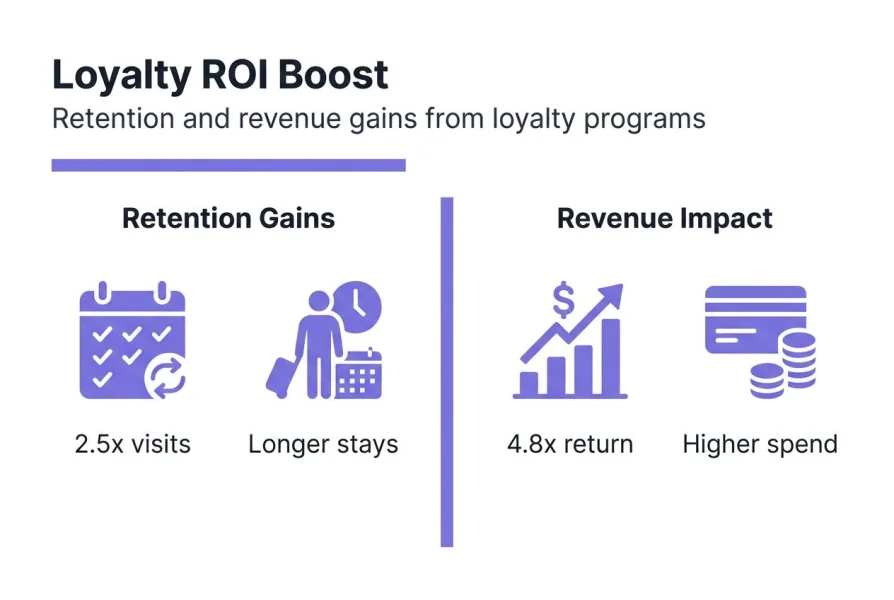
Research shows loyalty programs deliver an average ROI of 4.8x, making them one of the most effective marketing investments available. This return stems from transforming one-time buyers into repeat customers who spend more per transaction and visit more frequently.
Customer lifetime value increases substantially when members engage with your program. A retained customer costs five to seven times less than acquiring a new one, making retention-focused strategies financially superior to constant acquisition efforts.
For small to medium businesses, understanding loyalty program benefits boost retention growth helps justify initial investments. While setup requires capital and planning, long-term revenue gains dwarf these costs.
Key cost considerations include:
- Platform subscription or development fees
- Reward fulfillment expenses based on redemption rates
- Staff training and program communication costs
- Analytics tools for tracking member behavior
The beauty of modern loyalty platforms lies in scalability. You can start small with basic rewards and expand features as revenue grows, keeping costs aligned with returns.
With the ROI basics clear, next examine how loyalty programs directly boost customer visits and revenue.
How loyalty programs increase customer visits and revenue
Loyalty members demonstrate dramatically different purchasing patterns than occasional customers. Members visit roughly 2.5 times more often than non-members, creating predictable revenue streams that stabilize cash flow.
This visit frequency translates directly to revenue growth. Loyalty programs boost annual revenue from members by 12-25%, with top performers seeing even higher gains through personalized engagement and tiered reward structures.
Restaurant data reveals striking trends. In 2026, 39% of restaurant visits come from loyalty program members, more than double the 18% recorded in 2019. This shift demonstrates how essential loyalty infrastructure has become for competitive positioning.

The impact varies by industry but remains consistently positive:
| Metric | Impact Range | Business Type |
|---|---|---|
| Visit frequency increase | 2.0x to 3.5x | Retail and restaurants |
| Annual revenue per member | +12% to +25% | Service businesses |
| Transaction size growth | +8% to +15% | All sectors |
| Member retention rate | 60% to 85% | Well-designed programs |
These numbers reveal why successful businesses prioritize loyalty investment. Each additional visit from an existing member costs virtually nothing in acquisition spend while generating margin-rich revenue.
Implementing a reward for visit loyalty program creates immediate incentives for return trips. Customers receive tangible benefits for behaviors you want to encourage, reinforcing positive patterns through behavioral economics principles.
The compounding effect matters most. A member visiting 2.5 times more often over three years generates exponentially more lifetime value than occasional shoppers. Understanding how loyalty programs drive sales growth helps you forecast returns accurately.
Pro Tip: Track visit frequency separately from transaction value to identify which levers your program pulls most effectively. Some programs excel at bringing customers back more often, while others increase basket size.
Understanding visit and revenue impacts helps us appreciate how program design affects ROI.
Why reward-based promotions deliver higher ROI than discounts
Not all promotional strategies generate equal returns. Reward and incentive-based promotions deliver better ROI than simple discounts across conversion rates, profit per customer, and marketing investment returns.
The difference stems from perceived value versus actual cost. A $10 reward earned through purchases feels more valuable to customers than a $10 discount, yet costs you the same amount. This psychological premium increases engagement without eroding margins.
Reward programs also encourage incremental purchases that wouldn’t occur with discounts alone. Customers spend more to reach reward thresholds, increasing average transaction values while building anticipation for future redemptions.
| Strategy Type | Conversion Rate | Profit Per Customer | Return on Marketing Investment | Customer Lifetime Value |
|---|---|---|---|---|
| Reward-based programs | 14-34% higher | 18-28% higher | 22-31% higher | 35-45% higher |
| Blanket discounts | Baseline | Baseline | Baseline | Baseline |
| Hybrid approach | 8-15% higher | 10-18% higher | 12-20% higher | 20-30% higher |
Discounts train customers to wait for sales, degrading full-price purchasing behavior over time. Rewards create positive associations with your brand without conditioning customers to expect constant price reductions.
The loyalty aspect matters critically. Reward programs build emotional connections through progress tracking and achievement unlocking. Discounts create transactional relationships focused purely on price.
Exploring ways to leverage loyalty program benefits reveals how reward structures drive engagement beyond simple transactions. Points, stamps, and tier advancement gamify the experience, making shopping enjoyable rather than purely functional.
Pro Tip: Reserve discounts for new customer acquisition or inventory clearance, but build your retention strategy around reward-based incentives that protect margins while increasing frequency.
Next, explore how loyalty programs build a communication channel that enhances competitive edge and retention.
Building competitive advantage with loyalty ecosystems
Well-designed loyalty programs create more than transaction incentives. They establish a proprietary communication channel and structured recognition system that competitors cannot easily replicate.
This ecosystem delivers three strategic advantages. First, recognition makes customers feel valued through personalized acknowledgment of their patronage. Second, relevance ensures communications match individual preferences and purchase history. Third, exclusive access creates perceived scarcity that strengthens emotional bonds.
Members with accumulated value are harder to poach because switching costs increase with point balances and tier status. A customer with 2,000 points toward a significant reward won’t abandon your business for a competitor’s one-time discount.
Stickiness increases exponentially with program maturity. Members who’ve redeemed rewards multiple times demonstrate 60-80% higher retention than new enrollees. They’ve experienced tangible benefits and invested psychological commitment in your ecosystem.
Yet generic programs risk satisfaction slippage. Customers enrolled in multiple undifferentiated programs grow fatigued by cluttered wallets and irrelevant communications. Your program must deliver genuine value through thoughtful design.
“Leading brands recognize loyalty programs as strategic assets, not tactical promotions. They invest in personalization, experiential rewards, and omnichannel integration that creates sustainable competitive differentiation.”
Features that enhance competitive positioning include:
- Personalized reward recommendations based on purchase history
- Tiered status levels recognizing best customers publicly
- Experiential rewards beyond discounts like early access or exclusive events
- Seamless mobile integration for frictionless engagement
- Data-driven insights enabling relevant, timely communications
Pro Tip: Survey your loyalty members quarterly to understand what rewards they value most. Personalized program evolution based on feedback prevents commoditization and maintains engagement.
Staying current with top retail loyalty trends in 2026 ensures your program incorporates innovations that customers increasingly expect from modern brands.
Let’s apply these insights with practical tips for maximizing your loyalty program ROI.
Practical steps to maximize ROI from your loyalty program
Implementing an effective loyalty program requires strategic planning beyond simply choosing rewards. Follow these sequential steps to optimize returns:
-
Define clear objectives tied to business metrics like visit frequency, average transaction value, or customer lifetime value rather than vanity metrics like enrollment numbers.
-
Segment your customer base to tailor incentives for different behavior patterns. High-frequency customers need different rewards than occasional visitors.
-
Choose reward structures aligned with purchase patterns. Restaurants benefit from visit-based stamps while retailers often succeed with spend-based points.
-
Set achievable reward thresholds that encourage incremental purchases without requiring unrealistic spending levels that discourage participation.
-
Integrate data analytics to track redemption rates, member engagement, and revenue impact by cohort. Use insights to refine reward offerings continuously.
-
Communicate program benefits clearly at signup and throughout the customer journey through email, SMS, and in-app notifications.
-
Monitor member satisfaction through Net Promoter Score surveys and feedback mechanisms. Loyalty programs influence buying decisions when they deliver perceived value consistently.
-
Test different reward types like experiential benefits, exclusive access, or partner perks to discover what resonates most with your audience.
-
Leverage digital platforms that simplify management without requiring complex POS integrations or technical expertise.
-
Review program performance quarterly, adjusting reward structures and communication strategies based on data-driven insights rather than assumptions.
Starting with innovative loyalty schemes that boost customer retention provides proven frameworks you can adapt to your specific business model and customer preferences.
With these actionable steps, you’re ready to leverage loyalty program ROI fully.
Explore BonusQR loyalty solutions to boost your ROI
BonusQR delivers customizable loyalty platforms designed specifically for small to medium retail, restaurant, and service businesses. Our loyalty system features include points collection, stamp cards, cashback, and visit-based rewards without requiring POS integration.
The platform provides mobile and web app integration, push notifications for targeted engagement, real-time analytics, and complete branding customization. Whether you operate a services loyalty application or need a simple stamp card loyalty program, BonusQR offers flexible modules you can activate as your business grows.
Rapid setup gets your program running within days, not months. Pricing tiers from free to premium scale with your needs, while white-label options provide fully branded experiences for customers.
Finally, answer common questions to clarify remaining doubts about loyalty program ROI.
FAQ
What is the average ROI of a loyalty program?
Research indicates loyalty programs deliver an average ROI of 4.8x your investment. This means for every dollar spent on platform fees, rewards, and management, you can expect approximately $4.80 in net profit returns through increased customer retention, higher visit frequency, and improved transaction values.
How do loyalty programs boost customer visits and spending?
Members visit roughly 2.5x more often than non-members, creating predictable revenue streams. Additionally, loyalty programs boost annual revenue from members by 12-25% through larger basket sizes and more frequent purchases driven by reward incentives and engagement.
Are rewards more effective than discounts for loyalty ROI?
Yes, significantly. Reward-based promotions outperform discounts by 14-34% across conversion rates, profit per customer, and marketing investment returns. Rewards build emotional connections and encourage incremental spending without training customers to wait for price reductions.
How can I ensure my loyalty program keeps delivering ROI?
Regularly update rewards based on member feedback and purchase data to maintain relevance. Personalize offers using behavioral segmentation and track satisfaction metrics to identify slippage early. Well-designed loyalty programs maintain high member satisfaction by evolving with customer expectations rather than remaining static after launch.


