For Central European small businesses, Bonusqr is the recommended free digital loyalty card app: genuinely free to start, no customer app download required, GDPR-ready, and live in minutes. Customers collect stamps or rewards by scanning a QR code or adding a pass to Apple Wallet or Google Wallet — no installation, no friction. As Harvard Business Review research confirms, keeping the right customers is more valuable than acquiring new ones, and a well-run digital loyalty programme is one of the most direct ways to act on that.
Here is a quick orientation across the main category options:
- Bonusqr (recommended): permanent free tier, Wallet and QR support, no credit card required to start, GDPR-ready, Central Europe-focused.
- Permanent free plan, entry-level: basic stamp-card tools with limited active cards and no branding customisation — suitable for testing the concept before committing.
- Wallet-pass-first option: prioritises Apple Wallet and Google Wallet distribution; typically free for low volumes but charges per active pass at scale.
- POS-bundled free tier: loyalty included as part of a broader point-of-sale package; free only while using that POS system.
Key takeaways
The most effective free digital loyalty card for Central European small businesses is one that requires no customer app download, uses Wallet passes or QR codes for stamp collection, and is GDPR-compliant from the start.
| Point | Details |
|---|---|
| No customer app needed | Wallet passes and QR codes remove the main adoption barrier — customers scan once and collect stamps immediately. |
| Permanent free tier matters | A free trial gives you features temporarily; a permanent free tier lets you test real adoption before any cost. |
| GDPR and data ownership | Confirm data-hosting location and that you can export your customer list on the free plan before committing. |
| Upgrade when limits bite | Watch your active card count and message limits — when either approaches the free-tier cap, the upgrade cost is usually justified by one extra repeat visit. |
| Bonusqr for Central Europe | Bonusqr offers a free tier with Wallet/QR support, no POS required, and GDPR-aligned data handling for Central European businesses. |
What do free digital loyalty card apps actually include?
Not every “free” plan is equal. The table below maps the dimensions that matter most when you are choosing a digital loyalty programme for a small team.
| Dimension | Permanent free tier | Free trial only | POS-bundled free tier |
|---|---|---|---|
| Free plan limits | Limited active cards or customers | Full features for 14–30 days, then paid | Tied to POS subscription; loyalty free while POS is active |
| Customer app required? | No — QR code or Wallet pass | Varies by vendor | Often yes, via POS provider’s app |
| Apple/Google Wallet support | Yes (on quality platforms) | Yes during trial | Rarely included |
| Setup time | Under 10 minutes | Under 10 minutes | Longer — POS configuration required |
| Core free features | Stamp cards, basic analytics, QR distribution | Full feature set during trial | Stamp cards, basic reporting |
| Branding/customisation | Limited on free; full on paid | Full during trial | Minimal |
| POS integration | Not required | Not required | Built-in |
| GDPR/regional availability | Check data-hosting location and language support | Check before trial ends | Depends on POS vendor |
| Support | Community or email | Full support during trial | Via POS provider |
| Scaling cost | Monthly subscription from low tier | Subscription after trial | Bundled with POS pricing |
The key distinction is between a permanent free tier and a free trial. A trial gives you full features temporarily; a permanent tier gives you limited features indefinitely. For most small businesses, a permanent free tier is the safer starting point — you can test real customer adoption before spending anything.
Pro Tip: When you sign up for any free plan, test three things immediately: confirm no credit card is required, issue yourself a test Wallet pass to check the distribution flow, and verify you can export your customer data. If any of these are blocked on the free tier, treat it as a red flag.
Trust signals worth checking on any vendor page: “no credit card required” wording, an app-store rating above 4.0, explicit mention of the countries and languages supported, and at least one named customer example or case study.
How do you choose the right free loyalty card app?
The decision comes down to five practical criteria.
True cost. A free plan that locks your customer data behind a paywall, or that forces an upgrade the moment you reach 50 active customers, is not genuinely free. Read the limits carefully.
Card distribution method. Wallet passes and QR codes eliminate the biggest friction point in loyalty adoption: customers do not need to download a separate app. A web pass or scannable QR at the counter is all they need. This single factor has more impact on adoption than any other feature.
Staff workflow. Your team needs to be able to stamp or validate a card in under five seconds. If the process requires logging into a separate system or entering a code manually, staff will stop using it within a week.
Analytics. Even basic analytics — visit frequency, redemption rate, active card count — tell you whether the programme is working. Platforms that hide all analytics behind a paid tier make it impossible to justify upgrading.
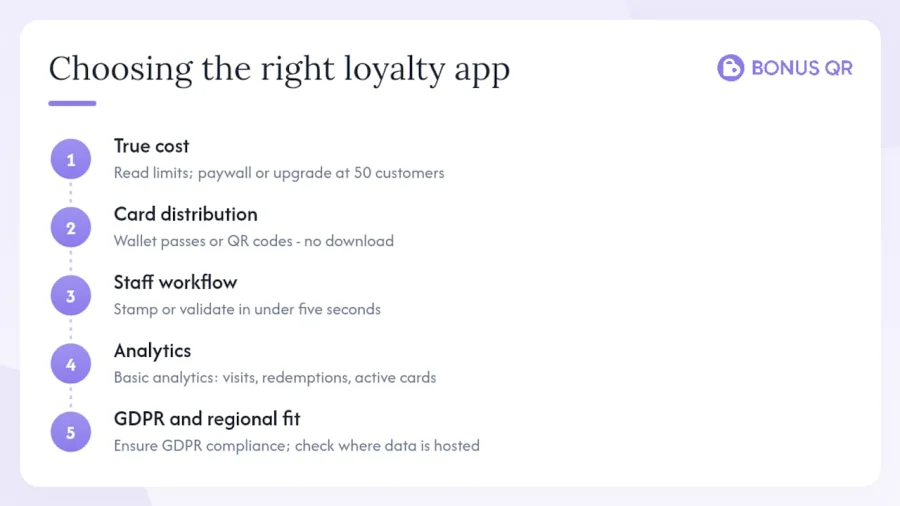
GDPR and regional fit. For Central European businesses, data must be processed in compliance with GDPR. Check where customer data is hosted and whether the vendor’s privacy documentation covers your jurisdiction.
Vendor checklist: questions to ask before you commit
- Is a credit card required to activate the free plan?
- Can I issue an Apple Wallet or Google Wallet pass on the free tier?
- How many active customer records does the free plan allow?
- Can I export my full customer list at any time, including on the free tier?
- What happens to my data if I cancel or downgrade?
- Is the platform available in my language and compliant with GDPR?
- What is the support response time on the free plan?
- Are push notifications available without upgrading?
Red flags to watch for
- Core features (analytics, Wallet support, branding) locked entirely behind paid tiers with no free access at all.
- No mention of data export or data ownership in the terms of service.
- Mandatory annual contracts with no monthly option.
- No “no credit card required” statement on the sign-up page.
- Vague GDPR compliance claims with no detail on data-hosting location.
How to set up a free digital stamp card without a customer app
You can go live in under ten minutes. Here is the fastest path.
- Create your account. Sign up on your chosen platform — confirm no credit card is required. Choose the stamp-card module.
- Design your pass. Add your logo, brand colours, and reward rule. Keep it simple: “Collect 8 stamps, get one free” works for most businesses.
- Generate your QR code and Wallet link. The platform produces a scannable QR and an “Add to Wallet” link simultaneously. Both point to the same customer pass.
- Display at the counter. Print the QR code on an A5 card or small tent sign. Place it where customers pay. Independent cafés like Surfin Cafe use simple counter signage to prompt customers to scan — no staff explanation needed.
- Train your staff. Show them how to open the staff-scan screen on their phone or tablet and tap to add a stamp. The whole process takes under five seconds per customer.
- Set your reward rule and test it. Complete a full stamp cycle yourself before going live.
Example reward rules by business type:
- Café: “Collect 8 stamps (one per coffee purchase), receive your 9th coffee free.” Kingshots Coffee’s Dug Out Café demonstrates how a simple counter-based stamp workflow drives repeat visits without any technical complexity.
- Salon: “Collect 5 stamps (one per appointment), receive 20% off your 6th visit.” See loyalty application for services for more examples tailored to appointment-based businesses.
Pro Tip: Before going live with customers, run a full test cycle with two staff phones: one acting as the customer scanning the QR, one acting as the cashier stamping the card. Catching a broken link or a display issue at this stage costs nothing; catching it at the counter during a busy morning costs you a customer.
What do the core features actually mean for your business?
Feature names on vendor pages can be misleading. Here is what each one means in practice.
Stamp cards are the digital equivalent of a paper punch card. Each visit or purchase adds a stamp; a completed card triggers a reward. They are the simplest loyalty mechanic and the easiest for customers to understand. For a retail or café context, they typically outperform points systems in adoption because the progress is visible and the reward is concrete.
Points systems assign a numeric value to each transaction. They suit businesses with variable spend (restaurants, grocery stores) where a flat “one stamp per visit” rule would feel unfair to high-value customers. Points systems require slightly more configuration and customer education.
Coupons and discounts are one-time or time-limited offers distributed digitally. They work well for first-visit conversion and reactivating lapsed customers, but they do not build the habitual return behaviour that stamp cards do.
Wallet passes (Apple Wallet and Google Wallet) are the delivery mechanism that removes the need for a customer app. A customer taps “Add to Wallet” once; the pass lives on their phone’s lock screen and updates automatically when a stamp is added. Note that Apple’s platform documentation covers specific constraints around pass distribution and in-app purchases — worth reviewing if you plan to distribute passes at scale.
Push notifications let you send a message directly to a customer’s lock screen when their pass updates or when you run a promotion. On most free plans, notifications are limited or absent entirely.
Feature-to-outcome mapping for small businesses:
- Stamp cards → repeat visits and habit formation.
- Points systems → higher average transaction value.
- Coupons → first-time conversion and reactivation.
- Wallet passes → frictionless adoption without a customer app download.
- Push notifications → timely re-engagement between visits.
For a deeper comparison of digital loyalty versus paper cards, the trade-offs in adoption, cost, and data visibility are worth reviewing before you decide on a format.
When does a free plan stop being enough?
Most free plans are genuinely sufficient for a business with fewer than a few hundred active loyalty customers per month. The limits that typically force an upgrade are:
- Active card cap. Many free tiers cap active customer records at a low number. Once you exceed that, new customers cannot join without you upgrading.
- Message limits. Push notifications and email campaigns are often restricted to a handful per month on free plans, making re-engagement campaigns impractical.
- No white-label branding. The vendor’s logo appears on your customer’s pass. For businesses where brand presentation matters, this is an early reason to upgrade.
- Missing integrations. Free tiers rarely include POS or e-commerce integrations, which means manual stamp workflows indefinitely.
- Analytics depth. Basic visit counts are usually free; cohort analysis, churn tracking, and campaign attribution are typically paid features.
The practical upgrade triggers to watch for:
- Your active customer count is approaching the free-tier cap.
- You want to send a targeted promotion to lapsed customers and the free plan blocks it.
- A customer complains that the vendor’s branding on the pass looks unprofessional.
- You need the loyalty data to sync automatically with your till or booking system.
A cost-benefit check is straightforward: if a paid plan costs less per month than the revenue from one additional repeat customer visit, the upgrade pays for itself. Scalable loyalty solutions typically unlock automation, deeper analytics, and white-label options at the first paid tier.
Why Bonusqr is our recommended option for Central European small businesses
Bonusqr is built for exactly the use case this article describes: a small business that wants a genuinely free digital loyalty card, no customer app required, live in minutes, and compliant with European data-protection standards.
Key features available on the Bonusqr platform:
- Free tier with no credit card required to start. You can design, launch, and distribute a stamp card before committing to any payment.
- Apple Wallet and Google Wallet support. Customers add their pass once and collect stamps via QR scan at the counter — no app download, no account creation on their side.
- Rapid setup without POS integration. The staff-scan workflow runs on any smartphone. You do not need to change your till system or install new hardware.
- Customisation and branding. Logo, colours, and reward rules are configurable from the dashboard. White-label and fully custom app options are available for businesses ready to scale.
- Marketing and engagement tools. Push notifications, coupons, referral modules, and automated campaigns are available as you grow.
- Analytics. Real-time dashboards show active cards, visit frequency, and redemption rates — the metrics that tell you whether the programme is working.
- GDPR compliance and Central Europe fit. Bonusqr’s platform is designed with European data-protection requirements in mind, with language support relevant to Central European markets.
For a full overview of what the platform includes, the Bonusqr features page covers every module across free and paid tiers.
A note from the publisher
The no-app approach is not just a convenience feature — it is the difference between a loyalty programme that customers actually use and one that sits dormant on a sign-up page. Having worked through loyalty rollouts with small retailers and cafés across Central Europe, the pattern is consistent: the moment you remove the “download our app” step, adoption climbs. Bonusqr’s GDPR-aligned setup and hands-on onboarding support make it a practical starting point for any business that has been putting this off.
Bonusqr’s free plan: what you get and how to start
Bonusqr gives small businesses a free digital loyalty programme with no credit card required at sign-up. You get stamp-card functionality, Apple Wallet and Google Wallet pass distribution, a QR-based staff workflow, and basic analytics — everything you need to test real customer adoption before spending anything. The setup takes minutes, requires no POS changes, and your customer data stays GDPR-compliant from day one.
Review the full feature set on the Bonusqr platform, then register at Bonusqr to launch your first stamp card today.
Sources
- The value of keeping the right customers | HBR
- Apple Support — Billing | Apple
- The Dug Out Cafe (Kingshots Coffee)
- Surfin Cafe
When reviewing any vendor page, look specifically for “no credit card required” on the sign-up screen, explicit GDPR or data-hosting statements, and confirmation of the countries and languages supported. Those three signals tell you more about a platform’s suitability for Central Europe than any feature list.


