
 Deutsch
 Español
 Français
 Italiano
 Magyar
 Polski
 Slovenčina
 Čeština

TL;DR:
- Real-time analytics provide live insights to improve loyalty program effectiveness.
- SMBs can use real-time data to proactively engage customers and boost retention.
- Regularly reviewing analytics and involving staff maximizes loyalty program success.
You invest in a loyalty program, customers sign up, and then… silence. You’re not sure who’s coming back, which rewards are working, or whether the program is paying off. Many small and medium-sized business owners in retail and food service face this exact problem. The good news: real-time analytics can close that gap. This guide explains what real-time analytics means for loyalty programs, why it matters for businesses your size, and how to use it to make smarter decisions starting today.
Key Takeaways
| Point | Details |
|---|---|
| Immediate impact tracking | Real-time analytics let you see loyalty program results and engagement as they happen. |
| Actionable insights | You can adjust offers and communication instantly for higher effectiveness. |
| Simple integration for SMBs | Modern loyalty tools make analytics setup manageable, even for small teams. |
| Improved retention | Businesses using live analytics often see increased customer loyalty and repeat visits. |
What is real-time analytics for loyalty?
Traditional loyalty reporting works like a monthly bank statement. You see what happened, but the moment to act has already passed. Real-time analytics is different. It gives you a live view of what your customers are doing right now, so you can respond while it still matters.
In a loyalty context, real-time analytics empowers loyalty managers to track member actions as they happen. That means you see a new enrollment the moment it occurs, a reward redemption as it’s processed, or a campaign response within minutes of sending a push notification.
Here are the core indicators you can track in real time:
- Enrollment rate: How many new members join per day or per hour
- Point accumulation: How quickly customers earn points across visits
- Reward redemptions: Which rewards are claimed and how often
- Campaign response rate: How many customers act on a promotion within hours
- Visit frequency: How often individual customers return within a set period
These numbers are not just interesting. They tell you what’s working and what needs fixing before you lose customers to a competitor.
| Metric | Traditional reporting | Real-time analytics |
|---|---|---|
| Enrollment data | Monthly summary | Live count |
| Redemption tracking | End-of-period report | Instant notification |
| Campaign response | Delayed results | Same-day feedback |
| Customer visit trend | Historical only | Current pattern |
For small businesses, the customer engagement guide makes it clear: knowing your customers’ behavior in the moment is what separates reactive programs from proactive ones. Most SMB owners assume advanced analytics tools are only for large chains with dedicated data teams. That’s simply not true anymore. Modern loyalty platforms have made real-time dashboards accessible, affordable, and easy to read without a background in data science.
How real-time analytics transforms loyalty programs
Once you understand the foundation, the value becomes clear. Real-time insight changes how you run your loyalty program on a practical, day-to-day level.
Consider this scenario: a customer who hasn’t visited in 21 days walks near your store. A real-time trigger sends them a push notification with a bonus points offer. They come in. That’s not luck. That’s live data working for you. Personalizing engagement like this is only possible when you know what a customer is doing right now, not last month.
Here’s a comparison of outcomes before and after real-time analytics adoption:
| Outcome area | Before real-time analytics | After real-time analytics |
|---|---|---|
| Customer retention | Reactive, slow to respond | Proactive, timely outreach |
| Campaign effectiveness | Guesswork-based | Data-adjusted in real time |
| Visit frequency | Stable or declining | Measurably improved |
| Average spend per visit | Inconsistent | Trending upward |
Using real-time analytics helps tailor rewards and communications to what works best. That means you stop wasting budget on promotions that don’t resonate and double down on the ones that do.

The impact on retention is significant. When you track key loyalty metrics consistently, you spot at-risk customers earlier and act before they leave. You also identify your most loyal customers and reward them in ways that feel personal, not generic.
Key benefits you’ll notice quickly:
- Faster identification of underperforming rewards
- Higher redemption rates from timely, relevant offers
- Stronger customer relationships through personalized outreach
- Reduced churn from proactive re-engagement campaigns
Pro Tip: Set up automated triggers for major loyalty milestones, like a customer’s 10th visit or their first reward redemption. These automated moments feel personal to the customer and require zero manual effort from your team.
Best practices for implementing real-time analytics
Knowing the benefits, let’s look at how to put real-time analytics into action for your loyalty program.
Start by choosing the right platform. Not all analytics tools are built the same. Look for a solution that offers a clean, easy-to-read dashboard, mobile access for you and your staff, and automated alerts for key events. SMBs should prioritize user-friendly dashboards that don’t require technical training to understand.
Here’s a step-by-step checklist to get started:
- Define your goals first. Decide what you want to measure before you set anything up. Retention? Redemption rate? Visit frequency?
- Choose a platform with live data. Confirm that the tool updates in real time, not just daily or weekly.
- Connect your data sources. Integration with point-of-sale systems is essential for live data collection. Without it, your analytics will always lag.
- Set up alerts for key events. Configure notifications for low redemption rates, enrollment spikes, or inactive customers.
- Train your team. Make sure front-line staff understand how the program works and what the data means.
- Review and adjust weekly. Treat your dashboard like a living tool, not a one-time setup.
“A loyalty program without regular data review is just a discount program with extra steps.”
Avoid these common pitfalls:
- Data overload: Start with three to five core metrics. Too many numbers at once leads to paralysis.
- Skipping staff training: If your team doesn’t understand the program, customers won’t either.
- Ignoring mobile access: Your staff needs to check data on the floor, not just from a back-office computer.
For food service businesses, data-driven cafe strategies show that even simple dashboards can reveal powerful patterns, like which days drive the most repeat visits.
Pro Tip: Schedule a 15-minute weekly team review using your live dashboard. Show staff what’s trending, celebrate wins, and identify one area to improve. This builds a data-aware culture without overwhelming anyone.
Measuring success: KPIs and examples for SMBs
Implementation is just the start. Measuring success helps you keep improving and proves the value of your loyalty investment.
Top metrics include repeat purchase rate, average ticket size, and reward redemption rates. These three numbers give you a clear picture of whether your program is driving real behavior change.
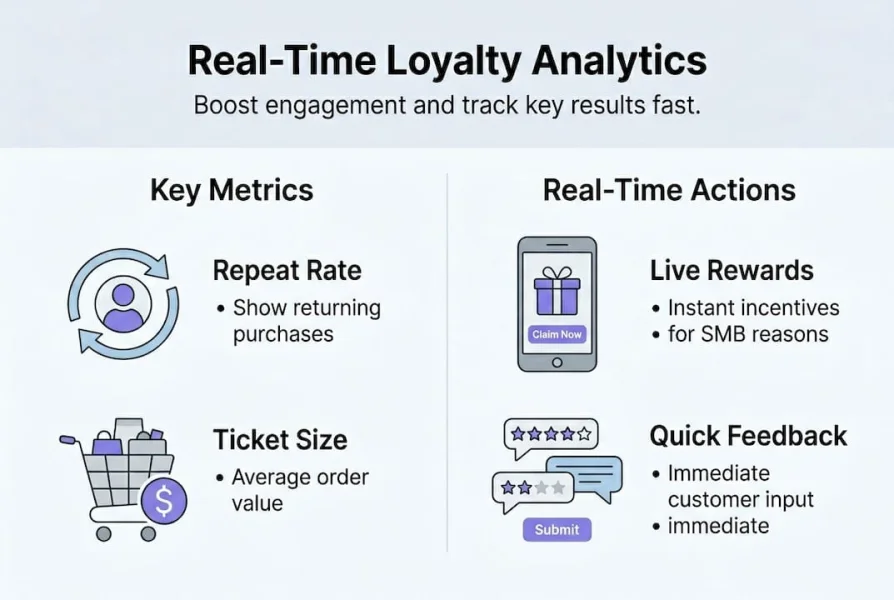
Here’s a quick reference for core KPIs:
| KPI | What it measures | Healthy benchmark |
|---|---|---|
| Repeat purchase rate | % of customers who return within 90 days | 40% or higher |
| Average ticket size | Average spend per loyalty member visit | 15-20% above non-members |
| Reward redemption rate | % of earned rewards actually claimed | 20-30% |
| Enrollment growth rate | New members per month | Steady month-over-month increase |
Consider a mid-sized cafe that started using real-time analytics. Before adoption, their repeat visit rate sat at 28%. After six months of using live data to trigger personalized offers and re-engagement campaigns, that number climbed to 44%. Their average ticket size also grew by 17% because the program surfaced upsell opportunities at the right moment.
Businesses using analytics see 10-20% improvement in retention when they act on data consistently. That’s not a small number for a retail shop or restaurant running on tight margins.
Signs your loyalty analytics are working:
- Redemption rates are climbing month over month
- Lapsed customers are returning after re-engagement campaigns
- Your most loyal customers are spending more per visit
- Enrollment is growing without heavy discounting
If you’re not seeing these signals, check your common loyalty mistakes to find where the program may be falling short.
Why most SMBs underuse real-time loyalty analytics and how to avoid it
Here’s an uncomfortable truth: most small businesses collect loyalty data but rarely act on it. They set up a program, watch enrollments come in, and then check the dashboard once a month if they remember. That’s not analytics. That’s record-keeping.
The real risk of a “set and forget” loyalty approach is that problems compound quietly. A reward that stopped resonating six weeks ago has already pushed customers away by the time you notice. Failing to continuously review analytics is a leading cause of underperformance in loyalty programs.
The fix isn’t more data. It’s building a habit of using the data you already have. Involve your whole team in the results. When your staff sees that Tuesday afternoon is a weekly spike in redemptions, they can prepare better, staff appropriately, and engage customers more warmly during that window.
Practical example: one retailer noticed a consistent spike every Thursday evening in their loyalty mistakes to avoid review. They launched a Thursday-only bonus points event and saw a 22% increase in visits that day within four weeks. The data was always there. They just started looking at it.
Pro Tip: Pull up your live dashboard during your next team meeting. Ask your staff what they think is driving the numbers. Their frontline observations combined with your data will surface insights no algorithm can find alone.
Turn insights into action with BonusQR
Real-time analytics only delivers value when it’s built into a system your team can actually use. BonusQR gives you an electronic reward platform designed specifically for retail and food service businesses like yours. You get live dashboards, automated campaign triggers, and mobile-friendly tools that work without complex POS integration.
Explore the full range of loyalty analytics features to see how easy it is to start tracking what matters. Whether you run a single cafe or a multi-location retail brand, the retail loyalty application gives you the tools to act on data, not just collect it. Start with a free plan or book a demo to see real-time analytics in action.
Frequently asked questions
What are the main benefits of real-time analytics for loyalty programs?
Real-time data enables faster and more effective campaign adjustments, which increases customer retention and allows you to optimize rewards without waiting for end-of-period reports.
Which KPIs should I track in my loyalty program?
Focus on repeat purchase rate, average ticket size, and reward redemption rates as your core three. Top KPIs include these metrics because they directly reflect customer behavior and program health.
How difficult is it to set up real-time analytics for a small business?
It’s simpler than most owners expect. Modern user-friendly features make analytics setup fast, and most small teams can get a basic dashboard running within a few days.
Can real-time analytics help with personalized customer offers?
Absolutely. Personalization is powered by real-time tracking of member actions, which lets you send the right offer to the right customer at the right moment.
What is a common mistake to avoid with loyalty analytics?
The biggest mistake is collecting data but not reviewing it regularly. Continuous data review is essential to avoid underperformance and keep your loyalty program improving over time.
Recommended
- Increase Customer Engagement: A Simple Playbook to Turn | BonusQR
- How to Master Customer Engagement in Retail Stores (Without | BonusQR
- Analytics & Stats - Loyalty Platform Feature | BonusQR
- Loyalty program ROI: Boost retention and revenue by 4.8x | BonusQR
- Boost Candidate Engagement 50% in UK Security Recruitment|SJB