A booking loyalty program rewards customers for reserving with you again: a discount, a free upgrade, a stamp toward a free service, or points that turn into a perk. The phrase means two different things online. For travelers it usually means Booking.com Genius. For a business owner it means a system you run yourself so that clients book you directly, again and again. This guide covers both: how Genius works and what it costs hosts, then how a small business can build its own repeat-booking rewards and measure whether they work.
Key takeaways
- A booking loyalty program rewards repeat reservations. For a small business, its job is to make the second, third and fourth booking happen without paying a platform commission each time.
- Booking.com Genius has three levels, unlocked by completed bookings (5 in two years for Level 2, 15 for Level 3). Hosts fund the discounts, so the real cost is higher than the headline percentage.
- Simple rewards usually beat complicated ones: a stamp card, a free add-on, or a direct-booking discount that customers understand in five seconds.
- Judge any program by four numbers: repeat booking rate, direct booking share, commission savings against program cost, and average revenue per loyalty customer.
What a booking loyalty program is
At its simplest, a booking loyalty program recognizes people who keep choosing you. Industry guidance on repeat bookings describes rewards such as discounts, free services, upgrades or exclusive offers, which encourage customers to pick the same provider again and support retention. Amadeus Hospitality frames the goal as an ongoing relationship in which guests repeatedly choose and book your brand over competitors, built from positive experiences and trust. A reward is the visible part. The experience is what earns the return visit.
There are three common shapes:
- Platform programs, such as Booking.com Genius. The platform owns the customer relationship and the rules. Customers are loyal to the marketplace, and you, the provider, fund part of the reward.
- Brand programs, such as hotel chain points. Large, expensive to run, and built around a booking engine and a CRM that most small operators do not have.
- Your own program. A stamp card, points or cashback tied to your name. You control the rewards, the data and the margin.
The lifeblood of a small business is the customer who comes back. If your bookings come mostly through a marketplace, your own program is how you turn a one-time marketplace guest into a direct customer.
How Booking.com Genius works
If you searched this phrase as a traveler, here is the mechanism. Booking.com’s Genius page lays out three levels:
| Level | How you unlock it | What you get |
|---|---|---|
| Level 1 | Create a free account | 10% discounts on select stays and rental cars |
| Level 2 | 5 bookings in 2 years | 10 to 15% discounts, select free breakfasts, room upgrades |
| Level 3 | 15 bookings in 2 years | 10 to 20% off stays, 10 to 15% off rental cars, free breakfasts, room upgrades, priority support |
A few details matter before you count on the savings:
- Membership is for life. Booking.com’s own announcement says Genius status lasts a lifetime once you create an account, and the Genius page says benefits you unlock stay with you.
- Discounts apply to the price before taxes and fees on stays.
- Only qualifying, completed bookings count toward your level. The page lists exclusions such as ride hail, cruises, insurance, public transit, free options and extra purchases.
- Discounts are on select properties, not every listing. Travelers on forums regularly report that the Genius price sometimes matches the non-member price, so compare before you book.
One more point for hotel guests: booking through an online travel agency often means you do not earn credit with the hotel’s own loyalty program. That gap is exactly the opening for a small property or service business to run its own rewards.
Booking.com rewards outside Genius
People also ask about the Booking.com card, which is separate from Genius levels. The Booking.com Genius Rewards Visa is a US co-brand credit card. The card page lists 6% in travel credits on stays booked in the Booking.com app and 5% on other Booking.com travel, no annual fee, and a Genius Level 3 unlock for cardholders. Welcome bonuses and terms change, and the card is subject to credit approval, so read the current terms on that page before applying.
Travel credits are earned through card spending and Booking.com purchases. Genius discounts come from your booking history. They are two layers on the same marketplace, and neither gives you a relationship with the individual hotel, restaurant or studio you stay at.
What Genius costs the business
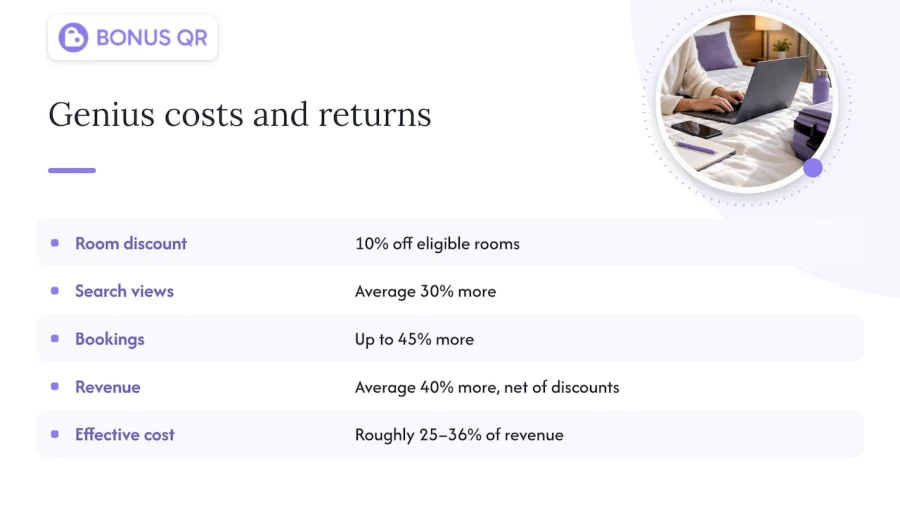
For a host, Genius is a trade: lower price in exchange for visibility. Booking.com’s partner guide to Genius says hosts must offer 10% off their least expensive and most popular room types, and that Genius partners average 30% more search views, can get up to 45% more bookings and average 40% more revenue once discount costs are accounted for. Participation is optional, and hosts can pause the discounts for 30 or 90 days a year, depending on their discount level, to protect rate parity in peak periods.
The headline discount is not the whole bill, though. One 2026 revenue-management analysis argues that because the commission applies to the already reduced price, the total effective cost of a 10 to 20% Genius discount lands between roughly 25% and 36% of revenue. The same source says visibility is no longer guaranteed by the discount alone: the algorithm weighs conversion rate, price competitiveness and review scores, with a 7.5 out of 10 review score needed to enter.
There is also the stacking risk. Pricelabs warns that combining several promotions, such as Genius with an early booker deal, can seriously erode margin.
A quick worked example, using arithmetic only. Say a room is listed at $200 and you offer a 15% Genius discount, so the guest pays $170. If the commission is charged on $170, you pay it on a lower base but you have already given up $30. Every additional point of discount comes straight out of what you keep. Run this calculation for your own commission rate before opting in, and decide what share of your bookings you want to depend on a platform.
Why your own program matters for repeat bookings
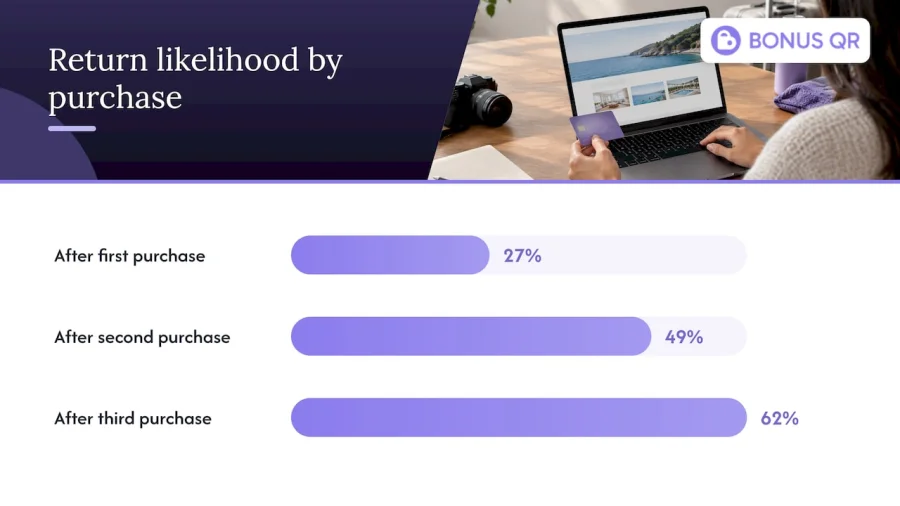
A marketplace gets you the first booking. A program of your own gets you the next ones, with no commission and a direct line to the customer. The numbers from the hospitality side are persuasive, even if they come from industry publications rather than controlled trials. A 2026 report on small-budget hotel loyalty cites Cornell research finding that guests joining independent hotel loyalty programs raised their annual room nights by nearly 50%. Another analysis puts the likelihood of a return at 27% after a first purchase, 49% after a second and 62% after a third. Treat these as directional, not guarantees. The pattern is what counts: the second booking is the hardest, and each one after it gets easier.
This applies far beyond hotels. A salon, a physio studio, a yoga class, a pet groomer, a rental car desk and a restaurant that takes reservations all live on rebooking. If appointments are your business, our guide to salon booking software that drives loyalty is a good companion, and for lodging, see how hotel rewards programs work from the guest side.
How to build rewards that bring people back to book
Pick a reward customers understand instantly
The same industry guidance suggests offering discounts, free services, upgrades or exclusive experiences, personalizing offers with customer data, and recognizing milestones. The hotel report adds a useful point for independents: repeat guests who first arrived through an online travel agency can be moved to direct booking with simple, non-points-based rewards such as free late checkout or a direct-booking discount. Complexity is the enemy. If a customer cannot explain the reward to a friend, it will not change behavior.
Match the reward type to how often people book:
- Frequent, low-ticket bookings (haircuts, fitness classes, coffee pickups): digital stamp cards. Ten stamps, one free.
- Medium frequency, variable spend (restaurants, spas, car rentals): points that scale with spend, so bigger bookings earn faster.
- Rare, high-ticket stays (hotels, guesthouses): tiered perks and direct-booking benefits, because points would take years to accumulate.
- Mixed customer base: cashback tiers, where regulars earn a higher percentage back.
Reward the booking, not just the payment
In a booking business, the reward moment should connect to the reservation itself. Give a bonus for booking the next appointment before the customer leaves, for choosing off-peak slots, for bringing a friend, or for leaving a review after the visit. Each of these pushes the behavior you actually want.
Follow a simple launch sequence
- Define the one behavior you want: a rebook within 30 days, a direct booking, or an off-peak visit.
- Choose a reward whose cost you can calculate. Know the margin on a free service or a discount before you advertise it.
- Make joining effortless. A QR code at the counter, on the receipt, in the confirmation email and on the booking page removes the sign-up barrier.
- Add a welcome reward. A first stamp or bonus points on joining gives people a reason to start today.
- Automate the follow-up. Reminders, birthday rewards and a nudge when a customer has not booked in a while should run without you.
- Review the numbers monthly and adjust the reward, not the whole program.
Automation is where most small teams fall down, so it is worth reading how to automate loyalty campaigns for better retention. For the broader picture, this overview of customer retention strategies covers the thinking behind keeping customers, and our own pieces on customer retention in hospitality and points reward systems go deeper on mechanics.
Our perspective
We built BonusQR for owners who do not have a loyalty department, a developer or a point-of-sale integration project. In our experience, small businesses do not fail at loyalty because the idea is wrong. They fail because the program is too hard to launch, too hard to explain, or too manual to keep running. A paper stamp card gets lost. A points scheme that needs a POS upgrade never gets installed.
That is why the platform is QR-based: a customer scans, joins and earns, and you need no extra hardware. The rewards, the notifications and the reporting run in the background, so you can spend your time on the people in front of you. We also think the marketplace question is a strategic one. Platforms like Genius can be a fine source of new customers, but each repeat booking you move to your own channel is revenue you keep and a customer you can actually reach. A loyalty program is the simplest way to start that shift.
Our advice: start small, with one reward and one behavior, and measure it for 60 days before you add anything.
— Michal Palus
How to tell if it is working
A loyalty program that you do not measure is a cost you cannot defend. Two industry sources agree on the core metrics: repeat booking rate, direct booking share, commission savings and average revenue per loyalty guest. Here is how to use them:
| Metric | What it tells you | How to read it |
|---|---|---|
| Repeat booking rate | Share of customers who book more than once | Compare members with non-members over the same period |
| Direct booking share | How much of your volume skips the platform | Should rise as members rebook with you directly |
| Commission savings vs. program cost | Whether the program pays for itself | Subtract rewards and software fees from avoided commissions |
| Revenue per loyalty customer | Whether members spend more | Compare average spend per member and per non-member |
A simple test: record your baseline repeat rate before launch, run the program for one full booking cycle (a quarter for most service businesses, longer for hotels), and then compare. If members rebook more but your margin shrinks because the reward is too generous, trim the reward. If sign-ups are low, the problem is usually visibility at the point of booking, not the reward.
One caution from academic work: a dissertation on loyalty campaigns found that a missing link between campaign management and booking systems prevents quantitative analysis of how communication affects loyalty over time. In practice, that means you should make sure your loyalty data and your booking data can be compared. For a deeper look at return on investment, read our piece on maximizing loyalty program ROI in hospitality.
Mistakes that quietly kill repeat bookings
- Stacking discounts without a ceiling. Genius plus an early-booking deal plus a loyalty perk can erase your margin. Set a maximum total discount.
- Rewards that expire too fast. A customer who books twice a year will never complete a card that lapses in 60 days.
- No reminder to rebook. Most people do not return because they forgot, not because they were unhappy.
- Ignoring reviews. A program cannot rescue a poor experience. Ratings also affect marketplace ranking, as the 7.5 entry score above shows.
- Treating loyalty as a discount only. Early access, a free add-on or a thank-you message can matter as much as money off.
For restaurants that take reservations, our restaurant loyalty software guide and reward program ideas show how this works at the table.
Launch your own program with BonusQR
BonusQR gives small businesses customizable digital stamp cards, points, tiered cashback, onboarding promotions and special occasion rewards, plus automated push and email notifications, referral and review modules and analytics. It works without a POS system, and Apple and Google Wallet support is included. You can start on the Free plan, move to Basic at €19 per month or Premium at €69 per month, and compare what each includes on the BonusQR pricing page.
If you want your own branded app with a booking widget and e-shop features, look at the white-label option: a one-off setup of €690 and a monthly subscription of €69. For something fully tailored, custom app development starts from €1,500 one-off, with monthly maintenance from €69. You can also see everything on bonusqr.com.
FAQ
Is Booking.com Genius worth it for travelers?
It is free to join, and Level 1 starts with a free account, so there is little to lose. The value depends on how often you book: Level 2 needs 5 bookings in two years and Level 3 needs 15. Discounts apply only at select properties, so compare the Genius price with the regular one before you commit.
Is Genius worth it for a hotel or host?
It can raise visibility, and Booking.com reports that partners average more search views and bookings. But you fund a discount of at least 10% on your cheapest and most popular rooms, and the commission is applied on top of the reduced rate. Calculate your effective cost, check your review score, and use the option to pause discounts in peak periods.
How do I start a loyalty program for bookings?
Choose one behavior, such as rebooking within 30 days, and one reward you can afford. Make joining as simple as scanning a QR code, then automate reminders and reward notifications. Review repeat rate and direct booking share after one full booking cycle.
What rewards work best for repeat bookings?
Simple ones. Stamp cards suit frequent, low-ticket services, points suit variable spend, and non-points perks such as a free add-on, late checkout or a direct-booking discount suit stays and higher-value reservations. Pick the reward your customers can describe in one sentence.
Do I need a POS system to run a loyalty program?
Not with a QR-based platform. Customers scan a code to join and collect rewards, and you manage the program from a dashboard. A POS integration can help at larger sites, but it is not required to start.
Sources
- Booking.com Genius loyalty program
- Booking Holdings: third level of Genius benefits
- Booking.com Genius Rewards Visa
- Booking.com for Partners: Genius program guide
- Rield: Booking.com commission guide 2026
- Pricelabs: Genius program guide for hoteliers
- WP Booking System: loyalty programs and repeat bookings
- Amadeus Hospitality: hotel guest loyalty
- Hotel Tech Insight: hotel loyalty on a small budget
- Switch Solutions: measuring hotel loyalty ROI
- The Points Guy: Booking.com Genius
- Dissertation on campaign management and booking systems
- Customer retention strategies


