
 Deutsch
 Español
 Français
 Italiano
 Magyar
 Polski
 Slovenčina
 Čeština
The regular at the counter reaches for a coffee, smiles, then freezes. The paper punch card is sitting at home on the kitchen table, and the free drink earned last week slips away again. That tiny moment is why a digital loyalty card app matters, because it keeps the reward with the customer instead of letting a forgotten bit of card stock decide whether a visit counts.
For a small business, the practical version is simple. A customer joins on their phone or in a web flow, gets a personal QR code, and the visit is logged when staff scan it. The reward can live in a wallet pass, a browser-based loyalty page, or a lightweight app, but the important part is the same, the card is always where the customer already is, on the phone.
The Broken Wallet and the Digital Fix
The old punch card fails in a very ordinary way. It gets left in a coat pocket, shoved under a till receipt, or forgotten in the car. That means the business loses a stamp opportunity, and the customer loses momentum, which is a bad deal for both sides.
A digital loyalty card app fixes the problem by replacing the physical card with a mobile or web-based version tied to one customer profile. The merchant scans a code, the system records the visit, and the reward balance updates without anyone hunting for paper. That is why the format matters as much as the reward itself, because the card has to be easy enough to use on a busy day.
What the customer actually sees
The customer should not feel like they are “installing software” just to earn a coffee. They should see a short sign-up flow, a QR code, and a clear reward balance. If the business uses a wallet pass, the pass sits in Apple Wallet or Google Wallet and can be brought up in seconds. If it uses a web flow, the customer opens a link and starts collecting points without a download.
Practical rule: if staff need to explain the loyalty system twice, the system is already too heavy for a busy till.
That is where BonusQR fits naturally as one option. It uses a QR-based loyalty flow that can run without POS integration or extra hardware, which is exactly what many small venues need when they want loyalty without adding another operational headache.
Why this feels better on a live counter
A café barista does not want to manage a second tablet. A salon receptionist does not want to stop a booking flow to troubleshoot an app login. A retail assistant does not want to explain why a customer has to download something before a discount can be applied. A QR-led loyalty system removes that friction and keeps the service line moving.
The deeper point is simple. The reward is no longer trapped in a drawer, a wallet, or a phone screen that no one can find. It is built into the visit itself, which is the only place it can reliably drive repeat business.
Why UK Consumers Now Expect Digital Loyalty
The market in the UK has already moved past the “new idea” stage. Research reported in 2026 found that 48% of consumers had four or more loyalty cards saved digitally, and 43% preferred managing points or rewards through a digital loyalty card rather than downloading a brand's own app for that job. That is a strong signal for small businesses, because customers are already comfortable with wallet-style loyalty and do not need to be taught the basic habit.
The same research found that 82% of consumers who had a brand's loyalty program on a digital card had already used it to make a purchase, up from 61% in 2025. That is a 21 percentage point jump in one year, and it matters because it shows digital loyalty is not just storage. It is part of the buying journey itself, which makes QR-led loyalty a conversion channel rather than a passive database. Digital wallet loyalty card data
Habit is already doing the heavy lifting
UK shoppers are not being asked to change their behaviour from scratch. A 2026 roundup reported that 92% of UK shoppers use loyalty cards weekly, and that Tesco Clubcard leads with 45% penetration in the UK market. That level of familiarity lowers the risk for a small venue, because the customer already understands what a loyalty card is supposed to do. UK loyalty card statistics roundup
What matters next is format. If customers already carry several cards digitally, the business gains more by making its own card easy to store than by creating a standalone app with its own learning curve. That is why wallet passes and QR flows are often the better first move for cafés, salons, gyms, restaurants, and local retailers.
Loyalty is now a spending tool, not a vanity feature
A 2026 consumer dataset reported that 52% of consumers use loyalty programs at least weekly, 41% use mobile apps for loyalty programs one to two times a week, 72% said loyalty programs make them more likely to spend with their preferred brand, and 69% said discounts and coupons were the most valuable rewards. Those figures point in the same direction. Loyalty works best when it is simple, reward-led, and visible enough to influence the next visit. Customer loyalty statistics
Bottom line: UK customers already accept digital loyalty, so the business problem is no longer adoption. It is choosing the least annoying way to deliver it.
Essential Features of a Digital Loyalty Card App
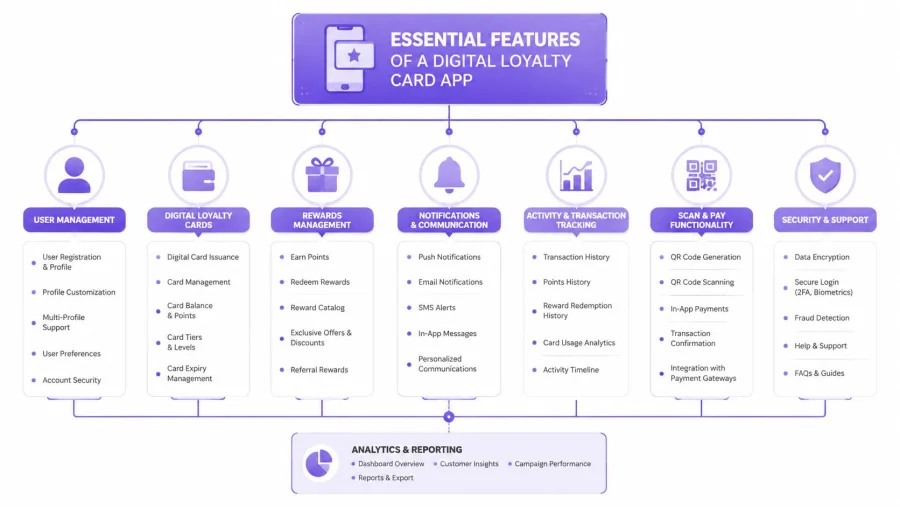
The right feature set is less about "having an app" and more about removing reasons not to use it. A good loyalty system should make the customer faster at checkout, make the staff's job easier, and give the owner enough data to see what is working. That is the standard that matters in a brick-and-mortar business.
The six features that earn their place
- QR code check-in: The customer shows one code, staff scan it, and the visit is logged quickly. That keeps the queue moving and reduces mistakes at the till.
- Points or stamps in one profile: A customer should see progress at a glance, not wonder whether a stamp was recorded. One profile keeps the reward story clear.
- Coupons and offers: A useful system can send a welcome reward, a birthday treat, or a seasonal coupon without rebuilding the programme every time.
- Wallet pass support: Apple Wallet and Google Wallet make the card easier to find, which matters when customers are already carrying too many passes.
- Analytics: The owner needs to see who returns, which coupons get used, and where visits are trending.
- No-POS option: Staff should be able to scan and redeem without buying new hardware or rebuilding the checkout setup.
That combination is why a digital loyalty card app should be judged by workflow, not by app-store presence. A venue with no technical team needs something that can be launched and maintained by regular staff. The mobile web option to manage points on mobile web is useful for exactly that reason, because it lowers the barrier for both the business and the customer.
What to expect from a practical setup
A workable system should let the customer sign up on mobile, keep the loyalty card in one place, and show reward history without support calls. It should also let the owner change offers without rebuilding the whole programme. Modern loyalty architecture is often split into separate components, such as a rules engine, a points ledger, fulfilment, and an API layer, because that structure keeps one failure from taking down the whole experience. Loyalty system architecture
The simplest check is this. If the system can't handle sign-up, scan, reward, and reporting without extra machinery, it will create more work than it saves.
Digital Loyalty in Five Real Businesses
A loyalty system has to fit the venue, not the other way around. A coffee shop, a salon, and a gym all use repeat visits, but they do not reward the same behaviour in the same way. The strongest tools flex around that difference.
Coffee shops and cafés
A café lives and dies by repeat habits. The tenth coffee reward works because the mechanic is easy to understand and easy to explain at the till. A QR-based loyalty card keeps the process moving, and the staff only need to scan once and let the system do the rest.
Restaurants and quick-service eateries
Restaurants need more than a punch card. A birthday coupon, a return-visit offer, or a value-based reward can bring people back when they are choosing where to eat. When the loyalty profile also holds menus, notes, or reservation links, the venue has one customer record that serves the visit before and after the meal.
Beauty salons and wellness centres
A salon client often books in cycles, which makes a visit-based reward useful. A customer who comes in for colour, treatment, or a regular refresh should be recognised without staff having to rebuild the offer every time. QR scan loyalty works well here because reception can keep the flow calm and professional.
A good loyalty system should feel like part of the appointment, not an extra task at the desk.
Gyms and fitness studios
A gym needs consistency more than flashy rewards. Visit thresholds, attendance streaks, or reward milestones fit the rhythm of classes and check-ins. The loyalty system should reward the member who keeps showing up, not punish them with a complicated redemption process they never remember.
Retail and grocery stores
Retail needs flexibility. Seasonal discounts, coupon drops, and targeted offers work better when they can be changed without a developer. Grocery and older customer groups may still prefer a visible in-store prompt, which is why a hybrid setup often performs better than a pure app strategy.
Launch and Measure Your Loyalty Programme
A loyalty rollout should be treated like a small operational project, not a vague marketing idea. The best launches are short, visible, and easy for staff to repeat. A clean first two weeks matters more than a perfect long-term plan, because the team needs a programme that starts getting used right away.
A practical 14-day launch rhythm
- Set the rules. Define whether the programme is stamps, points, spend thresholds, or a mix.
- Print the scan materials. Put the QR prompt at the till, on receipts, and near the entrance.
- Train the staff. One sentence should be enough for the team to explain the programme without sounding scripted.
- Promote at checkout. Ask every customer to join while the visit is still fresh.
- Check the first responses. Look at which offers get claimed and which ones are ignored.
A venue can start free with BonusQR, and its pricing details are available on the view pricing page. That matters because the launch budget should go into promotion and staff adoption first, not into needless setup costs.
The numbers that actually help an owner
The most useful metrics are the ones tied to behaviour. Top-customer share shows whether the regulars are concentrating enough spend to matter. Coupon redemption rate tells the owner whether the offer is attractive or just decorative. Visit frequency lift shows whether the programme is changing habits rather than just collecting sign-ups.
Automated push or email offers help once the base flow is working. A birthday coupon, a reminder about unused rewards, or a feedback request after a visit can be enough to bring a customer back without a full campaign. The important thing is to keep the message useful and tied to a real visit, not to flood the inbox with generic marketing.
What to improve after week one
If sign-ups are good but redemptions are low, the reward is probably too hard to understand. If redemptions are healthy but visits are not increasing, the incentive may be too shallow. If staff stop mentioning the programme after a few days, the sign-up pitch is probably too long.
Operational test: a loyalty programme is working when staff can explain it in one breath and customers can redeem it without asking twice.
Wallet Pass or Downloadable App
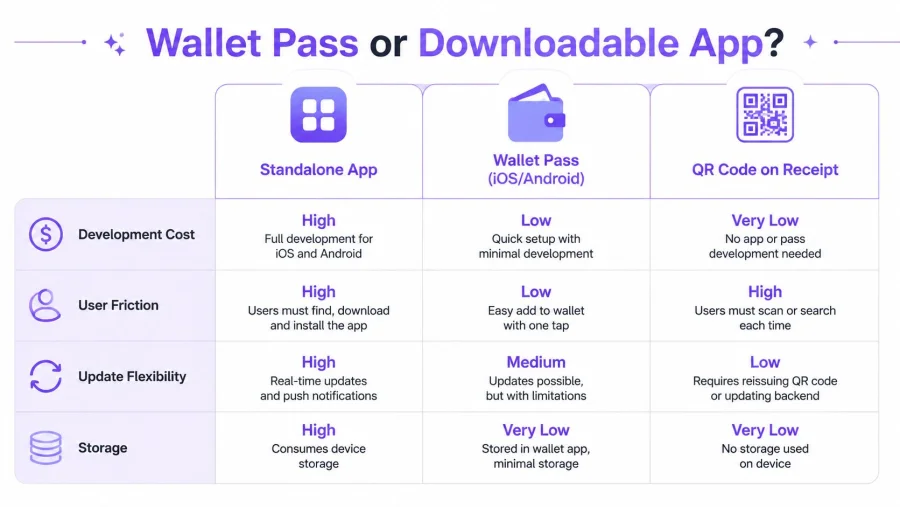
The most useful comparison in loyalty is not app versus no app, it is friction versus convenience. A standalone app can offer more space for brand features, but it also asks the customer to search, download, log in, and remember another icon. That is a lot to ask for a free coffee or a simple visit reward.
Three paths, three different jobs
A standalone app makes sense when the business wants a richer experience and expects customers to return often enough to justify the install. It can hold more brand content, but it carries the heaviest adoption burden.
A wallet pass in Apple Wallet or Google Wallet is lighter. It gives the customer a familiar place to store the card, and it keeps the loyalty pass visible without another app download. For many UK venues, that is the cleanest balance of speed and familiarity.
A paper or receipt QR flow is the least technical path. It is useful where the audience is mixed, where older customers still want something tangible, or where the venue wants a simple entry point before moving people into a wallet pass later.
Why the lowest-friction option usually wins
The choice depends on checkout friction and audience, not on the word “digital.” If the customer already uses mobile wallets, forcing an app download can add unnecessary resistance. If a venue has a lot of walk-in traffic, a QR-to-wallet or web flow often gets more sign-ups because there is less to think about at the counter.
That is the contrarian part most guides miss. The lowest-friction loyalty solution is often not a loyalty app at all, but a QR-to-wallet or web experience that removes install barriers while preserving the reward mechanics. The QR-based rewards in Apple Wallet approach sits nicely in that middle ground for venues that want convenience without the overhead of a full app rollout.
Which businesses should avoid overbuilding
A small café, a neighbourhood salon, or a local retailer usually does not need a heavy custom build first. A simpler wallet pass or web flow can prove demand before anything bigger is attempted. The business can always expand later, but it cannot easily recover from a launch that scares customers away with too many steps.
Common Questions About Digital Loyalty Apps
The first question is usually about cost, and it's fair. A digital loyalty card app doesn't need to start as a big software project, and a free-to-start option can be enough for a small venue that wants to test repeat visits before paying for more complexity. The right starting point is the one that lets the team launch quickly and keep the system usable at the till.
The second question is about unused rewards. In a 2026 analysis based on Antavo data, 26.2% of U.S. consumers' loyalty points go unspent and 11.9% expire unused, which shows why simple, easy-to-claim rewards matter. Customer loyalty breakage analysis A small business should not bury value behind confusing thresholds or awkward expiry rules. Clear stamps, straightforward coupons, and visible balances usually perform better because customers can understand the payoff without checking the fine print.
The third question is whether older customers will use a digital system. The UK data above suggests the habit is already widespread, and that matters more than age alone. A hybrid setup works well here, because wallet passes and paper prompts can sit alongside each other while the team learns which customers prefer which path.
Practical answers that remove friction
- Keep the reward obvious: If the benefit takes too long to explain, staff will skip the pitch.
- Make sign-up quick: A short QR scan beats a full form on a busy counter.
- Use reminders sparingly: A useful offer is better than constant messages.
- Offer one fallback path: Wallet pass, web flow, or paper prompt should be enough for most venues.
The next move is straightforward. Choose the lightest loyalty setup that your staff can run every day, put the QR prompt where customers already queue, and test it for two weeks before you complicate it.