
 Deutsch
 Español
 Français
 Italiano
 Magyar
 Polski
 Slovenčina
 Čeština
We recommend A/B testing at least two formats against each other and segmenting by traffic source before you commit a budget to one offer long term.
TL;DR:
- For tight margins, choose a fixed amount or spend threshold to cap discount costs; stronger margins can support targeted BOGO or mystery promotions.
- Use a 7–14 day expiry, verify new customers by email or phone, and define traffic source and stacking rules before launching.
- Compare offer recipients with a no offer holdout on conversion, order value, acquisition cost, and 30 and 90 day retention; redemption alone cannot show profitability.
- Credit signup rewards to the same points or stamp balance customers use later, and automate reminders for offers that remain unredeemed.
1. A catalogue of welcome offer ideas by business goal
Not every welcome offer does the same job. Some exist to turn a browser into a buyer, others to collect an email address, and others to make that first basket bigger or set up a longer relationship. Sorting your options by goal first, format second, stops you picking an offer because it is popular rather than because it fits what your business actually needs right now.
Group A: friction-reducing offers that convert intent into a sale
These are the offers to reach for when visitors are already on your site or in your app but hesitating at the final step. They remove a specific objection rather than trying to create demand from nothing.
- Free shipping on the first order. Shown as a banner or checkout message: “Free delivery on your first order, no code needed.” This works because delivery cost is one of the most common reasons a basket gets abandoned, and it costs you a fixed, predictable amount rather than a variable percentage of revenue. It suits businesses with healthy product margins and a shipping cost that will not eat into profit on a typical order. Cross-country research on digital commerce suggests that fulfilment promises affect conversion as strongly as the discount itself, so pair the offer with a clear delivery estimate rather than a vague promise.
- A fixed-amount discount at checkout. Example copy: “£5 off your first order, applied automatically.” A flat amount feels concrete in a way a percentage sometimes does not, particularly on lower-priced baskets, and it is easier for a customer to picture the saving in real money. It fits retailers, cafés and service businesses with a typical order value where £5 or £10 is a meaningful chunk, not a rounding error.
- A percentage off the first order. The classic “15% off your first order” works across almost any sector because it scales with basket size, rewarding bigger purchases proportionally. It is best suited to businesses with enough margin to absorb a variable discount, and it tends to perform better when the saving is framed in cash terms for lower-value baskets, since research on uncertain price promotions found that framing as a dollar amount rather than a percentage increases perceived value when the discount itself is small.
Group B: acquisition-first offers for list-building
Use these when the immediate goal is not the sale itself but getting permission to talk to the customer again, through email, SMS or app notifications.
- A signup coupon for an email address. “Join our list and get 10% off” trades a small discount for a reusable marketing channel; it suits almost every business type but works best when the follow-up email sequence is already built, otherwise the signup has no destination.
- An email-only or SMS-exclusive discount. Framing the offer as exclusive to subscribers (rather than available to anyone) increases perceived value and reduces the sense that you are discounting indiscriminately.
- An app-download reward. “Download our app and get a free item on your first order” suits businesses that want customers inside their own channel long term, such as cafés, gyms or retailers running a loyalty app, since the app itself becomes the retention tool after the welcome offer has done its job.
Group C: value-maximising offers that lift average order value
These offers are not designed to be the cheapest way to acquire a customer, but are especially effective in sectors with clear seasonal peaks such as swimwear, as explained in the role of swimwear sales in retail strategy. They are designed to make the first transaction bigger, which matters most for businesses where a single extra item or a slightly larger basket meaningfully changes unit economics.
- Spend-threshold discounts. “Spend £40, get £10 off” nudges a basket that would otherwise sit at £30 up to the threshold, and the discount is self-funding because the extra £10 of goods usually costs you less than £10 in margin. This fits retail and grocery particularly well, where a small basket increase has a predictable cost.
- Bundle-first-order offers. Packaging two or three related products together at a set price for first-time buyers only (“Starter bundle, first order only”) works well for businesses with a clear “entry” product and natural companions, such as skincare, coffee or supplements.
- BOGO on trial products. “Buy one, get one free” on a specific item, rather than storewide, lets you use a lower-margin or overstocked product as the hook while protecting margin elsewhere in the catalogue. It suits businesses introducing a new product line where the goal is trial rather than profit on the first sale.
Group D: loyalty-forward welcome offers
If your business runs or plans to run a loyalty programme, the welcome offer should feel like the first step of that programme rather than a one-off gimmick.
- Bonus points on signup. “Get 100 points just for joining, worth £5 towards your next order” gives an immediate reward while pulling the customer into a points balance they will want to keep building.
- A tiered welcome sequence. Instead of one offer, a short series (“10% off order one, double points on order two, a free item on order three”) keeps the relationship active across the first month rather than ending it after a single discount.
- Stamp-card fast-track. Starting a new customer with one or two stamps already filled in on a digital stamp card gives them a visible head start towards their first reward, which tends to feel more generous than it costs.
Group E: engagement and viral formats
These offers ask the new customer to do more than just buy, whether that is bringing a friend or simply paying attention to a campaign.
- Referral double-sided bonuses. “Give £10, get £10” rewards both the existing customer and the new one, which tends to outperform one-sided referral offers because neither party feels like they are doing the other a favour for nothing.
- Mystery or chance-to-win promotions. A spin-the-wheel or scratch-card format where the customer could win anything from a small discount to a free product can outperform an equivalent sure discount, particularly when that sure discount would otherwise look small. Research published in the Journal of Consumer Research, based on five studies covering 8,969 participants, found probabilistic promotions beat an equivalent guaranteed discount under exactly these conditions, which makes mystery formats a useful substitute when your margin cannot support a generous flat discount.
2. How to put welcome offers into action without losing margin
Choosing the right idea is only half the job. Where you show it, how long it lasts, and who qualifies will determine whether it drives genuine new business or simply discounts sales you would have made anyway.
- Pick your channels deliberately rather than everywhere at once. A site popup catches browsers early but can feel intrusive if it fires before someone has even seen your products; a dedicated landing page works well for paid traffic where the offer is the whole reason someone clicked; checkout messaging reassures a customer who is already committed; and a welcome email or SMS message confirms the offer and gives it a shelf life once someone has signed up. App push notifications and Wallet passes suit businesses whose customers already have the app installed, since the offer then sits where the customer will see it again.
- Set a validity window that creates urgency without feeling manipulative. A first-order discount valid for 7 to 14 days after signup gives a genuine reason to act soon while still leaving room for someone who was not ready to buy on day one. Shorter windows (24 to 48 hours) suit impulse categories; longer ones suit considered purchases such as furniture or equipment.
- Build segmentation rules before you launch, not after. Decide upfront whether the offer applies only to genuinely new customers (checked by email or phone number, not just a new browser session), whether it gates by traffic source so paid-ad visitors do not get a discount organic visitors do not see, and whether it can stack with other codes. Loose rules here are the most common reason a welcome offer quietly becomes a permanent discount that returning customers find a way to reuse.
- Decide your fraud and abuse safeguards early. Limiting one redemption per email, phone number or device, and flagging multiple signups from the same address, protects margin without needing to police every order manually.
- Measure against a holdout, not against last month. Keep a small group of new customers who see no welcome offer at all, then compare conversion rate, average order value, customer acquisition cost and 30-day retention between that group and the offer group. Without a holdout, you cannot tell whether the offer caused the lift or whether the lift would have happened anyway.
Pro Tip: Run only one new welcome-offer test at a time per channel; testing two formats simultaneously on the same traffic source makes it impossible to know which one moved the number.
3. How platform automation makes welcome offers easier to run
Running the ideas above by hand, exporting a discount code list, manually emailing new signups, checking redemptions in a spreadsheet, is realistic for a handful of customers a week and unworkable past that. This is the gap a loyalty and couponing platform exists to close.
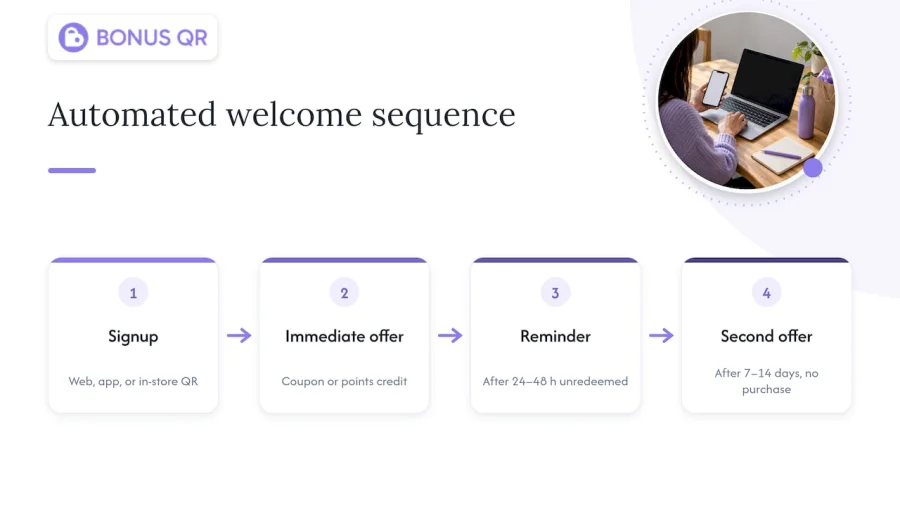
A typical setup looks like this: a new customer signs up through a site form, app download or in-store QR code, which triggers an automatic coupon or points credit the moment they join. The reward lands in their digital wallet or inbox without anyone on your team touching it. A reminder push or email follows at 24 to 48 hours if the offer has not been redeemed, and a slightly different, often escalating, second offer can follow at 7 to 14 days for anyone who still has not made a first purchase.
- Sign-up triggers that fire a coupon or points balance instantly, rather than on the next manual marketing send.
- Apple Wallet and Google Wallet support, so the welcome offer sits on a customer’s phone lock screen rather than buried in an inbox.
- Automated reminder sequences for unredeemed offers, timed in hours rather than left to whoever remembers to check.
- Real-time dashboards showing redemption rate as the campaign runs, not weeks later.
Automated delivery to the channel where conversion actually happens, email for desktop shoppers, app push or Wallet for mobile ones, tends to reduce the friction between “received an offer” and “used it”, compared with manual fulfilment that depends on someone checking a list. BonusQR’s pricing page sets out which of these modules are available on each plan if you want to see how the automation maps to cost.
3. How to structure minimum spend, exclusions and expiry clearly
Vague terms are the fastest way to turn a welcome offer into a customer-service problem. Set a minimum spend only when it genuinely protects margin, for example “£5 off orders over £25,” and state it in the same sentence as the discount itself, not in small print underneath.
List exclusions plainly rather than broadly. “Excludes sale items and gift cards” is clear; “terms and conditions apply” is not, and it tends to generate support queries rather than prevent misuse. If a category genuinely cannot carry the discount, such as items already discounted elsewhere, say so by name.
Expiry dates should appear on every piece of creative carrying the offer, popup, email and checkout banner alike, using the same wording each time. A 7 to 14 day window after signup gives most first-time buyers enough time to decide without letting the offer linger so long it loses urgency. Avoid “while stocks last” alone as an expiry mechanism: pair it with an actual date so customers and your own team know when the offer genuinely ends.
4. Personalising welcome offers by customer segment
A single welcome offer shown to everyone treats a price-sensitive first-time browser the same way as someone who arrived through a referral link already intending to buy, which wastes margin on the second group and may still undersell the first.
Segmenting by traffic source is the simplest starting point: a visitor who clicked a paid ad promising a discount should see that exact discount, not a different one, while organic or referral visitors might respond just as well to a smaller offer or none at all. Behavioural signals matter too; a visitor who has browsed three product pages but not added anything to a basket may need a stronger nudge than one already at checkout.
Purchase intent signals from past browsing, where available, let you match the offer format to the likely objection: a free-shipping message for someone who has abandoned a basket at the delivery-cost step, or a bundle offer for someone who has viewed several complementary products. The comparative research on European digital commerce found consumer response to promotions varies meaningfully by market and context, which is a reminder that a single offer rarely performs identically across every segment, so testing variations by segment rather than assuming one size fits all tends to pay off.
5. Connecting welcome offers to your loyalty programme
A welcome offer that ends the moment it is redeemed misses an opportunity. The strongest versions treat the first discount as the entry point into an ongoing points or stamp-card system, so the customer’s relationship with your business continues past the first purchase rather than resetting to zero.
Practically, this means the welcome bonus should credit the same points balance or stamp card the customer will use on every future visit, not a separate one-off code. A new customer who gets 100 welcome points towards a 500-point tier is already a fifth of the way to their next reward before their second visit, which gives them a reason to come back that a simple discount does not.
Tiered loyalty programmes can also use the welcome period to set expectations: a short message explaining what unlocks at the next tier (“spend £50 more to reach Silver and start earning double points”) turns the welcome offer into the first chapter of a longer plan rather than an isolated event. This is the kind of structure a loyalty platform like BonusQR is built to automate, since the welcome credit and the ongoing points or stamp system live in the same programme rather than needing to be stitched together manually.
6. Measuring whether your welcome offers actually work
A welcome offer that boosts first-order conversion but attracts only one-time bargain hunters is not a success story, even if the redemption number looks good. Real-time analytics matter here because they let you catch that pattern within days rather than discovering it a quarter later in a revenue review.
The core metrics to track are conversion rate among new visitors, average order value for orders using the offer, customer acquisition cost once the discount is accounted for, and retention at 30 and 90 days for customers who redeemed a welcome offer versus those who did not. Redemption rate alone tells you the offer was attractive; it does not tell you whether the resulting customers were worth acquiring.
Running the welcome offer against a holdout group, a sample of new customers who see no offer at all, is the only reliable way to know how much of your conversion lift is genuinely caused by the offer rather than by seasonal demand or a marketing push happening at the same time. A dashboard that updates in real time lets you spot a sudden spike in redemptions from the same handful of email domains, a common fraud pattern, before it has drained your margin for the month.
7. Automating welcome offers across every channel
Running a welcome offer manually across email, SMS, app push and in-store QR codes means coordinating four separate tools and hoping none of them fall out of sync. Automation exists to remove that coordination problem rather than to replace judgement about which offer to run.
A workable automated sequence looks like this: a signup event, whether from a web form, app download or in-store QR scan, triggers immediate delivery of a coupon or points credit to the customer’s wallet or inbox. A reminder follows at 24 to 48 hours if the offer sits unredeemed, and a second, often slightly different, offer can follow at 7 to 14 days for anyone who still has not made a first purchase. None of these steps need a person to press send each time once the rules are set.
The advantage of running this from one platform rather than several disconnected tools is that the same customer record tracks signup, redemption and loyalty points together, so a reminder email and an app push are not sent independently of each other and risking a mismatched message. BonusQR’s white-label options are built for businesses that want this entire sequence running inside their own branded app rather than a generic one.
8. Staying compliant when you run promotional offers
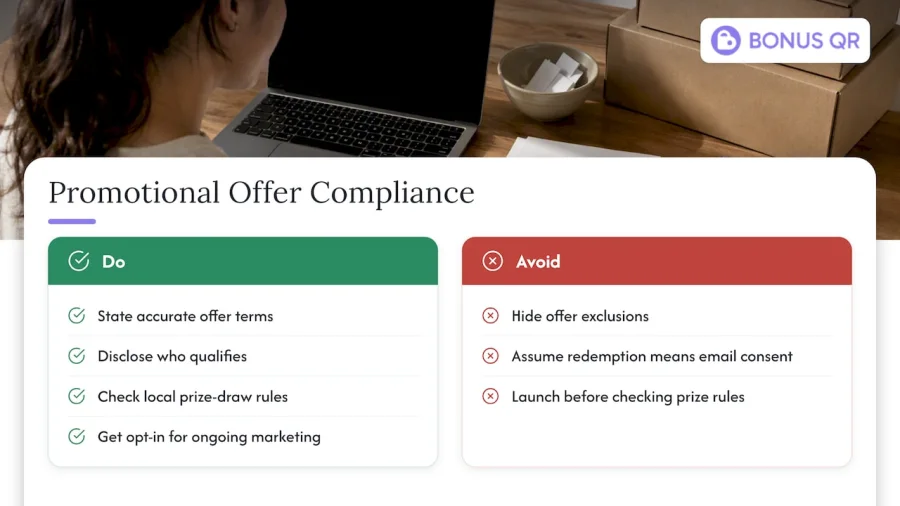
Welcome offers sit under ordinary advertising and consumer protection rules in most markets, which means the terms you state have to be accurate and the discount has to be genuinely available on the terms described, not a headline figure undercut by hidden exclusions.
Clearly disclosing who qualifies (new customers only, one per household, one per email address) protects you from disputes as much as it protects the customer from confusion. If your offer involves a prize draw or chance-to-win element, check your local rules on promotional competitions and sweepstakes before launch, since these often carry separate requirements around odds disclosure, no-purchase-necessary entry routes and prize fulfilment that a straightforward percentage discount does not.
Data collected through a signup form for a welcome offer, email address, phone number or birthday, is personal data and should be handled under whatever privacy framework applies in your market, with a clear opt-in for ongoing marketing messages rather than an assumption that redeeming a discount equals consent to be emailed indefinitely. None of this should stop you running the offer; it simply means the terms, consent and prize rules need to be right before the campaign goes live, not patched afterwards.
9. Designing welcome offers for mobile and app experiences
A welcome offer that reads clearly on a desktop screen can fall apart on a phone if the code is long, the popup covers the whole screen, or the terms require scrolling through three paragraphs before checkout. Mobile and app experiences need the offer compressed to its essentials: the saving, the condition, and a one-tap way to claim it.
Apple Wallet and Google Wallet passes solve a specific mobile problem, the customer does not need to remember a code at all, because the discount or points balance sits on their lock screen ready to scan or tap at checkout. This matters more for in-person businesses like cafés, salons and gyms, where typing a code into a phone at the till is friction a wallet pass removes entirely.
Within an app, a welcome offer should appear once, prominently, rather than as a recurring popup that trains customers to dismiss it. A single clear banner on first open, paired with a push notification reminder a day or two later, tends to feel helpful rather than repetitive. Checkout flows inside the app should auto-apply the discount for eligible new customers wherever possible, since every extra tap between “I want this” and “I bought this” is a chance for the sale to drop off.
Which welcome offer to prioritise for your margin
If your margins are tight, a flat-amount discount or a spend-threshold offer protects your downside better than a blanket percentage off, because you control the exact cost per redemption rather than it scaling with every basket size. Businesses with stronger margins, or ones using a welcome offer mainly to introduce a new product line, have more room to experiment with BOGO or mystery formats, where the occasional bigger giveaway is offset by the extra attention the format generates.
Whatever you pick, treat it as a starting hypothesis rather than a settled policy. The businesses that get the most out of welcome offers tend to run two or three formats in parallel against small, comparable segments, then double down on whichever one lifts both conversion and 30-day retention, not just the first sale. Combining the welcome offer with an ongoing points or stamp-card mechanic, rather than letting it end at redemption, is usually what turns a one-time discount into a customer worth keeping.
— Michal
Putting your welcome offers into practice with BonusQR
Every idea in this guide, a signup coupon, a points bonus, a stamp-card fast-track, a referral reward, needs somewhere to live and a way to reach the customer automatically, and that is the gap our platform is built to close. We offer configurable modules for digital coupons, points, stamp cards and automated marketing campaigns, with Apple Wallet and Google Wallet support built in, so the welcome offer you choose can go live without custom development.
Setup does not require POS integration, and plans range from a free tier through to Premium on our pricing page, where you can compare which features suit the offers you are running. Larger businesses wanting a fully branded app can look at our white-label setup, detailed on our white-label page. If you are ready to test your first welcome offer, register for an account and set up your first signup trigger today.
FAQ
Can you give me some examples of special offers?
Common examples include a percentage or fixed-amount discount on a first order, free shipping for new customers, a bonus-points or stamp-card credit on signup, and a double-sided referral bonus where both the existing and new customer receive a reward. Bundle-first-order offers and BOGO on a specific trial product are also widely used special offers.
What are good promotional ideas?
Strong promotional ideas tie the offer to a clear business goal: a signup coupon or app-download reward for list-building, a spend-threshold discount for raising average order value, and a time-limited offer with a 7 to 14 day validity window to create urgency without feeling permanent. Mystery or chance-to-win formats can also outperform an equivalent small sure discount, according to research in the Journal of Consumer Research.
What are some good discount codes to try?
Test both against each other with a holdout group before settling on one as your default.
What are some examples of promotions?
Examples include a welcome email offering 10% off the first purchase, a checkout banner offering free shipping to new customers, an in-app push notification reminding a customer of an unredeemed signup coupon, and a referral promotion giving both parties a reward. A platform such as BonusQR can automate the delivery and tracking of each of these formats from a single dashboard.
How long should a welcome offer stay valid?
A validity window of 7 to 14 days after signup gives most new customers enough time to decide without letting the offer lose its sense of urgency. Impulse-purchase categories often perform better with a shorter 24 to 48 hour window instead.