
 Deutsch
 Español
 Français
 Italiano
 Magyar
 Polski
 Slovenčina
 Čeština
A shopper walks into Sephora for one lip gloss and leaves talking about points, status, and early access as if joining a private club. That reaction explains why Sephora's loyalty programme matters far beyond beauty retail.
Small business owners notice the same thing and ask a fair question. What makes VIB status Sephora feel so powerful, and can a café or salon create that same pull without a massive budget?
The Allure of the Black and White Stripe Bag
Sephora didn't turn loyalty into a routine discount card. It turned loyalty into part of the shopping identity.
A customer doesn't just buy moisturiser, fragrance, or mascara. That customer earns something, accesses something, and gets closer to a more recognised status. In beauty, that matters because the products already carry emotion. Loyalty adds a second layer of excitement on top.
Why the programme feels bigger than points
The famous black and white stripe bag signals taste, discovery, and insider access. Sephora's programme builds on that signal. Shoppers don't only remember the item they bought. They remember the birthday gift, the members-only sale window, the reward sitting in the account, and the feeling that every order counts towards the next milestone.
That's why so many beauty shoppers search for VIB status Sephora instead of just “Sephora rewards”. They're not chasing a coupon. They're chasing belonging.
A similar instinct appears in beauty content more broadly. Shoppers who want premium scent without premium prices often browse resources like luxury perfume dupes for less, because the appeal isn't just saving money. It's getting closer to a luxury experience.
Loyalty works best when customers feel recognised, not processed.
Why small businesses should pay attention
This isn't only a story about a global retailer. It's a lesson in behaviour design.
When a loyalty scheme is built well, customers come back more often and spend with more purpose. In the UK, members of loyalty programmes generate 12-18% more incremental revenue growth per year than non-members, according to Queue-it's loyalty statistics roundup. That doesn't mean every scheme succeeds automatically. It means the upside is real when the structure is right.
For a café, the equivalent isn't a VIB badge. It might be a “regulars tier” with a birthday pastry, faster free-drink rewards, and occasional early access to seasonal drinks.
For a salon, it might be a points balance that turns routine appointments into visible progress towards a treatment add-on or product reward.
The genius behind the buzz
Sephora's programme became iconic because it combines three things that customers love:
- Progress: every purchase moves the member forward
- Recognition: higher-status members feel seen
- Choice: rewards don't feel one-size-fits-all
That mix creates conversation. Customers compare status, discuss sale access, and plan purchases around member benefits. For a small business owner, that's magic. The best loyalty programmes don't just reward spending. They give customers a reason to keep the relationship active.
Decoding Sephora Loyalty The Tiers Explained
The term VIB status Sephora usually refers to the North American loyalty structure. That's where much of the confusion starts, especially for UK shoppers reading US content.
The easiest way to understand Sephora is to separate North America from the UK immediately.
The North American model
In North America, Sephora loyalty is commonly described in three levels.
| Tier | How it works | What shoppers usually associate with it |
|---|---|---|
| Insider | Free entry point | Basic access to the programme, birthday-style rewards, sale participation |
| VIB | Reached with $350 annual spend, as described in the provided research background | A stronger sense of status, upgraded sale access, enhanced rewards |
| Rouge | Reached with $1000 annual spend, as described in the provided research background | Top-tier treatment, premium perks, the strongest recognition |
That's the version many shoppers have in mind when they search for VIB. It's status earned through spending over a calendar year, and it's often discussed alongside savings events and prestige perks.
What VIB means in practice
VIB matters because it sits in the middle. It feels achievable, but not automatic.
That middle tier is where loyalty programmes often become most effective. Entry-level membership gets people in the door. Top-tier status is aspirational but distant. The middle tier creates tension. A customer can see it, calculate it, and justify one more order to get there.
Practical rule: The best middle tier feels close enough to chase and valuable enough to matter.
For a business owner, this is a useful design principle. A three-tier structure often works because the middle level does most of the behavioural heavy lifting.
The UK is different
Many articles err here. They explain VIB as though it applies everywhere. It doesn't.
A major point of confusion is that UK shoppers often assume the US VIB system applies locally, even though Sephora UK launched a distinct programme where Gold status requires 800+ points, not a $350 spend threshold, as reported by Cosmetics Business on Sephora UK's tier-based loyalty launch.
That difference matters because it changes how customers think about progress. In one market, the framing is annual spend. In the other, the framing is points accumulation and tier movement.
A simple comparison
A clearer way to think about the difference is this:
- North America: “How much has the customer spent this year?”
- UK: “How many points has the customer earned, and which tier has that made them eligible for?”
That isn't a minor technicality. It changes the emotional shape of the programme.
A spend-based ladder appeals to shoppers who make larger planned purchases. A points-based ladder can make progress feel more visible across smaller, more frequent transactions.
Small business owners who want to understand why tiering works should study both models. A useful next step is this guide on customer retention, which shows how tiered structures turn occasional buyers into repeat customers.
Why this distinction matters
A shopper searching “How do I get VIB at Sephora?” may be asking one of two very different questions:
- How does the North American spend-based system work?
- What is the UK equivalent of VIB?
Those aren't the same question, and answering them as if they were the same creates the confusion that dominates this topic.
For a café, salon, or local retailer, this is a useful warning. If a programme isn't easy to understand, customers won't engage with it the way the business expects. Loyalty needs clear rules, visible progress, and rewards that feel worth earning.
The Perks and Psychology Behind VIB Status
The power of Sephora loyalty doesn't come from points alone. It comes from what the points mean to the customer.
A shopper rarely says, “This programme has an efficient incentive structure.” The shopper says, “I'm close to a reward,” or “I get access before other people,” or “I don't want to lose my status.” Those reactions are emotional, but they're also predictable.
Exclusivity turns shopping into membership
Early access is one of the smartest loyalty tools in retail because it changes the customer's role. The person isn't just buying product. The person is getting in earlier than non-members.
That shift matters because exclusivity feels more generous than a plain markdown. It protects the brand's premium image while still giving members something tangible.
For a salon, this could mean preferred booking windows for loyal clients before holiday periods. For a café, it could mean loyal customers get first access to limited pastries or seasonal drinks. The reward isn't bigger because it costs more. It's bigger because it signals priority.
Progress is addictive when customers can see it
Points work because they make progress visible. Tier names work because they make progress social.
In the UK version of Sephora's programme, members earn 1 point per £1 spent, but there isn't a direct VIB equivalent with automatic discounts or point multipliers. The programme leans more on engagement-based benefits such as birthday treats and double-point events, as described in the referenced video summary of Sephora's UK structure.
That tells small business owners something important. Loyalty doesn't need to copy every US-style perk. It needs to reward the behaviour that fits the market.
A neighbourhood café may get better results from occasional bonus-point days than from a complicated annual-spend system. A hair salon may benefit more from birthday rewards and tiered service perks than from blanket discounts.
Choice makes rewards feel personal
Sephora's reward logic also works because customers don't feel pushed into a single outcome. A rigid programme can feel transactional. A flexible one feels curated.
The moment a customer can choose between a voucher, a product-style reward, or another benefit, the reward gains emotional value. Choice increases the chance that the customer sees the reward as relevant.
Customers stay engaged when the reward feels like their reward, not the merchant's leftover idea.
Why these mechanics drive the next visit
A strong loyalty perk should trigger one of four reactions:
- “I'm close.” Progress motivates the next purchase.
- “I'm included.” Status builds attachment.
- “I'd better use this.” Time-sensitive value reduces delay.
- “That reward suits me.” Choice raises perceived worth.
These triggers don't require a giant marketing department. They require structure.
For business owners interested in the behavioural side, this deeper look at BonusQR loyalty program psychology maps the same principles to everyday local businesses.
What small businesses often miss
Many small merchants launch a loyalty card and stop at “buy X, get Y”. That can work, but it leaves a lot on the table.
Sephora-style loyalty adds narrative. The customer is not merely collecting stamps. The customer is moving upward, earning access, and participating in a system that recognises loyalty in different ways.
That's why the programme feels polished. The rewards are only part of it. The core driver is the psychology behind anticipation, status, and visible progress.
The UK VIB Status Mystery Solved
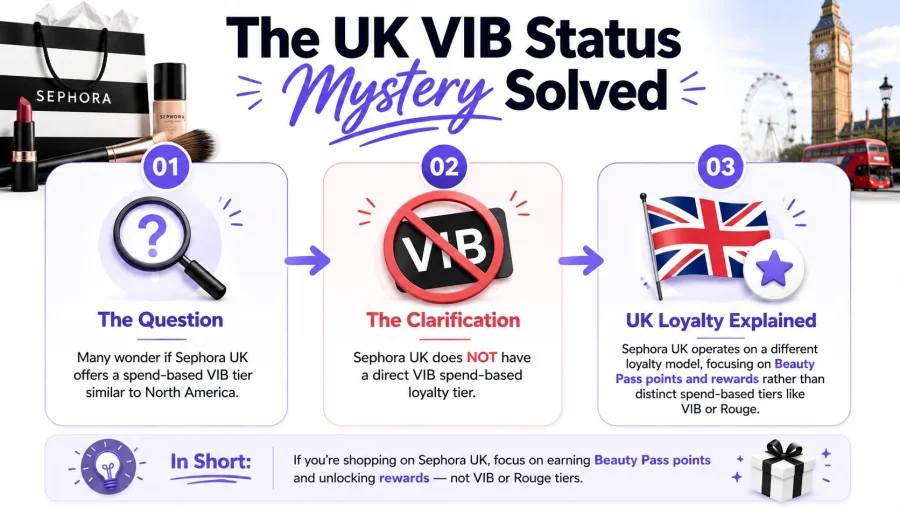
For UK shoppers, the phrase VIB status Sephora is often the wrong map for the local programme.
The search intent is understandable. People read US articles, watch US videos, and assume the same spend ladder applies in Britain. It doesn't. Sephora UK uses a different loyalty structure, and that difference changes how customers should earn, track, and redeem rewards.
What UK shoppers are actually joining
In the UK, Sephora runs MY SEPHORA, not a direct copy of the North American VIB structure.
According to the official MY SEPHORA programme page, 100 points provide a £5 voucher, a product selection from the tier edit, or a charitable donation. That's the clearest practical milestone in the programme. It gives members a concrete target and a clear sense of what their points can do.
The same official programme information also presents Sephora UK as a multi-brand beauty environment, with access across 300+ brands in makeup, fragrance, skincare, and haircare. That matters because broad assortment makes point earning feel easier. Customers can stay inside one ecosystem while buying across different beauty needs.
The tier structure that replaces VIB
The UK model uses tier labels that differ from the North American system.
Here is the basic structure described in the verified data:
- Bronze: 0 to 199 points
- Silver: 200 to 799 points
- Gold: 800+ points
This point-led model changes the customer conversation. Instead of asking, “Have I spent enough this year for VIB?” the UK shopper asks, “How many points do I have, and how close am I to Gold?”
That is a better fit for a market where shoppers may build loyalty through repeated smaller purchases rather than one or two major annual hauls.
Why the confusion keeps happening
The confusion persists for three simple reasons:
| Source of confusion | What shoppers assume | What's actually true in the UK |
|---|---|---|
| US-based articles | VIB is universal | The UK programme uses Bronze, Silver, and Gold |
| Spend-based language | Status must come from annual spend thresholds | UK status is framed around point accumulation |
| Shared brand name | One Sephora system operates everywhere | Regional programmes differ |
A British shopper looking for “the UK VIB equivalent” is usually looking for Gold, not VIB. That's the practical answer.
A loyalty programme only works when the customer can explain it back in one sentence.
What small businesses can learn from the UK model
The UK structure is a strong example of how to simplify loyalty without making it boring.
Customers earn in one clear way. They gain access to rewards at a visible milestone. They move through named tiers that suggest increasing recognition. That combination is easier to communicate than a pile of disconnected offers.
For a salon, this might mean:
- Bronze clients receive basic points tracking
- Silver clients receive priority booking or a treatment add-on
- Gold clients receive the most exclusive perks
For a café, it could look like:
- Bronze for standard stamp collection
- Silver for occasional surprise treats
- Gold for stronger monthly rewards or member-only offers
The lesson isn't “copy Sephora's labels.” The lesson is “remove ambiguity.”
One more UK detail worth knowing
Sephora UK's delivery rules also support the loyalty experience. The official delivery information page states that free standard tracked delivery applies to UK orders over £20, while orders over £200 receive signed-for delivery. That kind of threshold design nudges customers towards slightly larger baskets while making fulfilment feel more premium at higher order values.
That's another local-business lesson. Loyalty isn't just about points. It also includes small operational thresholds that shape customer behaviour.
Lessons from Sephora 5 Loyalty Tactics for Your Cafe or Salon
A small business doesn't need Sephora's budget to borrow Sephora's logic. It needs a system that makes regulars feel progress, recognition, and momentum.
That's where many independent businesses struggle. They launch a card, offer one free item, and then wonder why customers forget about it. That gap is common. In the UK, only 57% of loyalty programme owners are satisfied with their programmes' performance, according to Antavo's UK loyalty trends analysis.
The issue usually isn't effort. It's design.
1. Turn ordinary customers into visible tiers
Sephora understands that labels matter. “Member” is fine. “Gold” is better.
A café could create three levels such as Guest, Regular, and House Favourite. A salon could use Glow, Signature, and VIP Care. The names don't need to sound luxurious. They need to signal movement.
What matters is that each level offers a slightly better experience, not just a bigger discount.
- Café example: top-tier members get first access to limited bakes on weekends.
- Salon example: upper-tier clients get earlier access to holiday bookings.
2. Make the first reward feel close
One reason Sephora-style programmes work is that customers can see a reachable milestone.
If the first reward takes too long, people stop paying attention. A local merchant should give customers an early win. That might be a free coffee upgrade, a fringe trim add-on, or a discounted dessert after a manageable number of visits or points.
Short-term momentum creates long-term habit. Customers need proof that the programme is alive.
Operator's test: If a new customer can't understand how to earn the first reward within seconds, the scheme is too complicated.
3. Use events, not only permanent perks
Sephora doesn't rely on static rewards alone. Temporary bursts of value keep the programme fresh.
A small business can do the same with simple campaigns:
- Double-point Tuesdays in a café during slower periods
- Bonus points on colour services in a salon when a quiet week needs support
- Birthday-month treats that feel personal without eroding margins
These short campaigns do two jobs. They lift traffic in specific windows and remind customers that the programme changes over time.
4. Reward behaviour that helps the business
Many loyalty schemes falter at this point. They reward the easiest transaction to measure, not the behaviour the merchant desires.
Sephora's structure encourages repeat purchasing, category exploration, and ongoing engagement. A local merchant should ask the same behavioural question: what action deserves a reward?
A stronger loyalty design might reward:
| Business type | Behaviour to reward | Better incentive idea |
|---|---|---|
| Café | Visiting during off-peak hours | Bonus points on mid-morning orders |
| Salon | Rebooking before leaving | Extra points for same-day rebooking |
| Restaurant | Returning with a friend | A shared appetiser reward after a qualifying visit |
| Fitness studio | Consistent attendance | Milestone reward after repeated visits within a set period |
That approach makes loyalty strategic. It stops being a giveaway and starts becoming a steering wheel.
5. Give customers choices, not just freebies
A one-size reward often disappoints half the audience.
One salon client values a treatment upgrade. Another would rather save on retail product. One café regular wants a pastry. Another wants an extra espresso shot. Choice makes the reward feel earned and relevant.
This is one of Sephora's smartest habits. Customers stay interested when the reward catalogue has variety.
A small merchant doesn't need a huge menu of rewards. Even two or three redemption options can make the scheme feel more personal:
- Café: free drink modifier, pastry, or money-off voucher
- Salon: mini add-on, product discount, or priority appointment perk
- Restaurant: dessert, appetiser, or loyalty credit
What this looks like in real life
A salon doesn't need “VIB”. It needs a system clients can feel.
A café doesn't need a global rewards bazaar. It needs clear progress, occasional surprise, and a reason for customers to scan again next time.
The biggest takeaway from Sephora isn't glamour. It's intentionality. Every loyalty rule should answer a practical question: what customer behaviour is this designed to encourage?
Build Your Sephora-Style Loyalty Programme in Minutes
A small business owner can admire Sephora's structure and still assume it's too complex to build locally. That assumption keeps many businesses stuck with paper punch cards, manual spreadsheets, or no loyalty at all.
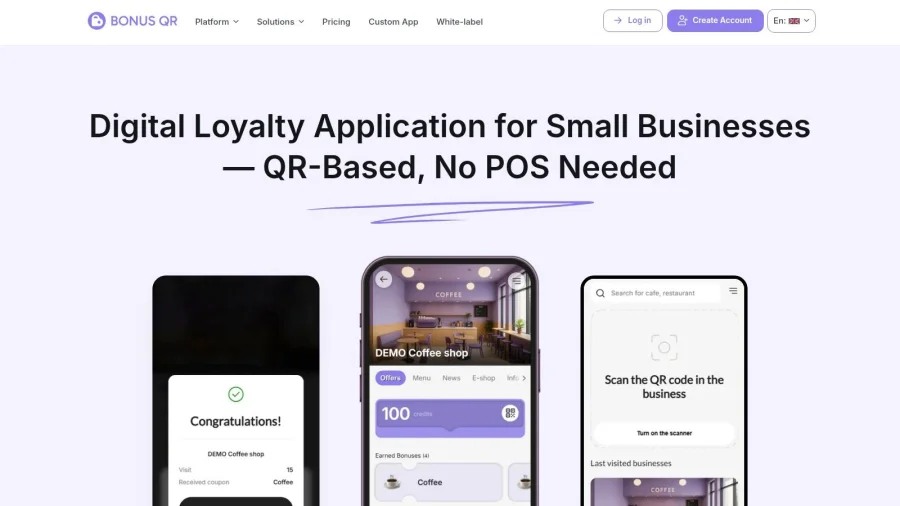
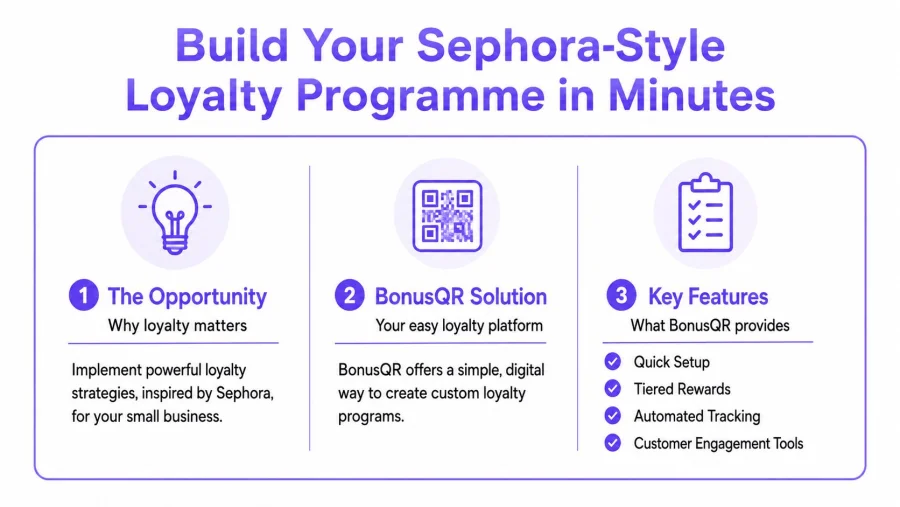
A better approach is to use a system that makes tiering, rewards, and promotional campaigns simple to launch and easy for staff to run. That's where BonusQR fits.
What a local Sephora-style setup needs
Most brick-and-mortar businesses don't need enterprise software. They need four basics:
- Simple customer sign-up
- Clear reward rules
- Fast scanning at the counter
- A way to run limited-time offers without technical hassle
BonusQR is built around that reality. Customers can sign up on mobile or web, receive a personal QR code, and track points, rewards, and visit history in one profile. Staff can scan and redeem inside the app, so there's no need for extra hardware or POS integration.
How the structure maps to Sephora-style thinking
A café or salon could use BonusQR to build the same core mechanics that make Sephora compelling, while keeping everything affordable and manageable.
For example:
| Sephora-style principle | Local business version with BonusQR |
|---|---|
| Tiered recognition | Create Silver and Gold customer levels with different rewards |
| Visible progress | Use points, stamps, visit thresholds, or spend thresholds |
| Timed campaigns | Launch seasonal coupons or bonus-point weekends |
| Personal perks | Add welcome bonuses, birthday offers, or fixed discounts |
| Ongoing engagement | Send push or email reminders, offers, and feedback requests |
That means a salon can set up a points scheme for every treatment, a birthday bonus for clients, and a higher-tier reward for frequent visitors without custom development.
A café can create a stamp card for drinks, a bonus for quieter weekdays, and a welcome reward for first-time sign-ups.
Why simplicity matters more than feature count
Many loyalty programmes fail because staff don't use them consistently or customers don't understand them quickly enough.
BonusQR removes a lot of that friction. The platform is QR-based, designed for physical businesses, and supports reward types that match real local operations: stamps, points, cashback, fixed discounts, welcome bonuses, birthday and seasonal coupons, and more. It also includes analytics on top customers, coupon performance, and visit trends.
The best loyalty system is the one staff can explain in one sentence and use in one tap.
A practical rollout for a café or salon
A business could launch with this sequence:
- Start with one core mechanic such as points per visit or spend.
- Add one fast win like a welcome bonus.
- Introduce one status layer such as Gold members after repeat visits.
- Run one campaign per month like double points on quiet days.
- Review analytics to see which rewards bring people back.
That's much closer to Sephora's logic than a static “buy nine, get one free” card.
For merchants that want a fast, affordable way to do this, BonusQR offers loyalty software for brick-and-mortar businesses that can be launched quickly without the usual technical overhead.
Why this approach suits independent businesses
Independent merchants don't need to imitate Sephora's branding. They need to copy its discipline.
That means clear milestones, meaningful rewards, and communication that keeps the programme active. BonusQR makes that practical for cafés, salons, restaurants, fitness studios, and local retailers that want modern loyalty without building custom tech from scratch.
Common Questions About Sephora Loyalty
Does Sephora UK have VIB status?
Not in the North American sense. UK shoppers use a different programme structure, so searching for VIB status Sephora in Britain usually leads to US information that doesn't match the local setup.
Do Sephora UK points expire?
Yes. According to the referenced Rivo overview of Sephora's loyalty rules, Sephora UK points expire after 12 months of account inactivity. Inactivity means no purchases, redemptions, or other point-earning activity. For customers, the practical takeaway is simple. One qualifying action within the year helps keep points active.
What's the best way to earn points faster in the UK?
The clearest approach is to stay active and pay attention to engagement-driven promotions, especially events like birthday treats or double-point moments that have been associated with the UK structure in the earlier discussion. Regular participation usually matters more than chasing a single large order.
Can shoppers use the same Sephora status across countries?
Shoppers shouldn't assume that they can. Sephora's regional programmes differ, and the UK setup isn't a direct copy of the North American model. A customer who reads US guidance should check the local programme terms before expecting the same tier names or benefits.
What should a small business copy from Sephora first?
Start with one visible milestone and one memorable perk. That combination does more than a complicated menu of rewards no one understands. A café might use a birthday treat plus a simple points balance. A salon might use tier names plus a rebooking reward. The principle is the same. Make loyalty easy to track and satisfying to use.