
Choosing the right loyalty program can feel overwhelming for retail business owners facing evolving customer expectations and rapidly advancing technology. In 2026, customers expect retailers to understand their preferences, shopping patterns and communication preferences. This article reveals the top retail loyalty trends shaping successful customer retention strategies this year, giving you a practical framework to evaluate and implement programs that drive measurable results. You’ll discover which trends deliver the best return and how to choose the right approach for your business size and goals.
Key takeaways
| Point | Details |
|---|---|
| Loyalty programs now reward diverse behaviors beyond purchases | Modern programs incentivize app usage, referrals, reviews, and social engagement to build relationships. |
| Personalization and clean data are foundational for success | Investment in data platforms and eliminating dirty data enables accurate targeting and segmentation. |
| Omnichannel integration creates seamless customer experiences | Programs must work across mobile, web, and in-store touchpoints to meet 2026 expectations. |
| Focus shifts from transactions to lifetime value | Strategic programs prioritize retention, margin protection, and building brand advocates over single sales. |
6 criteria to evaluate retail loyalty trends in 2026
Before adopting any loyalty trend, you need a clear framework to assess whether it aligns with your business goals and customer expectations. These six criteria help you separate genuine innovations from fleeting fads.
First, evaluate personalization capabilities. In 2026, customers expect retailers to understand their preferences, shopping patterns and communication preferences. Programs that deliver generic rewards feel impersonal and fail to drive repeat purchases.
Second, consider behavioral diversity. Does the trend reward only purchases, or does it recognize valuable actions like referrals, reviews, app downloads, and social media engagement? Modern customer engagement in retail extends far beyond the checkout counter.
Third, assess data quality requirements. Programs relying on accurate customer data will fail if your database contains errors, duplicates, or incomplete records. Clean data is non-negotiable for effective segmentation and targeting.
Fourth, examine omnichannel accessibility. Your loyalty program must work seamlessly whether customers shop on mobile apps, websites, or in physical stores. Fragmented experiences frustrate customers and reduce engagement.
Fifth, measure impact on lifetime value. The best trends focus on long-term customer relationships rather than short-term transaction spikes. Programs should demonstrably improve retention rates and increase average customer value over time.
Sixth, evaluate integration capabilities. Can the loyalty trend connect with your existing customer data platforms, point-of-sale systems, and marketing automation tools? Isolated programs create operational headaches and limit your ability to act on insights.
- Personalization based on individual shopping behavior and preferences
- Rewards for multiple behaviors including purchases, referrals, and engagement
- Foundation of clean, accurate customer data for targeting
- Seamless functionality across all customer touchpoints
- Clear metrics showing retention and lifetime value improvements
- Easy integration with existing business systems and tools
Top 6 retail loyalty trends shaping 2026
The retail loyalty landscape has transformed dramatically. Retail loyalty programs in 2026 are evolving beyond simple point-collection schemes to become strategic growth engines combining data, technology, and customer experience.
First, expanding reward structures beyond transactions dominates the evolution. Modern loyalty programs reward behaviors such as app usage, referrals, reviews, and social engagement, transforming loyalty into a relationship-building strategy. This shift recognizes that customers create value in multiple ways, not just through spending.
Second, AI-powered personalization enables hyper-targeted offers and communications. Advanced analytics identify individual preferences, predict future behavior, and deliver customized rewards that resonate. This trend moves programs from broad demographic targeting to individual-level precision.
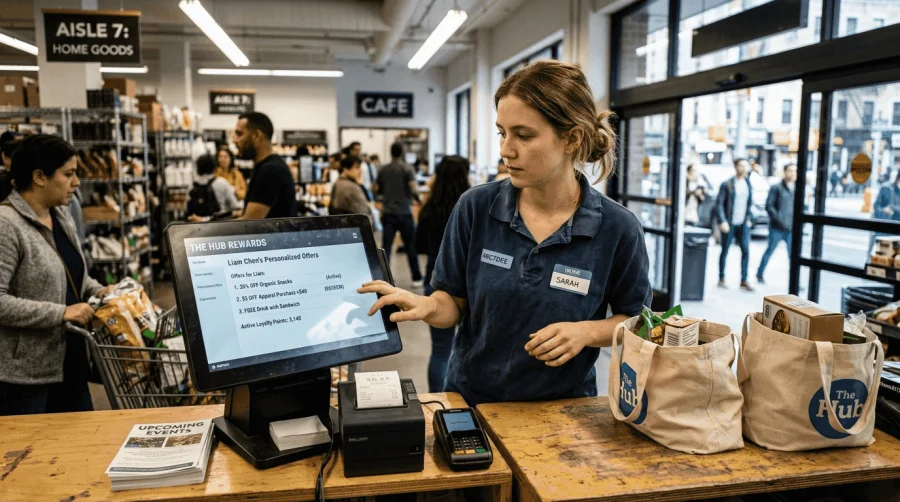
Third, omnichannel integration creates unified experiences across digital and physical touchpoints. Customers can earn and redeem rewards seamlessly whether they shop online, via mobile app, or in-store. This eliminates friction and meets expectations for convenience.
Fourth, experiential and emotional rewards complement traditional discounts. Programs now offer exclusive access, early product launches, personalized services, and community-building experiences. These rewards create stronger emotional connections than price reductions alone.
Fifth, first-party data collection reduces dependence on paid advertising. Loyalty programs become strategic data engines, capturing zero-party and first-party customer information that enables owned marketing channels. This trend addresses rising advertising costs and privacy regulations.
Sixth, lifetime value optimization replaces transaction-focused metrics. Programs prioritize customer retention, repeat purchase frequency, and margin preservation over attracting one-time buyers. This strategic shift improves profitability and builds sustainable competitive advantages. Check out these innovative loyalty schemes for inspiration on implementation.
- Multi-behavior reward systems encouraging engagement beyond purchases
- AI-driven personalization delivering individualized customer experiences
- Unified omnichannel programs working across all shopping environments
- Experiential rewards creating emotional connections with your brand
- First-party data strategies reducing paid media dependency
- Lifetime value focus improving long-term profitability
Comparing leading retail loyalty trends: benefits and challenges
Each loyalty trend offers distinct advantages but comes with implementation hurdles you must understand before committing resources.
| Trend | Primary Benefit | Key Challenge | Best For |
|---|---|---|---|
| Multi-behavior rewards | Increases engagement frequency by 40-60% | Requires tracking infrastructure across channels | Retailers with digital presence |
| AI personalization | Boosts conversion rates through precise targeting | Demands clean data and ongoing model refinement | Data-mature businesses |
| Omnichannel integration | Eliminates friction and improves satisfaction | Complex technical implementation | Multi-channel retailers |
| Experiential rewards | Builds emotional loyalty and differentiation | Higher cost per reward delivered | Premium or lifestyle brands |
| First-party data focus | Reduces marketing costs and improves targeting | Requires customer trust and value exchange | Privacy-conscious markets |
| Lifetime value optimization | Improves margins and retention metrics | Longer timeframe to show results | Established retailers |
The dirty data challenge affects every trend requiring customer information. Retailers invested heavily in customer data platforms, advanced analytics, and AI-driven targeting engines, spending an estimated $15 billion in 2025. Yet dirty data is a significant problem inherent in how loyalty programs work, affecting data reliability and targeting accuracy.
Multi-behavior programs deliver quick engagement wins but require you to define which behaviors truly matter for your business model. Not every action deserves equal reward value. AI personalization offers powerful targeting but fails completely with inaccurate customer records or insufficient data volume.
Omnichannel integration provides the smoothest customer experience but demands significant technical investment and ongoing maintenance. Experiential rewards create memorable moments that discount-focused competitors cannot match, yet they cost more per customer and require creative planning.
First-party data strategies future-proof your marketing by reducing reliance on third-party cookies and paid platforms. However, customers will only share information if they perceive clear value in exchange. Lifetime value optimization aligns programs with profitability but requires patience as results compound over months and years.
Pro Tip: Start with a data audit before implementing any trend. Clean your customer database, remove duplicates, and establish data quality standards. Even the most sophisticated loyalty technology fails with unreliable information. Explore successful examples in these top retail loyalty programs to see how leading brands overcome these challenges.
Choosing the right loyalty trends for your retail business in 2026
Selecting loyalty trends that match your business reality requires honest assessment of your current capabilities, resources, and customer base.
First, evaluate your technology readiness and data maturity. In 2026, successful SMB retailers recognize that engagement extends far beyond the transaction itself. If you lack customer data platforms or analytics capabilities, start with simpler multi-behavior programs before attempting AI personalization.
Second, match trends to your customer demographics and shopping patterns. Younger, tech-savvy customers expect mobile-first experiences and gamified engagement. Traditional shoppers may prefer straightforward point systems with clear redemption paths.
Third, consider your budget constraints and resource availability. Omnichannel integration and experiential rewards require larger investments than digital-only programs. Many successful retailers begin with focused digital initiatives and expand as they prove ROI.
Here’s a practical implementation roadmap:
- Start with clean data and a simple digital program rewarding purchases and one additional behavior like referrals or reviews.
- Implement mobile accessibility through apps or mobile-optimized web experiences to capture engagement data.
- Add personalization elements using segmentation based on purchase history and demonstrated preferences.
- Expand to omnichannel integration once digital programs show consistent engagement and positive retention metrics.
- Introduce experiential rewards and advanced AI personalization as your data volume and quality improve.
- Continuously measure retention rates, customer lifetime value, and program profitability to guide optimization.
Smaller retailers should prioritize trends offering immediate engagement improvements with manageable complexity. Multi-behavior digital programs and mobile accessibility deliver strong results without requiring enterprise-level infrastructure.
Mid-sized retailers can pursue omnichannel integration and first-party data strategies, using loyalty programs to reduce acquisition costs while improving retention. This segment benefits most from balancing quick wins with strategic investments.
Pro Tip: Choose a loyalty platform that grows with your business. Look for solutions offering modular features you can activate as you scale, avoiding the need to rebuild programs from scratch. Study proven tactics in these best loyalty campaigns of 2026 to accelerate your learning curve and avoid common pitfalls.
How BonusQR supports your loyalty strategy in 2026
Implementing modern loyalty trends requires technology that’s both powerful and accessible for small and medium retailers. BonusQR provides the essential tools to execute the strategies outlined in this article without enterprise complexity or cost.
Our electronic reward loyalty platform enables you to reward diverse customer behaviors beyond purchases, supporting the multi-behavior trend driving engagement in 2026. You can recognize referrals, social shares, reviews, and app interactions alongside traditional transactions.
The stamp card loyalty program offers an intuitive starting point for retailers new to digital loyalty, delivering immediate customer engagement while building your first-party data foundation. This approach aligns with the lifetime value optimization trend by focusing on repeat visit frequency.
BonusQR’s mobile and web application features provide the omnichannel accessibility customers expect, ensuring seamless experiences whether they engage via smartphone, tablet, or desktop. This flexibility supports both in-store and online retail environments without requiring point-of-sale integration.
Retail loyalty trends 2026 frequently asked questions
What are the biggest changes in retail loyalty programs for 2026?
The fundamental shift moves from transaction-only rewards to comprehensive engagement systems recognizing multiple customer behaviors. Programs now leverage AI for personalization, prioritize first-party data collection, and focus on lifetime value rather than single purchases. Omnichannel integration and experiential rewards complement traditional discounts to create differentiated customer experiences.
How important is personalization in loyalty programs?
Personalization is critical because customers now expect retailers to understand their individual preferences and shopping patterns. Generic rewards feel impersonal and fail to drive engagement. AI-powered personalization can boost conversion rates significantly by delivering relevant offers at optimal times, but effectiveness depends entirely on data quality and accuracy.
How can SMB retailers overcome challenges with dirty data?
Start with a thorough data audit to identify duplicates, errors, and incomplete records. Establish validation rules at data entry points to prevent new errors. Regularly clean your database using automated tools and manual review. Invest in customer data platforms designed for data quality management. Remember that even sophisticated loyalty technology fails without reliable customer information as the foundation.
What behaviors should modern loyalty programs reward?
Beyond purchases, reward referrals that bring new customers, reviews and ratings that build social proof, app downloads and usage that enable direct communication, social media engagement that expands brand awareness, and account profile completion that improves data quality. The specific behaviors depend on your business model, but diversifying rewards increases engagement frequency and strengthens customer relationships.
How does investing in loyalty programs impact customer lifetime value?
Effective loyalty programs significantly increase lifetime value by improving retention rates, boosting repeat purchase frequency, and increasing average order values through targeted promotions. Programs shift focus from costly acquisition to profitable retention, protecting margins while building brand advocates. The impact compounds over time as loyal customers generate more revenue at lower marketing costs compared to constantly replacing churned customers.


