Ever wondered how the local coffee shop gets those first-time customers to come back again and again? If you're still handing out paper punch cards, you're leaving money on the table. Reward card apps are the modern, simple answer for small businesses to build a loyal following and boost sales without getting tangled up in complex, expensive marketing.
Why Reward Card Apps Are Essential for Growth
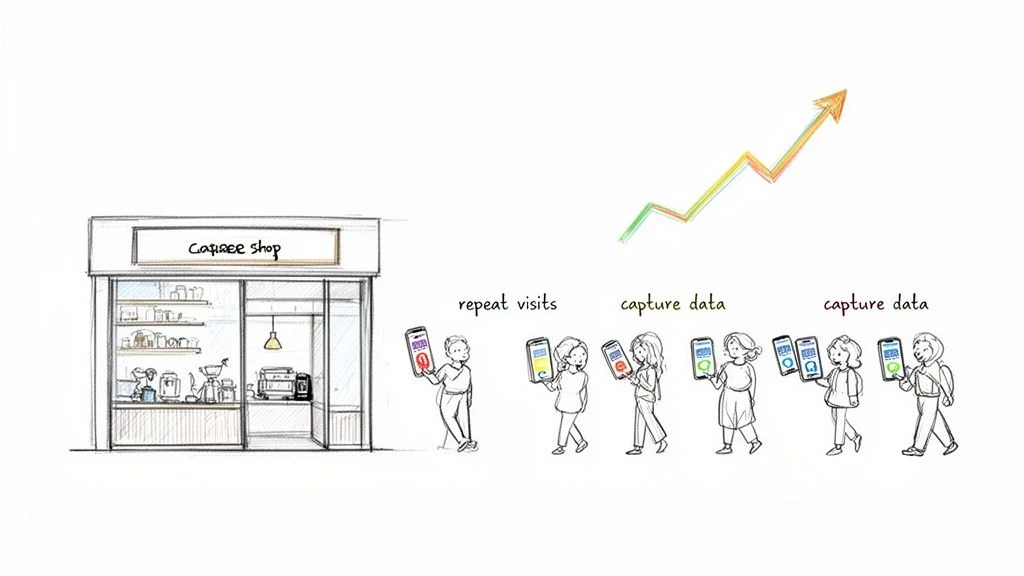
For small business owners, staring at flat sales numbers is a familiar frustration. You're great at what you do, but how do you turn a one-time buyer into a regular? Switching from paper to digital reward card apps isn't just a minor upgrade-it's a core strategy for any coffee shop, salon, or local retailer trying to grow in today's market.
These apps solve common small business pain points. Instead of guessing who your best customers are, you get clear, actionable insights into their buying habits. This is real data you can use to make smarter decisions that actually move the needle on your revenue.
Solving Your Key Business Challenges
For a small business, every customer matters. Reward card apps offer a direct and surprisingly effective way to tackle the nagging challenges that keep you up at night.
- "How do I stop customers from leaving?" We all know it costs more to find a new customer than to keep an existing one-about five times more. A simple loyalty app gives people a tangible reason to choose you over a competitor.
- "How do I get people to visit more often?" When a customer is just one or two visits away from a free coffee or a discount, they’re far more likely to stop by your place instead of going somewhere else. It directly influences their daily choices.
- "How can I compete with the big chains?" Big brands have used slick loyalty programs for years. A modern, easy-to-use app lets you offer that same polished experience, helping you compete effectively without their massive budgets.
From Data to Dollars
The true power of a good reward card app lies in the data it gives you. Every time a customer scans a QR code to earn a point, you're learning about their habits. This isn't just trivia; it's a roadmap to growing your revenue.
Imagine you own a cafe and notice a group of regulars only visits on weekends. With your app, you could send them a special "2-for-1" offer valid only on a Tuesday. Just like that, you’ve encouraged more visits and started filling up your quietest times.
A loyalty program does more than just offer discounts; it opens a direct line of communication with your customers, turning one-off transactions into long-term relationships.
The numbers don't lie. The global loyalty market is projected to skyrocket from USD 13.59 billion in 2025 to USD 31.11 billion by 2033. This growth is fueled by real results, especially for small businesses. In fact, 61% of US customers say they want digital rewards they can use right away.
Better yet, loyalty members are 59% more likely to choose you over a competitor and 43% more likely to buy from you weekly. When you consider that a giant like Starbucks drives over half its revenue from its rewards members, it’s clear how a similar-but simpler-program can make a huge difference to your bottom line. You can learn more about these loyalty market trends and what they mean for your business.
What Really Makes a Reward Card App Great?
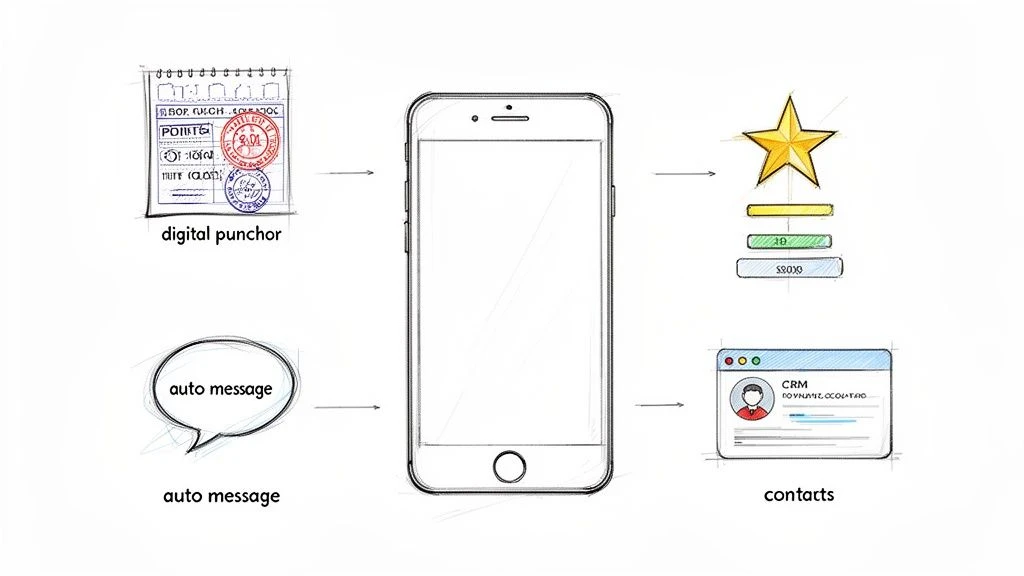
Before you compare reward card apps, you need to know which features actually make a difference for a small business. The best apps are more than a digital copy of a paper card. They are simple, powerful tools built to bring customers back without creating headaches for you or your staff.
Once you understand these core features, you can cut through the marketing fluff and pick an app that truly fits your business. Let's break down what separates a good loyalty program from a great one.
Digital Punch Cards and Points Systems
At its core, a loyalty app needs a dead-simple way for customers to earn rewards. The two most popular methods are digital punch cards and points-based systems.
- Digital Punch Cards: This is the digital version of the classic "buy 10, get one free" model. It’s incredibly easy for customers and staff to understand, making it perfect for businesses with fast, high-volume sales like a coffee shop or food truck.
- Points-Based Systems: This approach offers more flexibility. Customers earn points for every dollar spent, which they can redeem for various rewards. It’s a great fit for businesses with a wider range of products or services, like a retail boutique or a hair salon.
For most small businesses, simplicity wins. If a system is confusing, people won't use it. That's where a QR-code-based app like BonusQR stands out, giving you the familiar feel of a punch card without any complicated setup.
Automated Messaging and Re-Engagement
What happens when a regular customer hasn't stopped by in a while? A great reward card app doesn't just wait. It proactively nudges them to come back with automated messages.
This feature allows you to set up simple, targeted messages based on a customer's last visit. For example, a hair salon can automatically send a reminder to a client who hasn't booked in eight weeks, perhaps with a small discount to encourage them to schedule. This one feature alone can significantly reduce customer churn.
The ability to automatically reach out to customers at just the right moment is what separates a basic digital card from a true business-building tool. It turns your loyalty program into a proactive sales engine.
Tiered Rewards and Gamification
To drive deep loyalty, you have to make your best customers feel special. Tiered reward systems add a fun, game-like layer to your program, encouraging customers to spend a little more to unlock better perks.
Imagine a customer at your cafe reaching "Gold Status" after 20 visits. Suddenly, they get a permanent 10% discount or first access to new seasonal drinks. This makes your most valuable customers feel seen and gives everyone else a goal to aim for. The data backs this up: 46% of customers say programs are more engaging when they have fun challenges or tiers.
These three elements-simplicity, automated outreach, and tiered rewards-are the building blocks of a loyalty program that does more than just give away free stuff. It actively grows your business. An app that nails these basics is often far more valuable than one bloated with features you'll never use.
A Practical Look at Today's Top Reward Card Apps
Choosing the right reward card app can feel overwhelming, but it boils down to a few simple questions: Can you get it running this weekend? Is the pricing transparent? And most importantly, will your customers actually use it? Let's cut through the noise and compare the most popular options from a busy small business owner's perspective.
Instead of a generic pros and cons list, we'll dig into the critical differences that set these tools apart. This will help you see which one truly fits your business, whether you’re running a bustling food truck or a quiet neighborhood boutique.
Ease of Setup: How Fast Can You Go Live?
For any small business owner, time is your most precious resource. You don't have an IT department or weeks to spend on a complicated rollout. The setup process reveals one of the biggest gaps between different reward card apps.
- POS-Integrated Systems (Competitor C): These apps integrate directly with your Point of Sale system. While that sounds good, it often means a huge investment in time and money. Think technical support calls, scheduled installations, and heavy staff training-it could take weeks to get running.
- Complex Standalone Apps (Competitor A & B): Tools like FiveStars or the now-discontinued CandyBar often require their own hardware, like a customer-facing tablet. This still involves setting up new devices and teaching your staff a new workflow at the checkout counter.
- QR Code-Based Apps (BonusQR): This is, by far, the fastest and simplest way to get started. With an app like BonusQR, you can be live in minutes, all from your own phone. You create your digital punch card, generate a QR code, and print it out. That's it. You’re ready to start rewarding customers the same day.
For a small business where every minute counts, the difference between a one-day launch and a one-month project is huge. A simple QR code system removes the single biggest obstacle to starting a loyalty program: the setup headache.
Pricing Models: Predictable Costs vs. Hidden Fees
Your loyalty program should make you money, not drain your bank account with confusing fees. Pricing is another area where the differences between apps become crystal clear. Many draw you in with a low starting price, only to charge you per transaction or per customer, which gets expensive fast as you grow.
Let’s be real-you're competing against giants, but a smart, simple approach gives you an edge. The US loyalty market is projected to hit USD 25.99 billion by 2026. While over 90% of companies offer a program, the average person only uses 9 of the 19 they've signed up for. The takeaway? Simplicity wins. Especially when 61% of customers just want instant rewards without fuss. Getting this right can boost customer satisfaction by over 20%, meaning real growth for your business. You can learn more about the intensifying competition for customer engagement to see just how crowded the field is.
For a small business, a predictable, flat-fee model is almost always the best choice. BonusQR was built on this idea, offering transparent pricing that doesn't punish you for success. You pay one low monthly rate, no matter how many customers sign up or how many rewards they redeem.
A Head-to-Head Look at Your Options
To make this choice even clearer, this simple table highlights how different solutions stack up on the factors that matter most to a small business owner.
Feature and Cost Comparison of Top Reward Card Apps
This table gives you a side-by-side look at the leading types of reward card apps, focusing on ease, cost, and customer experience.
| Feature | BonusQR | Competitor A (e.g., FiveStars) | Competitor B (e.g., CandyBar) | Competitor C (POS-integrated) |
|---|---|---|---|---|
| Ease of Setup | Minutes; just print a QR code | Days; hardware installation | Hours; tablet and app setup | Weeks; professional install needed |
| Pricing Model | Simple, predictable flat fee | Tiered pricing based on features | Per location, with add-ons | High monthly fees + setup costs |
| Customer Experience | Seamless; scan with their own phone | Have to enter a phone number | May require an app or tablet use | Tied directly to POS checkout |
| Hardware Required | None; uses the customer's phone | Dedicated customer-facing tablet | Often requires a dedicated tablet | Depends on POS compatibility |
| Best For | Cafes, food trucks, salons, boutiques | Businesses with dedicated counter space | Small retail with moderate traffic | Large restaurants, multi-location retail |
As you can see, the right choice really depends on your specific business and how much complexity you're willing to take on.
The Customer and Staff Experience
Finally, think about what it’s like for your customers and your team. If a program is clunky, nobody will use it, no matter how great the rewards.
A system that makes customers download another app or fumble with a tablet at checkout adds friction. It slows down your line and annoys both customers and staff. The beauty of a QR-code system is that everyone already knows how to use their phone's camera-it’s universal.
For your team, a complicated system means more training and more room for error. A standalone QR code is totally separate from your payment process, so employees don't have to learn a new workflow. They just point the customer to the sign. When looking at your options, you might want to see how the Lunabloomai App measures up against your list of must-haves for a great reward card app.
For businesses that run on speed and simplicity-like a coffee shop with a long morning line or a pop-up market stall-a standalone QR solution like BonusQR is the clear winner. It delivers all the core benefits of a loyalty program without the cost, complexity, and friction of more elaborate systems.
How to Choose the Right App for Your Business Type
Let's be honest-the best reward card app for a busy coffee shop is almost never the right choice for a high-end salon. Picking the right loyalty program isn't about finding the one with the longest feature list. It’s about finding the one that solves your specific day-to-day problems.
The secret is to match the app’s strengths to the rhythm of your business. A one-size-fits-all approach fails because it ignores what makes your operation unique. A quick QR code scan is a lifesaver for a business that needs speed, while a deeply integrated system might be better for one that thrives on high-value, repeat clients.
This decision tree can help you visualize that first big choice: do you need a simple, standalone app or a more complex one that ties into your POS?
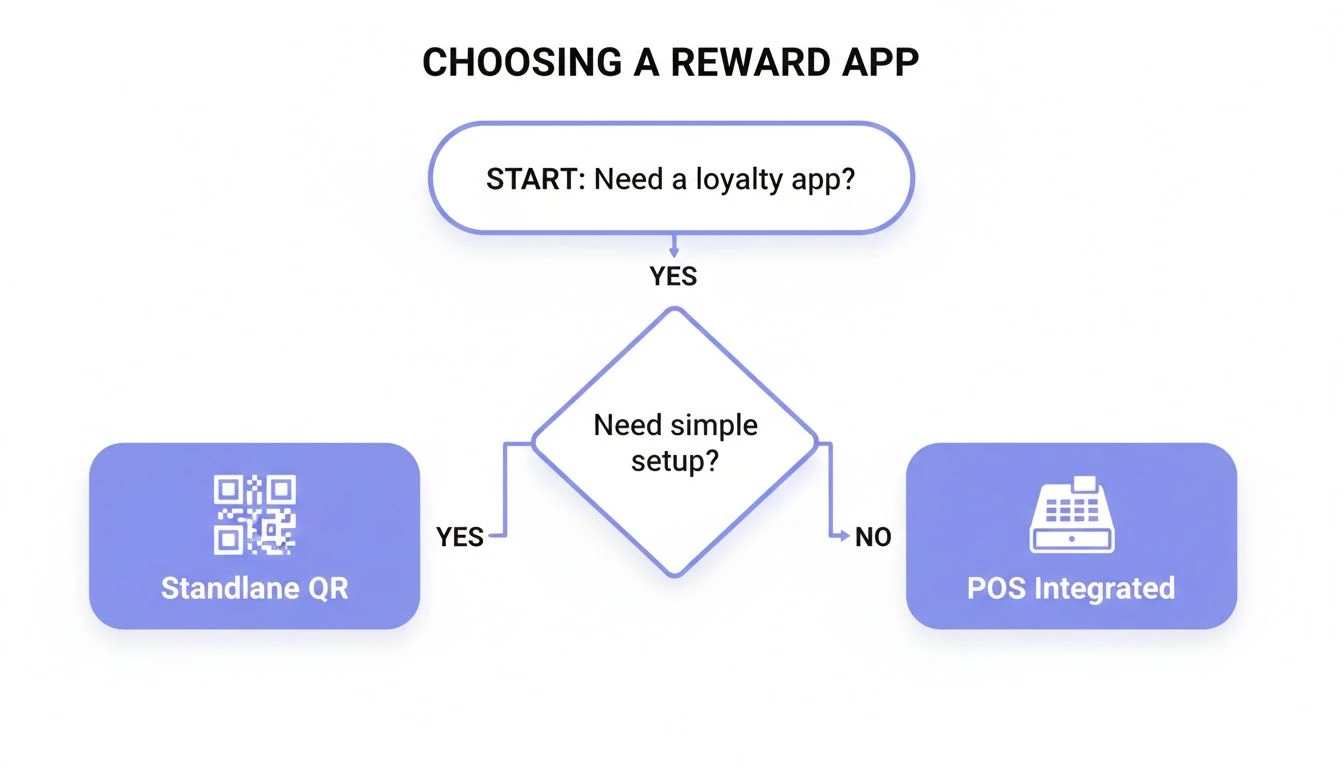
As the chart shows, if a fast, painless setup is your priority, a standalone QR code solution is the quickest path forward, letting you skip the headaches of POS integration.
For Coffee Shops and Cafes: Speed Is King
When the morning rush hits, the last thing you need is a loyalty program that gums up the works. For cafes, speed and simplicity are everything. Your customers want their coffee fast, and your staff needs to keep the line moving.
This is where a QR code system like BonusQR really shines.
- No Friction for Customers: They just point their phone's camera at a code on the counter. No app to download, no phone number to punch in. It’s that simple.
- Zero Disruption for Staff: Your team doesn't have to learn a new process on the POS. The loyalty program runs on its own, so they can focus on making great drinks.
Think about it: a program that adds just five seconds to every transaction can create a massive bottleneck. A simple scan-and-go process keeps your line short and your customers happy.
For Salons and Spas: Personalization Drives Loyalty
Unlike grabbing a quick coffee, a salon visit is an experience built on relationships. Your clients book appointments in advance and often buy high-margin retail products. Your loyalty app needs to mirror that high-touch model.
For appointment-based businesses, a great rewards app does more than track visits; it becomes a client relationship management tool, encouraging repeat bookings and higher spending.
Look for features that let you get personal:
- Tiered Rewards: Create a VIP experience. Offer exclusive perks for your best clients, like a free deep conditioning treatment after five color services or first dibs on new product lines.
- Appointment-Based Triggers: Automate reminders to clients when it’s time to book their next haircut or facial. This helps fill your schedule and stops clients from drifting away.
For Restaurants and Bars: Balancing Different Customer Types
Restaurants serve all kinds of people: the quick lunch crowd, happy hour regulars, and weekend groups. Your loyalty program has to be flexible enough to appeal to all of them.
A simple "buy 10, get one free" might work for lunchtime sandwiches, but you also need to reward a table that drops $200 on a Saturday night. A hybrid approach often works best, maybe combining digital punch cards with a points-for-spend system. Gamification is a huge plus here, as 46% of consumers say it makes loyalty programs more fun.
The data backs this up. Mobile apps are the go-to channel for 64% of consumers who use loyalty programs. And with 42% of Millennials installing brand apps to show their loyalty, a fast app is a must for a coffee shop. For a salon, where 24% of consumers stay loyal for personalized deals, that tailored experience is what matters most. Ultimately, since 54% of US online adults let loyalty programs influence where they shop, your choice of app is a direct driver of sales. You can dive deeper into how loyalty programs influence consumer behavior in this detailed report.
How to Launch Your Loyalty Program for Maximum Impact
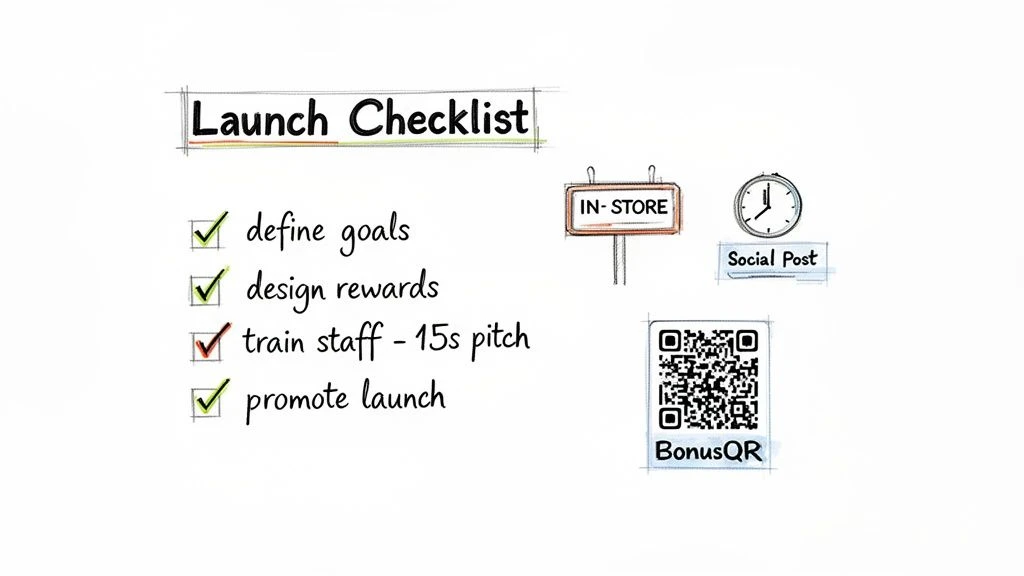
Picking the right reward card app is just the start. A killer launch can create genuine excitement and turn a simple program into your best tool for driving repeat business from day one. Get it wrong, and you’re left with confused staff, uninterested customers, and a program that fizzles out.
Let's make sure that doesn't happen.
Define Your Goals and Design Your Rewards
First things first: what are you trying to accomplish? Don't skip this step. A clear goal is your North Star.
What's the main objective?
- Get customers to visit more often?
- Increase how much they spend each visit?
- Generate more word-of-mouth buzz?
Once you have your answer, build a reward that gets you there. If you want more frequent visits, a classic "Buy 5, Get 1 Free" punch card is perfect. To boost spending, a 10% discount after hitting a points milestone works wonders. The key is to offer something that feels generous but is sustainable for your business.
The best loyalty programs feel like a genuine 'thank you,' not a complicated marketing scheme. Keep rewards simple, desirable, and easy for customers to understand at a glance.
Train Your Staff and Promote the Launch
Your team is your secret weapon. If they’re excited and can explain the program clearly in 15 seconds, your customers will be too.
A quick, friendly pitch like, "Want to earn a free coffee? Just scan this code with your phone!" is far more effective than a rambling explanation at a busy checkout counter.
Now, it’s time to make some noise.
- In-Store Signage: Put flyers with your QR code right at the register, on tables, and on the front door.
- Social Media: Post a clean, simple photo announcing the new program on your social channels with a clear call to action.
- Personal Invitation: This is huge. Have your staff personally invite every customer to join when they pay.
This is where a tool like BonusQR really shines. You can set up your program and have a printable QR code ready in minutes, allowing you to go from idea to launch in less than a day. For a deeper dive, read our article on how to start a loyalty program customers will love. For industry-specific tips, check out these ideas for building successful restaurant customer loyalty programs.
Why BonusQR Is the Smartest Choice for Your Business
In a market flooded with overly complex reward apps, the simplest choice is often the smartest. We get it. For small business owners, the fear of high costs, tech headaches, and confusing programs is real. BonusQR was built to cut through that noise, giving you the most direct path to building true customer loyalty.
BonusQR strips away everything you don't need and focuses on what actually works: a dead-simple program your customers will love and your staff can run without a minute of training. There’s no clunky hardware, no complicated POS integrations, and zero hidden fees that penalize you for growing. It’s a straightforward solution designed for the realities of running a small business.
Unmatched Simplicity and Speed
The biggest advantage of BonusQR is how incredibly easy it is. You can get your entire loyalty program running in the time it takes to brew a pot of coffee. Forget scheduling technicians or wasting weeks on training.
- Setup in Minutes: Create your digital punch card right on your phone.
- Generate Your QR Code: Your unique business code is ready instantly.
- Print and Display: Place the code on your counter, and you're good to go.
This rapid setup means you can start rewarding customers today, not next month. It frees you from the implementation anxiety that stops so many businesses. You can check out our guide on how to start a loyalty program with BonusQR to see just how quick it is.
For a busy entrepreneur, time is your most valuable asset. BonusQR gives that time back by delivering a powerful loyalty tool that just works, letting you focus on your customers instead of managing software.
Transparent, Affordable Pricing
Let's talk about the biggest pain point with other reward apps: unpredictable costs. Per-transaction fees, tiered plans based on customer numbers, and charges for "premium" features can quickly eat into your profits. BonusQR throws that model out the window.
Our pricing is a simple, flat-fee structure. You pay one low, predictable monthly rate. That's it. It doesn’t matter if you have 100 customers or 1,000-your bill stays the same. This transparency gives you the peace of mind to grow your program without ever worrying about surprise costs. You get all the essential tools to drive repeat business, without the financial guesswork.
Got Questions? We've Got Answers
Choosing a loyalty app usually brings up a few last-minute questions. As a small business owner, you need straight answers. We've gathered the most common concerns to help you move forward with total confidence.
Let's clear up the practical hurdles-like what it will actually cost, how to switch from paper cards, and how you’ll know if it's even working.
How Much Should I Expect to Pay for a Reward Card App?
Let's talk money. Pricing for reward card apps can feel all over the place. Some apps take a percentage of every transaction, while others use tiered pricing that gets more expensive as your customer list grows. Both models can dig into your profits, especially as you become more successful.
For most small businesses, a flat-fee model is the simplest and most predictable option. You get one consistent monthly cost and are never penalized for growth.
For instance, BonusQR keeps it simple with a low monthly rate, no matter how many members you sign up. That kind of transparency ensures your loyalty program is a profit driver, not a creeping expense.
How Do I Switch from Paper Punch Cards to a Digital App?
Going from paper to digital is way easier than you think. You don't need a complex migration strategy. The secret is to frame the switch as a fun upgrade for your customers.
Here’s a simple game plan:
- Build Hype: A week beforehand, let everyone know a new digital rewards program is coming. Put up a sign and post on social media.
- Give a "First Scan" Bonus: Offer an extra stamp or a small freebie the first time they use the new digital card. This small gesture makes a big difference.
- Honor Old Cards: For a limited time-say, 30 days-let customers trade in their old, half-filled paper cards for the same number of stamps on the new app.
This process turns a potential headache into a positive experience. With a simple QR code app, it's a seamless switch that makes your customers feel taken care of.
How Can I Measure the ROI of My Loyalty Program?
So, how do you know if your new loyalty app is actually making you money? Measuring your return on investment (ROI) is about tracking a few key numbers that directly affect your bottom line.
Just keep an eye on these three metrics:
- Visit Frequency: Are your members coming back more often than non-members?
- Average Spend: Are they spending more each time they visit?
- Member Growth: How many new people are signing up for your program each week?
If these numbers are heading in the right direction, your program is paying for itself. A good reward card app will make this data easy to find, proving its worth month after month.


