Aisha runs a 22-seat coffee shop and has spent three years handing customers a rubber-banded stack of paper loyalty cards. Only a small fraction of regulars carry one consistently. The rest leave cards at home, lose them, or throw them away with the receipt. Her choice is familiar but leaky paper, or a digital reward-points programme that can cost less each month than a bag of premium beans.
That decision matters because loyalty membership alone proves very little. UK reporting says around 80% of UK adults belong to at least one loyalty programme, while roughly 26% of points go unredeemed, representing about £3 billion in annual value according to UK loyalty programme statistics. A programme can attract sign-ups and still fail to create visits.
This guide focuses on the practical decision in front of Aisha and other independent owners. It covers how reward points work, which structure fits a café, salon, gym or shop, how to launch the programme in BonusQR, and how to avoid breakage, HMRC, VAT and UK GDPR problems without hiring a consultant. Owners reviewing wider ways to cut costs for small businesses in 2026 can treat loyalty software as an operating decision, not just a marketing expense.
The Reward Points Decision Most Small Businesses Get Wrong
The wrong question is, “Should the business offer loyalty points?” The useful question is, “Which customer behaviour should the programme make easier to repeat?”
Paper cards often fail because the customer has to remember a physical object. Staff must stamp it correctly, replacement rules create awkward conversations, and the business can't see how many customers are close to a reward. A digital programme removes much of that friction, but only if the earning rule and reward are simple enough to understand at the till.
Aisha doesn't need a scheme with a complicated catalogue, multiple VIP levels and a long list of promotional conditions. She needs one clear action, such as scanning after each purchase, linked to one reachable reward. The same principle applies to a salon that wants rebooking, a gym that wants consistent attendance, or a retailer that wants customers to return rather than shop only during sales.
Operator's rule: A reward that customers can't explain in one sentence won't change their behaviour.
Before launch, the owner should make four decisions:
- Choose the behaviour: Reward visits, spend, bookings, referrals or a quieter trading period.
- Set the earning rule: Customers should know exactly how purchases become points.
- Choose one first milestone: A reachable reward creates momentum faster than a distant catalogue.
- Give staff a short script: “Scan this QR code and the points will be added to your account” is enough.
The paper card isn't automatically wrong. It becomes wrong when the business can't measure participation, customers regularly forget it, or staff spend time resolving missing stamps. A digital points setup earns its place when it makes redemption visible, reduces till friction and gives the owner evidence for changing the offer.
What Reward Points Actually Are and How They Work
A reward point is a unit of credited value. A customer earns it after a qualifying purchase, then exchanges accumulated points for a defined reward. Points aren't legal tender, and the business decides the earning conditions, redemption options and expiry terms.
A coffee shop makes the mechanics easy to see. Suppose a flat white costs £3.50 and the programme awards one point per pound. A customer earns three points on that purchase if the business rounds down, or a clearly defined equivalent if the software handles the calculation automatically. After repeated visits, the customer reaches the chosen threshold and receives a free drink or another reward.
The owner must decide what the points mean before asking customers to collect them. Four parts control the customer experience:
- Earn rule: The amount of spend or the action that creates points.
- Point value: The reward value attached to a particular balance.
- Redemption catalogue: The free item, discount, voucher or experience available.
- Expiry: The period after which unused points lapse, if the scheme uses expiry.
Points, stamps and discounts are different
Stamps count qualifying visits or items. A customer might receive one stamp for each coffee and earn a free drink after completing a card. Discounts reduce the current transaction, such as a percentage off the bill. Reward points sit between the two. They can reflect spend, visits or actions, then remain available for a later reward.
Mixing all three systems without a clear hierarchy creates confusion. A café shouldn't tell customers that they earn points, collect stamps and receive an automatic discount unless each mechanism has a distinct purpose. One visible programme with one primary earning action is easier for staff to operate and customers to remember.
A points programme can be configured with a set up a points program approach that connects spend to future rewards. The critical design choice isn't the technology. It's whether the customer reaches the reward soon enough to believe the programme is useful.
The Core Mechanics That Decide Whether a Points Programme Succeeds
The earn ratio sets the pace. One point per pound is a sensible starting point because it lets the owner relate points to actual spend. Two points per pound can work when the reward ladder is tighter, but generosity without a cost calculation creates a balance of future obligations.
Tiering should solve a real commercial problem, not decorate the app. One VIP tier after a meaningful lifetime balance is easier to explain than three levels with small differences. The owner should attach a practical benefit to the tier, such as early access, a booking privilege or a targeted bonus, rather than adding status language with no customer value.
Multipliers are useful when they change timing. Double-point periods on a quiet Tuesday morning can shift visits without reducing the price of every transaction. The promotion should have a defined purpose and an end date, otherwise customers wait for the multiplier.
Expiry needs equal care. A 12-month inactivity period is a clean operational default, but the customer must see the rule before earning points and receive clear reminders where appropriate. The 2026 UK analysis of unused loyalty points reported that 26.2% of points go unused and 11.9% expire unspent, so expiry isn't a minor settings choice. It directly affects perceived value.
| Mechanic | Common Setting | Business Impact | Risk If Misjudged |
|---|---|---|---|
| Earn ratio | One point per pound | Makes earning easy to connect to spend | A generous rate can erode margin |
| Tier | One meaningful VIP level | Rewards valuable customers without clutter | Too many levels confuse staff and customers |
| Multiplier | Double points in quiet periods | Moves demand towards weaker trading times | Customers may delay normal visits |
| Expiry | 12 months of inactivity | Keeps inactive balances manageable | Silent expiry feels punitive |
| Redemption | One reachable first reward | Gives customers a clear target | A distant threshold causes abandonment |
The mechanics interact. A high earn rate paired with loose expiry creates a hidden liability, because customers accumulate balances the business may later need to honour. A practical rule is to keep redemption cost between 5% and 10% of scheme revenue, while checking the calculation against product margin, average basket and likely redemption behaviour.
Use a BonusQR performance dashboard or an equivalent reporting tool to monitor points issued, rewards claimed and repeat activity. The owner needs those figures to adjust the programme before an attractive offer becomes an expensive promise.
Why Reward Points Beat Discounts for Customer Retention
A discount ends when the transaction ends. Reward points create a reason to return.
A customer who has already accumulated part of a balance has something unfinished. That doesn't guarantee another visit, but it gives the business a retention mechanism that a generic “20% off today” sign doesn't provide. The customer isn't only comparing today's price. They're also considering progress already made towards a future reward.
Points can also feel more valuable than their direct cost. A free pastry, upgraded service or complimentary drink feels like a benefit earned through behaviour. A reduction applied automatically at checkout feels like a price adjustment. That distinction matters because a points reward can protect the standard price on ordinary visits while still giving the loyal customer a reason to come back.
The margin case for points
A permanent discount pays everyone who uses it, including customers who would have purchased anyway. Points can be limited to defined actions, selected products or quieter periods. The owner controls when value is released instead of lowering every transaction price.
Personalisation adds another advantage. A café can offer extra points during a slow afternoon. A salon can reward an early rebooking. A retailer can attach a bonus to a category with healthy margin. These offers require customer and transaction data, which a paper card can't provide.
UK grocery pricing research shows why customers need clarity. The government review found that 97% of shoppers belong to at least one supermarket loyalty scheme, while average member savings on loyalty-priced items ranged from 17% to 25%. Yet 40% said they didn't trust loyalty prices were a genuine saving, and 55% believed non-member promotional prices were higher than the usual selling price, according to the government review of loyalty pricing.
The lesson for an independent business is direct. Points must feel earned, visible and auditable. If customers can't tell what they received or when they can use it, the scheme becomes another opaque discount system.
Sample Reward Points Schemes You Can Copy This Week
The right scheme follows the purchase cycle. A café sees frequent, lower-value transactions. A salon sees fewer visits with a higher service value. A gym needs to reward consistency, while a retailer may need to influence spend and product choice.
| Business Type | Earning Mechanism | Redemption Threshold | Reward Example |
|---|---|---|---|
| Café | 10 points per coffee | 100 points | Free pastry |
| Hair salon | 50 points per haircut | 200 points | Service discount or product reward |
| Gym | Points for consistent attendance | A defined attendance balance | Personal training session |
| Retail store | Points based on spend thresholds | A defined spend balance | Discount or early access to sales |
Café
Award 10 points per coffee and set the first reward at 100 points, such as a free pastry. This is easy for staff to explain and gives the customer a visible connection between regular purchases and the reward. The café can add a controlled multiplier during a quiet trading period without changing the core offer.
Hair salon
Award 50 points per haircut and add a separate bonus for booking the next appointment before leaving. The redemption reward might be a service discount, a treatment upgrade or a selected product. The booking bonus should support rebooking, not merely reward a purchase that would have happened anyway.
Gym
Award points for attendance rather than only membership payments. A customer could earn points for qualifying visits, class participation or completing an agreed routine, then exchange them for a personal training session or another useful service. The rules should avoid rewarding unsafe overtraining or turning attendance into a competition that discourages beginners.
Retail store
Use spend thresholds and reserve stronger benefits for customers who reach a meaningful level. A retailer might offer early access to sales, a product reward or a fixed discount. Early access can be more attractive than a small price cut when the shop sells limited stock or seasonal products.
Each template should be tested against margin and customer reach before launch. The reward must be valuable enough to motivate action, but not so distant that the customer forgets the programme exists.
How to Launch and Optimise a Points Programme in BonusQR
A small operator should launch the simplest workable version first. The setup doesn't need a new till, extra hardware or a complicated integration. BonusQR can support points based on spend, QR scanning, coupons and free items, so the owner can connect the earning action to the existing checkout process.
Build the first version
- Create the account: Add the business name, branding, opening information and customer-facing programme description.
- Choose the earning action: Decide whether points come from spend, a transaction, a visit or an existing stamp rule.
- Set the threshold: Select the first reward customers can realistically reach.
- Define the reward: Use a free item, fixed discount, service upgrade or selected offer with a clear value.
- Set the expiry policy: Display the inactivity rule during sign-up and in the customer account.
- Test the redemption flow: Run an example purchase, check the balance, then redeem the reward before inviting customers.
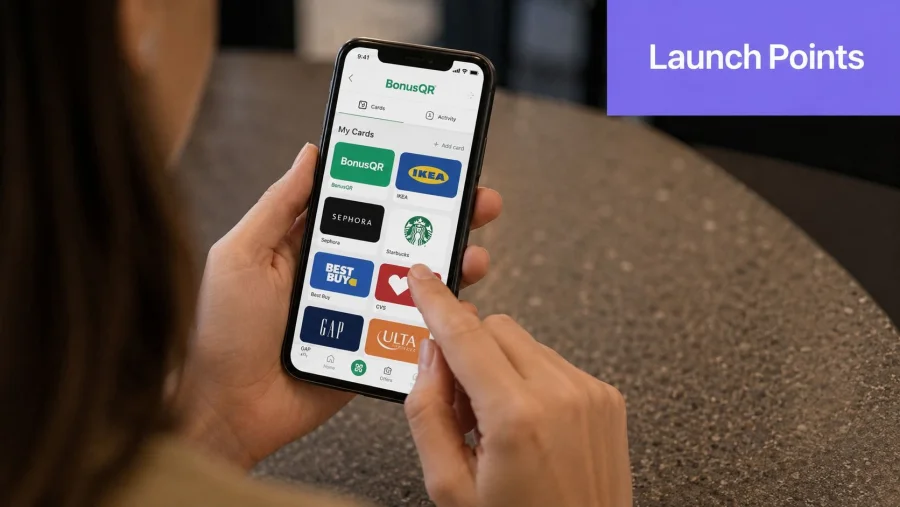
Customers scan a QR code at checkout to earn points, while staff use the app to confirm redemption. The owner can place the QR code on the counter, receipts, menus, appointment reminders and social posts. Wallet passes can keep the offer visible without requiring customers to carry a paper card.
Promote the behaviour, then read the evidence
Staff need one sentence that explains the programme and one sentence that explains redemption. A café might say, “Scan after payment to collect points,” followed by, “The app will show when the next reward is available.” Avoid explaining every future promotion at the counter.
After launch, monitor participation, points issued, rewards claimed and repeat visits. Look for customers who earn but don't redeem, customers who redeem once and disappear, and quieter periods where a multiplier could change demand. Adjust one variable at a time so the owner can identify what caused a change.
The Resorts World WiFi case study offers useful context for owners thinking about how digital customer experiences can support physical venues. It reinforces a practical point. The QR code should lead to a clear next action, not a crowded landing page.
Owners who need a detailed setup sequence can follow the BonusQR step-by-step loyalty guide. The first launch should be small enough for staff to operate confidently and specific enough for the data to mean something.
Common Pitfalls, UK Tax Rules and Privacy Essentials
Breakage is the quiet failure of loyalty. Customers earn points but never use them because the threshold is too high, the expiry is unclear or the account is hard to access. UK coverage says over a quarter of supermarket loyalty points go unredeemed annually, worth about £3 billion, as reported in UK coverage of forgotten supermarket loyalty points. A small business should not copy a scheme that depends on customers forgetting.
The fix is operational rather than clever:
- Show progress: Display the current balance and next reward clearly.
- Keep thresholds reachable: The first reward should arrive within a realistic customer cycle.
- Explain expiry: Put the rule in the sign-up flow and customer terms.
- Train the till team: Give staff a consistent scan and redemption script.
- Audit the margin: Recheck the reward cost whenever the earn ratio changes.
HMRC and VAT require a clean distinction
HMRC guidance says air miles, credit card points, petrol tokens and similar rewards generally aren't taxable when an employee acquires them in the same way as any other member of the public. A tax charge can arise when the reward is provided because of employment rather than through a public scheme, according to HMRC employment income guidance.
HMRC also states that prizes, awards or other incentives provided by a trader may be taxable for the recipient, as explained in HMRC business income guidance. A pure customer loyalty benefit can differ from a promotional giveaway, so owners should document the programme's purpose and ask an accountant about unusual rewards.
VAT treatment can change when points convert into vouchers. UK rules specifically direct businesses to section 8 of VAT Notice 700/7 when a collector exchanges points for face-value vouchers, according to HMRC guidance on business promotions and VAT. The conversion flow should be reviewed before launch.
UK GDPR applies to the customer record
If the programme collects a name, email address or phone number, UK GDPR applies and the customer must receive a privacy notice at sign-up. Customers also need a genuine, informed choice about joining, according to UK loyalty programme GDPR guidance.
Loyalty participation and marketing permission should be separate choices. A customer can collect points without agreeing to every promotional message. The owner should also limit data collection to what the scheme needs, record the lawful basis and provide a practical way to manage preferences.
Your Shortlist for Building a Programme That Actually Gets Used
A working programme needs fewer decisions than most owners expect. The business should reward one behaviour, set an earn rate inside its margin ceiling, choose one reachable redemption milestone and use software that records every transaction.
The popular scheme isn't automatically the active scheme. UK reporting says 80% of UK consumers used at least one loyalty scheme in 2025, while 55% belonged to four or more schemes and 58% had actively used only three or fewer in the past six months, according to Mintel-linked UK customer loyalty reporting. Customers can belong to many programmes while actively using very few. Simplicity is the competitive advantage for a small business.
Final design test: If staff need a paragraph to explain earning and customers need a calculator to understand redemption, the programme is too complicated.
The recommended operating rhythm is straightforward:
- Launch small: Start with one earning rule and one first reward.
- Measure monthly: Track redemption rate and repeat-visit frequency.
- Iterate quarterly: Change the threshold, multiplier or reward only after reviewing the evidence.
- Keep terms visible: Make expiry, exclusions and reward conditions easy to find.
The next action is practical. This week, the owner should create a BonusQR points programme, choose the first reward, test one complete earn-and-redeem transaction with staff, and place the QR code at the checkout. A live, measurable scheme will teach more than another month spent comparing paper cards with complicated enterprise programmes.
Choose the behaviour worth repeating in the business, set a reachable reward and launch the first BonusQR test this week. The sooner customers can earn and redeem clearly, the sooner the owner can replace guesswork with real loyalty data.


