Launch a points-plus-stamp hybrid with QR enrolment at checkout, automated email re-engagement, and a welcome bonus on the first visit. That combination covers the three things a working restaurant customer loyalty programme needs: a frictionless sign-up, a reason to return, and a channel to bring lapsed guests back.
Your immediate next steps:
- Pick one pilot location with consistent footfall and a team willing to ask every guest to scan.
- Set up QR enrolment at the till so sign-up takes under ten seconds.
- Launch a welcome offer (a free item or double points on the first stamp) to convert the first visit into a second.
Pro Tip: Before you configure anything, write down one commercial goal: “I want 20% of weekly covers to be loyalty members within 90 days.” A single measurable target keeps every design decision grounded.
Why a loyalty programme is worth the investment for restaurants
Repeat guests are simply more profitable than new ones. They spend more per visit, require less marketing to bring back, and are more likely to recommend you to others. The commercial logic is straightforward, but the numbers make it concrete.
Top-performing operators drive 30–37% of all transactions through loyalty members. That is not a marginal uplift; it means more than a third of revenue flows through a channel you own and can influence directly. For a restaurant running tight margins, that kind of predictable demand changes the economics of the business.
Reported loyalty programme ROI commonly falls between roughly 4.8x and 5.3x, though these benchmarks are self-reported and variable. Treat them as directional, not guaranteed. The real value lies in customer lifetime value (CLV): a guest who visits twice a month instead of once is worth dramatically more over a year, even before you account for referrals.
The four KPIs to track from day one:
- Penetration rate — what percentage of your covers are loyalty members? Aim for 20% within the first 90 days.
- Active rate — of enrolled members, how many transacted in the last 90 days? Below 40% signals an activation problem.
- Redemption rate — are members actually using their rewards? Low redemption means the offer is not compelling enough.
- CLV uplift — compare average annual spend for members versus non-members. This is your headline ROI figure.
Membership alone is not enough. European markets show rising enrolment figures but softening emotional connection in some segments, which means passive sign-ups do not automatically translate to incremental revenue. Activation is the real work.
Programme types and reward mechanics to consider
Choosing the right mechanics for your concept is more important than choosing the most sophisticated technology. Here is a practical breakdown of the main models.
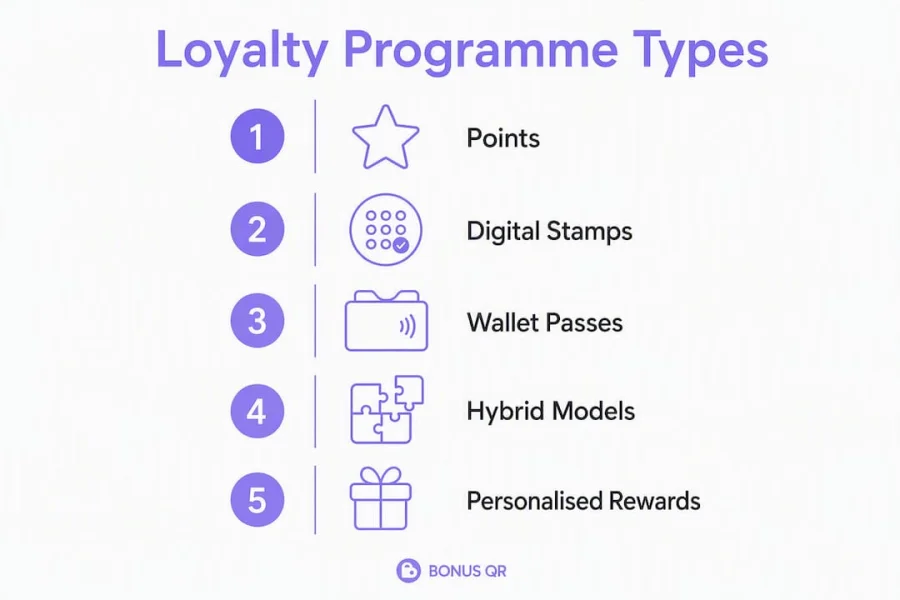
| Programme type | Best fit | Margin impact | Complexity | Customer appeal |
|---|---|---|---|---|
| Points (spend-based) | Full-service restaurants, multi-site | Medium | Medium | High — clear value exchange |
| Digital stamp card | Cafés, QSRs, fast casual | Low | Low | High — simple and visual |
| Tiered (status levels) | Multi-site, higher spend concepts | Medium | High | High — aspirational |
| Subscription / membership | Regulars, high-frequency concepts | Low ongoing | Medium | Medium — suits committed guests |
| Referral | Any concept at launch | Low | Low | Medium — social proof driver |
| Cashback | Retail-adjacent, grocery-café hybrids | High | Low | High — transparent |
| Hybrid (points + stamp) | Most restaurants | Medium | Medium | Very high |
Earning and redemption rules matter as much as the model itself. A points programme where 100 points equals €1 off a €20 bill is easy to understand. A programme where guests need to decode a conversion table will see low redemption and low engagement.
Key operational mechanics to define before launch:
- Earn rate: points per euro spent, or stamps per visit.
- Redemption threshold: the minimum balance required to redeem (e.g. 500 points = €5 reward).
- Expiry policy: points that expire after 12 months of inactivity prevent liability build-up.
- Stacking rules: decide whether a loyalty reward can be combined with a promotional discount. Most operators cap this at one discount per transaction.
Wallet passes change the UX significantly. Apple Wallet and Google Wallet allow guests to store their loyalty card directly on their phone’s home screen, without downloading a dedicated app. For Central European markets where app fatigue is real, this reduces the friction between sign-up and first use considerably. A pass can display current points balance, push a notification when a reward is ready, and update automatically after each visit.
Pro Tip: Start with a digital stamp card if your concept has a clear frequency driver (e.g. daily coffee, weekly lunch). Add points on top once you have enrolment momentum. Launching both simultaneously creates confusion for staff and guests alike.
How to design your programme step by step
A well-designed programme is built backwards from a commercial goal, not forwards from a feature list. Follow this sequence.
-
Define your commercial goal and budget. Set a penetration target (e.g. 25% of monthly covers enrolled within six months), a retention target (e.g. 60% of enrolled members visit again within 60 days), and a maximum cost-per-redemption you can absorb without hurting margin.
-
Choose your mechanics and enrolment flow. Decide on the programme type (see above), then map the enrolment journey: QR code at till → mobile web form → welcome push notification. QR enrolment under ten seconds at the point of sale is the proven standard. Every additional step you add reduces conversion.
-
Write your earning and redemption rules explicitly. Do not leave these vague. Example: “Guests earn 1 point per €1 spent. 500 points = €5 reward. Points expire after 12 months of inactivity. Rewards cannot be combined with other promotional discounts.”
-
Set your welcome offer. A first-purchase bonus (double points, a free side, or a complimentary stamp) converts a curious sign-up into an engaged member. Keep it simple and deliverable by any member of staff.
-
Plan your communication sequence. At minimum: a welcome message (immediate), a nudge at day 14 if no second visit, and a re-engagement message at day 45.
Birthday offers and milestone rewards (e.g. “You’ve earned your 10th stamp!”) add emotional value without significant cost.
-
Brief your team. Staff asking guests to scan at checkout is the single most important driver of enrolment adoption. Write a one-sentence script: “Would you like to collect points on today’s visit? Just scan this code — it takes ten seconds.”
-
Select a pilot location. Choose a site with consistent footfall, a motivated manager, and a team willing to test new processes. Run the pilot for 90 days before rolling out.
90-day pilot checklist: Week 1–2: configure programme and train staff. Week 3–4: soft launch with QR codes at till and welcome offer live. Week 5–8: monitor enrolment rate daily, active rate weekly. Week 9–12: run first re-engagement campaign for members who have not returned. Review all KPIs at day 90 before deciding on full rollout.
Pro Tip: Set a staff enrolment target — for example, each shift should sign up at least five new members. Track it on a whiteboard in the kitchen. Friendly competition between shifts is one of the fastest ways to build enrolment momentum.
Technology options and integrations you need to understand
The technology decision shapes everything downstream: data ownership, integration complexity, and how quickly you can launch. There are three practical paths.
Integration patterns
Quick launch (no POS integration): The programme runs via a standalone mobile web app or QR code. Guests scan to enrol and to register visits. No connection to your POS is required. This is the fastest path to a live programme — often within days — and suits single-site operators or those testing the concept before committing to deeper integration.
Medium (POS plugin or API connection): Points or stamps are awarded automatically when a transaction completes at the POS. This removes the need for a separate scan at checkout and reduces staff friction. Integration typically takes two to six weeks depending on your POS provider.
Deep (custom API / headless loyalty): Full integration across POS, web ordering, delivery platforms, and CRM. Points accrue across every channel. This is the right path for multi-site operators with significant tech investment, but it requires developer resource and a longer timeline.
| Path | Launch time | Integration effort | Data ownership | Best for |
|---|---|---|---|---|
| Quick launch (no POS) | Days | None | Full | Single-site, pilot phase |
| POS plugin | 2–6 weeks | Low–medium | Full | Single or small multi-site |
| Custom API | 8–16 weeks | High | Full | Multi-site, high-volume |
Data ownership is non-negotiable. Every enrolment is a first-party data asset. First-party data underpins personalised targeting that increases year-on-year loyalty spend. If your loyalty platform does not give you direct access to your member database — including email addresses, visit frequency, and spend history — you do not own your programme. Delivery platform integrations, in particular, often retain guest data; a loyalty programme you control is the counterbalance.
Key channels to consider for real-time integration:
- In-store: POS or QR scan at till.
- Web ordering: loyalty sign-in at checkout so online orders earn points.
- Delivery platforms: limited integration options; focus on driving delivery customers to your owned channel via loyalty incentives.
- Apple Wallet and Google Wallet: pass updates push automatically when points change, keeping the programme visible without requiring the guest to open an app.
What a realistic implementation timeline and budget look like
Budgeting for a loyalty programme means accounting for platform costs, integration work, and the ongoing campaign spend that actually drives engagement. Here is a realistic breakdown.
Timeline by stage:
- Weeks 1–2 (Planning): Define goals, mechanics, and rules. Select platform. Brief legal/GDPR review.
- Weeks 3–4 (Setup): Configure programme, upload branding, set up enrolment flow and welcome offer.
- Weeks 5–6 (Integration): Connect POS or confirm QR-only launch. Test end-to-end enrolment and redemption.
- Weeks 7–8 (Staff training and soft launch): Train team, print QR materials, run a soft launch with a small group.
- Weeks 9–20 (Pilot): 90-day live pilot at one location. Monitor KPIs weekly.
- Weeks 21+ (Rollout): Expand to additional sites based on pilot results.
Typical cost components:
| Cost item | Single-site estimate | Multi-site estimate |
|---|---|---|
| Platform setup / onboarding | €0–€500 | €500 |
| Monthly SaaS subscription | €30/month | €150/month |
| POS integration (if required) | €0 one-off | €1,500 |
| Welcome offer cost (per member) | €1–€3 | €1–€3 |
| Monthly campaign / comms spend | €50–€200 | €200 |
For a single-site café or restaurant in Central Europe, a working programme is achievable for under €200 per month all-in during the pilot phase, assuming a quick-launch (no POS) approach. Multi-site rollouts with POS integration will require a more substantial budget, but the per-site cost falls as you scale.
Budget the welcome offer separately from platform fees. If you sign up 200 members in the first month and each welcome offer costs €2, that is €400 in acquisition cost — a figure worth tracking against the CLV of those members.
How to measure success and run optimisation experiments
Measurement is where most programmes stall. Operators launch, watch enrolment climb, and then stop looking at the numbers that actually indicate whether the programme is profitable.
Weekly metrics to watch:
- New enrolments per location.
- Active rate (members who transacted in the last 30 days).
- Redemption rate (rewards redeemed as a percentage of rewards issued).
Monthly metrics to review:
- Average spend per visit: members versus non-members.
- Retention rate: percentage of month-one members who transacted again in month two.
- CLV trend: is member lifetime value growing quarter on quarter?
Pro Tip: Set up a simple spreadsheet dashboard before you launch. Columns: week, new enrolments, active members, redemptions, average member spend, average non-member spend. Fifteen minutes of data entry per week will tell you more than any automated report in the first 90 days.
Over 70% of advanced loyalty campaigns use segmentation rather than blanket email blasts. Even basic segmentation — “members who have not visited in 45 days” versus “members who visit weekly” — produces meaningfully better results than sending the same message to everyone.
Three experiments worth running in the first six months:
- Welcome offer A/B test: trial a free item versus double points as the welcome bonus. Measure which drives a higher rate of second visits within 30 days.
- Redemption threshold test: lower the minimum redemption threshold for one month and measure whether active rate improves.
- Re-engagement timing test: send the lapsed-member message at day 30 for one cohort and day 45 for another. Compare return rates.
Cohort analysis is the tool that separates programmes that genuinely lift net revenue from those that simply discount existing orders. Group members by enrolment month and track their spend trajectory over six months. If loyalty members spend more per visit than they did before joining, the programme is adding value. If spend is flat but redemption cost is rising, you are discounting without driving incremental revenue.
Profitability rules of thumb and common pitfalls
A loyalty programme that costs more than it generates is a liability, not an asset. These guardrails protect your margins from the start.
Rules of thumb:
- Keep total redemption liability below 2–3% of programme revenue. If your members are redeeming at a rate that exceeds this, your earn rate is too generous.
- Cap stacking: one promotional discount per transaction, maximum. A guest combining a loyalty reward with a happy-hour discount and a referral bonus is a margin problem waiting to happen.
- Set a campaign budget ceiling: no single re-engagement campaign should offer a reward worth more than the average margin on the visit it is designed to trigger.
- Welcome bonuses should be deliverable at zero or near-zero food cost (a free coffee, a complimentary dessert) rather than a percentage discount, which scales with order size.
Common pitfalls:
- Overly generous launch offers. A “50% off your next visit” welcome bonus will fill the restaurant once and train guests to wait for discounts rather than pay full price.
- No enrolment process. Printing QR codes and hoping guests scan them without staff prompting produces single-digit enrolment rates.
- Poor staff engagement. If the team does not understand the programme or believe in it, they will not ask guests to join. Training is not optional.
- Fragmented data. Running loyalty through one platform, email through another, and delivery through a third means you cannot connect behaviour to outcomes. Consolidate data ownership early.
Red flag checklist for early metrics: If enrolment rate is below 5% of covers after four weeks, your QR placement or staff script needs fixing. If active rate drops below 30% after 60 days, your welcome offer is not compelling enough to drive a second visit. If redemption rate is above 15%, review your earn rate immediately — you may be giving away more than you intended.
Pro Tip: Run a monthly “margin check” on your loyalty programme: total rewards redeemed (at cost) divided by total member revenue. If that ratio is climbing above 3%, tighten your earn rate or add an expiry policy before the liability compounds.
Legal and data-protection checklist for Central Europe
Launching a loyalty programme in Central Europe means operating under the General Data Protection Regulation (GDPR), which applies across all EU member states and EEA countries. Non-compliance carries real consequences, from regulatory fines to damaged member trust.
GDPR essentials:
| Requirement | What it means in practice |
|---|---|
| Lawful basis for processing | Most loyalty programmes rely on contract (membership T&Cs) for transactional data and consent for marketing communications. |
| Consent for push/email | Opt-in must be freely given, specific, and documented. Pre-ticked boxes are not valid consent under GDPR. |
| Data retention limits | Define and publish how long you retain member data. Inactive members should be flagged for deletion or re-consent after a defined period (commonly 24 months). |
| Data portability | Members have the right to request their data in a portable format. Your platform must support this. |
| Right to erasure | A member who asks to be deleted must be removed from all systems, including marketing lists and analytics databases. |
Voucher and tax reminders (Central Europe):
| Redemption model | VAT / accounting note |
|---|---|
| Points redeemed for a discount on a purchase | Typically reduces the taxable value of the transaction; consult your local tax adviser for the applicable treatment in your jurisdiction. |
| Free item reward (gift-in-kind) | May be treated as a supply for VAT purposes depending on cost and jurisdiction. |
| Cashback to a wallet | Treatment varies by country; some jurisdictions treat this as a financial service. |
This is general information, not legal or tax advice. Confirm current rules with a qualified adviser in your jurisdiction before launching.
What to include in your T&Cs:
- Programme name, operator details, and contact information.
- How points or stamps are earned and redeemed, including expiry rules.
- Stacking and exclusion rules (which products or promotions are excluded).
- How member data is used and the lawful basis for each processing activity.
- How members can request data access, portability, or erasure.
- Programme amendment and termination rights.
Across Central European jurisdictions, the core GDPR obligations are consistent, but national supervisory authorities (such as the UOOU in the Czech Republic, NAIH in Hungary, or UODO in Poland) may have specific guidance on consent mechanisms and retention periods. Check with local counsel before launch.
Proven campaign ideas and ready-to-copy examples
The best loyalty programme ideas for restaurants are simple enough for any staff member to explain in one sentence and compelling enough to change a guest’s behaviour.
-
First-purchase bonus. Award double points or a free item on the first loyalty transaction. Push notification copy: “Welcome! You’ve earned 100 bonus points on your first visit. Your next coffee is on us at 500 points.” Best for: cafés and QSRs.
-
Weekday frequency boost. Award extra stamps on Tuesday and Wednesday to shift demand from peak to shoulder periods. Email copy: “Quiet week? Not for our loyalty members. Earn double stamps every Tuesday and Wednesday this month.” Best for: full-service restaurants with a clear weekend peak.
-
Menu-item tie-in. Attach bonus points to a specific dish you want to promote (a new menu item or a high-margin line). Push copy: “Try our new seasonal risotto and earn 3x points this week only.” Best for: any concept launching a new menu.
-
Referral reward. Give both the referrer and the new member a bonus when the new member completes their first visit. SMS template: “Share your loyalty code with a friend. When they visit, you both earn 200 bonus points.” Best for: any concept at launch or when enrolment has plateaued.
-
Birthday perk. Send a personalised offer in the member’s birthday month. Email copy: “Happy birthday! A free dessert is waiting for you this month — just show your loyalty card when you order.” Best for: full-service restaurants; high emotional impact at low cost.
-
Milestone reward. Trigger a surprise reward at a visit milestone (e.g. 10th visit, 1,000 points). Push copy: “You’ve just hit 1,000 points! A €5 reward is now in your wallet.” Best for: all concepts; drives the “just one more visit” behaviour.
-
Location-based push. Send a time-sensitive offer when a member is near your location during a slow period. Push copy: “You’re nearby! Come in before 3 PM today and earn double stamps.” Best for: urban locations with high foot traffic.
Pro Tip: For customer retention strategies that compound over time, combine a birthday perk with a milestone reward in the same communication sequence. A member who receives a surprise reward and a birthday offer in the same month has two reasons to visit, not one.
How Bonusqr maps to the design checklist
Bonusqr covers every stage of the checklist above without requiring POS integration to get started, which makes it a practical choice for restaurants in Central Europe that want to pilot quickly.
Feature mapping:
| Checklist item | Bonusqr feature |
|---|---|
| QR enrolment at till | QR code-based sign-up via mobile web app — no app download required |
| Points and stamp card | Both modules available; configurable earn rates and redemption thresholds |
| Welcome offer | Onboarding promo module with configurable first-visit bonus |
| Push and email notifications | Built-in push and email automation for welcome series, re-engagement, and milestone triggers |
| Apple Wallet and Google Wallet | Native pass support; balance updates automatically after each transaction |
| Analytics and KPI tracking | Real-time dashboard covering enrolment, active rate, redemption, and spend |
| Branding and white-label | Full brand customisation; white-label app available for larger operators |
| Referral and review modules | Built-in referral incentive and review request workflows |
Sample pilot configuration using Bonusqr:
- Day 1: Set up a stamp card (6 stamps = free item) and a points module (1 point per €1 spent).
- Day 2: Configure a welcome offer (double points on first visit) and a re-engagement trigger (push notification at 45 days of inactivity).
- Day 3: Generate QR codes for till placement and brief staff on the one-sentence sign-up script.
- Week 2: Go live. Monitor enrolment daily via the Bonusqr dashboard.
- Week 6: Run the first segmented campaign to members who have not returned since their welcome visit.
Bonusqr’s loyalty system features include electronic rewards and coupon workflows that suit both quick-launch and POS-integrated deployments, covering the full range of programme types described in this guide.
Pro Tip: Use Bonusqr’s push notification module to send a “your reward is ready” message the moment a member hits their redemption threshold. That single automated message, sent at the right moment, is consistently one of the highest-converting touchpoints in any loyalty programme.
Key takeaways
A restaurant customer loyalty programme generates measurable ROI only when it combines frictionless enrolment, a compelling welcome offer, and consistent activation campaigns — not enrolment alone.
| Point | Details |
|---|---|
| Launch a hybrid programme | Combine points and a digital stamp card for maximum guest appeal and operational simplicity. |
| Prioritise enrolment speed | QR sign-up under ten seconds at the till, with staff actively asking every guest, is the proven standard. |
| Track three core metrics | Monitor penetration rate, active rate, and CLV uplift weekly in the first 90 days. |
| Protect margins from day one | Set redemption caps, stacking rules, and a campaign budget ceiling before you go live. |
| Bonusqr for quick launch | Bonusqr supports QR enrolment, Apple/Google Wallet passes, and automated campaigns with no POS integration required. |
What actually separates programmes that work from those that don’t
Most restaurant managers who struggle with loyalty programmes are not struggling with the technology. They are struggling with the gap between signing someone up and getting them to come back a second time.
The conventional wisdom says that a generous welcome offer solves this. It does not. A guest who joins for a free coffee and never returns was never going to be a loyal customer — the offer just made the acquisition cost visible. The programmes that compound over time are the ones where the second visit is easier than the first, and the third easier than the second. That means the communication sequence matters more than the launch offer, and the staff script matters more than the platform.
Personalisation without clear benefit feels intrusive to guests. The best operators explain the benefit at the moment of sign-up: “You’ll get a free dessert on your birthday and a reward every time you hit 500 points.” That sentence does more for activation than any push notification sent three weeks later.
One practical tip that consistently improves enrolment: put the QR code on the receipt, not just on a table tent. Guests who are paying attention at the end of a meal are more receptive than guests who are mid-conversation. And a receipt QR code works even when the staff member forgets to ask.
Pilot small, measure honestly, and iterate. A 90-day pilot at one location will tell you more than any amount of planning.
Bonusqr makes it straightforward to launch your first programme
Restaurants that want a working loyalty programme without a lengthy IT project have a clear path with Bonusqr. The platform lets you configure a points system, a digital stamp card, and automated push notifications in a matter of days, with no POS integration required to get started. Apple Wallet and Google Wallet passes are included, so members carry their loyalty card on their phone from the moment they sign up.
For a single-site café or a small restaurant group in Central Europe, the freemium tier covers the basics of a pilot. Larger operators can move to a premium subscription or a white-label app as the programme scales. Every plan gives you direct access to your member data, which means you own the relationship.
The concrete next step: register on Bonusqr and configure your first stamp card or points module. The setup takes less time than writing your first campaign email.
Useful sources and further reading
The following resources informed this guide and are worth consulting directly for deeper research.
- Paytronix 2025 Loyalty Report — annual benchmarks on loyalty check sizes, member acquisition rates, and engagement trends across restaurant concepts.
- Paytronix Loyalty Trends Report 2024 — the source for the 30–37% transaction share benchmark cited in this guide.
- GDPR consent for loyalty programmes (Brandfire) — practical guidance on consent mechanics, data retention, and GDPR compliance for loyalty operators in the EU.
- 7 loyalty programme ideas to boost customer value — external perspective on reward structuring and customer value strategies.
- Bonusqr: digital loyalty strategy guide for restaurants — strategic framework for digital loyalty programmes, with restaurant-specific examples.
- Bonusqr: customer loyalty programmes — complete guide — overview of programme types, mechanics, and implementation considerations.
For jurisdictional questions on GDPR, voucher VAT treatment, or consumer law in your specific Central European market, consult a qualified local legal or tax adviser. Regulatory requirements vary by country and are updated periodically.


