Referral Program Terms: What to Include and How to Write Them

Good referral program terms answer six questions in plain language: who can take part, what counts as a valid referral, what the reward is, when it is paid, what gets a reward withheld, and how you can change or end the program. If a participant can find all six answers in one short page, most disputes never start.
This guide walks through each clause, shows real payout timelines from published programs, and gives you wording you can adapt. It is written for owners of cafes, shops, gyms, salons and other small businesses who want a referral program that rewards loyal customers without creating legal or accounting headaches. It is general business information, not legal advice. Have a lawyer licensed in your state review the final text.
Key Takeaways
- Define the qualifying action precisely (for example, a first paid order over a set amount that is not refunded), because vague wording like “friend signs up” invites arguments about whether a reward is owed.
- Publish a verification period before rewards are released. Published programs use periods from 15 to 45 days to cover refunds, chargebacks and fraud checks.
- Add clauses for self-referrals, fake accounts, spam, reward clawbacks, caps, expiry, taxes, data use and the right to change or end the program.
- Require participants to disclose that they are rewarded when they promote you publicly, and keep the rule in writing.
- Keep the terms short, readable and linked from every place the program is promoted.
What Referral Program Terms Need to Cover
At minimum, written terms should explain eligibility, what counts as a valid referral, how and when rewards are paid, when you can withhold or claw back a reward for fraud, refunds or cancellations, prohibited behavior such as self-referrals and spam, your right to change or end the program, disclosure of compensation, tax responsibility, liability and data use, according to Referral Earl’s guide to referral clauses. A separate legal checklist published in May 2026 adds that the terms should say whether rewards are capped, how long a referral stays valid, and what happens if the referred customer cancels, gets a refund or files a chargeback.
For a small business, that translates into a one-page document with these headings:
- Program overview
- Who can participate
- What counts as a valid referral
- The reward
- When rewards are issued
- Limits, caps and expiry
- Fraud, abuse and prohibited conduct
- Disclosure when promoting publicly
- Taxes
- Privacy and data
- Changes, suspension and ending the program
- Governing law and contact details
You do not need legalese. Plain English is easier to enforce, and an Australian legal guide for small businesses recommends defining the offer and eligibility in plain terms, including reward type and timing, minimum spend, excluded products, customer status, geographic limits, one-per-person limits, abuse prevention, expiry and caps. The jurisdiction is Australian, but the checklist of decisions applies to any small business.
Eligibility: Who Can Refer and Who Can Be Referred
Start by saying who can send referrals and who can receive them. Real programs show the range of choices.
- Upwork’s referral terms require participants to be natural persons, U.S. citizens or residents, and at least 18.
- OUCU Financial’s program requires the referring member to be 18 or older and in good standing. Referred members must be 18 or older, must not be current members or have been members in the previous 12 months, and must meet account criteria within 90 days of joining.
You are probably not running a credit union, so keep yours simpler. For a cafe or retail loyalty program, a workable eligibility clause covers four points:
- The referrer is an existing customer with an active loyalty account.
- The referred person is a new customer who has never had an account with you.
- Employees, owners and their household members are excluded, or limited to a separate staff program.
- The program is open only in the places where you actually operate or where local rules allow it.
Sample wording: “To refer a friend, you must have an active account with us. A referred friend must be a new customer who has not previously held an account or made a purchase under their name, phone number or email address. You cannot refer yourself, and you cannot refer members of your own household.”
That last sentence matters in small communities, where a spouse or roommate often shares a phone and a loyalty card.
Defining a Valid Referral
This is the clause that decides most disputes. Vague definitions like “friend signs up” invite arguments about whether a reward is owed, and the qualifying action should be defined exactly, such as a new customer using a unique link or code, completing a first purchase above a minimum amount, or staying active past a trial period, as Referral Earl explains.
A good definition has four parts:
- How the referral is tracked. A unique link, a code, or a QR scan tied to the referrer’s account.
- The qualifying action. A first paid purchase, a booking completed, a membership activated.
- The minimum. A spend threshold, if you want one, such as a first order of $15 or more.
- The window. The number of days the friend has to complete the action after being referred.
The Upwork terms illustrate the structure. A qualified referral requires the referrer to share a unique link or code, the referee to register through it, and the referee to complete the contract step within a designated time frame. Everything is tied to a trackable event, not a promise.
How tracking and crediting should be described
Tell participants how a referral is credited, and what happens if two people claim the same friend. Attribution rules are standard in any recurring-commission affiliate program too: a unique link or code identifies who sent the customer, and the first valid attribution wins. Say the same in your terms: “If a new customer enters more than one referral code, the reward goes to the first code recorded on their account.”
Also state what does not count: referrals made by posting codes on coupon sites, paid ads that use your brand name, or mass messaging, if you want to prohibit them.
Rewards: What You Offer and When a Participant Qualifies
Spell out the reward in exact terms. Referral Earl’s template advises stating whether the reward is cash, store credit, a discount code or a free product, its exact value, its expiration date, and whether it is one-time or repeatable. An example it gives for the trigger: the reward is issued when the referred friend completes a first paid order of a stated amount, and the order is not refunded or charged back within 30 days.
For small local businesses, rewards usually take one of these shapes:
| Reward type | Example | Best fit | Terms to specify |
|---|---|---|---|
| Store credit | $5 credit for each friend who makes a first purchase | Retail, cafes, grocery | Expiry, no cash value, non-transferable |
| Discount for both sides | 15% off for the friend, 15% off for the referrer | Restaurants, salons | One use per customer, excluded items |
| Points or stamps | 50 bonus points per qualified referral | Any loyalty program | Point value, expiry, reversal rules |
| Free product or service | A free coffee or a free class after three referrals | Cafes, gyms, wellness | Which items, how to redeem, cap |
| Tiered reward | More value at 1, 3 and 5 referrals | Programs with advocates | How tiers reset, how progress is counted |
The tiered pattern is common in published incentive guides. One example ladder gives $10 store credit for one referral, $30 plus a bonus gift for three, and a free product or exclusive membership for five. If you want more ideas on structuring the reward itself, our guide to customer incentive ideas compares options, and the one on offering cashback rewards covers cashback in more depth.
Whatever you choose, add three limits in writing: a cap per person (for example, ten rewarded referrals per calendar year), an expiry for unused rewards, and a statement that rewards have no cash value unless you say they do.
Reward Delays: Why They Happen and What Timeline to Disclose
Referral rewards are held back because a sale is not final the moment it happens. Refunds, cancellations, failed payments and chargebacks can all unwind it. Referral Earl notes that many programs hold payouts until the refund window closes, so a canceled order does not leave the business paying for a sale that never really happened.
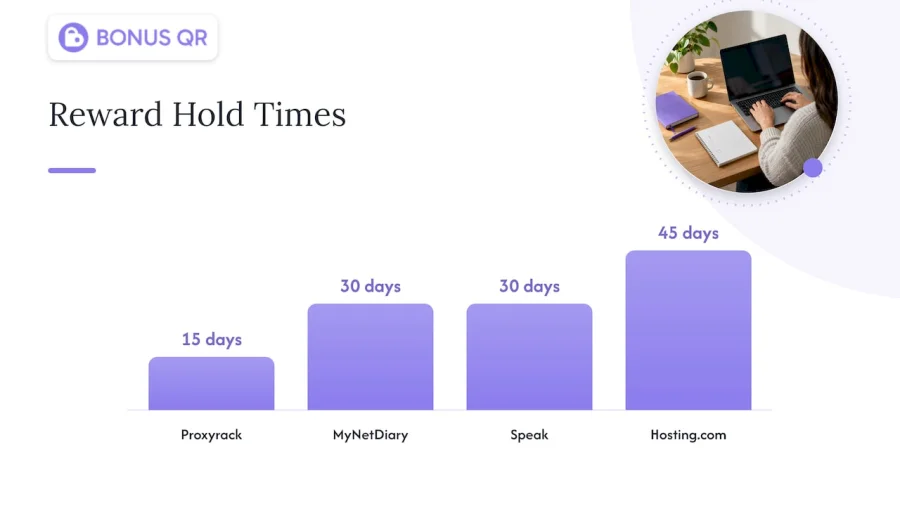
Published programs show how long that hold typically lasts:
| Program | Hold or payout timeline | What can cancel the reward |
|---|---|---|
| Proxyrack | Pending for 15 days after the referred customer’s eligible payment | Refund or dispute |
| MyNetDiary | 30-day verification period from the referred user’s first paid charge | Cancellation, refund, chargeback or failed payment |
| Speak | Reward 30 days after the friend’s payment, with a 30-day review | Refund, stopped installments, suspected fraud, local legal limits |
| Hosting.com | Pending for 45 days, then reviewed; payouts each Thursday | Refund, chargeback, fraud; minimum balances of $100 for PayPal and $200 for wire |
| Mercury | Payout up to 5 weeks after the qualifying criteria are met | Missing tax identification or documentation can delay payment |
These are online and financial services with digital payouts, and they are useful benchmarks, not rules. For a business that rewards with store credit or points, the hold can be shorter, often matching your own return window. The principle is the same: pick a verification period, publish it, and apply it to everyone.
Sample wording: “Rewards are issued 14 days after your friend’s first qualifying purchase, once the return period has ended. If the purchase is refunded, canceled or disputed before then, the referral no longer qualifies. We may delay a reward while we review a suspected violation of these terms.”
Two habits cut down on complaints about delays. First, show the status in the customer’s account (pending, approved, expired). Second, tell the referrer the date the reward is expected, not just “soon.”
Fraud, Duplicates, Reversals and Prohibited Conduct
Put abuse prevention in the legal text, not only in your admin settings. An attorney-authored checklist argues that a clear anti-abuse clause gives you leverage when the program scales and edge cases become inevitable. It suggests prohibiting fake accounts, self-referrals, paid traffic manipulation unless expressly permitted, and spammy outreach that breaks platform rules, while reserving the right to withhold payment for suspicious activity, claw back rewards after refunds or chargebacks, and ask for documentation.
A compact abuse clause for a small business covers:
- Self-referrals and household duplicates. Not allowed; one reward per person and per household.
- Fake or duplicate accounts. Rewards may be withheld or cancelled, and accounts closed.
- Spam. No unsolicited mass messages, no posting codes on public coupon sites.
- Reversals. If a qualifying purchase is refunded, charged back or voided, the reward is removed, and any redeemed value may be deducted from future rewards.
- Final decisions. You decide whether a referral qualifies, acting in good faith.
Keep the tone factual. Customers should read this as clear house rules, not an accusation.
Disclosure, Taxes and Privacy
Disclosure when participants promote you
If participants share your link on social media or a blog, the audience should know they are rewarded. Referral Earl points to FTC endorsement guidance as the basis for requiring participants to disclose that they will be compensated. Add a sentence such as: “If you share your referral link publicly, you must clearly state that you receive a reward for referrals.” Our article on incentivized reviews and what Google and the FTC allow covers the related rules when rewards are tied to reviews.
Taxes
In the U.S., referral rewards can count as income. A bank’s published terms say referral incentives are taxable income reported to the IRS, with a 1099 form issued in the year the incentive is earned. OUCU Financial says members with annual referral awards of $2,000 or more receive a 1099-MISC. Payroll providers report that the federal reporting threshold for 1099-MISC and 1099-NEC rose from $600 to $2,000 for payments made starting in 2026. Whether your program triggers reporting depends on the reward type and amounts, so ask your accountant. In the terms, keep it simple: “Participants are responsible for any taxes that apply to rewards they receive.” If you pay cash rewards at volume, add that you may need a tax form before paying out, as Mercury does.
Privacy and data
Say what you collect (name, email or phone of the referrer and, if you ask for it, the friend), why, and where your privacy policy lives. Do not let customers upload contact lists of friends unless your privacy policy and consent flow cover it. If you serve customers outside the U.S., the rules change: the GDPR applies to organizations targeting or monitoring individuals in the EU and requires a lawful basis, and Brazil’s LGPD covers individuals in Brazil. In the EU, the Omnibus Directive also prohibits fake reviews and endorsements of products offered to EU consumers. State the country whose law governs your terms.
Changing or Ending the Program
Reserve the right to modify, pause or end the program, and say how you will tell people. A fair version: “We may change these terms or end the program at any time. Changes apply to referrals made after the update is posted. Rewards already approved will be honored.”
The last sentence is a trust protector. It stops customers from feeling cheated when the program changes. In New Zealand, legal guidance warns that unfair contract terms can be a problem in standard-form consumer contracts under the Fair Trading Act, which is a good reminder that one-sided “we can do anything” language can backfire in many markets.
A Referral Policy Template You Can Adapt
Referral Earl’s template has nine sections: Eligibility, Qualifying Referral, Reward, Fraud and Abuse, Disclosure Requirement, Data and Privacy, Taxes, Modifications and Termination, and Governing Law. Here is a short version scaled for a local business. Replace the brackets and have a lawyer review it.
[Business name] Refer-a-Friend Terms
1. Eligibility. Open to customers with an active [Business name] loyalty account. Employees and household members of the referrer are not eligible to be referred.
2. Valid referral. A referral is valid when a new customer creates an account using your unique link, code or QR code and completes a first paid purchase of [$X] or more within [30] days.
3. Reward. You receive [reward] and your friend receives [reward]. Rewards have no cash value and expire [90] days after being issued.
4. Timing. Rewards are issued [14] days after the qualifying purchase, once the return period has ended.
5. Limits. Up to [10] rewarded referrals per person per calendar year.
6. Fraud and abuse. Self-referrals, fake accounts and spam are prohibited. We may withhold or reverse rewards for refunded, charged-back or suspicious purchases.
7. Disclosure. If you share your link publicly, say clearly that you earn a reward.
8. Taxes and privacy. You are responsible for taxes on rewards. We use your data as described in our Privacy Policy.
9. Changes. We may change or end the program at any time. Approved rewards will be honored.
10. Governing law. These terms are governed by the laws of [state].
Our Perspective
At BonusQR, we see the same pattern in small businesses: the referral idea is simple, but the rules live in someone’s head. A cafe owner knows a referral means a friend who buys a first coffee. The customer, the barista and the system each read it differently.
That is why we built our loyalty platform around rules that are defined once and applied automatically. Points, stamps, cashback, referral and review modules all run on the same logic, so a reward is issued when the conditions you set are met, with no POS integration required. When the terms say “first paid purchase,” the program is designed to follow the same definition.
Our advice is to write your terms first, then configure the program to match them. Short, specific terms plus automated tracking give you the best case for repeat visits and word of mouth, and they free you to focus on running the business.
Michal Palus
Turn Your Terms Into a Working Program
Terms only help if the program applies them consistently. With BonusQR you can run digital stamp cards, points, cashback, and referral and review modules from one platform, and customers join through a QR code. You can start on the Free plan, move to Basic at €19 per month or Premium at €69 per month as you grow, and compare what each includes on the pricing page. If you want the program inside your own branded app, see the white-label option. For restaurants, our guide to customer retention strategies shows where referrals fit alongside other tactics.
A Short Checklist Before You Publish
- The qualifying action is defined with an amount and a time window.
- The reward has an exact value, an expiry and a cap.
- A verification period is stated in days, and matches your refund policy.
- Self-referrals, duplicates, fake accounts and spam are prohibited.
- Disclosure, tax and privacy sentences are included.
- You reserve the right to change or end the program, and promise to honor approved rewards.
- The terms are linked at the point where customers get their referral link or code.
- A lawyer in your state has reviewed the final text.
FAQ
What should referral terms and conditions include?
At minimum: eligibility, a precise definition of a valid referral, the reward and its timing, fraud and abuse rules, a disclosure requirement, privacy and tax statements, and your right to change or end the program. Add caps and expiry so the cost of the program stays predictable.
How long should I make customers wait for a referral reward?
Match the wait to your refund or return window. Published programs use 15, 30 and 45 days, and one pays out up to five weeks after criteria are met. Whatever you choose, state it in days in the terms and apply it to everyone.
Can I use a free referral policy template?
Yes, as a starting point. Templates such as the one above cover the usual sections, but they cannot know your state, your reward type or your refund rules. Fill in the specifics and have a lawyer review the result before you launch.
Do referral rewards count as taxable income?
In the U.S., they can. Banks and other programs that pay cash rewards issue 1099 forms once totals pass a threshold, and the federal 1099-MISC and 1099-NEC threshold is $2,000 for payments made starting in 2026. For store credit or discounts, ask your accountant how they should be treated.
What if a customer refers themselves?
Prohibit it in the terms and say what you will do: withhold or reverse the reward and, for repeat abuse, close the account. A rule that is written down is far easier to apply fairly than one invented after the fact.
Sources
- Referral Program Terms: The Clauses You Can’t Skip (Referral Earl)
- Referral Program Terms and Conditions Template (Referral Earl)
- Legal Checklist for Referral and Ambassador Programs (businesslaws.xyz)
- How to Legally Structure a Refer a Friend Promotion (Sprintlaw Australia)
- Referral Programme Terms NZ (Sprintlaw New Zealand)
- Qualified Referrals (Upwork)
- Refer-a-Friend (OUCU Financial)
- MyNetDiary Referral Program Terms
- Mercury Customer Referral Agreement
- Hosting.com Refer a Friend Terms
- Proxyrack Referral Program FAQ
- Speak Referral Program Terms
- Grasshopper Bank Referral Program Terms and Conditions
- 1099 Reporting Thresholds: 2026 Changes Explained (OnPay)
- Data Privacy Laws by Country and U.S. State (CDP)
- The Omnibus Directive: Consumer Reviews (Mondaq)
- Referral Program Incentives Guide: Discounts vs. Rewards


