If you want to know whether you can reward customers for leaving a review, the short answer is this: on Google, no. Google’s policy prohibits offering incentives in exchange for reviews, and US regulators expect any incentive on other platforms to be disclosed and never tied to a positive opinion. The good news is that you can still build a steady stream of honest reviews, and reward loyalty at the same time, if you keep the two things separate.
This guide walks through what counts as an incentive, what Google and the FTC actually say, how rules differ in the UK and Australia, what happens when a business crosses the line, and how to design a review and rewards program that holds up.
Key Takeaways
- Google’s policy treats discounts, freebies and similar rewards offered for reviews as incentivized reviews, so rewarding Google reviews puts your Business Profile at risk.
- In the US, the FTC allows incentives for reviews on some channels only when the reward is not conditioned on a particular sentiment and the incentive is clearly disclosed.
- Never filter who you ask: selectively requesting reviews from happy customers is review gating, which Google and the FTC both discourage.
- The safest route is to reward visits and purchases through a loyalty program, and to ask for reviews in a separate, neutral message.
What counts as an incentivized review
Google defines an incentivized review as a review or rating influenced by a payment, discount, free goods or services, or any other benefit offered to the reviewer, as set out in its Maps contribution policy on incentivized or biased reviews. The definition is deliberately broad. It does not matter whether the reward is large or small, or whether you promised it before or after the review was written.
In practice, the rewards that count include discount codes, free products, loyalty points and entries into giveaways, according to the REVIEWS.io support documentation. That last category surprises many owners. A raffle entry for “everyone who leaves a review this month” feels harmless, yet it is still a benefit offered in exchange for a review.
Here are everyday examples that small businesses run into:
- A café posts a sign: “Show us your 5-star review and get a free cookie.”
- A salon texts clients a 10% coupon after they confirm that a Google review has been posted.
- A gym enters every reviewer into a monthly prize draw.
- A shop adds bonus loyalty points for each review submitted.
All four are incentivized reviews. The first one is also conditioned on sentiment, which makes it worse.
Incentive versus thank-you
The dividing line is the exchange. A genuine, unexpected thank-you after a review is still risky on Google, because the platform reads the outcome rather than your intent. A reward that has no connection to any review, such as a stamp for every visit, is ordinary loyalty. The rest of this guide is about keeping that distinction clean.
What Google’s policy prohibits
Google’s own guidance on getting more reviews is direct. Its Business Profile help page on tips to get more reviews says it strictly prohibits offering incentives, such as free or discounted goods or services, in exchange for posting, changing or removing a review. Google considers this fake and misleading content.
Three practical consequences follow.
- No rewards for Google reviews, positive or negative. Offering the same reward to everyone does not make it acceptable on Google. The “equal reward” approach you may read about applies to platforms that explicitly allow disclosed incentives.
- No review gating. Google prohibits review gating, and the FTC prohibits review suppression, as summarized in a review velocity study from Localo. Gating means steering unhappy customers to a private form and sending only happy ones to Google. Our reading of the guidance is simple: send the same review link to everyone you ask.
- No shared devices on site. One 2026 guidance summary reports that Google flags shared tablets, review kiosks and company devices as potential rating manipulation, so handing a customer your iPad at the register is a bad idea (Speedmobi’s review policy summary). Let customers use their own phones, at their own pace.
For a deeper look at why gating is such a common trap, this review gating policy overview for US firms explains how Google and FTC rules apply to it.
Asking is allowed
Nothing here stops you from asking. You can display a QR code at the counter, add a link to a receipt or send a follow-up message. What you cannot do is attach a reward to the act of reviewing. A good request is neutral: it thanks the customer for the visit and invites honest feedback, whatever it turns out to be.
What the FTC requires in the United States
The Federal Trade Commission approaches the issue from a consumer protection angle. Its business guidance says it is unwise to incentivize consumer reviews, and that knowledge of an incentive may be material to consumers reading them (FTC business blog, 2019). That guidance predates the current rule, but the logic holds: shoppers weigh reviews differently when they know the reviewer was rewarded.
The current framework is the FTC’s Consumer Reviews and Testimonials Rule. According to the agency’s questions and answers on the rule, businesses may give incentives for reviews as long as there is no express or implied requirement that the review express a particular sentiment. In other words:
- You cannot pay for positive reviews. A reward that depends on stars or praise is out.
- Implied conditions count. If your message hints that a good review will be “appreciated”, you have implied a requirement.
- Neutral rewards are possible, but disclosure matters. Where a platform permits them, the reward should be the same whether the review is glowing or critical.
How to disclose an incentive
A summary of FTC guidance from LegalCamp notes that disclosures should be clear and conspicuous rather than buried in fine print, and that the incentive can be disclosed in the review or in the solicitation message. A 2026 best-practice guide adds that disclosures work best in plain language and visible by default, not hidden behind tooltips, expandable menus or separate policy pages (Eevy’s disclosure guide). Treat these as practical guidance and confirm specifics with an attorney if you run a large program.
The Better Business Bureau is stricter
The BBB takes a harder line than the FTC. Its explainer on paid customer reviews says the FTC does not prohibit paid reviews when incentives are clearly and conspicuously disclosed, but that the BBB does not accept reviews from people who were offered or given compensation, even if disclosed. If BBB reviews matter to your reputation, never reward them.
How the rules differ outside the US
If you serve customers in several countries, the picture shifts. Each of these points is attributed to its country because none applies everywhere.
| Region | What the guidance says | Source |
|---|---|---|
| United States | Incentives allowed on some channels if not tied to sentiment and clearly disclosed | FTC |
| United Kingdom | Fake and concealed incentivized reviews are prohibited; guidance published April 4, 2025 | CMA guidance |
| Australia | Incentives must be offered equally regardless of whether the review is positive, and clearly disclosed | Western Australia Commissioner |
| European Union | Businesses must take reasonable, proportionate steps to ensure verified product reviews are genuine and describe their verification process | Klaviyo help center |
The common thread is disclosure and fairness. A reward for a review must be visible to readers, and it cannot depend on the verdict. If you are building a program for UK customers specifically, it also helps to understand how review signals affect search visibility and why the regulators care about trust in them.
Note that a country’s law permitting a disclosed incentive does not override a platform’s own rules. A practice that is legal can still get your Google reviews removed.
What happens when a business breaks the rules
Enforcement is real, and it operates on two tracks: the platform and the regulator.
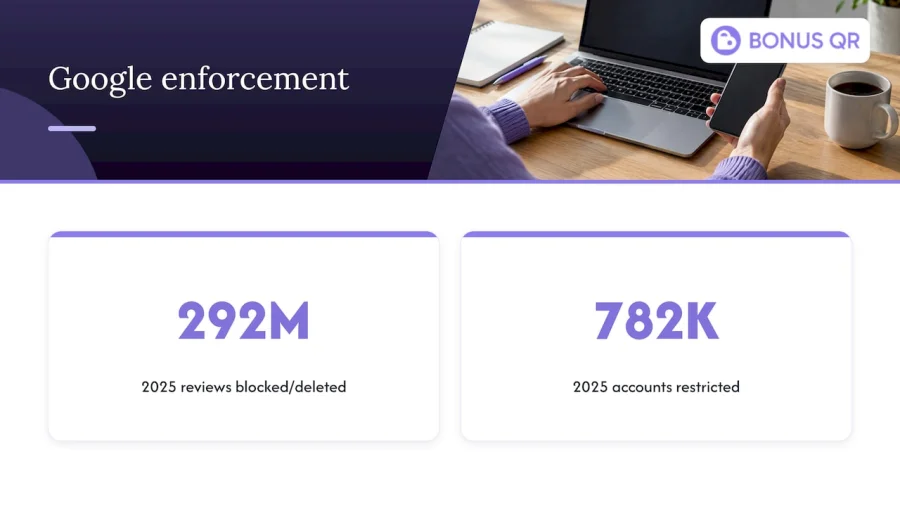
Platform action. Google reported that in 2025 it blocked or deleted 292 million reviews and restricted posting for 782,000 accounts for violating its fake engagement policies (Localo study). The same source notes that penalties can include batch review removal, posting restrictions, or suspension or deletion of a Business Profile. Another 2026 summary reports that Google’s systems look for patterns such as sudden spikes in reviews, staff names, and multiple reviews from one device or IP address (Speedmobi). A coupon campaign that produces thirty reviews in a weekend creates exactly that kind of spike.
Regulator action. In the UK, the Competition and Markets Authority secured changes from Google: warning alerts on the profiles of businesses found to boost ratings with fake reviews, deactivation of their review function, and deletion of all reviews for six months or more for repeat offenders. The CMA said businesses could also face investigation and, in future, fines (CMA announcement). In the US, the FTC’s 2024 rule bans fake reviews and gives the agency a basis to pursue violators.
For a small business, the most likely outcome is not a lawsuit. It is losing the reviews you worked hard to collect, plus the lost trust when a warning appears on your profile. That cost far outweighs a free cookie.
How to run a review rewards program without crossing the line
Many owners search for a “review rewards program” because they have already seen how well rewards drive behavior. The solution is to point the reward at something Google does not regulate: your customers’ visits, purchases and referrals.
Reward behavior, not reviews
A loyalty program gives points, stamps or cashback for buying. Every customer earns them whether or not they ever write a review. Because the reward is not connected to a review, there is no exchange for Google to object to. If you want ideas for what to offer, our list of customer incentive ideas covers formats from stamp cards to special-occasion rewards.
Ask for reviews in a separate, neutral moment
Keep the review request apart from any reward message. A simple sequence works well:
- The customer visits and earns points or a stamp as usual.
- A day or two later, a short message thanks them and shares your review link.
- The message mentions no reward, no discount and no expected rating.
- The same message goes to every customer, not a hand-picked group.
The last point matters. Klaviyo’s guidance says review requests should not be hand-selected based on expected positive ratings, and that honest reviews should be treated alike (Klaviyo help center).
Use private feedback for what it is good at
A private feedback form is not a public review, and it is a good place to learn what went wrong. The distinction is that you offer it to everyone, and you do not use it as a filter that decides who sees the Google link. Our guide to collecting customer feedback shows how to do that without gating.
If you reward reviews on a platform that allows it
Some platforms and your own website review system may permit disclosed incentives. If you use one, follow the common denominators from the sources above:
- Offer the same reward for every review, positive or negative.
- Tell reviewers in the request that the reward is for writing the review, regardless of sentiment, as one 2026 compliance guide recommends (Idukki).
- Disclose the incentive visibly next to the review.
- Keep the reward modest, because Eevy warns that a very large reward can make a review look bought (Eevy).
- Check that platform’s own terms first, and do not use this route for Google reviews.
A worked example
Imagine a neighborhood coffee shop with 400 regular customers. It used to hand out free pastries to anyone who showed a fresh review. Under Google’s policy, that is an incentive and has to stop. Instead, the shop moves to a stamp card: every tenth coffee is free, whether or not the customer has ever reviewed anything. Separately, a message goes out the day after each visit with a link to the Google profile and one line: “Tell us how we did.” Reviews arrive more slowly, but they are real, and no one can say they were bought.
A short compliance checklist
Before you send your next review request, check each item:
- Does the message promise nothing in return for a review?
- Are you sending the same link to every customer you ask?
- Are staff, relatives and friends excluded from reviewing?
- Are customers using their own devices rather than a shared tablet?
- Are you replying to negative reviews instead of trying to remove them? Offering anything to change or remove a review is also prohibited, per Google’s help page.
- If you use any disclosed incentive elsewhere, is it visible and equal for all reviewers?
Our perspective
We talk to small business owners every week who are tempted to buy reviews with a discount, and we understand why. Reviews feel like the front door of a local business, and growth can feel slow. But we see the same pattern in every sector we work with: reviews follow good experiences, and good experiences are repeated by customers who have a reason to come back.
That is why we build BonusQR around rewarding visits, not opinions. Points, stamps and cashback work from a QR code, with no POS system to integrate, so a café or a gym can start rewarding repeat behavior quickly. Because the reward is tied to the purchase, you stay on the right side of Google’s policy, and you gain something more useful than a handful of reviews: data on who comes back and when.
Our advice is to run two separate tracks. Let the loyalty program do the work of retention, and let a neutral, equal-for-all request handle reviews. If you ever feel the urge to connect them, remember that your rating is only worth something if a stranger can trust it.
— Michal Palus
Build the loyalty side with BonusQR
If you want a compliant way to reward customers, BonusQR lets you set up digital stamp cards, points and tiered cashback without extra hardware. You can start on the Free plan, move to Basic at €19 per month, or choose Premium at €69 per month for the full feature set; see the pricing page for what each plan includes. Pair it with automated notifications and you can send a neutral review request to every customer, without ever linking it to a reward.
For related reading, see how free and premium loyalty programs compare on customer spend data.
FAQ
Can you incentivize Google reviews?
No. Google’s policy prohibits offering incentives such as free or discounted goods or services in exchange for posting, changing or removing a review. This applies even if you give the same reward to every reviewer. Ask for reviews freely, but attach no reward to them.
Is an incentivized review legal in the US?
Often yes, but legality and platform rules are different questions. Under the FTC’s rule, incentives are acceptable when they are not conditioned on a particular sentiment, and the incentive should be clearly disclosed. Google and the BBB still do not accept incentivized reviews, so a legal incentive can still get reviews removed.
What is the difference between a review rewards program and a loyalty program?
A review rewards program pays or credits people for writing reviews, which is an incentive in Google’s definition. A loyalty program rewards purchases and visits, and every customer earns the same way whether or not they review. The second is the safer structure for Google reviews.
What should I do if a competitor offers rewards for reviews?
Do not retaliate in kind. Document what you saw, and report the suspicious reviews through Google Business Profile, since Google’s own support community notes that incentivizing reviews violates its policies. Then keep building your own reputation with honest requests.
Sources
- Incentivized or Biased Reviews, Google Maps contribution policy
- Tips to get more reviews, Google Business Profile Help
- Incentivized reviews, REVIEWS.io Support Centre
- It’s unwise to incentivize positive skewed reviews, FTC
- The Consumer Reviews and Testimonials Rule: Questions and Answers, FTC
- Review Solicitation: Legal Requirements and Platform Rules, LegalCamp
- Incentivized Reviews: How to Offer Rewards and Stay Compliant, Eevy
- Are paid customer reviews legal?, Better Business Bureau
- CMA208 Fake reviews guidance, UK CMA
- CMA secures important changes from Google to tackle fake reviews, GOV.UK
- From the Commissioner: The good, the bad and the fake, Government of Western Australia
- Best practices for collecting customer reviews, Klaviyo
- Buying Google Reviews Doesn’t Work: Review Velocity Study, Localo
- Google Just Banned 5 Review Tactics, Speedmobi
- Incentivising reviews without breaking platform policy, Idukki


