A referral program works best when it sits inside your loyalty program, not next to it. Your existing customers earn points, stamps or cashback for bringing in a friend. The friend gets a reason to try you, and the reward is released only after a verified first purchase or booking. This guide shows how to design that structure, which rewards to offer, how to track referrals without spreadsheets, and what to watch for on consent and disclosure.
Key takeaways
- Pay referral rewards through the loyalty currency you already run (points, stamps, cashback). Customers then have a reason to come back and spend the reward.
- Release a reward only on a clear trigger: a first purchase, a first booking or a completed sign-up. Never pay on a link click.
- Referred customers tend to be more loyal and more profitable than other customers, but the effect is uneven. Target the customers most likely to share instead of rewarding everyone equally.
- Automate tracking and reward delivery. Manual tracking leads to missed rewards and disputes, and both damage trust.
- Check consent, disclosure and data rules before you launch, especially if you contact the friend’s details later.
Why referrals and loyalty belong together
A loyalty program rewards the people who already buy from you. A referral program rewards them for bringing in the next buyer. Run separately, each solves half of the problem. Combined, one customer action (sharing) feeds the same reward balance that drives the next visit.
Two pieces of evidence explain why this is worth the effort.
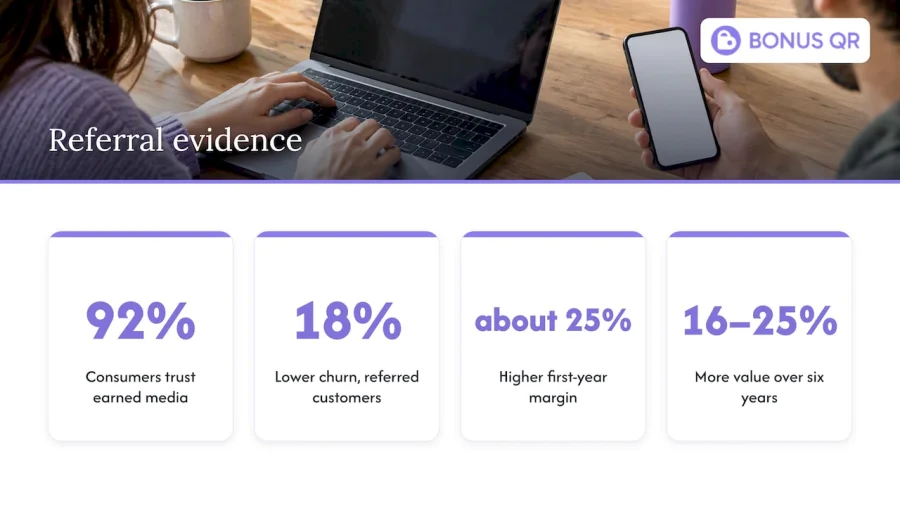
First, trust. Nielsen’s global surveys have repeatedly found that recommendations from people we know sit at the top of the trust ranking. Nielsen’s 2009 survey of more than 25,000 online consumers in 50 countries placed personal recommendations first, and a 2012 report on the same research put the share of consumers who trust earned media such as word of mouth at 92%. These figures are old and come from online panels, so read them as a direction, not as a promise for your neighborhood. The direction is consistent, though: a friend’s word beats an ad.
Second, value. A study of a leading German bank compared customers won through its referral program with other customers over three years. Referred customers showed an 18% lower churn rate and a contribution margin about 25% higher in the first year. A related Wharton-led study found referred customers 16% to 25% more valuable over six years. Both studies come from banking, where relationships last years. A cafe or a car wash will see different numbers, so test on your own customers before you assume the same lift.
The same Wharton research adds a caution that matters for small businesses: the effect is stronger among younger customers and weaker when you acquire older or low-margin segments. A referral program is not automatically profitable. It is profitable when the right people are referred.
Why referred customers stay
Researchers writing in the American Marketing Association’s summary of this work point to what they call social enrichment. A referred customer does not just arrive with a discount. They arrive with a guide: the friend who already knows your menu, your classes or your staff.
That has a practical consequence. If the referrer stops visiting, the social buffer disappears, and the referred customer’s loyalty may drift back to ordinary levels. So your program should do more than hand over a first-purchase coupon. It should move the new customer into their own relationship with you as quickly as possible. In practice that means:
- Enrolling the friend in your loyalty program at the first visit, so they start earning right away.
- Giving them a second-visit incentive, not only a first-visit one.
- Sending a short welcome message that mentions what they have already earned.
If you want a wider view of what keeps customers returning once they arrive, our partner-free overview of customer retention strategies covers the basics that a referral program builds on.
Choose a reward structure
Most referral programs fall into two shapes, as Salesforce’s guide to referral programs describes them.
| Structure | Who is rewarded | Best for | Watch out for |
|---|---|---|---|
| Double-sided | The referrer and the friend | Businesses that need new customers to take the first step, such as gyms, salons, restaurants | Costs more per successful referral |
| One-sided (referrer only) | Only the existing customer | Businesses with a strong brand and a high-value repeat purchase | The friend has little reason to act |
| One-sided (friend only) | Only the new customer | Simple welcome offers | Gives your current customers no reason to share |
For most small businesses, double-sided is the safest default. The referrer feels generous instead of salesy, and the friend has a tangible reason to visit this week and not someday.
Pick the reward type
Common rewards include discounts of 10% to 20%, store credit, cash and free service periods, according to the same Salesforce guidance. Within a loyalty program you have a better option than a standalone coupon: pay in the currency customers already collect.
- Points. Add a fixed number of points to the referrer’s balance. Works well where customers already have a points ladder.
- Stamps. Give a bonus stamp, or complete a stamp card, for a verified referral. Ideal for cafes, bakeries and car washes.
- Cashback. Credit a fixed amount toward the next purchase. Easy to understand, and it brings the referrer back to spend it.
- Fixed discount. A set amount off the friend’s first order, such as a welcome offer.
- Free product or service. A free coffee, a free class or a free add-on treatment. Low cost to you, high perceived value.
A practical rule: the reward should be worth enough to mention to a friend, but small enough that your margin on the new customer’s first two visits still covers it. Work it out before launch. If your average first-order margin is a few dollars, a reward worth ten dollars will lose money on every referral that does not turn into a repeat customer.
Set a clear trigger
The trigger is the event that releases the reward. The research behind Salesforce’s guidance names sign-up, first appointment and verified purchase as typical options. Choose one and state it in a sentence customers can repeat.
- Sign-up trigger. The reward is paid when the friend joins your loyalty program. Easy to track, but easy to game with throwaway accounts.
- First purchase trigger. Paid after the friend’s first completed transaction. The best balance for retail, food and grocery.
- First booking or appointment trigger. Paid after the friend attends, not just books. Best for gyms, salons, spas and service businesses where no-shows are common.
- Second visit trigger. Paid when the friend returns. Slower, but it pays only for a customer who actually came back, which is the outcome you want.
A two-step reward splits the difference. Give the friend a welcome reward on the first purchase, and pay the referrer once the friend has made that purchase. If you want to push for retention, add a bonus to the referrer when the friend’s second visit happens.
Referral reward ideas that fit a small business
These ideas are not tied to any particular software. Adapt the amounts to your margins.
For cafes and restaurants
- Both people get a free drink or dessert after the friend’s first order.
- The referrer earns a bonus stamp for every friend who completes a first visit. For more examples of what works in food service, see our loyalty program examples for restaurants.
- A shared-table reward: the referrer and friend visit together and get a free starter.
For gyms and wellness centers
- A free week or a free class for the friend, and a free month extension or a retail credit for the referrer once the friend attends.
- A team-up challenge: if two members hit a visit count within a month, both earn bonus points.
For retail and grocery
- A fixed discount for the friend’s first basket, and cashback to the referrer after it clears.
- Tiered referral rewards: the first referral earns a small credit, the third earns a larger one. The idea of giving bigger rewards over time is common in small-business referral guidance, and it suits customers who naturally like to share.
For hotels and service providers
- A loyalty-points bonus to the guest or client for each friend who completes a first stay or job.
- A special-occasion twist: a birthday or anniversary reward that doubles if the customer brings a guest.
For gas stations and convenience stores
- A per-visit bonus for the friend’s first fill-up or purchase, and points for the referrer on the same day.
Target the people who actually share
Not every customer will refer, and rewarding everyone equally wastes budget. Research by Ralf Elsner and Gianfranco Walsh on quantifying market mavens’ word-of-mouth value suggests that firms do better when they identify customers naturally inclined to share and focus on them, instead of running a broad, untargeted campaign.
You do not need a data science team to do this. Look at three signals in your loyalty data:
- Frequency. Customers who visit often know you well enough to recommend you.
- Reviews and shares. Anyone who has left a good review or posted about you already behaves like an advocate.
- Past referrals. Customers who have referred once will often do it again.
Then invite that group first, with a personal message and a stronger reward, and keep a lighter version of the offer visible to everyone else.
How to track referrals in your loyalty program
Tracking is where most small-business referral programs fail. A paper card, a code written on a receipt or a “just tell them my name” approach works for the first five referrals and breaks after that. Industry practitioners note that a manual or fragmented tracking process often leads to missed rewards or fraud, and both erode the trust you are trying to build.
A workable tracking setup answers five questions automatically:
- Who referred whom? Each customer gets a unique code or link, and the friend’s sign-up is tied to it.
- Did the trigger happen? The system confirms the first purchase, booking or visit before releasing anything.
- Was the reward delivered? Points, stamps or cashback land in the referrer’s balance without you touching it.
- Is anything suspicious? Multiple sign-ups from the same device or the same household, or a referrer and friend who share a name or payment card, deserve a manual look.
- What did it produce? You can see the number of referrals, the conversion from invite to first purchase, and the repeat rate of referred customers.
That last point deserves attention. Compare referred customers with the rest on repeat visits and average spend after 90 days. If referred customers do not come back more often, change the reward or the audience.
A simple checklist before launch
- Write the rules in two or three plain sentences: who qualifies, what triggers the reward, when it expires.
- Set a cap per referrer per month if your margins require it.
- Decide whether rewards can be combined with other offers.
- Decide how long a referral stays valid after the invite.
- Test the full path yourself with a friend’s phone: invite, sign up, purchase, reward.
Automation matters here for the same reason it matters elsewhere in loyalty: it keeps the experience consistent. Our guides on how to automate loyalty campaigns and on building a customer retention workflow show how to chain the welcome message, the reward notification and the follow-up offer without manual work.
Consent, disclosure and fraud: where owners get caught
This section is general information, not legal advice. If you run a regulated business or operate across borders, ask a lawyer who knows your market.
Consent for the friend’s data. A referral program does not exempt you from privacy rules. Regulators such as France’s CNIL explain that you need to respect rules on the data of both referrers and referees. In its guidance on referral operations, the point for businesses is that a referrer’s recommendation does not give you permission to market to the friend later. If you want to keep contacting the friend, get their own consent. A link the friend opens and signs up through, instead of a contact list the referrer uploads, keeps this simple. If you operate in Europe or Canada, the GDPR and Canada’s CASL and PIPEDA apply, and in the US state privacy laws and the TCPA affect text messaging, so check what applies to you.
Disclosure. If a referrer is paid or rewarded, the friend should know. Referral guidance for professional services recommends that referrers disclose any benefit they receive and stay within simply telling people that you provide a service. That guidance comes from an Australian bank’s home loan program, so treat it as an example of good practice rather than a US rule. A short line in the invite message, such as “I get a reward if you join”, is a sensible habit for any business. In the US, customers who post about you on social media in return for rewards raise endorsement-disclosure questions under Federal Trade Commission rules, so tell them to label those posts.
Professional conflicts. If you are an accountant, adviser, clinic or similar, referral rewards can create conflicts of interest. Check your licensing body’s rules before offering anything of value for referrals.
Fraud. Expect some self-referrals and fake accounts. Pay on verified purchases, not sign-ups, limit rewards per person, and review unusual patterns before releasing large payouts.
Our perspective
We build BonusQR for small businesses, and we see the same pattern again and again: owners know referrals would help, but the process of running them by hand is what kills the idea. A card here, a code there, and by the third week nobody remembers who owes what.
Our view is that a referral program should be a module of your loyalty program, not a separate project. The reward should be points, stamps or cashback in the balance the customer already has, the trigger should be verified, and the notifications should go out without you. That is why our platform treats referrals and reviews as modules next to stamp cards, points and tiered cashback, and why we avoid requiring a POS integration for any of them.
We also think smaller is better to start. One reward, one trigger, one simple message. Run it for 60 days, compare referred customers with the rest, and adjust. A program you can explain in a sentence is a program customers will actually share.
— Michal Palus
Running referrals with BonusQR
BonusQR is a QR-based digital loyalty platform: customers collect points, stamps or cashback without extra POS hardware, and the system handles reward distribution, customer insights and promotional notifications. The referral and review modules sit alongside those tools, with analytics to see what your campaigns produce.
You can start on the Free plan, move to Basic at 19 EUR per month or Premium at 69 EUR per month, and compare what each includes on the BonusQR pricing page. If you want a branded app, white-label setup is 690 EUR one-off with a monthly subscription of 69 EUR per month, described on the white-label page. Custom apps start from 1500 EUR one-off, with monthly maintenance from 69 EUR per month, on the custom app page.
If you are still choosing a format for your rewards, our digital loyalty card guide is a good next read.
A 30-day plan to launch your first referral program
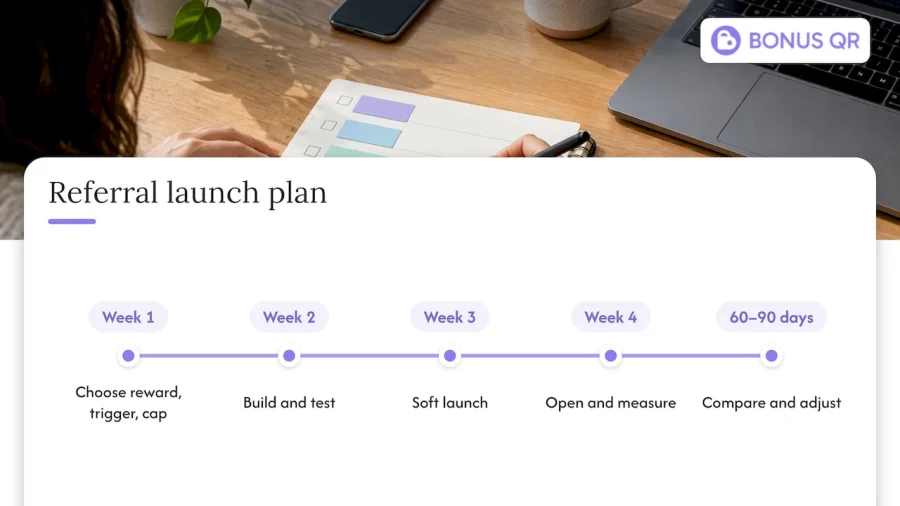
Week 1: decide. Pick one reward type, one trigger and a cap. Calculate the cost per successful referral against your first-order margin.
Week 2: build. Set up the reward in your loyalty platform, write the invite message and the welcome message, and test the whole path with a friend.
Week 3: soft launch. Invite your 20 to 50 most frequent customers personally. Ask for feedback on the wording of the offer.
Week 4: open and measure. Show the offer at the counter, on receipts, on your QR poster and in your push or email notifications. Track invites sent, sign-ups, first purchases and rewards paid.
After 60 to 90 days, compare referred and non-referred customers on repeat visits and spend. Keep what works, change the reward if conversion is low, and tighten the trigger if you see abuse.
FAQ
How do you reward customers for referrals?
Pay in the currency your customers already use: points, stamps, cashback, a fixed discount or a free product or service. Release the reward after a verified trigger such as the friend’s first purchase or attended appointment. A double-sided reward, where both people benefit, usually feels fairest and gets shared more.
What is the best trigger for a referral reward?
For most small businesses it is the friend’s first completed purchase or attended appointment. Sign-ups alone are easy to fake, and a click proves nothing. If repeat business is your goal, add a bonus when the friend makes a second visit.
How do I track referrals in a loyalty program?
Give every customer a unique code or link, tie the friend’s sign-up to it, and let the system confirm the trigger and credit the reward automatically. Then review referral counts, conversion from invite to purchase and the repeat rate of referred customers. Tracking by hand works for a handful of referrals but tends to break as volume grows.
Is a referral program worth it for a small business?
Often yes, because recommendations from people customers know are among the most trusted forms of marketing, and studies in banking found referred customers churned less and were more profitable. The result depends on your margins and audience, so start small and measure referred customers against the rest before you scale.
Do I need customer consent to contact referred friends?
Yes, in many markets you need the friend’s own consent before you add them to marketing, and the referrer’s recommendation does not cover it. Privacy and messaging laws differ by country and state, so check the rules that apply to you or ask a local adviser.
Sources
- Referred customers are more profitable and more loyal (German bank study)
- Referral Programs and Customer Value, Wharton
- Boosting Your Customer Referrals, American Marketing Association
- Nielsen Global Online Consumer Survey, 2009
- 92% of Consumers Prefer Word-of-Mouth, Digital Music News
- Referral programs, Salesforce
- Referral program ideas for small business, Salesforce
- Improving referral management by quantifying market mavens’ word-of-mouth value
- Referral Rock
- CNIL: rules for referral operations
- Westpac referrer guidelines


