Monday morning, a small café owner watches the rush disappear through the door. The regulars will probably return. The customers who came in because it was raining, because the queue elsewhere was longer, or because a colleague recommended the place may not. Without a reason to return, the till starts the next day from zero.
That's the loyalty problem for independent shops. It isn't a shortage of reward ideas. It's the silent margin leak created by one-time visits, forgotten customers, unused paper cards, and systems that demand more administration than a busy owner can give. A well-designed loyalty programme gives customers a simple reason to come back, while giving the operator a clearer view of which visits and offers pay.
The UK is already a mature loyalty market. Tesco Clubcard launched in 1995, and contemporary reporting puts Tesco Clubcard above 22 million members, Nectar above 18 million, and Boots Advantage Card above 17 million. A 2026 industry summary says 88% of UK adults belong to at least one loyalty scheme, while another 2026 study reports 9 in 10 Britons are signed up to one, as reported in UK loyalty programme statistics. Small shops don't need to copy supermarket complexity. They need to borrow the useful part, a clear reason to return, delivered with almost no friction.
Why Loyalty Programs Matter for Small Shops
A café owner doesn't need another marketing project. They need the next visit.
A customer who buys one coffee and disappears has still cost the shop staff time, rent, energy, ingredients, card processing, and attention. A customer who returns regularly gives those fixed costs more chances to earn a margin. That's why loyalty programmes should be treated as a repeat-visit mechanism, not a decorative sign beside the till.
The UK government's review of grocery loyalty pricing found that loyalty-priced grocery products generated more than £5 billion in revenue between November 2023 and January 2024, representing roughly 22% of grocery revenue for supermarkets offering those promotions. The review also noted that the number of loyalty prices continued to grow during 2024, according to the government review of loyalty pricing. An independent café won't run supermarket-style pricing, but the commercial lesson is clear. Loyalty has moved into the transaction itself.
The cost of doing nothing
Rent and energy bills don't wait for a customer to become a regular. Ingredient costs and wages keep applying whether the morning rush returns tomorrow or not. Discounting every item for everyone is a blunt response, while a targeted reward can protect the standard price and give an existing customer a reason to choose the shop again.
Customers understand the value. A 2026 UK survey found that 73% of British consumers believe loyalty cards offer good value, 70% say they encourage repeat visits, and 41% say the savings help manage their finances, according to UK loyalty programme survey findings. That matters for cafés, salons, gyms, restaurants, and local retailers because the reward isn't only about generosity. It signals that returning customers receive a practical benefit.
Retention needs a working system
The strongest small-business loyalty programme is usually the one staff can explain in one sentence and customers can use without help. A QR-first system fits that constraint because it avoids a new till project, paper storage, and a compulsory app download.
For a wider view of retention strategies for RevOps leaders, operators can also look at how larger teams connect customer behaviour, follow-up, and commercial outcomes. The small-shop version is simpler: record the visit, make the reward visible, remind the customer before the habit fades, and measure whether another visit follows.
A practical small business loyalty program should therefore begin with the shop's real constraint, not with a catalogue of features. The operator needs a mechanic that fits the average purchase, a reward that doesn't wreck gross margin, and a dashboard that answers one question each week: are more customers returning?
The Main Loyalty Program Mechanics Explained
Four mechanics cover most small-shop loyalty programmes. Each can work. The mistake is choosing the one with the most impressive terminology instead of the one that matches customer behaviour.
Points
Points work like keeping score during a routine. The customer earns a balance from spending or selected actions, then exchanges it for a reward.
This suits salons, wellness centres, gyms, and retailers where purchases vary in value. A salon might award points per pound spent, while a café with similar-priced drinks may create unnecessary mental arithmetic. Points are useful when the business wants to capture spend, service type, or purchase frequency, but the reward must arrive quickly enough to remain believable.
Stamps
Stamps work like a paper punch card without the paper. Each qualifying visit earns one mark, and the customer receives a defined reward after a visible number of visits.
This is usually the cleanest choice for cafés, bakeries, quick-service restaurants, and other businesses with frequent, predictable purchases. A low-frequency business should avoid a long stamp cycle. If a customer may visit only occasionally, a birthday offer or visit-based bonus can provide value before the main reward feels remote.
Cashback
Cashback returns part of the customer's value as a balance or discount. It suits retailers and higher-ticket services where a percentage-based reward feels more natural than a free item.
The operator must set a firm redemption rule. Cashback without a clear expiry, minimum spend, or redemption path can become a liability that customers forget and staff struggle to explain.
Tiered membership
Tiers work like a membership ladder. Customers gain better access or benefits as their activity increases.
This can suit gyms, beauty businesses, and retailers with a meaningful difference between occasional and frequent customers. A 30-cover café rarely needs several tiers. Customers shouldn't need a spreadsheet to understand whether they're close to a free drink.
Practical rule: The reward cadence matters more than the headline reward. A modest benefit that arrives clearly will beat a generous benefit customers rarely reach.
| Mechanic | Best Fit For | Typical Reward Pace | Customer Effort | Data You Capture |
|---|---|---|---|---|
| Points | Salons, gyms, variable-value retail | Linked to spend or actions | Medium | Spend, service, balance, frequency |
| Stamps | Cafés, bakeries, quick-service food | One qualifying visit at a time | Low | Visits, qualifying purchases, redemptions |
| Cashback | Retail and higher-value services | Accumulated balance or threshold | Medium | Spend, balance, redemption behaviour |
| Tiers | Gyms, salons, established retailers | Based on activity or spend | Medium to high | Status, spend, frequency, benefit usage |
Key KPIs That Show Whether Your Loyalty Program Works
Membership totals are easy to celebrate and easy to misuse. A customer can join, forget the programme, and never return. A QR dashboard full of registrations won't pay rent unless visits and profitable spend move with it.
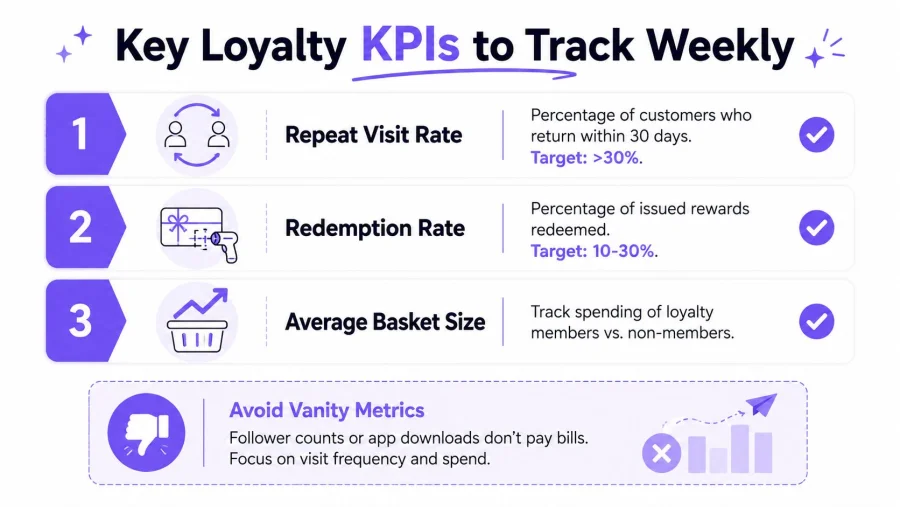
The headline KPI should be repeat-visit rate. Divide the number of identified customers who return within the chosen period by the number of identified customers who visited at the start of that period. Use the same window every week so the comparison remains useful. A QR dashboard or till export should provide the visit records. If the rate rises after launch, the programme is creating a habit. If registrations rise while the rate stays flat, the offer or reminder is failing.
The weekly scorecard
- Active member share: Divide members who earned or redeemed during the period by total registered members. This separates a living programme from a database of forgotten sign-ups.
- Redemption rate: Divide rewards redeemed by rewards issued. Very low redemption suggests the customer can't see, reach, or understand the benefit. Very high redemption can indicate that the offer is too generous or too easy to claim.
- Incremental spend per loyalty visit: Compare the average basket from identified loyalty visits with the average basket from comparable non-member visits. The comparison needs similar products and trading periods, not a busy Saturday against a quiet Tuesday.
- Customer lifetime value against reward cost: Add the customer's recorded spend over the observation period, then subtract the cost of rewards issued or redeemed. This isn't a perfect accounting measure, but it shows whether the reward is buying profitable behaviour.
The dashboard should answer whether customers return, redeem, and spend. Follower counts, app downloads, and total stamp counts are supporting signals at most. They can rise without changing revenue.
A till-side checklist
Print these questions and keep them beside the till:
- Did identified customers return?
- Did active members earn or redeem?
- Did loyalty visits produce a sensible basket?
- Did the reward cost less than the value of the additional behaviour?
- Did staff record visits consistently?
No benchmark can replace a clean baseline from the shop's own data. A small operator should choose a starting period, record the current behaviour, and look for direction rather than pretend that an arbitrary target is universal.
Paper Cards Versus App-Based Versus QR-Based Systems
Paper cards feel cheap because the first purchase is cheap. The cost appears later, when staff stamp manually, customers lose cards, and the owner can't tell whether the programme creates another visit.
An app can solve the data problem, but it introduces a different obstacle. Customers may not want another app for one café, salon, or gym. Storage notifications get ignored, downloads create friction, and the operator becomes responsible for maintaining a digital product rather than running a reward scheme.
QR-based loyalty sits between those options. The customer scans a code to join or opens a personal QR code on a phone. Staff scan the customer-facing code at the till, and the transaction is logged without extra hardware or a full POS integration. QR check-ins are also familiar outside loyalty, as shown by this practical overview of Ticketsmith QR check-in.
| Dimension | Paper Card | App-Based | QR-Based |
|---|---|---|---|
| Cost per active member | Low printing cost, but repeated card replacement | Higher platform and maintenance burden | Platform cost with digital delivery |
| Staff time per stamp | Manual stamping and counting | App search, login, or device handling | Scan and confirm |
| Signup friction | Low, but little customer identification | High if a download is required | Low through a mobile or web flow |
| Data ownership | Almost none | Depends on provider and permissions | Depends on provider, with digital activity records |
| Redemption visibility | Customer presents card | Usually recorded digitally | Automatically recorded when scanned |
| Failure points | Lost cards, illegible marks, missing data | Forgotten app, device and login issues | Phone battery, connection, or scan problems |
What small shops should choose
Paper is acceptable for a very simple launch, especially when the owner wants to test whether customers respond to any reward at all. It becomes a poor long-term system once the business needs to identify inactive members, test offers, or compare repeat behaviour.
Apps suit businesses with a strong reason for customers to return to the app, such as bookings, ordering, community content, or frequent push messaging. They don't suit a shop whose only digital requirement is a reward balance.
QR works well where the business needs low signup friction and usable records. BonusQR, for example, lets a brick-and-mortar business configure stamps, points, cashback, visit and spend thresholds, fixed discounts, welcome bonuses, birthday offers, and seasonal coupons. Customers can use a mobile or web profile, and wallet passes can keep the loyalty card available without requiring a separate native app.
Owners looking into how to implement digital loyalty programs should judge every system by three operational tests: can staff process it during a queue, can customers understand it without coaching, and can the owner see whether it changes visits?
Launching a Loyalty Program Step by Step
A launch should work with one manager and two part-time staff. If the programme needs a developer, a new till, or a training manual, it isn't ready for the counter.
Start with the purchase
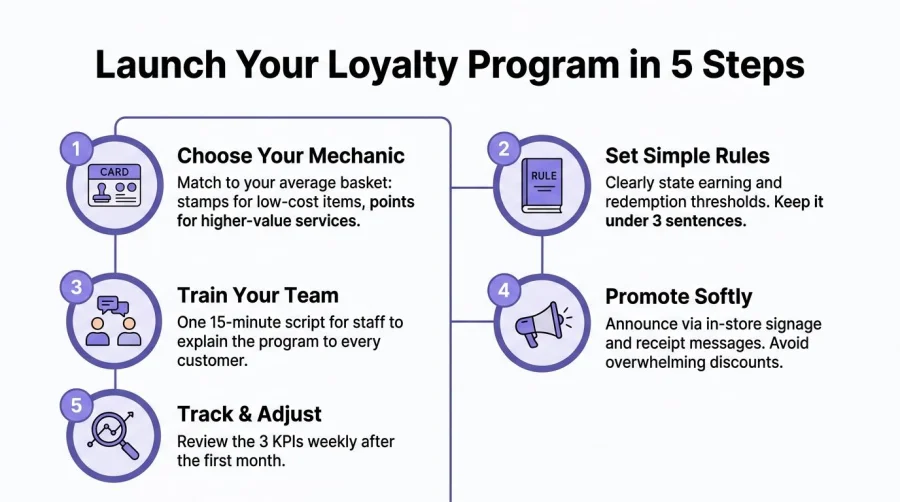
Match the mechanic to the average basket and buying rhythm. Stamps make sense for low-cost, repeatable purchases such as coffees. Points or cashback become more practical for salons, gyms, and retailers where the transaction value varies.
Write the rule in plain English before choosing colours or signage. The customer should understand how to earn, what the reward is, and how to redeem it without asking a second question.
Build the shortest signup route
Put a QR code on receipts, table tents, counter signs, and appointment confirmations. Send the customer to a one-field form where a mobile number or email address identifies the profile. Ask for more information only when the benefit justifies the extra effort.
Staff need one sentence to use consistently: “Scan this code to collect your reward and see when you're next eligible.” That is more effective than asking customers whether they'd like to join a “customer engagement initiative”.
Prepare the awkward moments
A one-page staff guide should cover three situations:
- No code: Find the profile using the approved identifier, or record the visit through the fallback process.
- QR missing: Resend the customer's code instead of creating a duplicate profile.
- Wi-Fi failure: Use a documented manual note or offline queue, then reconcile it when the connection returns.
The guide should also state who can approve a correction. Uncontrolled manual adjustments undermine the data the owner needs later.
Keep privacy language clear
Use a plain-English privacy notice and an optional marketing consent box. Don't pre-tick the box. Explain what messages customers will receive, why the business stores the information, and how they can withdraw consent. A 30-day retention rule can help remove stale operational records, but the business should confirm its retention approach against the data it holds and its legal obligations.
Promote without buying attention
Use a counter card, receipt message, table tent, and staff prompt. A launch-week double stamp can create urgency without permanently weakening the offer. Add a reminder to the exit receipt so the customer sees the next action immediately after purchase.
Don't launch every benefit at once. Start with one earning rule, one reward, and one reminder. Complexity can be added after the weekly scorecard shows that customers understand the first version.
Real Examples of QR Loyalty in Action
A QR system is only useful if it changes what happens during a real shift. The stories below are illustrative operating scenarios, not verified performance case studies, so they should be used as design examples rather than promises of results.
A neighbourhood café replaces its worn paper card with a QR code printed on every receipt. The reward remains a visit-based stamp, but the customer can see progress on a phone and the owner can identify members who joined but haven't returned. The barista's job becomes a quick scan rather than checking whether a paper card has the right number of marks.
The useful KPI is repeat-visit rate, supported by redemption rate and staff correction time. The owner can then test whether the reminder should arrive after an inactive period, after a near-complete card, or alongside a quieter-day offer. A café can also review best QR code tactics for 2026 for practical placement and promotion ideas, then keep only the tactics that customers use.
A two-chair salon faces a different problem. Its services vary in price, so stamps would treat a short appointment and a higher-value service too similarly. The owner uses points linked to spend and adds stylist codes, allowing the weekly review to show which services and customer journeys lead to another booking.
The important result isn't a dramatic claim about growth. It's visibility. The owner can see whether points are being earned, whether clients redeem, and whether a reward encourages a return without giving away margin on every appointment. That information is impossible to recover from an anonymous paper card.
For both businesses, the admin target should be a short weekly review, not a second job. The system earns its place when staff can process the action during service and the owner can make one informed adjustment from the resulting data.
Optimisation, Myths, and FAQs
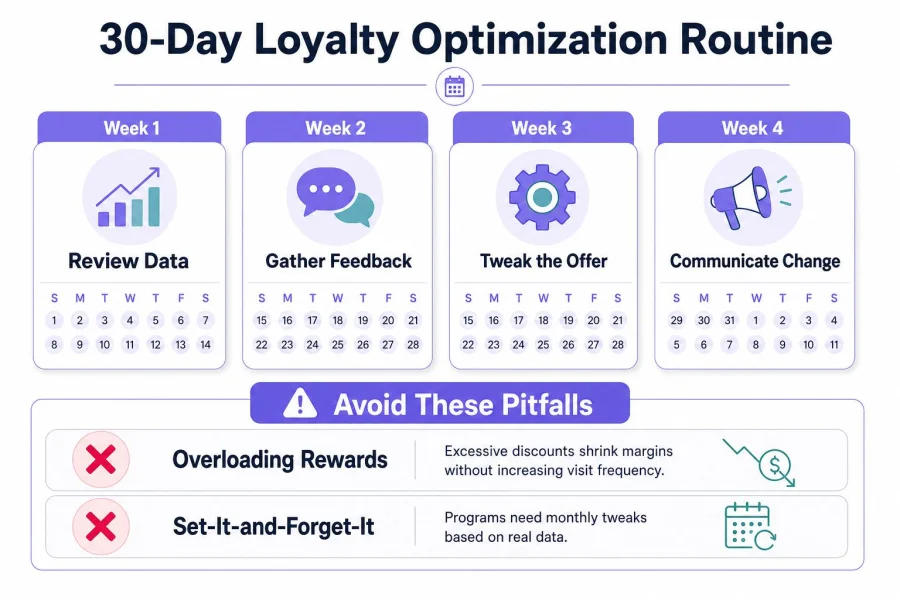
The most expensive loyalty mistake is assuming that more reward always creates more loyalty. An over-generous punch card can train customers to wait for a free item, while the shop pays the cost of the reward without gaining additional frequency. UK consumers are strongly motivated by discounts, rewards, and cashback, with one UK report putting that motivation at 75%, but the value must still be controlled through a sustainable earning and redemption rule, as outlined in UK loyalty programme trends.
A simple optimisation routine beats a grand relaunch.
- Monday, review data: Check repeat visits, active member share, redemption, and basket value.
- Wednesday, inspect friction: If redemption is below 8%, review whether customers can see the reward, reach the threshold, and understand redemption. This threshold is an operating prompt, not a universal benchmark.
- Friday, rotate the prompt: Change the counter card or receipt message so staff have a fresh, specific reason to mention the programme.
- At month-end, adjust one rule: Change the threshold, reward, or reminder timing, never all three together.
Frequently asked questions
Does the programme need GDPR consent?
A service profile and marketing consent are not automatically the same thing. Explain the difference, use an unticked opt-in for promotional messages, and provide a clear withdrawal route.
Should the business charge customers for the app?
Usually not for a basic local reward. A paid membership needs an obvious recurring benefit, while a simple loyalty card should remove friction rather than add a price barrier.
What reward suits a £4 coffee?
Use a modest, easy-to-reach benefit that protects the margin on the other purchases. The right value depends on ingredient cost, gross margin, visit frequency, and whether the reward generates another visit.
What happens when a household shares one phone?
Allow one household profile only if the shop is comfortable treating the household as one customer. Don't create duplicate accounts to inflate membership totals.
How should lapsed members be reactivated?
Send one relevant reminder with a clear expiry or next step. If there's no response, stop messaging rather than training customers to ignore every offer.
Does loyalty beat raising prices by 20p?
It can protect repeat behaviour, but it doesn't replace sound pricing. Measure the margin from the new price alongside the visits influenced by the programme, then choose the combination that leaves the shop healthier.
The cheapest workable route is clear: choose one mechanic, put it behind a QR scan, train staff on the exceptions, and review the same KPIs every week. A small business can start with BonusQR's free option, configure a digital reward flow without POS integration or extra hardware, and add wallet passes, automated messages, and deeper rules only when customer behaviour justifies them.
Start with one offer this week. Put the QR code on the till, receipt, and table card, train every staff member to explain it in one sentence, and record the baseline before launch. Set up a simple loyalty flow with BonusQR, then review repeat visits, redemptions, and basket value after the first month before spending money on anything more complicated.


