Priya owns a busy thirty-seat café in Bristol. Every morning, she watches regulars search for paper punch cards, discover they've left them at home, and promise to bring them next time. New customers often leave without hearing about the scheme at all. The cards cost money to print and replace, yet Priya can't tell whether the programme is creating repeat visits or adding work for staff.
That's the practical problem loyalty platforms solve. They replace a loose collection of cards, spreadsheets and verbal reminders with a system that records purchases, identifies customers, applies reward rules and gives the owner usable information. The right platform doesn't need to look like enterprise software. For most independent businesses, it needs to be quick at the till, easy for customers to understand and affordable enough to justify every month.
The UK loyalty market is already a substantial commercial category. One market forecast estimates its value at US$2.23 billion in 2024, projecting US$2.56 billion in 2025 and US$4.06 billion by 2029, with a projected 12.2% CAGR from 2025 to 2029. The same forecast records a 16.4% CAGR from 2020 to 2024, reflecting sustained investment in digital rewards and retention infrastructure. The UK loyalty market forecast shows why small merchants are no longer choosing between loyalty and no loyalty. They're choosing which type of loyalty system fits their customers.
What Loyalty Platforms Actually Do for a Small Shop
Priya's paper cards fail in predictable ways. Customers lose them, staff forget to stamp them, and the owner can't see which rewards generate visits. A digital loyalty platform turns each purchase into a recorded event. The customer scans a QR code, the system adds a stamp or points, and the reward balance remains attached to a phone number, profile or wallet pass rather than a piece of card.
In plain terms, loyalty platforms capture purchase activity, store customer identity, apply reward rules and return performance data to the merchant. Some also support coupons, referrals, birthday offers, messages, menus, reservations and customer feedback. That broader function matters because a loyalty programme should support the customer relationship, not just count stamps.
Three delivery models
Small merchants usually encounter three formats:
- Tablet or POS add-ons sit inside an existing checkout workflow. They can be convenient when the EPOS connection is reliable, but integration fees and technical limitations need careful checking.
- QR dashboards use a visible code at the counter, reception desk or checkout. Staff can scan a customer's personal code, or the customer can scan a business code to check in. This model suits cafés, salons and independent shops that want minimal hardware.
- White-label apps present the programme under the merchant's branding. They can support richer messaging and account features, but they're only worthwhile when customers have a clear reason to return to the app.
Priya's café doesn't need a complex enterprise rules engine. It needs a QR code that works during the breakfast rush, a simple reward customers understand and reporting that shows whether regulars are returning. A salon may need spend-based rewards and reactivation messages instead. A gym might prioritise attendance streaks.
Practical rule: The platform should remove a task from the team, not create a new one.
The same principle applies to promotional content. A café can use a simple phone-shot video to explain how its rewards work, while a larger retailer may need a more polished campaign. Businesses exploring that content workflow can review an AI video creation platform as a separate resource, without confusing content production with the loyalty system itself.
Core Features Every Modern Loyalty Platform Should Have
A small shop needs a loyalty platform that fits its buying pattern and daily workload. The right system gives the owner control over rewards, customer access and costs without forcing staff through extra steps. A long feature list means little if the QR code fails at the till or customers cannot understand the reward.
Match the reward to the buying pattern
QR-based rewards suit cafés, salons and independent retailers that want low hardware costs. A code at the till, counter or reception desk can let customers check in themselves, or let staff scan their account. The journey must take seconds and work reliably during busy periods.
Stamps work for cafés and takeaway businesses with a regular visit rhythm. A coffee shop can reward completed visits, while a juice bar can add a bonus stamp to a higher-margin item. Customers see their progress clearly, so staff spend less time explaining the scheme.
Points fit retailers with changing basket values. A customer buying one small item can earn less than someone filling a basket. Points can cover product categories, seasonal offers and spending thresholds, but every extra rule creates another chance for confusion. Keep the earning and redemption logic easy to state at the checkout.
Cashback suits salons, wellness businesses and gyms, where visits may be less frequent but transactions carry higher value. A percentage or fixed-value balance gives customers a clear reason to book or return without making them complete a long stamp sequence. A gym can also use attendance-based rewards, while a salon may prefer balances tied to spend.
Remove the app-download obstacle
Apple Wallet and Google Wallet passes keep rewards available without requiring a full app download. They can display reminders when customers have opted into relevant messages and already recognise the business.
A platform should also provide a mobile web option. Some customers prefer a wallet pass, others use a browser, and a smaller group may want a branded app. Choice matters because UK loyalty research reports that 38% of loyalty programme owners prefer plastic loyalty cards, while only 57% of UK programme owners are satisfied with their loyalty programmes. UK loyalty research on format and satisfaction supports a practical conclusion: forcing every customer into one digital format creates avoidable friction.
Make reporting useful at owner level
Analytics should show repeat visits, average spend among members, reward redemption and reward cost as a share of revenue. A café owner can use those figures to decide whether weekday incentives are working. A salon owner can identify customers who need a booking reminder. Reporting must support a decision, not fill a dashboard.
Tiered VIP status, referrals and birthday triggers belong after the basic reward mechanic works. They add work when the core journey is unclear. Businesses comparing loyalty workflows with membership operations can also review guidance on how to manage your sports club easily, especially where attendance and member communication overlap.
BonusQR combines QR loyalty cards with stamps, points, cashback, coupons, wallet passes and customer activity tracking without requiring a POS integration. That type of setup can suit a local merchant that needs a straightforward system rather than enterprise controls.
Start with a reward customers understand, a format staff can operate and reporting that shows whether the scheme earns its keep. Businesses should track rewards analytics from the first campaign, rather than issuing rewards for months without checking the result.
The Business Case and Real ROI Drivers
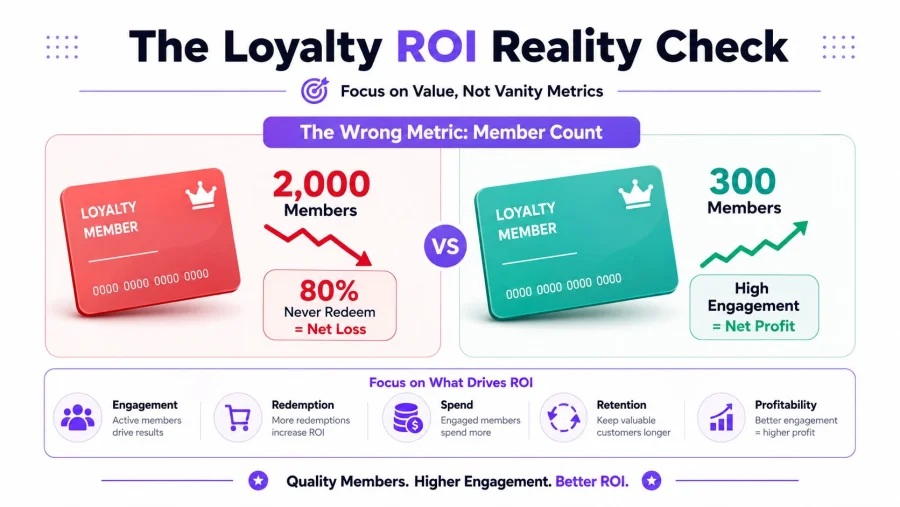
Member count is a vanity metric unless members return and redeem. A large database full of inactive profiles can cost more to maintain than it produces. A smaller group that visits consistently can create a much healthier commercial result.
The business case rests on two levers:
- Repeat-visit frequency, whether customers return more often.
- Average spend lift, whether members spend more per visit than they otherwise would.
Those effects matter because each additional visit creates another chance to sell a drink, treatment, class, meal or product. The owner should review the effect over a sustained period rather than celebrating a short burst of sign-ups.
UK loyalty operators are increasingly expected to measure financial return. A 2026 UK loyalty survey reports that 91% of programme owners actively track loyalty ROI, and those tracking it reported an average 5.4x ROI. UK loyalty ROI reporting makes the operational point clear: reporting isn't a luxury for large brands. It's part of deciding whether the programme deserves continued budget.
A café owner can model the opportunity without pretending every enrolled customer is valuable. If a fifteen-cover café turns twelve covers into weekly regulars, the resulting revenue can be estimated from the café's average transaction value and trading weeks. The exact value depends on those inputs, so the owner should calculate it from actual till data rather than borrow a generic benchmark.
What to put into the calculation
- Incremental visits: Compare active members with their earlier visit pattern.
- Member spend: Compare average member spend with a suitable non-member baseline.
- Reward cost: Include the value of redeemed products, discounts and staff time.
- Retention period: Review whether the behaviour continues beyond the launch excitement.
- Contribution margin: Judge the reward against profit contribution, not turnover alone.
The cited 5.4x average ROI is a benchmark, not a promise for every café or salon. A programme can still fail if rewards are too generous, customers receive discounts they would have claimed anyway, or staff issue credits inaccurately.
The honest test is simple. If the programme doesn't increase profitable visits, improve spend, or bring back lapsed customers, more members won't fix it.
How to Choose the Right Loyalty Platform
A single-location owner doesn't need a procurement department to assess loyalty software. The vendor should answer ten practical questions clearly, in writing and without a sales maze.
A ten-point buying checklist
- Monthly cost versus transaction fees: Ask for the full recurring price and every usage charge. A low headline fee can become expensive if each scan or redemption adds cost.
- Contract length and exit terms: Avoid a long commitment before the team has tested the customer journey.
- Setup requirements: Check whether the business needs a developer, new tablets, staff logins or a complex integration.
- Customer data ownership: Confirm that the merchant can export customer records and programme data in a usable format.
- Reward flexibility: The platform should support stamps, points, cashback, visits, spend thresholds and fixed discounts where relevant.
- Customer experience: Joining should work quickly on a phone. If customers need repeated explanations, adoption will suffer.
- POS compatibility: Check the actual setup, including Square, SumUp, Zettle, Lightspeed or SalonIQ. A logo on an integration page isn't proof that the workflow works as expected.
- Security and compliance: If names, emails, phone numbers or app profiles identify customers, the programme processes personal data. UK GDPR requires an Article 13 privacy notice and a written Article 28 processor contract with the platform provider. UK GDPR guidance for loyalty programmes explains the data-minimisation implications.
- Reporting depth: The owner should be able to see redemption, repeat activity, spend and campaign performance without exporting everything to a spreadsheet.
- Human support: Ask who handles setup, staff questions and account problems after launch.
The right answer is usually the simplest suitable tool, not the most feature-rich platform. A merchant looking for practical guidance on choosing customer loyalty software should focus on staff speed, customer clarity and measurable economics.
Red flags include hidden fees, locked data, long contracts and pricing tiers that punish growth. Vendors should explain what happens when the programme succeeds, not only what it costs at launch.
Campaign Examples for Cafés, Salons, Gyms and Retailers
The same loyalty platform can support very different campaigns. A café rewards frequency. A salon protects a high-value relationship. A gym encourages attendance. An independent retailer uses rewards to influence timing, basket value and seasonal demand.
| Business | Suitable mechanic | Useful campaign | Common mistake |
|---|---|---|---|
| Café | Stamps | Reward takeaway coffee visits, add bonus stamps for selected upsells, and issue a birthday drink offer | Making the reward so distant that customers stop checking progress |
| Salon | Points or cashback | Award value per pound, support refer-a-friend incentives and reactivate inactive clients with a targeted message | Discounting every appointment instead of protecting margin |
| Gym or studio | Visits and streaks | Reward class-pack milestones and consistent attendance, such as two visits within a week | Rewarding attendance without checking whether the member renews |
| Independent retailer | Points or tiered cashback | Use weekday multipliers and a pre-Christmas double-points period | Applying the same reward to every product and time of day |
Why the combinations work
Cafés benefit from visible progress and quick redemption. A QR stamp card at the till fits the pace of a morning queue better than a long registration form. The birthday reward adds a personal reason to return, while an upsell bonus can guide behaviour without discounting every drink.
Salons need a longer customer relationship. Points per pound reflect different treatment values, while referral rewards turn satisfied clients into acquisition channels. A re-engagement campaign should be based on the salon's normal booking rhythm, with clear terms and no awkward message to customers who have already booked.
Gyms and studios should reward the behaviour that supports retention, not just issue points for opening an account. Class-pack access and attendance streaks can make progress visible. Staff can also find broader ideas for motivating teams in this guide to employee rewards, although employee incentives and customer loyalty should remain separate programmes.
Retailers need timing control. A points multiplier on quiet weekday mornings can shift visits, while a seasonal campaign can help customers choose the shop before Christmas. A loyalty card for small businesses can provide the underlying customer profile without forcing a local retailer into an enterprise implementation.
The two anti-patterns shared across all four sectors are unclear eligibility and rewards that customers don't value. The best campaign is easy to repeat, easy to explain and financially defensible.
KPIs Worth Tracking Once You Launch
A small business doesn't need a data analyst to run a useful loyalty review. The owner needs a short list of measures tied to decisions. Raw membership totals belong in the background, not at the centre of the weekly conversation.
The signal metrics
Repeat-visit rate per active member shows whether enrolled customers are returning. A café can use it to decide whether the stamp target is realistic. A gym can compare attendance patterns and adjust its reactivation message.
Average spend per member versus non-member identifies whether the programme influences basket size. A retailer might introduce a category-specific points bonus if members buy frequently but keep baskets small. A salon can use the comparison to judge whether a cashback reward protects enough value.
Redemption rate tells the owner whether customers understand and want the reward. Low redemption can indicate weak communication, excessive distance to reward or a mechanic that doesn't fit the business.
Six-month customer lifetime value gives the programme a longer view. The owner should compare the value of retained customers with reward cost and service margin, rather than treating every purchase as equally profitable.
Reactivation rate measures whether lapsed members return after a targeted message. If reactivation remains weak, changing the offer may be more useful than adding another tier.
UK loyalty evidence also shows why balance visibility matters. Industry reporting estimates that roughly 26% of loyalty points go unredeemed, representing about £3 billion in annual value, while 54% of active members check balances at least weekly and 83% say saving money is their main motivation. UK loyalty balance and redemption reporting supports a practical choice: make balances easy to find, explain rewards plainly and use reminders responsibly.
The vanity metrics
App downloads, social shares and total sign-ups can look impressive without changing customer behaviour. They should never outrank repeat visits, spend, redemption or reactivation.
A useful weekly review takes fifteen minutes. The owner opens the dashboard, records one meaningful trend, changes one rule or message, and checks the effect the following week. That discipline turns loyalty software into an operating tool rather than a digital filing cabinet.
Common Pitfalls and Honest FAQs
Five problems weaken local loyalty programmes: friction, irrelevant rewards, redemption leakage, complicated rules and perceived unfairness. Small merchants rarely need more technology to solve them. They need to test the customer journey as carefully as the sales message.
Start at the counter. A QR code that asks a customer to photograph it, upload a receipt and connect another application creates more resistance than the paper card it replaced. Make the scan obvious, show the reward immediately and give staff one clear explanation to use.
Reward value must match the buying pattern. Customers respond strongly to financial relief, and instant benefits often make more sense than a long wait for points to accumulate. As noted earlier, UK research on reward preferences supports straightforward offers such as a clear discount, free item or visible balance. Elaborate gamification adds work without fixing a weak offer.
Fairness is part of the product
The UK market is crowded with overlapping schemes. 97% of UK shoppers belong to at least one supermarket loyalty scheme and hold an average of three memberships, according to the UK government review of grocery loyalty pricing. The review found average loyalty pricing savings ranging from 17% to 25% across the five supermarkets examined, while 43% of consumers considered it unfair when members received lower prices than non-members.
A café, salon or independent shop should publish complete terms, explain eligibility consistently and avoid rules that make newcomers feel shut out. Give customers a clear reason to join. Do not make non-members feel manipulated at the till.
Redemption leakage deserves a monthly audit. Issued points are not the same as redeemed value, while unclaimed rewards create message clutter and confusion. Set a prominent expiry policy, check for fraudulent scans and investigate accidental credits or rewards that staff repeatedly override.
Honest answers for small merchants
Are loyalty platforms worth it for a small business? Yes, when customers buy repeatedly and the programme stays easy to use. Start with one mechanic that fits the buying pattern. A café may use visit rewards, while a salon may reward appointments or referrals.
Do customers need a downloaded app? No. QR codes, mobile web links and Apple or Google Wallet passes can support a programme without a full app.
How many points are safe to issue? Price the reward from contribution margin, not headline revenue. The reward must support profitable behaviour.
When should a programme change? Simplify it when redemption stalls, enrolment falls or customers need repeated explanations. Extra features will not repair confusing rules.
UK retail engagement remains shallow despite widespread membership. Mintel reports that 55% of consumers belong to at least four loyalty schemes, but 58% have actively used three or fewer during the past six months. Mintel's UK retail loyalty research reinforces the practical lesson: joining is easy. Repeated, trusted use is the primary test.
A café, salon, gym or independent retailer should test one customer journey, one reward and one reporting routine before committing to a larger rollout. Businesses replacing paper cards with a QR-based programme can start exploring BonusQR, compare the setup with their existing workflow and launch only after staff can explain the reward clearly and customers can use it without friction.


