Loyalty Launch Checklist for Small Businesses
A loyalty program launches well when seven things are settled before the first customer scans anything: a measurable goal, a simple reward structure, written rules and costs, working technology with privacy covered, trained staff, a planned launch week, and a short list of metrics you will review. This checklist walks through each one in order, with the questions to answer and the tasks to tick off, so you can go from idea to live program without guessing.
It is written for owners and managers of cafes, shops, gyms, salons, hotels and similar businesses who do not have a marketing team or a dedicated IT person. Repeat customers are the lifeblood of a small business, and a launch that is planned for a few weeks usually beats one improvised in an afternoon.
Key Takeaways
- Start with one behavior you want to change (for example, more repeat visits), and attach a number to it before you design any reward.
- Pick the simplest structure that fits your visit pattern: stamps for frequent low-ticket visits, points or cashback for varied spending.
- Write the rules, expiry terms and reward cost down before launch, and collect marketing consent properly from the first sign-up.
- Test real customer journeys and train your team before the public launch, not during it.
- Review a handful of metrics weekly for the first month, then adjust one thing at a time.
The launch checklist at a glance
Use this as the one-page version. Each item is explained in the sections below.
| Phase | Task | Done when |
|---|---|---|
| 1. Goal | Baseline your current repeat rate and average order | You have numbers written down |
| 1. Goal | Choose one primary objective and a target | One sentence with a number and a date |
| 2. Structure | Pick stamps, points, cashback or a mix | Customers can explain it in one breath |
| 2. Structure | Set the first reward and how soon it can be earned | A typical customer reaches it within a few visits |
| 3. Rules and costs | Calculate reward cost as a share of sales | You know your margin after redemption |
| 3. Rules and costs | Write terms: expiry, exclusions, changes | Terms are published and short |
| 4. Technology | Set up the program, branding, QR code and wallet pass | A test customer can join and redeem |
| 4. Technology | Add consent and privacy notices | Opt-ins are unticked by default and recorded |
| 5. People | Train staff on earn, redeem and problem cases | Everyone completes a practice run |
| 6. Launch | Soft launch with regulars, then announce publicly | Feedback fixed before the big push |
| 7. Measure | Choose 4 to 6 metrics and a review rhythm | A recurring calendar slot exists |
Step 1: Define the goal and the behavior you want
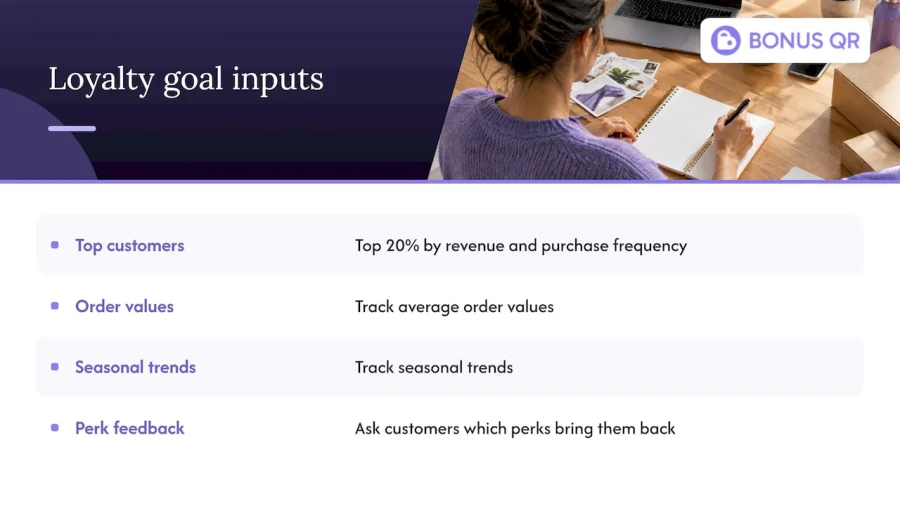
A loyalty program is a way to pay customers for actions that help your business. So the first decision is which action. Xero’s small business guide suggests looking at your top 20% of customers by revenue and purchase frequency, tracking average order values and seasonal trends, and asking customers directly which perks would bring them back more often. It then recommends turning that into a clear goal, such as lifting repeat visits by 20% or average order value by 15%.
The same guide quotes a loyalty industry executive who frames the starting point as two questions: what are your core objectives (acquire customers, increase spending, reduce churn, boost advocacy or collect data), and which specific customer behaviors support them. As FitSmallBusiness puts it, the goals of the program determine which actions you reward.
Baseline before you build
You cannot show improvement without a starting point. Before launch, record:
- How many customers come back within 30 and 90 days.
- Your average transaction value and visits per customer per month.
- Which days, hours or seasons are slow.
- Your top 20% of customers and what they buy.
If you do not have this data, pull it from your till reports, booking calendar or card processor, or run a two-week count by hand. If you want a deeper walk-through of using retention numbers to set objectives, this guide on customer retention strategies is a good companion.
Turn it into one sentence
Good goal statements are specific: “Raise the share of first-time customers who return within 30 days from 25% to 35% by the end of the first quarter.” Avoid goals like “build loyalty” that you cannot measure. Pick one primary goal and at most one secondary goal for the first three months.
Step 2: Choose the structure, earning rules and rewards
Structure should follow how your customers actually buy. Here is a practical way to match them.
| Your business pattern | Structure that usually fits | Example reward |
|---|---|---|
| Frequent, similar, low-ticket visits (coffee, lunch, car wash) | Digital stamp card | Free item after a set number of visits |
| Varied basket sizes (retail, grocery, fuel) | Points or tiered cashback | Percentage back as credit on the next purchase |
| Appointment-based (salon, gym, wellness) | Stamps or points per visit, plus referral reward | Free add-on service or guest pass |
| Occasional high-value purchases (hotels, specialty retail) | Points with tiers, special occasion rewards | Upgrade, early access, birthday offer |
Our own guide to loyalty program ideas for small businesses goes deeper on formats, and if you are considering levels, read how to design effective loyalty program tiers before committing.
Rules for earning and rewards
- Make the first reward reachable. A customer should be able to earn something within the first few visits. Early wins build the habit.
- Reward the behavior from Step 1. If your goal is frequency, reward visits. If it is basket size, reward spend thresholds.
- Keep the math obvious. If a customer needs a calculator to understand it, simplify it.
- Add a welcome incentive. An onboarding bonus gives people a reason to sign up at the counter instead of later.
- Plan one or two extras. Birthday or special-occasion rewards and referral rewards are easy additions once the core works. Do not launch with six mechanics at once.
Step 3: Work out costs, redemption terms and program rules
A program that feels generous but erodes margin will be quietly cut within a year, which hurts trust. Do the arithmetic first.
Calculate reward cost
- Decide the reward value at cost, not at retail price. A free coffee that sells for $4 may cost you far less to make.
- Divide the reward cost by the spend or visits required to earn it. That is your effective discount rate.
- Compare it with your gross margin. Members who earn rewards should still be profitable customers.
- Add the software fee and any staff time. Software plans for small business loyalty platforms usually run from free tiers to a monthly subscription. On our side, BonusQR plans include a Free plan, Basic at 19 EUR per month and Premium at 69 EUR per month.
A worked example: if a customer earns a $5 reward after spending $100, the nominal rate is 5%. If the reward costs you $2 to provide, your real cost is closer to 2%. Always check the version of the number that matches how you will actually fulfill the reward.
Write the terms
Terms for a loyalty program have three jobs: a contract, a disclosure, and a guide members can use. Brandmovers explains that weak terms are long on liability language and short on what members look for: how points are earned, when they expire and what happens if the program changes. Cover at least:
- Who can join and how to enroll.
- How rewards are earned, and what does not count (gift cards, taxes, tips, returned items).
- How and when rewards can be redeemed, and whether they can be combined with other offers.
- Whether balances or rewards expire, and how you will notify members.
- Your right to change or end the program, and the notice you will give.
- How to contact you about a missing reward.
Terms and expiry rules differ by state, so if you plan to expire balances or run the program across several states, ask a local attorney or your state attorney general’s office what applies to you.
Step 4: Get the technology and data protection ready
Technology for a small business should not need a project team. The questions to answer:
- Does it need a POS integration? Some platforms require one. A QR-based approach, like ours, lets customers earn rewards without additional POS systems, which shortens setup considerably.
- How do customers join and show their card? Look for a scannable QR code at the counter and a wallet pass. Apple and Google Wallet support means members can keep the card on their phone without installing anything extra.
- Can you brand it? Logo, colors and reward names should look like your business.
- What can you automate? Reward distribution, notifications and basic reporting should run without daily manual work.
- Where does the data live, and who can see it? Limit staff access to what they need.
Privacy and marketing consent
A loyalty program collects personal information, and that carries obligations. A law-firm review of privacy issues in loyalty programs notes that email and text communications fall under CAN-SPAM and the Telephone Consumer Protection Act, which require consent, opt-out mechanisms and honoring opt-outs, and that marketing texts sent without the required prior express written consent can bring per-message statutory penalties.
According to Brandmovers, if your business is covered by the California Consumer Privacy Act and the program collects personal information in exchange for benefits, the notice must reach California members before they opt in. It also reports that California’s Attorney General announced an investigative sweep of loyalty programs on January 28, 2022, over missing financial incentive notices. Practical steps:
- Collect only what you need (a name and phone or email is often enough).
- Use unticked consent boxes for marketing email and push or text messages, and keep a record of when each person agreed.
- Put a privacy notice link on the sign-up screen.
- Include an unsubscribe in every email and an opt-out in every text.
- If you are unsure whether CCPA or another state law applies to you, confirm with a privacy attorney.
Step 5: Test it and train your team
Most launch problems happen at the counter, not in the software. Two preparations matter most.
Test real customer journeys
Omnivy describes user acceptance testing as the decisive phase before launch, with scenarios that simulate actual customer journeys, such as a customer signing up, a purchase updating the balance, and a reward being redeemed with the discount applied. Kaizen Loyalty’s launch playbook adds edge cases worth trying: refunded transactions, split payments and guest checkout converting to a member.
For a small business, a simple version looks like this:
- Sign up as a new customer from a personal phone using the QR code.
- Make a purchase and confirm the stamp or points appear.
- Reach a reward threshold and redeem it at the counter.
- Process a refund on a rewarded purchase and see what happens to the balance.
- Try a customer without a smartphone, and decide what you will do for them.
- Have a second staff member repeat steps 1 to 3 on a different shift.
Train staff before the soft launch
Kaizen Loyalty says training should cover how the earn mechanic works, how members check balances and redeem, how to handle a member who thinks points are missing, what to say when a redemption fails, and where to escalate problems. It also says to finish this before the soft launch rather than run it at the same time. Add a one-page cheat sheet by the till, and give staff a simple line to invite customers: “Want to earn a free coffee? Scan here, it takes ten seconds.” Staff who ask are the main reason enrollment rates rise.
Perspective: why simple and fast beats complicated
We built BonusQR for owners who cannot spend months on a loyalty rollout. In our experience, the programs that stall are rarely the ones with a weak reward. They are the ones where setup dragged on, the team was unsure how to explain it, or the rules were too clever for a customer to repeat.
That is why we designed the platform around a QR code, so customers can start earning without a POS integration, and around modules you can switch on one at a time: stamps, points, cashback, referrals and reviews. Our aim is that you launch the core mechanic first, watch what customers do, and add the next layer with the automation doing the repetitive work of rewards, notifications and reporting.
Our advice is to treat launch as the beginning of a measured experiment. Pick a goal, start with a reward customers understand, review the numbers weekly, and change one thing at a time. A program that is live and improving will outperform a perfect one that is still in planning.
Michal Palus
Step 6: Plan launch week and the first month
A soft launch with your most loyal customers reveals problems cheaply. Then you open it up publicly.
Before launch day
- Invite 20 to 50 regulars to join first and ask what confused them.
- Fix wording, signage and any reward issues they flag.
- Place QR codes at the till, on tables or at reception, and on receipts or bags.
- Prepare a short announcement for email, social media and your window or counter.
Launch day
- Make sure every person on shift can enroll a customer and redeem a reward.
- Offer the welcome bonus at the point of sale.
- Check the first enrollments yourself to confirm everything is recording.
- Keep a log of questions and complaints in one place.
The first three weeks
Kaizen Loyalty suggests designing the welcome as a sequence rather than a single message: an immediate confirmation that explains how to earn, a second touchpoint within seven days giving a specific reason to buy, and a third in weeks two or three highlighting a reward the member is close to earning. You can build the same rhythm with push or email notifications:
| When | Message | Purpose |
|---|---|---|
| Right after sign-up | Welcome, current balance, how to earn | Confirm and set expectations |
| Within 7 days | A specific, relevant reason to visit | Prompt the second visit |
| Week 2 or 3 | “You are one visit from your reward” | Use progress to drive repeat visits |
Our customer retention workflow article shows how to connect these touchpoints to the rest of your marketing.
Step 7: Track metrics and improve
Choose a few numbers and review them on a fixed day. Loyalty metrics guides commonly list repeat purchase rate (the share of members who shop more than once), active member rate (the share who did something within a set period) and redemption rate. These are the core set for a small business:
| Metric | What it tells you | Compare with |
|---|---|---|
| Enrollment rate | Are staff inviting and customers saying yes? | Share of transactions that are by members |
| Active member rate | Are members engaging after sign-up? | Active members divided by total, per month |
| Repeat purchase rate | Is the program changing behavior? | Your pre-launch baseline |
| Average order value, members vs. non-members | Are members spending more? | Non-member average |
| Redemption rate | Are rewards attractive and reachable? | Rewards redeemed divided by rewards earned |
| Reward cost as share of member sales | Is it sustainable? | Your margin target |
How to use the numbers
- Low enrollment: improve signage, simplify the sign-up, and coach staff to ask.
- Many sign-ups but few active members: the first reward is probably too far away, or the welcome sequence is weak.
- Very low redemption: rewards may be unappealing or hard to find in the app.
- Very high redemption with falling margin: raise the threshold slightly or change the reward to something with a lower cost to you.
- Flat repeat rate: revisit the behavior you rewarded in Step 1.
Make one change at a time and give it three to four weeks, otherwise you cannot tell which change worked. Our analytics let you follow customer behavior and the results of campaigns in one place, so the review does not turn into a spreadsheet project.
Choosing a plan for your launch
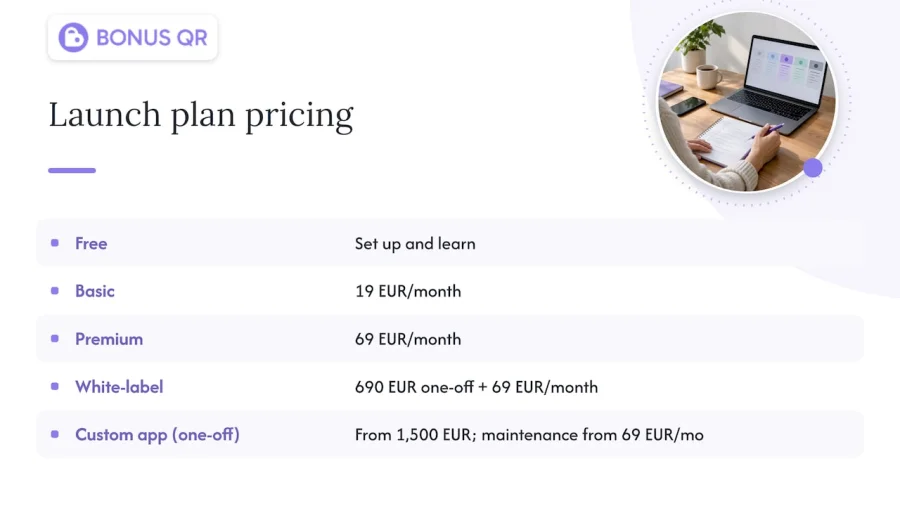
If you want to run this checklist on a platform built for small businesses, start with what you need on day one. The Free plan lets you set up and learn. Basic is 19 EUR per month and Premium is 69 EUR per month; see the pricing page for what each includes. If you want an app under your own brand, our white-label option has a one-off setup fee of 690 EUR and a monthly subscription of 69 EUR per month. For something fully tailored, custom app development starts from 1500 EUR one-off, with monthly maintenance from 69 EUR per month. Our small business guide to loyalty programs is a good place to start if you are still weighing the idea.
FAQ
How long does it take to launch a loyalty program?
For a small business using a ready-made platform, setup can be done in days, and the longer part is planning the goal, rewards and rules. Allow one to two weeks for baseline numbers, rule writing, testing and staff training. A soft launch with regulars adds another week or so before you announce publicly.
What should be on a loyalty program launch checklist?
A complete one covers seven areas: a measurable goal, the program structure and rewards, costs and written terms, technology and privacy consent, staff training and testing, a launch plan with a welcome sequence, and the metrics you will review. The table near the top of this article puts each task and its completion test on one page.
Do I need a POS integration to run a loyalty program?
Not necessarily. Some systems depend on one, but QR-based platforms such as ours let customers earn stamps, points or cashback without additional POS systems. Check how redemption will work at your counter and test it before launch.
How much should a loyalty reward cost me?
There is no single right figure. Calculate the reward at your cost, divide it by the spend needed to earn it, and compare the result with your gross margin. Aim for a rate that keeps members profitable, then revisit it after the first month of redemption data.
Do I need customer consent to send loyalty messages?
Yes, for marketing emails and texts in the US you need to follow CAN-SPAM and, for texts, the Telephone Consumer Protection Act, including consent and opt-out handling. Use unticked consent boxes, record when people agree, and confirm requirements for your state with an attorney.
Sources
- Loyalty program for small business: how to create | Xero US
- How to Create a Loyalty Program in 8 Steps | FitSmallBusiness
- How To Write Loyalty Program Terms and Conditions | Brandmovers
- Points Well Taken: The Privacy Side of Loyalty Programs and Promotions
- A Complete Guide to Loyalty Program Implementation | Omnivy
- Loyalty Programme Launch Playbook | Kaizen Loyalty
- Best Loyalty Metrics: KPIs to Measure Program Success


