
 Deutsch
 Español
 Français
 Italiano
 Magyar
 Polski
 Slovenčina
 Čeština
The single most important priority in loyalty fraud prevention is protecting the full account lifecycle: verify lightly at sign-up, apply adaptive authentication at sign-in, and gate high-value redemptions with monitoring behind all three. Account takeover and stored-value cash-out are the two risks that cause the most damage fastest. The good news is that these controls can be risk-based, so most members never notice them.
TL;DR:
- Forter found rewards accounts were 6 to 7 times likelier to attract fraud; attackers often monetized redeemed vouchers within 48 hours.
- Verify contact details and screen bots at sign up, then reserve extra authentication for risky logins and hold unusual high value redemptions for review.
- A Netacea case study detected more than 650,000 credential stuffing attempts in 30 days by combining device, behavioral, and intent signals.
- Test new thresholds with a small cohort for a week, track false positives, and expand only after legitimate members avoid unnecessary blocks.
What loyalty fraud is and why it matters
Loyalty fraud covers any attempt to create, access or drain a rewards account without the legitimate owner’s consent, from fake sign-ups chasing a welcome bonus to full account takeovers that empty a points balance. Accounts holding loaded funds or loyalty points are far more attractive to attackers than ordinary accounts, and Forter’s analysis found they are estimated at 6 to 7 times likelier to attract fraud.
The business impact goes beyond the stolen points themselves. You carry the direct cost of reimbursing legitimate members, the operational cost of investigating each case, and the reputational damage when customers lose trust in a programme meant to reward their loyalty. Churn tends to follow quickly once members feel their accounts are not safe.
Programmes with convertible rewards or prepaid value are especially exposed because points, once converted into gift cards or transferred to another account, behave like cash. That conversion step is exactly what attackers are after, and it is also the easiest point to defend.
Common loyalty fraud types
Recognising the pattern you are dealing with determines which control actually stops it. Most loyalty fraud falls into a handful of recurring categories.
- New-account and synthetic fraud: fake or fabricated identities created purely to claim sign-up bonuses or referral rewards.
- Account takeover: attackers use credential stuffing, phishing or breached password lists to log into a genuine member’s account.
- Redemption and cash-out abuse: points converted rapidly into gift cards, transfers or resaleable items before the real owner notices.
- Promo and referral abuse: the same person or bot network claiming referral bonuses repeatedly using disposable e-mail addresses or minor identity variations.
- Insider and collusion fraud: staff or partners manipulating balances, approving fraudulent redemptions or sharing account access with external accomplices.
Each type tends to cluster around a specific lifecycle moment, which is why a lifecycle-based defence works better than a single blanket rule.
Why loyalty programmes are targeted
Attacker economics explain why loyalty schemes sit high on the target list. A points balance or stored value is close to liquid, and conversion into gift cards or transfers can happen within hours, giving fraud teams a narrow window to catch it. Forter’s research describes exactly this pattern: accounts used to redeem vouchers quickly become cash-out targets, often monetised within 48 hours.
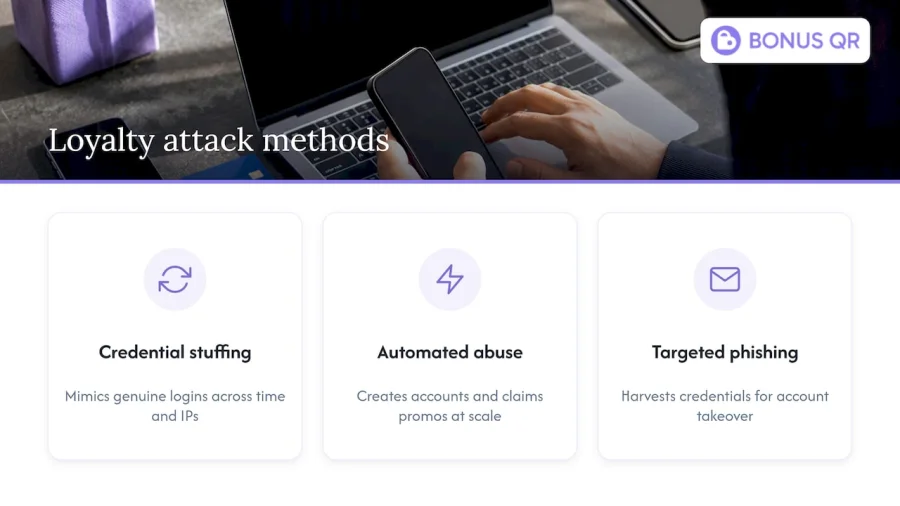
Attackers favour low-and-slow credential stuffing that mimics genuine login behaviour, spreading attempts across time and IP ranges to stay under simple rate limits. Bot farms automate account creation and promo claims at scale, while targeted phishing campaigns harvest the credentials that feed account takeover. None of these techniques are new, but loyalty programmes often lag behind banking platforms in deploying the defences that counter them.
Lifecycle prevention checklist: sign-up, sign-in, redemption and monitoring
Closing the gaps that fraudsters exploit means applying different controls at different stages of the member journey, not one rule covering everything.
- Sign-up: verify e-mail or phone number, apply rate limits per IP and device, run bot detection on form submissions, and check device and IP reputation before activating rewards.
- Sign-in: use adaptive multi-factor authentication that only triggers extra steps when risk signals appear, and offer passkeys or other passwordless options to reduce friction for returning members.
- Redemption: add pending periods on high-value redemptions, cap transfer velocity and destination counts, and route unusual requests to manual review.
- Monitoring: run real-time analytics on redemption and login patterns, feed alerts into a SIEM or equivalent system, and set daily review routines with clear alert thresholds.
Vendor checklist guidance from Human Security echoes this structure, pairing sign-up verification and bot protection with redemption controls designed to stop abuse without disrupting legitimate members.
Pro Tip: Test new thresholds on a small cohort first, measure the false-positive rate for a week, and only roll out programme-wide once genuine members are not getting caught in the net.
Detection and monitoring: behavioural analytics, device signals and bot management
Different signals catch different attack patterns, and the strongest defence fuses them rather than relying on any single one.
- Behavioural analytics: track redemption velocity, session anomalies and sudden changes in reward-use patterns against a member’s normal history.
- Device and network signals: use device fingerprinting, IP reputation checks and carrier verification to catch SIM-swap attempts before they lead to account takeover.
- Bot and intent analysis: distinguish genuine browsing from scripted traffic, which is essential against credential stuffing and distributed low-volume attacks that avoid simple rate limits.
The Netacea case study on a major UK loyalty scheme illustrates the scale involved: hundreds of thousands of credential stuffing attempts were detected in the first month of monitoring, fused across device, behavioural and intent signals server-side. Integrating alerts into daily operations matters as much as the detection itself. Thresholds set too tight generate alert fatigue, so review cycles and escalation paths need to be as deliberate as the detection logic itself.
Balancing prevention with member experience
The best fraud controls are the ones legitimate members never notice. Risk-based step-up authentication keeps extra verification reserved for sessions that actually show suspicious signals, rather than challenging every login. Passkeys and other passwordless methods cut friction while improving security, since there is no password left to steal or stuff.
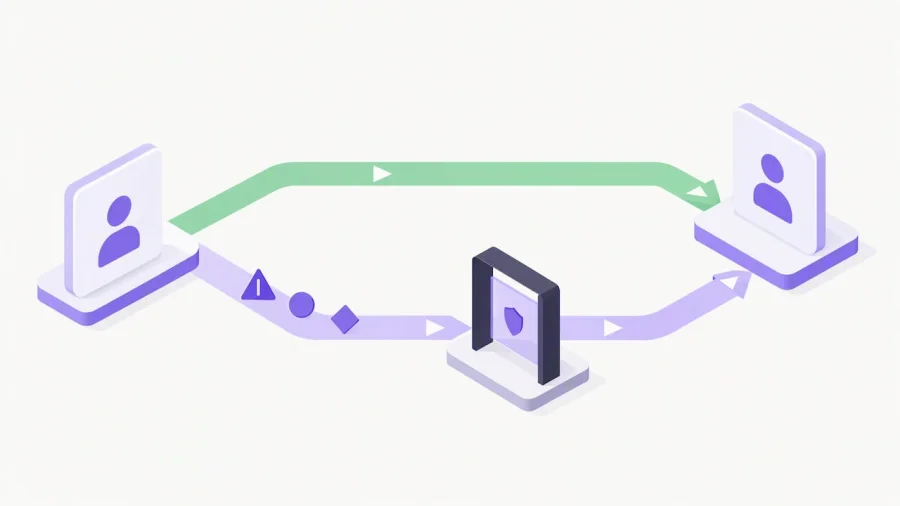
When an account does get locked, clear communication and a fast recovery path matter as much as the block itself. A member who cannot easily prove their identity and regain access will remember the frustration longer than the fraud attempt they were protected from.
Pro Tip: Write your account-recovery messaging before you launch stricter controls, not after the first support ticket arrives.
Incident response: detect, limit and recover
A clear playbook turns a fraud incident from a crisis into a routine.
- Contain immediately: restrict account privileges, force a credential reset, and place suspicious redemptions on hold.
- Handle the customer: apply your reimbursement policy consistently, use prepared support scripts, and send clear notification templates explaining what happened.
- Review afterwards: run a root-cause analysis, tune detection rules and thresholds based on what was missed, and report findings to stakeholders so the next incident is caught faster.
Case studies and research evidence
The scale of loyalty fraud is well documented. Forter’s analysis found accounts holding stored value or points are 6 to 7 times likelier to attract fraud than ordinary accounts. The Netacea case study on a major UK retailer’s loyalty scheme recorded over 650,000 credential stuffing attempts within 30 days, alongside reported cost reductions once bot management and intent analytics were deployed.
Mastercard’s guidance frames the comprehensive answer as combining people, process and technology, pairing staff training and clear escalation paths with identity verification and device authentication. No single tool replaces that combination.
Publisher perspective from a loyalty-platform provider
Prevention works best when it is designed into a programme from day one, not bolted on after a loss. Configurable verification at sign-up, adjustable redemption rules and exportable analytics make the difference between catching fraud early and discovering it in a quarterly report. When evaluating a platform, ask how easily its default thresholds can be adjusted without a developer, because that flexibility is what lets fraud controls keep pace with new attack patterns.
— Michal
How Bonusqr supports lifecycle fraud controls
We designed our loyalty platform so lifecycle controls can be made available from the start rather than added later. Setup can run without POS integration, and redemption rules, verification modules and real-time analytics can be configured directly, so controls around high-value rewards can be tightened as a programme grows. Some programmes may add a branded white-label app or a custom build with ongoing maintenance.
Our pricing page lists the Free, Basic and Premium tiers, and our white-label options cover branded apps for programmes that need their own standalone presence. Register for an account to see how the controls fit your current member flow.
FAQ
What is loyalty fraud?
Loyalty fraud is any unauthorised attempt to create, access or drain a rewards account, including fake sign-ups chasing bonuses, account takeovers and cash-out schemes that convert points into resaleable value. It targets the points, stamps or cashback balance rather than a traditional payment instrument.
How do I remove my name from SAFPS?
The South African Fraud Prevention Service (SAFPS) handles listing removal through its own dispute process, and this falls outside loyalty programme management entirely. Contact SAFPS directly through its official channels for the specific steps that apply to your listing.
Is the loyalty programme real?
Whether a specific loyalty programme is genuine depends on checking it against the retailer’s official website, app store listing or in-store signage rather than relying on an unsolicited link or message. Legitimate programmes never ask you to pay to “unlock” rewards you have already earned.
Which credit card company has the best fraud protection?
Credit card fraud protection is a separate question from loyalty programme security, since it covers payment transactions rather than points or rewards balances. Compare specific providers’ published fraud guarantees and liability policies directly, as these vary by card issuer and are not something a loyalty platform determines.