
 Deutsch
 Español
 Français
 Italiano
 Magyar
 Polski
 Slovenčina
 Čeština
A loyalty card is a physical or digital card issued by a business that rewards customers for repeat purchases or specific behaviours with points, discounts, or exclusive benefits. Loyal customers spend up to 67% more than new ones, which makes a well-run rewards programme one of the highest-return investments a small business can make. The challenge is not whether to run one. The challenge is designing it well enough that customers actually use it. This guide covers everything from card types and reward structures to launch steps, measurement, and the common mistakes that quietly kill engagement.
What is a loyalty card and how does it work?
A loyalty card is a retention tool that records and rewards a customer’s purchasing behaviour over time. The card acts as a link between each transaction and a growing benefit, giving customers a concrete reason to return rather than shop elsewhere.
Physical cards work through barcodes, magnetic stripes, or NFC chips scanned at the point of sale. Digital loyalty cards live inside a mobile app or web browser and are accessed via QR code or a customer account. Both formats track the same core data: how often a customer visits, how much they spend, and which rewards they have earned.
The most common mechanisms are:
- Points per pound spent. Customers earn one or more points for every pound they spend. Points accumulate and are redeemed for discounts, free products, or exclusive offers.
- Stamp cards. Customers collect a stamp per visit or purchase. After a set number of stamps, they receive a reward. This format suits cafés, bakeries, and service businesses.
- Tiered membership. Customers move through levels (Bronze, Silver, Gold) as their spending increases. Higher tiers unlock better rewards, which encourages larger and more frequent purchases.
- Cashback. A percentage of each transaction is returned as credit. Customers redeem this credit on future purchases.
Loyalty cards drive repeat purchases, strengthen customer relationships, and provide insights into buying behaviour. That last point is underused by most small businesses. Every redemption and visit creates a data point you can act on.
Modern loyalty points systems integrate with POS terminals, eCommerce platforms, CRM tools, and marketing platforms for real-time data across every channel. This means a customer can earn points in your shop on Monday and redeem them through your website on Friday without any manual reconciliation on your part.
Pro Tip: Set a minimum spend threshold before points are awarded. This lifts your average transaction value from day one without reducing the perceived generosity of the programme.
What are the different types of loyalty cards?
Loyalty cards come in multiple formats, each with different costs, durability levels, and branding potential. Choosing the right type depends on your budget, your customers’ expectations, and how you want your brand to feel.
Physical card formats
Plastic cards are the most widely used format. They are affordable to produce in bulk, easy to brand with full-colour printing, and familiar to customers of all ages. The downside is that customers lose them, forget them at home, or accumulate so many that yours gets buried in a wallet.
Eco-friendly cards made from recycled PVC or plant-based fibre are a growing choice for businesses with sustainability values. Eco-friendly loyalty cards provide durable options that align with sustainability branding, which matters to a growing segment of consumers. If your brand already positions itself around environmental responsibility, the card becomes a physical expression of that commitment.
Metal cards sit at the premium end of the market. They communicate exclusivity and are typically reserved for top-tier members. The weight and finish of a metal card creates a tactile impression that plastic cannot replicate.
NFC-enabled cards use near-field communication to tap and register at compatible readers. They remove the need for scanning and speed up the checkout process considerably.
Digital formats
QR code cards are the most accessible digital option. Customers present a QR code on their phone, which staff scan at the till. No app download is required, which reduces friction at sign-up.
Customer loyalty apps go further. They store the card, send push notifications, display reward balances in real time, and allow you to run targeted promotions to specific customer segments. For businesses serious about building long-term retention, a dedicated app or web-based platform is the most capable format available.
| Card type | Typical cost | Durability | Branding impact | Tech required |
|---|---|---|---|---|
| Standard plastic | Low | Medium | Good | None |
| Eco-friendly | Low to medium | Medium to high | Strong for green brands | None |
| Metal | High | Very high | Premium | None |
| NFC-enabled | Medium | High | Good | NFC reader |
| QR code (digital) | Very low | N/A | Customisable | Smartphone |
| Customer loyalty app | Low (SaaS fee) | N/A | Excellent | Smartphone |
The strongest programmes combine a physical card for in-store use with a digital platform for data capture, push notifications, and personalised offers. You get the tactile familiarity of a card and the analytical power of software.
How to plan, design, and launch a loyalty card programme
A loyalty programme fails most often not because the rewards are poor, but because the business did not define its goals before launching. Start with clarity on what you want the scheme to achieve.
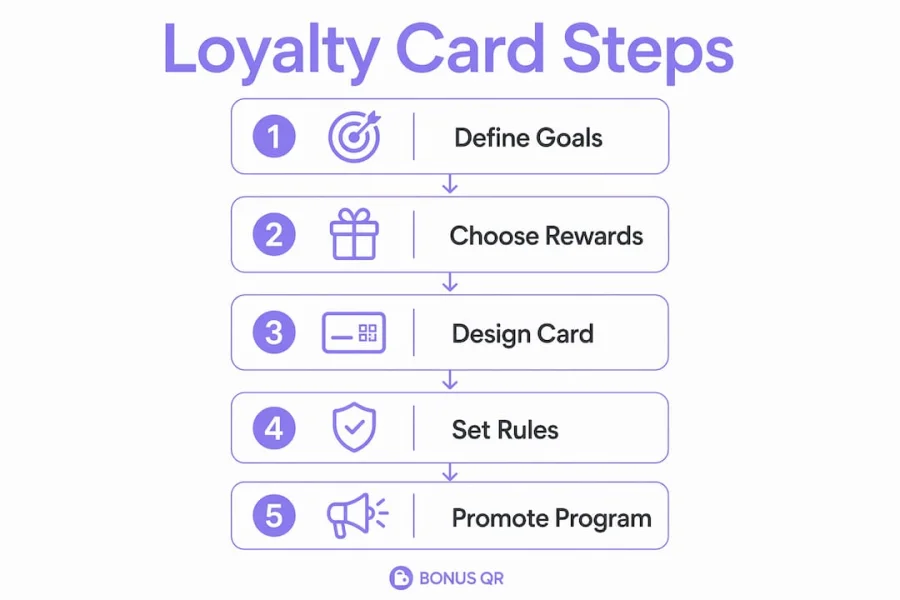
Step 1: Define your goals and customers
Decide whether your primary goal is to increase visit frequency, raise average spend, reduce churn, or generate referrals. Each goal leads to a different reward structure. A café trying to increase visit frequency benefits from a stamp card. A boutique trying to raise average spend benefits from a points-per-pound system with a minimum redemption threshold.
Identify your best existing customers. Look at your transaction data and find the top 20% by spend. These are the customers your programme must retain first. Design the rewards around what they actually value, not what you assume they want.
Step 2: Choose your reward structure
Successful loyalty programmes use structured rules for awarding points, tier-based rewards, and behavioural incentives like referrals or reviews. A practical starting structure for most small businesses is:
- Award one point per £1 spent.
- Set a redemption threshold (e.g., 100 points = £5 off).
- Add a bonus points event once per quarter to re-engage inactive members.
- Offer a double-points period during a traditionally slow trading month.
- Include a referral reward: existing members earn bonus points when they bring in a new customer.
Keep the maths simple. If a customer cannot calculate their reward in their head, the programme loses its motivational pull.
Step 3: Design your card and branding
Your loyalty card is a physical or digital extension of your brand. Use your brand colours, logo, and tone of voice consistently across the card, the app, and any promotional materials. A well-designed card that customers are proud to carry reinforces brand recognition every time they open their wallet or phone.
For digital cards, Bonusqr allows full branding customisation across both mobile and web formats, so your programme looks consistent regardless of how customers access it.
Step 4: Set operational rules
Decide on the following before you launch:
- Do points expire? If so, after how long?
- Can points be earned on sale items or only full-price purchases?
- Is there a welcome bonus for new sign-ups?
- How will staff handle disputes or technical issues at the till?
Document these rules clearly and train every member of staff before the programme goes live. Inconsistent application at the point of sale destroys customer trust faster than any other factor.
Step 5: Promote the programme
Tell your existing customers first. Email them, post on your social channels, and brief your staff to mention the programme at every transaction for the first two weeks. Place sign-up prompts at the till, on your receipts, and on your website. A well-promoted rewards programme generates its own momentum once early adopters start talking about the rewards they have earned.
Pro Tip: Offer a sign-up bonus of 50 points or a free stamp to every new member. This gives customers an immediate sense of progress and dramatically increases the likelihood they will return to build on it.
How to measure and optimise your loyalty card scheme
Measurement turns a loyalty programme from a cost centre into a growth tool. Without tracking, you are running a discount scheme with no feedback loop.
The metrics that matter
- Repeat purchase rate. The percentage of customers who return within a defined period (30, 60, or 90 days). This is the clearest signal of whether your programme is working.
- Average transaction value. Compare the average spend of loyalty members against non-members. Members should spend more per visit.
- Enrolment rate. The percentage of customers who sign up when offered the programme. A low enrolment rate points to a sign-up process that is too complicated or a reward that is not compelling enough.
- Redemption rate. The percentage of earned rewards that are actually claimed. A very low redemption rate suggests customers do not understand how to redeem, or the threshold is set too high.
- Churn rate among members. If loyalty members are still lapsing at the same rate as non-members, the programme is not delivering sufficient perceived value.
Measuring programme success involves tracking repeat purchase rates, average spend, enrolment rates, and using customer data analytics. Review these metrics monthly for the first six months, then quarterly once the programme stabilises.
Common pitfalls and how to avoid them
70% of consumers feel loyalty points have lost value, and programmes succeed by keeping rewards simple and enjoyable. That statistic points to a specific failure mode: programmes that make earning feel easy but make redemption feel impossible. If your threshold is too high, customers disengage before they ever claim a reward.
The other common pitfall is neglecting inactive members. Segment your member list by last visit date and send a targeted re-engagement offer to anyone who has not visited in 60 days. A simple “Your points are waiting” message with a time-limited bonus is often enough to bring them back.
Use your analytics to spot which rewards drive the most redemptions and which promotions generate the highest new enrolments. Shift your budget towards what works. A relationship marketing approach treats loyalty data as the foundation of every future communication, not just a record of past transactions.
Pro Tip: Run an A/B test on your welcome bonus. Offer 50 points to one group and a free product to another. Track which group returns more often within 30 days. The result will tell you whether your customers value currency or experience.
Key takeaways
A loyalty card programme succeeds when it combines a clear reward structure, consistent branding, and regular measurement to keep customers returning and spending more.
| Point | Details |
|---|---|
| Start with goals | Define whether you want to increase visit frequency, raise spend, or reduce churn before choosing a reward structure. |
| Keep rewards simple | Customers disengage when earning or redemption rules are hard to understand; simple maths drives consistent participation. |
| Combine physical and digital | Pairing a physical card with a digital platform gives you both customer familiarity and the data to personalise offers. |
| Measure monthly at first | Track repeat purchase rate, average spend, and redemption rate every month for the first six months to catch problems early. |
| Re-engage inactive members | Segment members by last visit and send a targeted offer to anyone who has not returned within 60 days. |
Why simplicity is the most underrated loyalty strategy
Running loyalty programmes for small and medium-sized businesses has taught me one consistent lesson: complexity kills participation. Business owners often add tiers, bonus categories, expiry windows, and partner rewards because they want the programme to feel premium. What customers actually experience is confusion.
The programmes I have seen perform best are almost embarrassingly simple. One point per pound. One hundred points equals a reward. A clear sign at the till. That is it. The business owner who resists the urge to add conditions and exceptions almost always outperforms the one who builds an elaborate structure.
The second thing I have noticed is that the physical-versus-digital debate is a false choice. Customers who carry a physical card feel a tangible connection to your brand. Customers who use a digital card give you data you can act on. The businesses that grow fastest run both in parallel, using the physical card as the entry point and the digital platform as the engine for personalisation and re-engagement.
My honest advice: launch something simple within the next 30 days rather than spending three months designing the perfect programme. You will learn more from 90 days of real customer behaviour than from any amount of planning. Adjust based on what the data shows, not what you assumed at the start. Customer retention strategies work best when they are built on evidence, and you cannot gather evidence until you launch.
— Michal
How Bonusqr supports your loyalty card programme
Bonusqr is built for small and medium-sized businesses that want a fully featured loyalty system without the complexity of enterprise software. The platform covers points collection, stamp cards, cashback, coupon distribution, and visit-based rewards, all manageable from a single dashboard. You can run both digital and physical loyalty cards under your own branding, with no POS integration required. Push notifications, real-time analytics, and automated campaigns handle the re-engagement work that most small businesses simply do not have time to do manually. Bonusqr offers a free tier to get started, with premium options as your programme grows.
FAQ
What is a loyalty card?
A loyalty card is a card issued by a business that records a customer’s purchases or visits and rewards them with points, stamps, discounts, or free products after reaching a set threshold.
How do I make a loyalty card for my small business?
Define your reward structure first, then choose between a physical card, a QR code format, or a digital platform like Bonusqr. Set clear earning and redemption rules, brand the card consistently, and train staff before launch.
What is the best loyalty points system for a small business?
The best system is one your customers can understand in under ten seconds. A simple points-per-pound model with a clear redemption threshold outperforms complex tier structures for most small businesses.
What are the main benefits of a loyalty card programme?
Loyalty programmes increase repeat purchases, raise average transaction values, and generate customer data you can use to personalise future offers and re-engage lapsed buyers.
How do I measure whether my loyalty programme is working?
Track repeat purchase rate, average spend per member versus non-member, enrolment rate, and redemption rate monthly. If redemption rates are very low, your threshold is likely set too high or the sign-up process is too complicated.