A modern loyalty scheme means a digital programme that rewards customers with points, stamps, cashback, or coupons for repeat visits and spend, not a paper punch card or a vague discount policy. Small businesses that switch to a digital platform typically see faster returns than those running manual schemes, because tracking, redemption, and promotion all happen automatically. If you want a practical starting point, BonusQR is built specifically for this job.
TL;DR:
- Digital loyalty schemes support multiple reward types, with points, stamps, and cashback being the most popular for different business models.
- Choosing a platform that allows enrollment without POS integration, supports automation, and offers clear reporting is crucial for quick, effective deployment.
- Launching within one to two weeks is feasible using a standard platform, with a focus on staff training and early promotion for success.
- Key metrics to monitor include enrolment rate, repeat visits, redemption rate, and customer spending differences between members and non-members.
- Avoid common pitfalls such as over-discounting and overly complex rules by simplifying reward rules and promoting the scheme actively.
What a digital loyalty scheme is and how customers actually use it
Forget the punch card. Today’s employee reward system examples for customers centre on four core mechanics, and each suits a different kind of business.
- Points: customers earn units per pound spent, redeemable later. Works well for retail and grocery.
- Stamp cards: digital versions of “buy 9, get the 10th free.” Ideal for cafes and quick-service spots with frequent, low-value visits.
- Cashback: a percentage returned as store credit. Suits higher-ticket purchases like salons or hotels.
- Coupons and referral rewards: one-off incentives that drive first visits or word-of-mouth growth.
Customers interact through a QR code scan at the till, a mobile or web app, a digital wallet pass on their phone, or via email and push notifications. Customers enrolled in digital loyalty programmes are markedly more likely to return and spend more than non-members, and wallet passes paired with push notifications drive noticeably higher engagement than paper cards ever managed.
The smartest schemes go beyond discounts. Behind the scenes, you’ll need a way to map purchases to customer identifiers, whether that’s a phone number, an app login, or a loyalty card scan, so rewards system mechanics actually connect to real transactions.
What features should you demand from a loyalty platform?
Not every platform is built the same, and the wrong choice costs you months of wasted setup. Run any vendor through this checklist before signing up.
- Enrolment method: can customers join via QR code, a shared link, or a simple form, without downloading anything mandatory?
- Reward mechanics: does it support points, stamps, cashback, coupons, and referral incentives, or just one rigid model?
- Automation and segmentation: can you send push notifications or emails to specific customer groups, like lapsed visitors or top spenders?
- Mobile experience: is there a proper app, and does it support Apple Wallet and Google Wallet passes so customers don’t need a separate download?
- Reporting: can you see enrolment numbers, redemption rates, and repeat visit data without exporting spreadsheets manually?
- Operational fit: does it require POS integration, or can it run standalone? Is white-label branding available if you outgrow the basic tiers?
Pro Tip: Test the redemption flow yourself before launch, not after. Sit at the till, scan a test reward, and time how long it takes. If it takes longer than 15 seconds, your staff will quietly stop offering it during a rush.
Pricing structure matters just as much as features. A platform with a genuinely free tier lets you trial the mechanics before committing budget. BonusQR, for example, offers a free plan alongside paid tiers, with rapid setup that doesn’t require POS integration at all, which matters if your till system is old or your provider won’t allow third-party plugins.
How do you launch a loyalty scheme in weeks, not months?
Launching well beats launching fast, but the two aren’t mutually exclusive if you follow a tight sequence.
- Set your numbers before you set anything else. Decide your target enrolment rate, your desired repeat-visit uplift, and an average order value goal. Without these, you can’t judge success later.
- Match rewards to visit frequency. A café with daily regulars suits a stamp card; a furniture shop with rare, high-value purchases suits cashback or tiered discounts instead.
- Build the basics. Add your branding, configure reward thresholds, connect email and push channels, and write plain-English terms so customers understand exactly what they’re earning.
- Train staff and test the workflow. Walk every team member through enrolling a customer and redeeming a reward, both in-store and through the app. Staff confusion kills adoption faster than any pricing mistake.
- Promote hard in week one and two. Put a QR code on receipts, at the till, and in your email signature. Post about it on social media. Mention it verbally at checkout, since verbal prompts convert far better than a sign customers walk past.
- Review at 30 and 90 days. Pull cohort data on who joined, who’s returned, and who’s gone quiet. Adjust reward thresholds or add a fresh offer if redemption rates are flat.
Starting with a QR-based stamp card or wallet pass, rather than forcing a native app download, avoids most of the friction that kills early adoption, while still letting you send reactivation messages through SMS, email, and wallet notifications.
Which metrics actually prove a loyalty scheme is working?
Four numbers tell you almost everything you need to know, and you should be checking them monthly at minimum.
- Enrolment rate: the percentage of customers who sign up relative to total foot traffic or transactions.
- Repeat visit rate by cohort: track members who joined in a given month and see how their return frequency compares to non-members over the following 90 days.
- Redemption rate: what percentage of earned rewards actually get claimed. A low rate signals confusing rules or poor communication.
- Average order value, members vs non-members: this is where loyalty schemes usually justify their cost.
Beyond those four, watch customer lifetime value, referral conversions, and how often your marketing emails get opened and acted on.
Customers enrolled in a digital programme spend more per visit on average than non-members, and adding wallet passes with push notifications measurably lifts both engagement and redemption compared with static paper cards.
Set a review cadence of 30 days for quick fixes and 90 days for structural changes, like swapping a points system for cashback. If redemption sits below expectations after two review cycles, A/B test a different reward type before assuming the whole programme has failed.
What mistakes quietly kill loyalty schemes?
Most failures trace back to a handful of avoidable errors.
- Over-discounting: constant blanket discounts train customers to wait for the next one, and margins suffer. Exclusive early access or invite-only perks build loyalty without the same cost, since personalisation and exclusivity outperform routine discounting over time.
- Overcomplicated rules: if a customer can’t explain your scheme back to you in one sentence, it’s too complex. Simplify earning and redemption until staff can explain it in ten seconds flat.
- Poor fulfilment: a reward that doesn’t apply at the till, or a stamp that vanishes after an app update, destroys trust fast. Reliable data handling and tracking matter more than flashy features.
- Silent promotion: a scheme nobody mentions doesn’t grow. Put it on receipts, at checkout, and in every relevant email.
How does BonusQR match this checklist in practice?
Running through the checklist above, BonusQR’s feature set covers most of what an SMB actually needs: points, stamps, and cashback modules that run independently or together, mobile and web app support, wallet pass compatibility, push notifications, and built-in analytics for tracking enrolment and redemption.
- POS-less setup means you can launch without touching your till system.
- Modular rewards let you start with a simple stamp card and add cashback or coupons later.
- White-label and custom app options are available for businesses that need to scale beyond standard branding.
- Tiered pricing, including a free plan, lets you test the mechanics before paying anything.
…
What criteria actually matter when choosing a vendor?
Feature lists look similar across most platforms, so the real differentiators sit elsewhere. Start with setup speed: how long from signup to your first customer scan? A platform requiring POS integration or a developer can add weeks to your timeline before you’ve rewarded a single customer.
Support quality matters more than most buyers expect. Check whether help is available when you’re mid-launch and something breaks, not just during the sales call. Look at whether the vendor publishes clear documentation or leaves you guessing.
Pricing transparency deserves scrutiny too. A platform that hides its actual cost behind “contact sales” until you’ve invested hours in setup wastes your time. Vendors publishing straightforward tiers, like BonusQR’s published pricing page, let you compare options in minutes rather than days.
Flexibility for growth is the final test. Your five-location café group today might need a branded app in two years. Ask whether the vendor offers a path from a basic plan to white-label or custom development, or whether you’ll need to migrate everything to a new provider once you outgrow the entry tier. Switching platforms mid-programme means losing customer data, retraining staff, and re-enrolling members, so getting this decision right the first time saves real cost later.
What does a loyalty scheme actually cost?
Pricing models in this space generally fall into three structures: free entry tiers, monthly subscriptions, and one-off setup fees for custom builds.
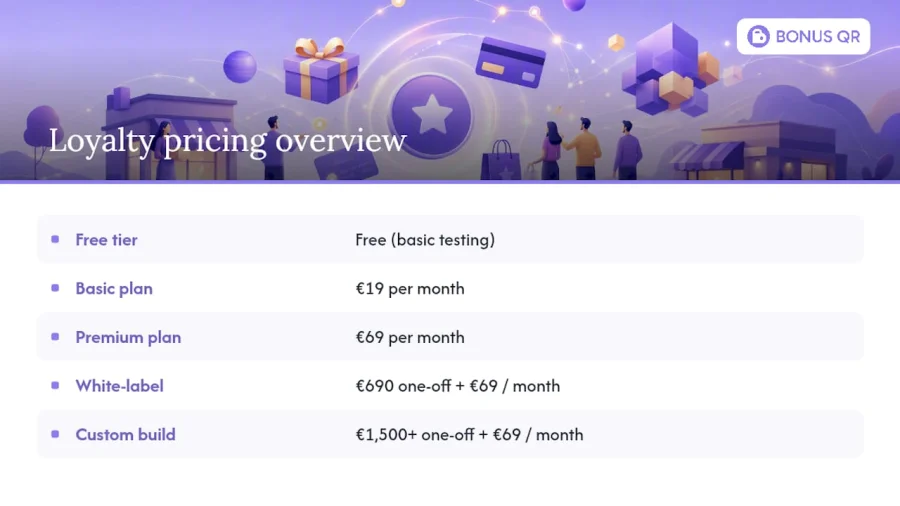
A free tier typically covers basic mechanics, enough to test whether digital loyalty suits your business before committing budget. BonusQR’s Free plan fits this exact use case. Once you need automation, deeper analytics, or higher customer volumes, subscription tiers kick in. BonusQR’s Basic plan runs €19 per month, and Premium sits at €69 per month, covering more advanced modules and reporting.
Businesses wanting their own branded app, rather than appearing inside a shared platform interface, pay differently. A white-label setup carries a one-off fee of €690, plus a Monthly Subscription of €69 to maintain the branded app. For businesses needing something built entirely to specification, custom app development starts from €1,500 as a one-off project fee, with Monthly Maintenance from €69 covering ongoing support.
Budget for the true cost beyond subscription fees too: staff time for training, any promotional materials like till signage, and the occasional reward giveaway during launch week. None of these are large costs individually, but they add up during the first month if you don’t plan for them.
How long does rollout actually take?
A basic digital loyalty scheme, using an existing platform rather than custom development, can go from signup to first customer enrolment within a week. Configuring branding, choosing reward mechanics, and setting up QR codes for till-side enrolment rarely takes longer than a few days once you’ve decided on your reward structure.
Staff training adds another few days, particularly if you run multiple locations or shifts. Budget a full week for everyone to feel confident scanning codes and explaining rewards to customers without hesitating.
A white-label app, with its own branding and app store listing, takes longer: expect several weeks for design approval, app store submission, and testing before public launch. Custom-built solutions with bespoke features like booking widgets or e-shop integration run on a longer timeline still, often stretching into months depending on scope.
Most SMBs are best served starting with the fastest path: a standard platform launch within one to two weeks, followed by a 90-day review before considering a white-label upgrade. Rushing straight to custom development before proving the reward mechanics work on a standard platform risks spending heavily on features customers may not actually use.
How does a loyalty scheme support retention and engagement goals?
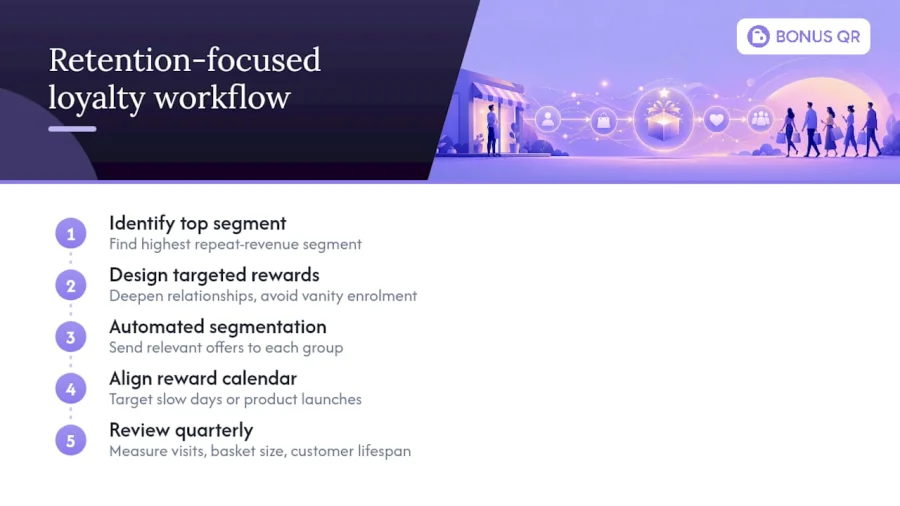
A loyalty scheme works best when it’s not a bolt-on marketing tactic but tied directly to how you retain your best customers. Start by identifying which customer segment drives the most repeat revenue, then design rewards that specifically deepen that relationship rather than chasing broad enrolment numbers alone.
Segmentation matters here. Treating every customer identically wastes the personalisation that modern platforms enable. A customer who visits weekly deserves different messaging and rewards than one who visits twice a year, and automated segmentation lets you send relevant offers to each group without manual list-building.
Align your reward calendar with your broader retention goals. If slow Tuesdays are a persistent problem, build a reward that specifically nudges loyalty members toward that day. If you’re launching a new product line, use exclusive early access for top-tier members as both a retention tool and a soft product launch strategy.
Review your programme against retention data quarterly, not just redemption numbers. A scheme with high enrolment but flat repeat-visit rates isn’t actually driving loyalty, it’s just collecting emails. The goal is measurable behaviour change: more frequent visits, higher basket sizes, or longer customer lifespans, not enrolment vanity metrics that look good in a dashboard but don’t move revenue.
What legal and privacy rules apply to a loyalty scheme?
Any programme collecting customer data, names, emails, phone numbers, or purchase history, falls under data protection obligations. In the United States, this means paying attention to state-level privacy laws, several of which now require clear disclosure of what data you collect and how you use it, plus a mechanism for customers to request deletion.
Get explicit consent before enrolling anyone. A checkbox at signup confirming customers agree to receive marketing communications protects you from complaints and keeps your email deliverability healthy, since unsolicited messages get reported as spam quickly.
Write your terms in plain language, not legal boilerplate nobody reads. State clearly how points or stamps are earned, whether they expire, and what happens if a customer wants to close their account and have their data removed. Reliable data handling isn’t just good practice, it’s what prevents missed rewards and customer complaints that damage trust in the programme.
If you’re storing payment information alongside loyalty data, confirm your platform meets PCI compliance standards for that specific function. Most reputable loyalty platforms handle this separately from core payment processing, but it’s worth confirming rather than assuming.
Priorities when choosing and launching a loyalty scheme
Start small. Pick one reward mechanic, set two or three measurable goals, and resist the urge to launch every feature at once. Operational reliability and staff buy-in matter more than an impressive feature list nobody uses correctly…
— Michal
How to try BonusQR for your business
BonusQR is built around the exact checklist covered above: fast setup without POS integration, modular rewards you can mix and match as your business grows, and mobile and wallet pass support that meets customers where they already are. If you want to see whether a stamp card or points system fits your customer base before spending anything, the free and paid pricing tiers let you compare options directly. Businesses ready to launch their own branded experience can explore custom mobile app development services, or register and get started today, or explore white-label and custom app options if you’re planning something more tailored to your brand.
FAQ
What is a digital loyalty scheme?
A digital loyalty scheme rewards customers electronically for repeat visits or spend, using points, stamps, cashback, or coupons tracked through an app, QR code, or wallet pass rather than a paper card.
How much does a loyalty platform cost for a small business?
Pricing varies by platform and features. BonusQR offers a free tier alongside Basic at €19 per month and Premium at €69 per month, with white-label setup available for €690 one-off plus €69 monthly.
How long does it take to launch a loyalty scheme?
A standard platform launch typically takes one to two weeks from signup to first customer enrolment, while white-label or custom-built apps can take several weeks to months depending on scope.
What metrics show a loyalty scheme is working?
Track enrolment rate, repeat visit rate by cohort, redemption rate, and average order value for members versus non-members as your primary indicators of success.
Do I need POS integration to run a loyalty scheme?
No. Platforms like BonusQR support QR-based enrolment and redemption without requiring POS integration, which speeds up setup considerably for businesses with older till systems.


