How to Train Staff for a Loyalty Program That Works
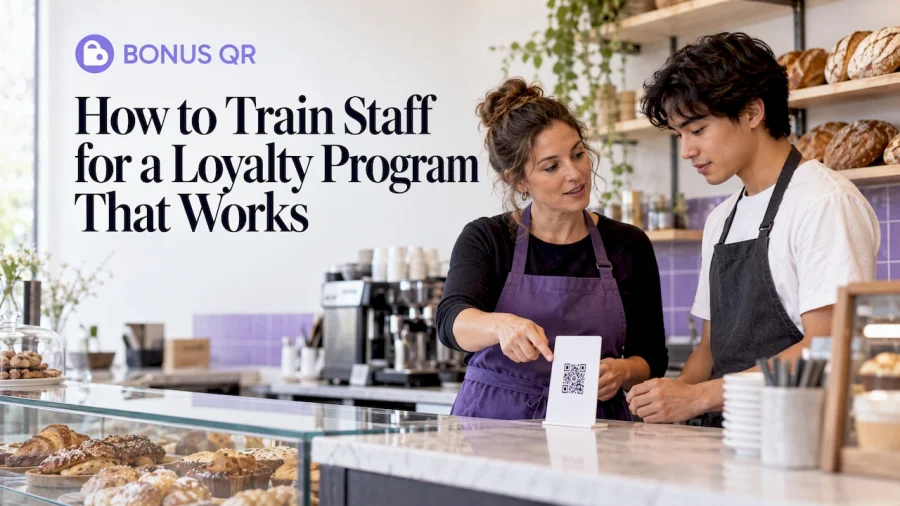
To train staff for a loyalty program, teach them four things in this order: how the program works, how to explain it in one sentence, how to enroll a customer in under a minute, and how to answer the questions that come up at the counter. Then keep it going with short refreshers and a few numbers you review each month. A loyalty program only grows when the person at the register or front desk brings it up, so a simple program that your team can explain beats a clever one nobody mentions. Our QR-based platform is built to make this training short, because there is no extra POS system for staff to learn.
Key Takeaways
- Staff need to know the program’s features, how customers earn and redeem, current offers, and where customers can read the rules before they pitch it to anyone.
- Teach a 10-second explanation and a 60-second enrollment routine, then practice both with role-play instead of a long slide deck.
- Make “ask every customer” the standing expectation, and give staff a one-page cheat sheet at every register or desk.
- Refresh training regularly: a 2025 study of a digital membership system found that continuous staff support and feedback loops mattered more than the software alone.
- Measure enrollment rate, visit frequency and retention, so you can see whether training is changing customer behavior.
Why your team decides whether the program succeeds
A loyalty program lives or dies at the moment of contact. The customer is paying, ordering or checking in, and a staff member either mentions the program or does not. If staff are unsure how points or stamps work, they skip it, and the customer leaves without joining.
This is true for every business type we work with: the cafe barista, the retail cashier, the front-desk person at a gym or hotel, the attendant at a gas station. In each case the employee is the program’s most frequent point of sale. Training is the cheapest way to raise enrollment, and it costs only a few hours of planning and a few minutes per shift.
There is a second reason to train properly. Customers are quick to lose patience with confusing rules. In its 2026 loyalty study, which surveyed more than 1,400 consumers and about 300 loyalty leaders, EY found that expiring points or limited redemption windows were the most common customer complaint, followed by the number of purchases needed to earn a reward. Your staff are the ones who will hear those complaints first, so they need clear answers ready.
What staff must know before they talk to customers
Before anyone practices a script, make sure they can answer a basic set of questions with confidence. The UK’s national retail qualification standard on explaining loyalty schemes to customers, published by the Scottish Qualifications Authority, lists the knowledge a retail employee needs. It translates well into a checklist for any small business:
- Features and benefits. What does a member get, and how does the program work?
- Where to find information. Where can a customer read the rules: a web page, the app, a printed card, a QR poster?
- Why it matters to the business. Staff who understand that the program exists to bring customers back, not just to give discounts, explain it more naturally.
- Current offers. What can members get right now: a welcome reward, a double-stamp day, a birthday perk?
- Frequent questions and concerns. What do customers usually ask, and what is the honest answer?
Turn these five points into a single page for your team. Fill in your own details so there is no guessing.
The one-page program card
Write out, in plain words:
- How a customer joins (for example, scan the QR code and enter a phone number or email).
- What they earn per visit or per purchase (one stamp per coffee, one point per dollar, a percentage back).
- What the first reward is and how many visits it takes to reach it.
- How a reward is redeemed and who confirms it.
- When points or rewards expire, if they do.
- Who to ask when something does not work.
If you cannot fit it on one page, the program may be too complicated for customers as well. Simplifying it is part of training. Our guide to a points reward system that actually works shows how to set earning and redemption rules that are easy to say out loud.
Teach staff to explain the program in 10 seconds
The most useful single skill is a short, natural explanation. Customers at a counter will not listen to a paragraph. A good explanation has three parts: what it is, what you get, and what to do next.
A few examples by business type:
- Cafe: “We have a stamp card on your phone. Every tenth coffee is free, and you can join by scanning this code.”
- Gym or wellness center: “Members earn points for every class they attend, and points turn into guest passes or a free massage add-on. I can sign you up right now.”
- Gas station: “Join our rewards program and you save on your fill-up today. It takes about 30 seconds with the code on the pump or at the register.”
- Retail: “If you join our rewards program, you earn points on today’s purchase. Want me to set it up while I ring you up?”
A company blog from a convenience-store fuel consultancy, H&S Energy Group, recommends teaching benefits instead of features. The idea fits every business: “You get a free coffee after ten visits” is a benefit, while “it uses a digital stamp engine” is a feature the customer does not care about.
Lead with what the customer gets today
Customers join when the reward feels close. Train staff to mention the immediate gain first: a welcome bonus, a first stamp already added, a discount on today’s order. If your program has an onboarding reward, make it part of the one-sentence pitch. The same fuel-retail blog suggests highlighting an immediate reward, such as savings on today’s fill-up, to give customers a reason to act now.
Keep the language honest and plain
Customers also want to know what they are signing up for. A regulator’s review of loyalty schemes in Australia, the ACCC’s 2019 final report, found that membership is voluntary and generally free, that schemes can collect data both actively and passively, and that privacy policies are often hard to understand. It recommended presenting relevant terms and privacy information clearly at key moments. The takeaway for your staff is simple: if a customer asks what you do with their email or phone number, they should be able to answer in a sentence and point to the privacy page. Add that sentence to the program card.
Teach the 60-second enrollment routine
Sign-up is where the most customers are lost. If it takes five minutes or needs a form, the line behind the customer will win. Train the routine until it is automatic.
A typical routine for a QR-based program looks like this:
- Check whether they are already a member. Ask first. Many returning customers have joined before, and asking them to join again is awkward.
- Offer the sign-up with a benefit. Use your 10-second line.
- Point to the QR code. The customer scans it with their own phone camera. Staff do not need to touch the customer’s phone.
- Walk them through the first screen. Let the customer enter their own details. Stay close enough to help if they hesitate.
- Confirm the first reward or stamp. Show them that something has already been credited. That moment is what makes the program feel real.
- Tell them how to find their card again. For example, in the app, in the browser, or in Apple Wallet or Google Wallet if you use it.
Because our platform is QR-based and does not require a POS integration, the staff-side steps are few: the customer scans, and the team confirms. There is no new till software to learn, which shortens training for seasonal and part-time staff.
Plan for customers who are not comfortable with apps
Not every customer is at ease with digital tools. A 2025 academic study of a digital membership system at a barbershop in North Sumatra, Indonesia found that staff gave personalized support to digitally reluctant customers, and that bi-monthly training and mentoring helped close digital-literacy gaps and reduce data-entry errors. After the shift to a digital membership, visit frequency in that business rose from 0.8 to 1.7 times a month, retention reached 64%, and 58% of active customers referred friends or family. It is one business in one country, so treat the numbers as an illustration of what staff support can do, not a forecast for your shop.
In practice, give staff permission to spend an extra minute with a hesitant customer, and teach them how to help without taking over the phone.
Handling the questions customers actually ask
Build a short list of common questions and agree on the answer. Your list will be specific to your program, but these almost always appear:
| Customer question | What staff should be able to say |
|---|---|
| “Does it cost anything?” | State plainly whether joining is free and what, if anything, it costs. |
| “What do I get?” | Name the first reward and how many visits or points it takes. |
| “Do my points expire?” | Give the exact expiry rule, or say they do not expire. |
| “What happens to my phone number or email?” | Explain what you use it for and point to the privacy page. |
| “I forgot to scan today. Can you add it?” | Follow your written rule, and know who can approve exceptions. |
| “I lost my phone or changed numbers.” | Know how the customer can recover the account. |
| “How do I use my reward?” | Walk through redemption step by step. |
The expiry row matters most. Since expiring points top the list of customer frustrations in the EY study mentioned above, make sure every employee gives the same answer. Better still, design the program so the rule is easy to state.
Practice methods that stick
A one-off meeting rarely changes behavior. Short, repeated practice does.
Role-play at the start of a shift
The H&S Energy Group tips recommend regular team meetings or quick daily huddles to review current promotions, along with cheat sheets and role-playing everyday customer interactions. Use five minutes before opening:
- One person plays the customer, one plays the employee, and a third observes.
- Run three scenarios: an easy yes, a hesitant “I don’t want another app,” and a problem (“my stamp didn’t register”).
- Swap roles so everyone practices both sides.
Seeing the program from the customer’s seat is the fastest way to find confusing wording.
Have every employee join the program
Anyone who has scanned the QR code, collected a stamp and redeemed a reward can describe it from experience. The same fuel-retail guidance encourages employees to use the program themselves so they can speak from experience. Give each team member a test account and ask them to complete a visit and a redemption in the first week.
Set a clear expectation
Make the rule simple: every customer is asked if they are a member. Post a short prompt at the register or front desk and mention it in the shift briefing. A consistent expectation removes the question of whether to ask or not.
Reward the behavior, not only the result
If you want staff to promote the program, give them a reason. Small incentives work: a shared team goal for weekly enrollments, recognition in the team chat, a preferred shift for the top enroller. Keep the focus on friendly invitations, not pressure, so customers never feel cornered.
Keep knowledge consistent across shifts and new hires
Turnover is the hidden problem. A hospitality training provider notes that US hospitality turnover averages 70 to 80% a year, so each departure takes training with it, and consistency across locations depends heavily on who is doing the training. Even if your business is a single shop, the same issue appears between the morning and evening shifts.
Some habits that help:
- One source of truth. Keep the program card in a shared place, and update it whenever you change a reward or run a promotion.
- A 15-minute onboarding module. Every new hire sees the same demonstration, does a mock enrollment, and answers the question table above before working a solo shift.
- A named buddy. Pair new hires with a staff member who enrolls customers well.
- A quick sign-off. Ask each new hire to enroll a colleague as a test customer before they are cleared to do it live.
- Announce changes at the shift huddle. A new offer that only the manager knows about will not reach customers.
If you run several locations, use the same card, same scenarios and same sign-off at each one.
Measure whether the training is working
Training you cannot measure is training you cannot improve. You do not need a complex dashboard. Track a few numbers each month and compare them before and after a training push.
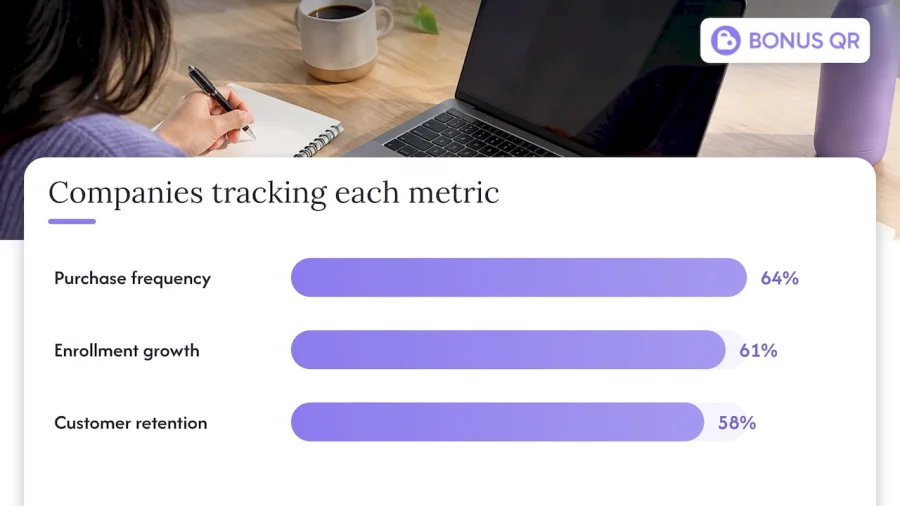
In a 2025 EY study of loyalty programs in five Latin American countries, the most common success metrics were purchase frequency (64% of companies), enrollment growth (61%) and customer retention (58%). These work well for small businesses too, and each connects to what staff do:
| Metric | What it tells you about training |
|---|---|
| Enrollment rate (new members as a share of transactions) | Whether staff are asking and whether sign-up is quick |
| Enrollment by shift or by employee | Where coaching is needed |
| Visit frequency of members | Whether the program is changing habits |
| Retention (members who return within 30 or 60 days) | Whether customers understand and use their rewards |
| Redemption rate | Whether staff explain how to claim rewards |
| Questions or complaints logged | Which part of the explanation is unclear |
Analytics are built into our platform, so you can see member activity and customer behavior without exporting spreadsheets. Compare enrollment before and after each training session, and share the results with the team. Employees respond to seeing that their effort moved a number.
A useful side check is a simple confidence rating. Ask each employee once a month to score from 1 to 5 how comfortable they feel explaining the program and handling a redemption. A low score is a signal to practice that scenario next.
A four-week training plan you can run alone
Here is a plan sized for a small team with no training department.
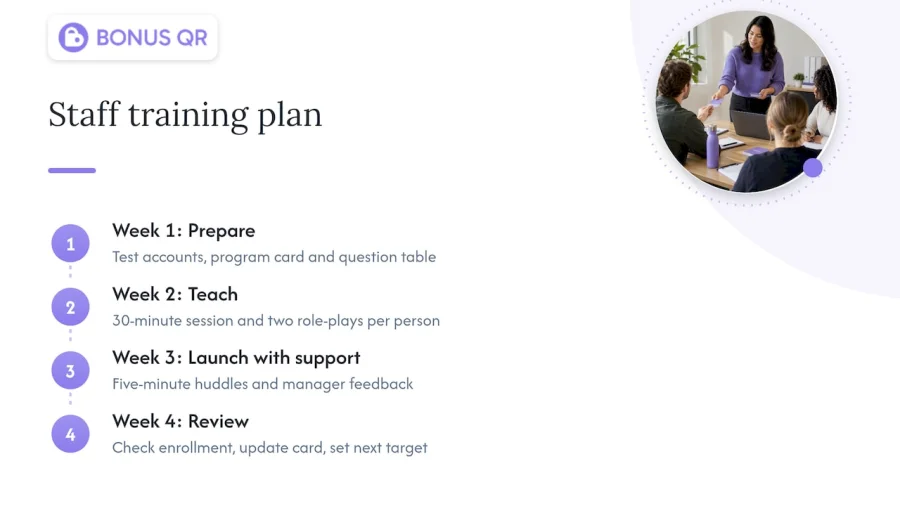
Week 1: Prepare. Write the program card and the question table. Create staff test accounts and have everyone complete a visit and a redemption.
Week 2: Teach. Run a 30-minute session: explain the five knowledge points, demonstrate the 10-second pitch and the 60-second enrollment, and run two role-plays per person.
Week 3: Launch with support. Post the cheat sheet at every register or desk. Open each shift with a five-minute huddle. The manager observes a few real enrollments and gives quick, friendly feedback.
Week 4: Review. Look at enrollment by shift, hear from the team about the questions customers asked, update the card, and set a target for next month.
After that, repeat a short refresher every couple of months and run a mini-training whenever you change a reward. For more on keeping members active once they have joined, see our customer retention workflow and the guide on how to engage loyal customers.
If you want a broader view of the habits behind lasting customer relationships, this walkthrough on fostering customer loyalty step by step covers the practices that sit around staff training.
Our perspective on training for loyalty
Most owners ask us about rewards first and staff second. We think it should be the other way around. A reward structure can be copied in an afternoon, but a team that confidently invites every customer to join is much harder to copy.
That is why we built BonusQR around a short staff routine. Customers scan a QR code, there is no additional POS system to learn, and the platform handles reward distribution, customer insights and promotional notifications. Your team spends its time with customers, not with software.
Our advice is to keep the program simple enough to explain in one breath, write it on one page, and practice it a little every week. Then use the analytics to see which shifts and which offers are working, and coach from that evidence. Small businesses do not need a training department. They need one clear script, one habit of asking, and one number to watch.
Michal Palus
Make training easier with the right platform
Training is quicker when the program itself is simple. BonusQR is a QR-based digital loyalty platform for small businesses, with digital stamp cards, points, tiered cashback, onboarding promotions, referral and review modules, push and email notifications, and analytics. You can start on the Free plan, move to Basic at €19 per month, or choose Premium at €69 per month for more features. See the details on the pricing page. If you want the program under your own brand, we also offer a white-label app with a one-off setup fee of €690.
FAQ
How long does it take to train staff for a loyalty program?
A basic session takes 30 to 45 minutes: the program card, the 10-second pitch, the enrollment routine and two role-plays each. Real confidence comes from short repeats, such as a five-minute huddle at the start of shifts over the first few weeks. New hires can complete the same session in their first days.
What should I tell staff to say when a customer does not want to join?
Teach a friendly, brief response: thank the customer, mention that they can join any time by scanning the code, and move on. Staff should not push or repeat the offer in the same visit. Asking every customer once keeps the experience pleasant and the invitation consistent.
How do I get part-time and seasonal staff up to speed quickly?
Give them the one-page program card, have them join as a test member, and let them practice the pitch and enrollment with a colleague before their first solo shift. A QR-based program with no POS integration keeps the staff-side steps few, so there is less to memorize. Pair them with an experienced buddy for the first week.
How do I know if the training worked?
Compare enrollment rate, member visit frequency and retention before and after training, and look at the results by shift. Rising enrollment shows staff are asking and sign-up is smooth, while rising repeat visits show customers understand the rewards. Share the numbers with the team each month.
Sources
- Explain to customers the features and benefits of a retail loyalty scheme (SQA, J09704)
- 2026 EY Loyalty Market Study
- ACCC Customer Loyalty Schemes Final Report, December 2019
- Implementation of the Digital Membership (Golden Ratio, 2025)
- EY loyalty strategies and programs in Latin America, 2025
- Promoting Rewards Programs: Team Training Tips (H&S Energy Group)
- How Employees Can Promote C-Store Loyalty Programs (H&S Energy Group)
- VR Training for Hospitality Staff (Yaksha)


