
 Deutsch
 Español
 Français
 Italiano
 Magyar
 Polski
 Slovenčina
 Čeština
A busy café can serve a queue efficiently and still lose customers. A salon can produce excellent work and still fail to see clients return. A shop assistant can smile, say the right words and thank every visitor, yet the till remains dependent on people who may never come back.
That's why how to improve customer service in a small shop shouldn't begin with another script or motivational poster. It should begin with a harder question: what makes a customer return, and how does the business know whether service is creating that habit?
The practical answer combines observable frontline behaviour, disciplined complaint recovery and a simple loyalty system that connects visits over time. For cafés, restaurants, salons, gyms and independent retailers, BonusQR can tie those activities together through QR-based rewards, visit history, feedback requests and targeted communication, without requiring extra hardware or a POS integration.
Why Most Customer Service Advice Fails Small Shops
“Smile more and train the team” is familiar advice because it's easy to print, teach and forget. A greeting matters, but it won't rescue a shop that never gives customers a reason to return. A warm welcome is useful on the first visit. A remembered customer, a properly resolved problem and a visible reward are what turn that visit into a routine.
Small businesses often treat customer service as a behaviour problem. The owner notices a flat greeting, a slow response or a careless farewell, then adds a script. The commercial issue is usually retention. If the same customer doesn't return, the business has no opportunity to improve the relationship, recover a poor experience or build trust.
The UK Customer Satisfaction Index, published by the Institute of Customer Service since 2008, gives businesses a useful reminder that service quality can be tracked over time rather than judged by instinct. Its July 2026 reading was 78.3 out of 100, up 1.0 point from the previous year and only 0.1 points above January 2026. The same benchmark reached 78.4 in July 2022, based on a national survey of 45,000 customer responses. Those figures come from the UK Customer Satisfaction Index research, and the lesson for a small shop is straightforward: modest improvements become visible when a business measures them consistently.
The second visit is the real test
A stranger may forgive a routine hello. A regular customer notices whether staff remember a preference, whether the business handles a delay fairly and whether the next visit feels easier than the last.
That makes loyalty mechanics the engine and frontline service the fuel. The shop needs both, but loyalty creates the feedback loop. It shows whether better greetings, faster recovery and more thoughtful follow-up lead to another visit.
The aim isn't pleasant transactions. It's measurable customer habits.
A paper card can encourage a return, but it rarely tells the owner who returned, what happened after a complaint or which customers have disappeared. A digital QR system can connect the visit to a customer profile, allowing the team to link service actions with repeat behaviour. That turns customer service from a vague standard into an operating system.
Diagnose the Real Service Gaps in Your Shop
Owners rarely identify their biggest service problem accurately from behind the counter. They see the rush, hear the complaints that reach them and remember the most dramatic incident. The quieter friction, such as unclear queues, awkward farewells or customers waiting without updates, often escapes notice.
A focused afternoon can reveal more than a new training course.
Observe the shop as a customer
Spend two hours in the business without taking over. Sit at a café table, book a salon appointment, or browse the shop as an ordinary customer. Record what happens at each stage:
- Arrival: Is the greeting clear, or does the customer have to work out where to queue, wait or check in?
- Waiting: Does staff explain delays before the customer asks?
- Service: Does anyone check that the product, treatment or order is right?
- Payment: Is the next step obvious?
- Farewell: Does the customer leave with a reason to return?
The owner should write observations, not explanations. “Customer stood near the till without acknowledgement” is useful. “Staff were too busy” is an excuse that prevents a fix.
Ask one uncomfortable question
For one week, attach a slip to receipts or place cards near the exit with one question:
What almost stopped you from coming back?
Keep the response optional and brief. Read every answer, including the ones that seem unfair. Customers may point to a slow queue, an uncomfortable chair, an unexpected price, a rushed consultation or an employee who sounded irritated.
Then review the last 20 negative reviews across Google, TripAdvisor and the business's social channels. Tag each comment as speed, accuracy, attitude or policy. The categories will show whether the problem is operational, interpersonal or created by a rule customers don't understand.
Ask regulars directly
Three regulars can provide sharper insight than a room full of assumptions. Ask each one face-to-face:
- “What would make you visit more often?”
- “What's the one part of the experience that gets in the way?”
- “What does the shop do that you'd miss if it changed?”
The owner should avoid defending the business. A diagnostic only works when the answers can challenge the owner's preferred explanation. Once the top service gaps are visible, the team can change one behaviour at a time and measure whether customers return more often.
Frontline Habits That Actually Change How Customers Feel
Customers remember small signals of attention. The staff member who recognises a returning visitor, explains a delay before being asked or takes ownership of a mistake creates a very different experience from someone who follows a script without noticing the person in front of them.
The language below can be printed, practised and adapted to the shop's tone.
Replace generic greetings with recognition
“Hi, how can I help you?” works for a stranger, but it says nothing to someone who has visited before. When the team recognises a customer, “Welcome back”, “Good to see you” or “The usual today?” signals memory.
A café can connect the greeting to a known preference. A salon can mention the customer's appointment or previous treatment. A boutique can say, “That colour worked well for you last time.” Staff shouldn't pretend to remember details they don't know. A simple, truthful acknowledgement is stronger than forced familiarity.
Narrate the service
Silence creates uncertainty. A stylist should explain the next stage of a treatment. A barista can say, “The flat white will be over shortly, and staff will bring it to the table.” A shop assistant can explain why an item needs to be ordered rather than implying that stock might appear.
Useful check-ins are short and specific:
- “How's the table enjoying the flat white?”
- “Is the water temperature comfortable before the treatment starts?”
- “Would a different size or colour make this more useful?”
- “The kitchen is catching up with the order now, and staff will update the table if that changes.”
Efficient service also depends on the physical workflow. Owners reviewing queues, prep stations and handoffs should consult this practical guide to commercial kitchen layout advice, especially when delays begin behind the scenes rather than at the till.
Own the recovery
“I'm sorry you feel that way” describes the customer's emotion without accepting responsibility. “That's on us. Here's what staff can do now” moves directly towards a remedy.
The fix might be remaking a drink, correcting an appointment detail, replacing a faulty product or explaining a policy with a fair alternative. Each incident should be logged so the team can see whether the same issue keeps appearing.
Finish with a reason to return
“Thanks for coming in” closes the transaction. A better farewell connects the next visit to something relevant: “The new seasonal drinks arrive next week”, “The next appointment can include the treatment discussed today”, or “That style is available in another colour if the customer wants to compare it next time.”
A simple digital record makes these habits easier to evaluate. The loyalty platform BonusQR can connect visits and rewards to the behaviours the team is trying to reinforce.
Turning a Bad Visit Into a Loyal Customer
A complaint is not an interruption to service. It is a live test of whether the business can take responsibility when the original promise has failed.
The UKCSI's January 2026 reading illustrates why recovery deserves separate attention. Overall satisfaction reached 78.2, while complaint handling scored 63.8, up 4.0 points year on year. Experience scored 79.8, and ethics scored 76.6, according to the Institute of Customer Service update on customer satisfaction. Complaint handling remained the weakest of those dimensions, so owners looking for meaningful gains should fix recovery workflows rather than polishing routine greetings alone.
Use one decision path
A small shop shouldn't require the owner to approve every reasonable remedy. Staff need clear boundaries and language they can use immediately.
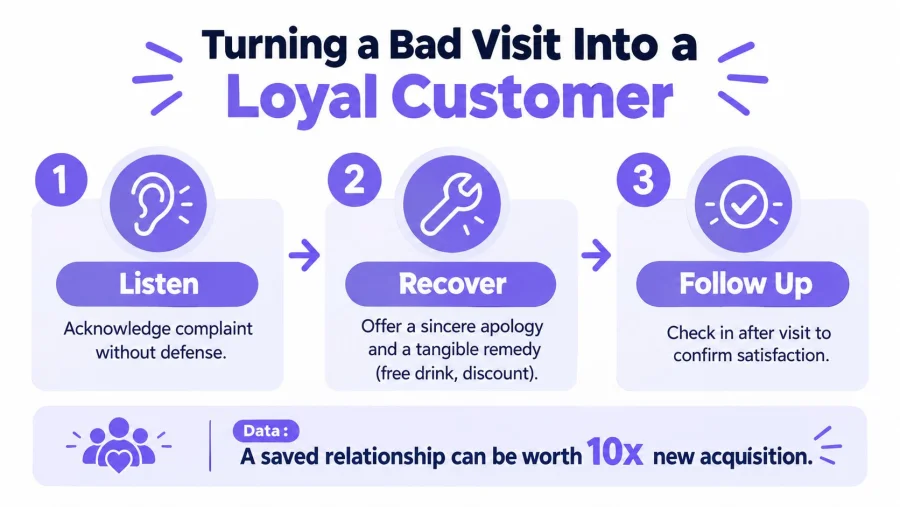
- Listen and acknowledge. Within the first moments, the team member should stop multitasking, face the customer and say, “That shouldn't have happened. Staff will sort it now.”
- Apologise without an excuse. For a long wait, say, “The wait was too long, and staff should have updated the customer sooner.” For a product defect, say, “The item wasn't fit for purpose. Staff can replace it or arrange the appropriate alternative.”
- Offer two concrete options. A café might remake the drink or remove it from the bill. A salon might correct the issue at the next suitable appointment or offer another practical remedy. A retailer might replace the product or process the available refund route.
- Follow up the same day. A personalised message should confirm what happened and ask whether the remedy resolved the concern.
- Record the incident. The shared log should include the cause, the remedy and the staff member who handled it.
For price complaints, staff should explain what the price includes before debating value. For waiting-time complaints, the first remedy is clarity, not defensiveness. For defects, the customer shouldn't have to prove the business cares before receiving a fair response.
Practical rule: Give staff authority to make a reasonable first fix, then review the pattern with the team. A recovery opportunity disappears when every answer requires a manager.
The process also needs a time standard. Public-facing complaints guidance recommends responding within 20 working days, with a target of 95% of cases meeting that standard. If a case will miss the deadline, the customer should be told before day 20 and updated until closure, as set out in the UK complaints management guidance. Those rules may not map perfectly onto every café or salon issue, but they establish the right discipline: acknowledge, set expectations and keep the customer informed.
Using QR Loyalty to Power Every Improvement
A paper stamp card rewards a return. A connected QR loyalty system can also show who returned, how often they visit and which customers need attention.
BonusQR is one example of this approach. A business can place a printed QR sticker on the counter, tables, receipts or appointment desk. The customer signs up through a mobile experience without downloading an app, earns points automatically and sees rewards and visit history in a personal profile. The setup doesn't require a POS integration or extra hardware, which matters to a small café, salon, gym or independent retailer operating on a tight budget.
Connect service to retention
A QR loyalty system can perform three jobs that a paper card can't handle well:
- Capture repeat-visit data: The owner can see whether a customer returned after a service interaction.
- Create a direct communication channel: The business can send relevant rewards, updates, feedback requests or reminders outside the physical visit.
- Support recovery: A customer who had a poor experience can receive a personal follow-up or carefully chosen return offer instead of disappearing.
BonusQR supports stamps, points, cashback, visit and spend thresholds, fixed discounts, welcome bonuses, birthday offers and seasonal coupons. The business can choose rules that fit its margin and customer rhythm rather than forcing every shop into the same reward structure.
Keep the ask simple
Staff shouldn't deliver a long explanation during a rush. The script can be:
“The QR code lets customers collect rewards and keep track of visits. It takes a moment to join, and staff can help if needed.”
The system can segment customers by frequency and spend, allowing the owner to separate a thank-you message for regulars from a win-back campaign for lapsed customers. It can also help connect a feedback request to the right point in the relationship. The mobile web rewards platform keeps the customer experience accessible through a browser-based flow.
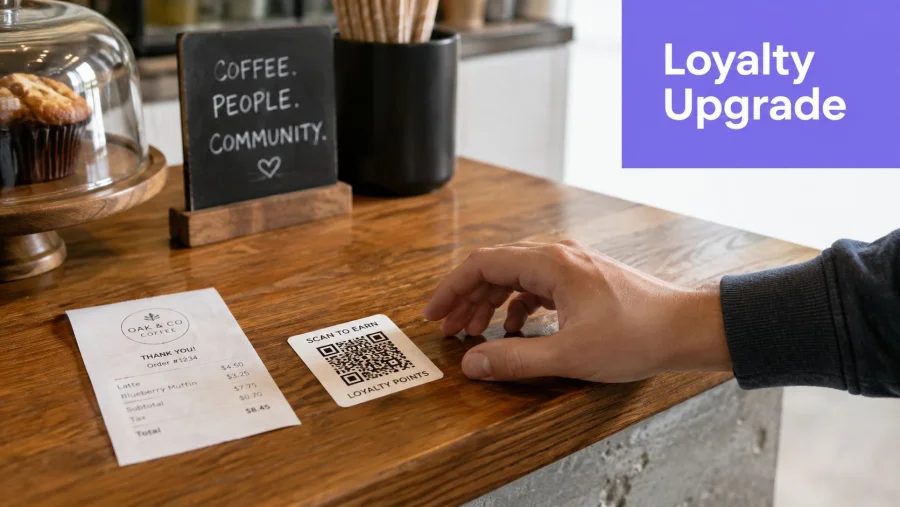
The important point isn't the QR code itself. It's the feedback loop. Staff can practise a new greeting, improve a recovery step and then watch whether customers return, rather than relying on the owner's impression of a busy day.
Measuring Progress With CSAT, NPS and Repeat Visits
A small shop doesn't need a complicated dashboard. It needs three measures that answer three different questions:
- CSAT: Did customers feel satisfied with this visit?
- NPS: Would customers recommend the business?
- Repeat visits: Did customers come back?
CSAT can be collected through a single post-purchase question linked to the loyalty QR: “How was the visit?” Customers select a 1 to 5 rating. NPS asks whether they would recommend the business, scored from 0 to 10. Promoters minus detractors produces one trend line, but the owner should read the comments as carefully as the score.
Repeat visits are the most practical behavioural measure. The loyalty system can show the share of customers who return within 30 days, giving the owner an outcome rather than an opinion. The BonusQR customer satisfaction tips can help owners build a feedback routine around this kind of measurement.
| Metric | What It Measures | How to Collect |
|---|---|---|
| CSAT | Satisfaction with the specific visit | Ask one 1 to 5 question after purchase |
| NPS | Willingness to recommend the business | Ask for a 0 to 10 recommendation score |
| Repeat visits | Whether customers return within 30 days | Review loyalty visit history weekly |
Read the signals together
Rising CSAT with flat repeat visits usually means the experience is pleasant but forgettable. The service may be competent, yet nothing gives customers a reason to make the next visit.
Flat CSAT with rising repeat visits suggests loyal customers are carrying the business, while less committed customers may be leaving. The owner should inspect feedback from newer or less frequent visitors rather than celebrating the repeat figure alone.
A weekly review can take 15 minutes:
- Compare this week's CSAT, NPS and repeat-visit trend with the previous review.
- Read the lowest-rated comments.
- Identify one frontline behaviour connected to those comments.
- Assign one owner or staff member to change it.
- Check the result at the next review.
The numbers don't replace judgement. They stop judgement from becoming guesswork.
Your 30-Day Customer Service Action Plan
A service programme fails when it becomes a binder that staff never open. The following sequence keeps the work small enough for a solo owner or a lean team, while creating a live loop of diagnosis, practice, loyalty and measurement.
Week one finds the actual problem
Run the afternoon observation, collect receipt feedback and review recent negative comments. Ask three regulars what would make them visit more often. Establish the starting CSAT and repeat-visit measures, then select the top three service gaps.
The owner shouldn't launch rewards before understanding the friction. A loyalty offer can bring someone back, but it won't permanently solve unclear queues, poor communication or an unresolved product issue.
Week two changes the words and actions
Rewrite the greeting, mid-visit check-in and recovery phrases. Rehearse for 30 minutes before opening, twice during the week. Staff should practise real situations, including a late order, a price objection, a disappointing treatment and a faulty product.
The manager should watch for ownership, clarity and speed, not theatrical enthusiasm. A calm, specific response beats an exaggerated performance.
Week three makes loyalty visible
Launch the QR loyalty programme through BonusQR. Print codes for tables, receipts, the counter or the appointment desk. Give staff one short invitation and ask them to offer it to every paying customer without interrupting the transaction.
The physical prompt matters. Customers can't use a loyalty system they never see, and staff won't mention a programme that takes too long to explain.
Week four reviews behaviour and recovers lapses
Review CSAT, NPS and scan-to-repeat ratios. Choose the weakest frontline habit and coach that behaviour again. Use loyalty data to identify lapsed customers, then send a focused recovery message rather than a generic discount to everyone.
Small businesses often need practical help with devices, connectivity or staff access during setup. Owners who need broader technical guidance can use this resource to find IT support for your startup before a minor systems issue disrupts the rollout.
The sequence is deliberately simple: diagnose, train, launch QR loyalty and measure. BonusQR gives the business one practical way to connect rewards, customer records, feedback and re-engagement without a POS integration. Owners should start the first diagnostic this week, then set up a visible QR reward journey before the next monthly review.
Choose one shop-floor problem today, create the matching staff phrase, and place a BonusQR code where every customer can see it. Start measuring satisfaction and repeat visits immediately, then use the results to coach the next behaviour instead of guessing what needs fixing.