
 Deutsch
 Español
 Français
 Italiano
 Magyar
 Polski
 Slovenčina
 Čeština
As a small business owner, you face a frustrating mystery: why do seemingly happy customers disappear? You see them smile, they say everything was great, but they never come back. This isn't just a random fluke; it's a critical business problem. The gap between a customer being satisfied today and being loyal forever is where small businesses lose the most revenue. This guide provides a simple, actionable framework for closing that gap, turning one-time visitors into your most passionate advocates.
The Real Reason Happy Customers Don't Come Back
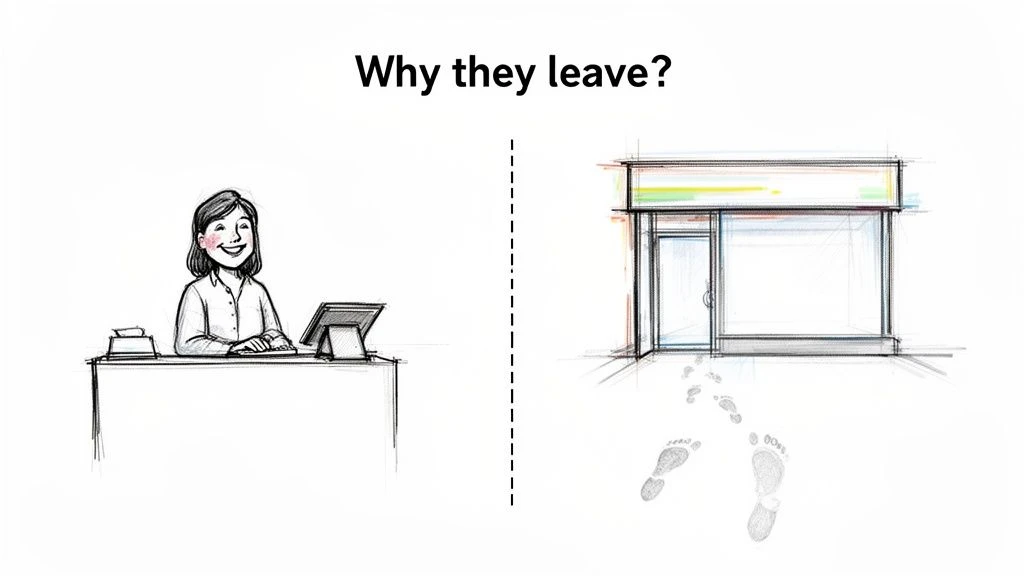
It’s the silent killer of growth for cafes, salons, and local shops. A customer enjoys your service, has a perfectly fine experience, and then vanishes without a word. Why? Because "fine" isn't good enough anymore. A smooth transaction doesn't create an emotional connection. Their experience was pleasant but forgettable, leaving them open to being lured away by a competitor's flashy discount or convenient location.
Measuring customer satisfaction isn't another chore; it's your most direct path to understanding what truly motivates people to choose you, again and again.
The Dangerous Illusion of "Satisfaction"
Here’s the trap most small businesses fall into: satisfaction is temporary. A customer might love the product they bought today, but that feeling fades. If the experience wasn't remarkable, it doesn't build a habit.
This isn't just a theory. The 2025 Global Consumer Study from Qualtrics highlights a growing disconnect: while customers often report being satisfied, their intent to buy again is dropping. A "happy" customer is no longer a guaranteed repeat customer.
The Hard Truth: Satisfaction measures a single past event. Loyalty predicts future revenue. Your goal isn't just to satisfy; it's to make them feel something that brings them back.
From One-Time Sale to Unbreakable Loyalty
How do you turn a single smile into a long-term relationship? By creating a simple, continuous conversation. A feedback loop. When you consistently ask for their opinion, you uncover the small details that make a huge difference.
This is where a simple, cost-effective tool can change everything. Forget expensive, complicated software. Imagine a QR code on a receipt that gives customers an instant reward just for sharing their thoughts. This is more than data collection-it's an interaction that shows you're listening.
With this simple approach, you can:
- Get Actionable Insights: Discover your Saturday morning service is too slow or that customers are raving about a new menu item.
- Strengthen Relationships: Easily identify your happiest customers and thank them personally, deepening their connection to your brand.
- Fix Problems Before They Escalate: When you get negative feedback, you can address it immediately, turning a bad experience into a powerful loyalty-building moment.
Satisfaction vs Loyalty: What's the Difference for Your Business?
Understanding this distinction is critical for growth. This table clarifies what you should be aiming for.
| Metric | What It Measures | Impact on Your Business |
|---|---|---|
| Satisfaction | A customer's feeling about a single interaction. | Prevents immediate complaints and negative reviews. |
| Loyalty | A customer's long-term emotional connection and commitment. | Drives repeat business, increases customer lifetime value, and generates word-of-mouth marketing. |
Ultimately, satisfaction is about meeting basic expectations. Loyalty is about creating an experience they can't get anywhere else. To see how this foundation supports powerful retention strategies, learn how a tier loyalty program stops you from losing your best customers.
The Only 3 Customer Satisfaction Metrics You Need to Know
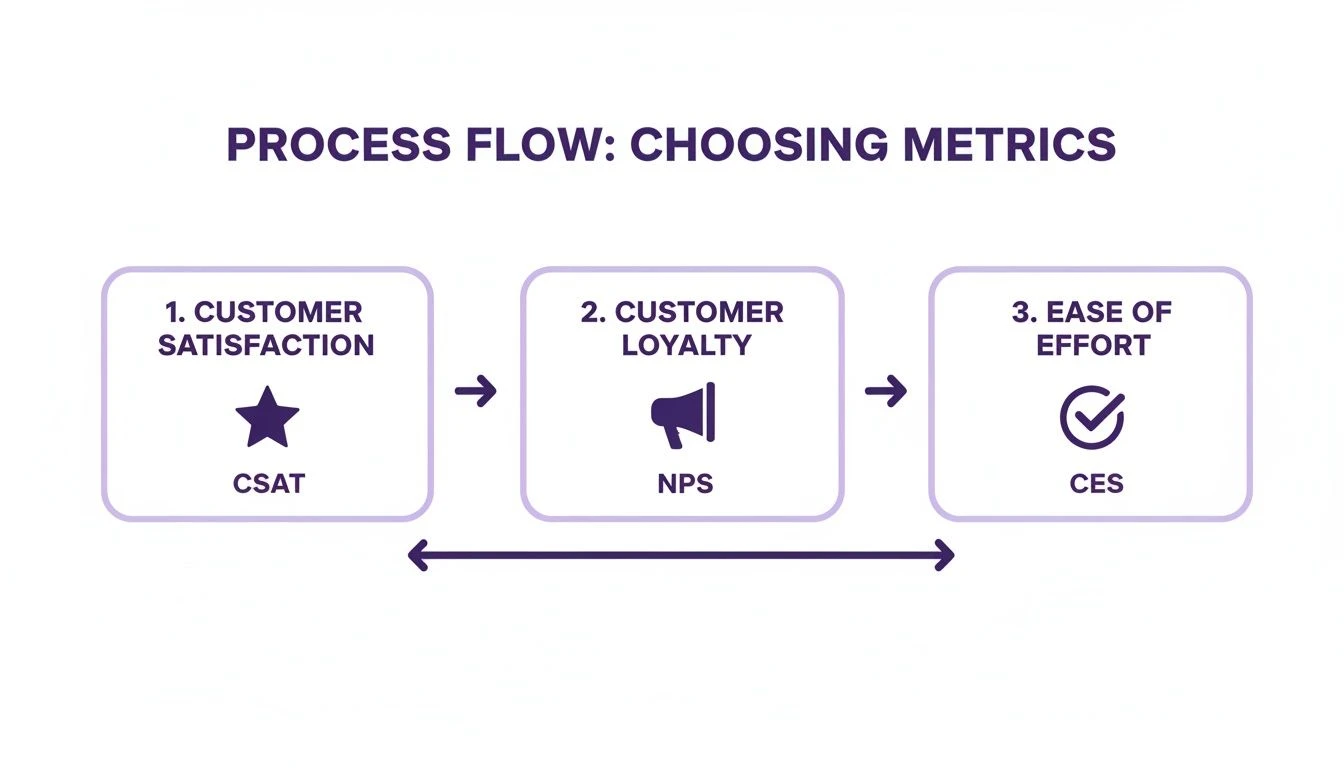
As a small business owner, you don't have time to become a data analyst. You need simple, clear signals that tell you if you're on the right track. Forget dozens of complex metrics; you only need to master one or two of the "big three."
Think of these as different questions you can ask to understand how customers really feel. The key is to pick the one that answers your most urgent business question right now.
1. CSAT: Your "How Did We Do Today?" Score
Customer Satisfaction Score (CSAT) is your immediate pulse check. It measures how a customer feels about a specific, recent interaction.
You ask a simple question right after a service:
- "How satisfied were you with your visit today?"
Customers rate their experience on a simple 1-5 scale. To calculate your score, you take the number of happy customers (those who gave a 4 or 5) and divide it by the total number of responses. A consistently high score means you're nailing the daily experience. A dip is a clear signal to investigate.
2. NPS: Your "Will You Recommend Us?" Score
The Net Promoter Score (NPS) measures long-term loyalty. It asks the ultimate question: "On a scale of 0-10, how likely are you to recommend our business to a friend?"
Based on their answer, customers are grouped into:
- Promoters (9-10): Your brand evangelists who drive word-of-mouth growth.
- Passives (7-8): Satisfied but not loyal. They're at risk of leaving for a better offer.
- Detractors (0-6): Unhappy customers who can damage your reputation with negative reviews.
Your NPS is the percentage of Promoters minus the percentage of Detractors. It's a powerful predictor of future growth.
3. CES: Your "How Easy Was It?" Score
The Customer Effort Score (CES) identifies and eliminates friction. It asks: "How easy was it to [get your issue resolved / redeem your points / place your order]?"
A high-effort experience is a loyalty killer. If customers have to struggle to book an appointment or use their rewards, they'll simply give up. As Forrester research shows, reducing customer effort is one of the fastest ways to boost loyalty, because when life is easy, customers have no reason to go elsewhere. You can discover more on how Forrester links customer experience to business results.
To start, just pick one metric. Master it. For more details on these vital signs, explore these essential customer satisfaction measures and our guide on mastering customer retention metrics.
How to Get Honest Feedback Without Annoying Your Customers
You've picked a metric. Now, how do you actually get the answers? The secret is to make giving feedback so easy and rewarding that it becomes a natural part of the customer experience.
Forget long, boring surveys. Your goal is to create a digital suggestion box that customers want to use. The easiest way? A simple QR code.
The Power of a Simple Scan
QR codes are the perfect tool for small businesses. They bridge the physical and digital worlds instantly. A customer scans with their phone and can give feedback in seconds, right when the experience is fresh in their mind.
Here are the best places to put your feedback QR code:
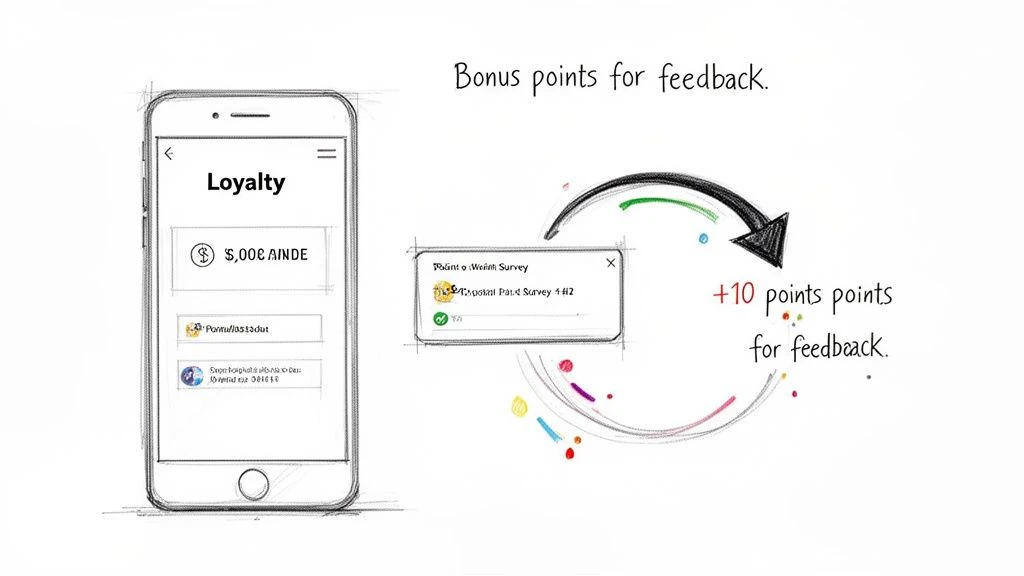
- On Receipts: This is prime real estate. A simple call-to-action like, "How did we do? Scan for 10 bonus points!" dramatically increases response rates.
- On Table Tents: In a cafe or restaurant, this lets customers share feedback privately and immediately, preventing a potential negative online review.
- At the Checkout Counter: A small sign near your payment terminal is a perfect, low-pressure invitation.
The #1 Rule: Make It Effortless
If giving feedback feels like work, only the angriest or happiest customers will bother. You need to hear from the quiet majority in the middle.
Pro Tip: A single, well-timed question will give you more honest insight than a 10-question survey that no one completes. Respect your customer's time.
One powerful question is all it takes. A quick CSAT prompt like, "How was your experience today?" with a simple star rating is fast, easy, and gives you a clean snapshot of their feelings.
Smart Ways to Ask for Feedback
Beyond QR codes, integrate feedback into other touchpoints:
- In-App Prompts: With a digital loyalty program like BonusQR, you can trigger a feedback request right after a customer redeems a reward, catching them at a moment of high engagement.
- Email & SMS Follow-Ups: A simple, automated text the next day ("Hey [Name], thanks for stopping by! We'd love to hear how we did.") feels personal and shows you care. This is a core part of effective review management.
Reward Honesty, Not Just 5-Star Reviews
A small incentive shows you value their time and opinion. This isn't about "buying" good reviews; it's about thanking them for their honesty.
- Bonus Loyalty Points: Add 10-20 points to their account. It’s a cost-effective thank you.
- A Small Discount: Offer 5% off their next visit for sharing feedback.
- Entry Into a Raffle: A monthly drawing for a gift card encourages ongoing participation.
This creates a culture where customers feel heard, which is the ultimate foundation of loyalty and helps you manage your business location maps and online reviews.
How to Turn Customer Feedback Into More Profit
Getting feedback is just the start. The real growth happens when you turn those comments and scores into action. This is where you shift from just listening to actively improving your business.
Every piece of feedback is a clue showing you how to make your business better. You don't need a data science degree-just a commitment to connecting the dots between what customers say and what you do.
From Data Points to Actionable Stories
Your satisfaction scores are signals. A dip in your CSAT score isn't just a number; it's a story.
Imagine you run a cafe and your CSAT score drops every Saturday morning. That's a direct signal that your weekend rush is causing problems: long waits, stressed staff, and rushed orders. The solution isn't to stare at the score; it's to schedule another barista. That’s how you turn data into decisions. Look for patterns, ask "why," and use the feedback to guide your operations.
The Power of "Closing the Loop"
One of the most effective things you can do is respond to customers who leave feedback, especially when it's negative. "Closing the loop" means reaching out, acknowledging their issue, and making it right.
An unhappy customer who feels heard is more likely to become a loyal advocate than a customer who never had a problem at all. Your response is a powerful marketing tool.
A simple, empathetic response can turn a crisis into a win:
- Acknowledge Their Experience: "I'm so sorry to hear your order wasn't right on Tuesday."
- State Your Standard: "That's not the experience we aim to provide."
- Offer a Solution: "We'd love another chance. Next time you're in, your coffee is on us."
This simple act of accountability can prevent a one-star review and earn a second chance. Recent trends show that 73% of consumers will walk away after multiple bad experiences, highlighting how crucial it is to get this right. You can discover more about these 2025 customer experience trends.
Your Weekly Feedback Action Plan
To build a habit, create a simple, repeatable process. Don't let feedback die in a spreadsheet.
| Task | Frequency | Why It Matters |
|---|---|---|
| Review Scores & Comments | Weekly | Catches issues and trends while they're fresh. |
| Share Insights with Your Team | Weekly | Aligns everyone on improving the customer experience. |
| Respond to Unhappy Customers | Within 24 hours | Shows you're responsive and turns negatives into positives. |
| Celebrate a Team Win | Weekly | Acknowledges great service and motivates your staff. |
This rhythm transforms feedback from a passive report into an active growth tool. It's also a crucial part of measuring customer engagement for real growth. By making this a core part of your weekly routine, you create a powerful cycle of listening, learning, and improving that builds unwavering loyalty.
The Ultimate Growth Hack: Combine Feedback and Loyalty
Now it's time to connect everything. The most powerful way to drive growth is to weave your customer satisfaction system directly into your loyalty program.
When you link feedback to rewards, the entire dynamic changes. Giving feedback stops feeling like a chore and becomes a valuable part of their relationship with you. Your loyalty program evolves from a simple punch card into a two-way conversation that fuels growth.
Build a Seamless Feedback and Reward Loop
A modern digital loyalty platform like BonusQR makes this effortless. It automates the process, asking for feedback at the perfect moment without adding work for your team.
Imagine a customer redeems a reward for a free coffee. Instantly, a notification asks: "How easy was it to redeem your reward?" You capture their feelings at a peak moment of positive engagement.
This does two things at once:
- It captures the most accurate emotion. In-the-moment feedback is the most honest.
- It reinforces positive behavior. It links the act of giving feedback to the reward they just enjoyed, creating a powerful positive association.
Use Insights to Build Deeper Loyalty
When feedback is connected to customer profiles in a system like BonusQR, you're no longer looking at anonymous data. You can see exactly which of your most loyal customers are thrilled (Promoters) and which might be unhappy.
This allows for hyper-personalized engagement:
The best loyalty programs don't just reward transactions; they reward engagement. Offering points for feedback tells customers their voice is one of the most valuable things they can give you.
Here are strategies you can implement immediately:
- Reward every opinion: Automatically add 10 bonus points to a customer's account the moment they complete a survey.
- Delight your biggest fans: Identify your Promoters and send them a surprise "thank you" offer. This turns your best customers into even stronger advocates.
- Proactively win back at-risk customers: Notice a regular giving neutral scores? Send them a targeted offer to remind them why they loved you in the first place.
This approach transforms measuring customer satisfaction from a backward-looking report into a forward-looking growth engine. You can spot trends instantly using tools that track your loyalty program analytics and stats. This integration builds deeper relationships, boosts retention, and drives real revenue for your business.
Your Questions on Measuring Customer Satisfaction, Answered
Starting to measure customer satisfaction can feel like a big step, but it doesn't have to be complicated. Here are answers to the most common questions from small business owners.
How often should I ask for feedback?
The key is to ask at the right time without being annoying.
- For in-the-moment feedback (CSAT): Ask immediately after a purchase, using a QR code on the receipt or at the counter.
- For big-picture loyalty (NPS): Ask every 90 days. This tracks trends over time without overwhelming customers.
Consistency is more important than volume. A steady stream of feedback is better than a one-off annual survey.
What if I only get negative feedback?
This is a common fear, but negative feedback is a gift. It shines a light on problems you might not see otherwise. For every customer who complains, dozens more just leave silently. That one person who speaks up gives you a chance to fix a problem that's costing you customers.
Embrace the criticism. A fast, empathetic response can turn an angry customer into your most loyal advocate.
I'm just a small business. Is this really necessary?
Absolutely. In fact, it's more critical for you. Unlike giant corporations, your success is built on repeat business from regulars. Every customer matters more.
Measuring satisfaction gives you the same insights that big brands pay millions for. It allows you to be nimble, personal, and responsive in a way they can't. Knowing what your customers love-and what they don't-is your competitive advantage. It helps you make smarter decisions based on real data, not just guesswork.
Ready to stop guessing and start growing? BonusQR makes it incredibly simple and affordable to measure customer satisfaction and link it to a loyalty program that actually builds your business.
Get started with BonusQR and discover what your customers are really thinking.