As a small business owner, you're juggling a thousand tasks. But the core problem that keeps you up at night isn't inventory or marketing-it's the nagging fear of losing a good customer over a single bad experience. You know that unlike big chains, you can't afford to be just a transaction. Your survival depends on building genuine loyalty, but how do you equip a busy team to create those standout moments consistently?
This guide is your answer. We're skipping the corporate jargon and giving you actionable, low-cost strategies to transform your team's customer service skills. You’ll learn how to turn every interaction into a loyalty-building opportunity, making your service so memorable that price becomes irrelevant.
Why Great Service is Your Unbeatable Advantage
For a small business, exceptional customer service isn't just a "nice-to-have"-it's your most powerful competitive weapon. Big-box stores compete on price; you compete on connection. Every regular you greet by name, every problem you solve with a personal touch-that's how you build a loyal following that can't be stolen by a 10% discount down the street.
The real question isn't if this matters, but how you, as a busy owner, can empower your team to deliver this level of care day in and day out. This guide provides a practical game plan to do just that.
What's at Stake? More Than You Think
In a world of automated responses and faceless corporations, a genuine human interaction is a superpower. It’s what makes your business different. Consider this: a staggering 86% of customers will leave a brand after just one bad experience. For a small business, that's a risk you simply can't afford.
But here's the powerful upside: customers who have a great experience don't just stay, they spend more and become vocal advocates for your brand.
This means every interaction is a moment of truth. It's not about avoiding a bad review; it’s about earning a customer for life. The skills we're about to cover will help your team evolve from simply processing orders to building the relationships that fuel your growth.
Your Roadmap to a Service-First Team
We've designed this guide to be intensely practical. Forget vague theories. We're focused on what actually works in a small business environment. Here’s what you'll learn:
- How to hire for empathy and onboard new staff so they champion your service culture from day one.
- The art of active listening to turn customer complaints into your biggest loyalty-building moments.
- Simple daily habits and reward systems that make outstanding service a natural, unbreakable routine for your team.
Great service is making every customer feel seen, heard, and valued. When you master this, you stop selling products and start building relationships that drive sustainable, long-term growth.
Investing in your team's skills is the single best investment you can make in your business's future. It pays dividends in customer loyalty, positive word-of-mouth, and a stronger bottom line. For an even deeper look, check out our guide to improving customer loyalty for small businesses.
Let's start building a service-first culture that turns every customer touchpoint into a reason for them to choose you again and again.
Hiring and Onboarding for a Service-First Culture
An unforgettable customer experience doesn’t start when a customer walks in. It starts with a single, critical decision: who you hire.
You can teach someone how your register works, but you can't easily teach genuine warmth, patience, or the innate desire to help. That’s why a service-first culture is built, not just trained. Your mission is to find people who are already wired for great service.
How to Identify Service Superstars in Interviews
Ditch tired questions like "What are your weaknesses?" Instead, use behavioral questions that reveal a candidate's true problem-solving instincts and emotional intelligence. Their stories are a window into how they'll act under pressure.
Here are three powerful questions to add to your interview process:
- To test empathy: "Tell me about a time you dealt with a truly frustrated customer. What was the situation, and how did you manage their emotions?"
- To assess problem-solving: "Describe a time you had to bend the rules or find a creative solution for a customer because the standard process wasn't working."
- To gauge resilience: "Walk me through a time you received difficult feedback. How did you handle it, and what did you learn from the experience?"
Listen for answers that focus on understanding the customer's perspective and finding a positive outcome, not just blaming the system or defending their actions.
The best service hires are natural problem-solvers who see a complaint not as a conflict, but as a challenge to overcome. They get genuine satisfaction from turning a negative experience into a positive one.
Onboarding: More Than Just Paperwork
Once you’ve found the right person, their first few days are critical. A strong onboarding process does more than explain job duties; it immerses them in your service philosophy from the moment they start. This is where you transform a new employee into a passionate brand advocate.
Make onboarding active. Instead of just handing over a manual, have them shadow your best team members. Let them see firsthand what exceptional service looks like and feels like in your business. This mentorship provides a powerful, real-world model they can emulate.
A well-structured onboarding is also a key factor when you're learning how to reduce employee turnover and keep your best people, because it ensures team members feel supported and prepared from day one.
Equipping Your Team with the Right Tools
Give every new hire a simple "service playbook." This isn't a rigid script, but a guide with go-to phrases for common situations, clear steps for handling complaints, and a summary of your service values. It gives them the confidence to act decisively while letting their personality shine through.
Finally, empower them with tools that make their job easier. Show them how to use your POS to view a customer's history or how a simple, cost-effective loyalty tool like BonusQR can be used to instantly reward a patient customer or make things right after a mistake. By giving them the authority and the tools to solve problems on the spot, you show that you trust them to uphold your brand's promise.
The Art of Active Listening and Genuine Empathy
If there's one customer service skill that truly separates the good from the great, it's the ability to truly hear what a customer is saying. This is where a simple transaction transforms into a human connection. It's how you turn a one-time buyer into a lifelong advocate.
It’s not just about staying quiet while someone talks; it’s about tuning into the emotion behind their words.
For a small business, mastering this is a game-changer. When you make a customer feel genuinely heard and understood, you forge an emotional bond that the big-box stores can't replicate. This is your home-field advantage.
Hearing the Problem Behind the Problem
Active listening isn't passive. It requires your full attention and a real desire to understand someone's perspective before you even think about offering a solution. It’s the difference between hearing noise and decoding a message.
Imagine a regular at your coffee shop is upset because their loyalty points seem to be missing. A passive employee hears, "My points are gone." An active listener hears the real issue: "I come here all the time, and I feel like my loyalty isn't being recognized." The problem isn't just the points; it's about feeling valued.
Or, consider a salon client unhappy with their haircut. They might say, "It's not what I asked for." A team member who is only hearing the words might get defensive. An empathetic listener picks up on the disappointment and vulnerability. They know the first step isn't to defend the haircut-it's to validate the client's feelings.
Simple Techniques Your Team Can Use Today
You don't need a huge training budget to sharpen these skills. It starts with simple habits your team can practice immediately.
Paraphrase and Confirm: This is your most powerful tool. Train your team to repeat the customer's issue in their own words. For example: "Okay, so I want to make sure I understand. The package arrived late, and to make things worse, the item inside was damaged. Is that right?" This single step instantly shows you were paying attention and validates their frustration.
Ask Clarifying Questions: Ditch "yes" or "no" questions. Instead, ask open-ended questions that encourage customers to share more details, like "Could you walk me through what happened when you tried to apply the discount code?" This helps you get to the root of the problem faster.
The impact of these small changes is massive. We know that when issues are resolved in the first interaction, customer loyalty soars. Training your team to listen actively is a direct investment in keeping your best customers.
Empathy is Your Competitive Advantage
Empathy isn't just about understanding; it’s about feeling with your customer. It’s acknowledging their frustration, sharing in their excitement, and seeing the situation from their side. It's the human touch that builds unbreakable bonds.
When a customer feels like you're on their side, the problem stops being them vs. your business. It becomes the two of you working together to find a solution. That shift changes everything.
This approach is your best defense against conflict and negative reviews. Better yet, it turns a potential crisis into a golden opportunity to prove how much you care. Every problem you solve is a chance to strengthen a relationship, which is the core principle behind how to measure customer satisfaction and stop losing your best customers.
Personalizing Service in Every Interaction
Good communication gets the job done. Great communication creates a connection. While quick, clear answers are essential, the real magic for a small business happens when you make a customer feel uniquely seen and valued. This is your secret weapon against the impersonal nature of large corporations.
Knowing your regulars is a superpower. It transforms a routine transaction into a moment of human connection. A big-box store can't replicate the feeling a customer gets when their local barista remembers their name and their complex coffee order.
Moving Beyond Generic Scripts
Let's be honest, scripts can feel robotic and impersonal. While having a framework for common issues is smart, true loyalty is built on personalization. It’s the difference between a generic "Hello" and a warm, "Welcome back, Sarah!" that makes customers feel like part of your community, not just another sale.
This is where simple tools can make a huge difference. Imagine a barista who not only knows a customer's name but can also say, "That oat milk you love is finally back in stock." That isn't just good service; it's an experience. It makes Sarah feel special and understood.
That simple moment, powered by easily accessible customer data, creates something money can't buy and big chains struggle to deliver. It’s how you build real, lasting loyalty. You can even apply some of the same principles found in CRM email personalization best practices to your face-to-face interactions.
The Power of Knowing Your Customer
Remembering customer preferences goes beyond their favorite products. It could be asking about the vacation they mentioned last time, recalling a dietary restriction, or simply remembering their kids' names. These small details show you're not just processing a transaction-you're paying attention.
And this level of detail is a massive growth engine. Studies show that hyper-personalization can deliver a 20% lift in loyalty and a 15% revenue growth-huge numbers for any small business that relies on repeat customers.
Over half of consumers say a great, personalized service experience is more important than price. When you make a customer feel valued, you're building an asset your competitors can't easily undercut.
This is especially true for restaurants. Using a tool like BonusQR to see a customer's order history allows a server to make brilliant suggestions. For example: "I know you enjoyed the spicy chicken last time; we have a new seasonal dish with a similar kick I think you'll love." That kind of tailored recommendation can lead to 15-20% sales uplifts.
The infographic below breaks down the core techniques of active listening-paraphrasing, clarifying, and de-escalating-which are the foundation for picking up on the personal details customers share.
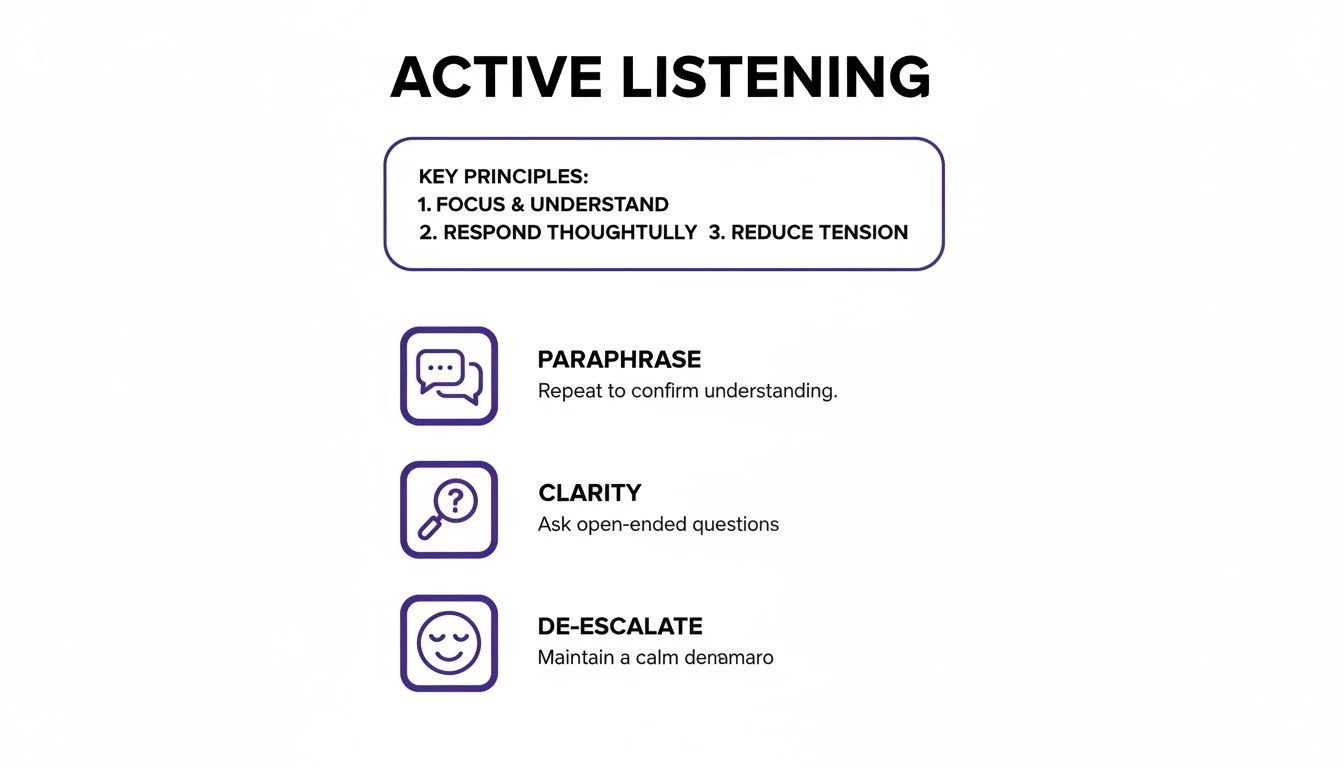
These skills are how you gather the small gems of information that fuel personalization, turning a simple conversation into a powerful tool for your next interaction.
Turning Data into Delight
Having customer data is one thing; using it to create moments of delight is what truly matters. Modern, simple loyalty programs don't just track purchases-they help you understand customer behavior.
This is incredibly powerful. Imagine you can instantly identify:
- Your VIPs: The regulars who visit often and spend the most.
- At-Risk Customers: Familiar faces you haven't seen in a while.
- Specific Tastes: The coffee lovers, the gluten-free crowd, or fans of a particular product.
The table below shows how this makes a difference in real-world situations.
Service Scenarios: Generic vs. Personalized
| Scenario | Generic Response | Personalized Response (Using BonusQR Data) | Customer Outcome |
|---|---|---|---|
| New Menu Launch | "Would you like to try our new special?" | "Hi Mark! I know you love spicy food. You have to try our new Diablo Burger; it's right up your alley." | Mark feels understood and is far more likely to try and love the new item. |
| Loyalty Reward | "You have 100 points, you can get a free coffee." | "Hey Lisa, I see you have enough points for a free coffee! Want your usual Americano on the house today?" | Lisa feels recognized and rewarded, strengthening her connection to the business. |
| Lapsed Customer Returns | "Welcome back." | "David, great to see you again! It's been a while. We've missed you." | David feels noticed and appreciated, making him more likely to become a regular again. |
Understanding these patterns empowers your team with actionable information. You can learn more about how to segment your customers effectively to create targeted offers or simply give your team a heads-up to give a VIP some extra attention.
Turn Customer Complaints into Your Greatest Strength
Let's be honest-no one enjoys getting a customer complaint. But the best small businesses have figured out a powerful secret: complaints aren't threats; they are opportunities.
A complaint is raw, unfiltered feedback. More than that, it's a golden chance to show a customer you genuinely care. When someone takes the time to tell you they're unhappy, they're giving you a chance to make things right.
In fact, customers who have a problem resolved quickly often become more loyal than they were before. This is your chance to turn a negative experience into a powerful story about why your business is different.
Think of it as an early warning system. One person's complaint might reveal a confusing menu item or a glitch in your online checkout before it frustrates hundreds of others.
The L.A.S.T. Method: Your Go-To Framework
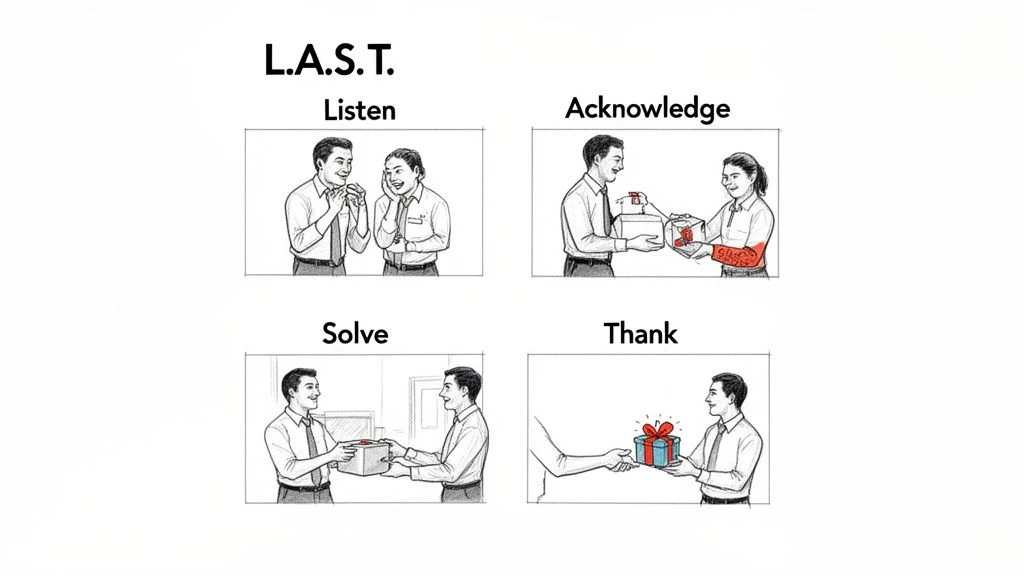
To handle these moments with grace, give your team a simple but incredibly effective tool: L.A.S.T. (Listen, Acknowledge, Solve, Thank). This four-step framework is a roadmap for de-escalating tension and finding a positive solution.
- Listen: This is the most critical step. Let the customer explain everything without interrupting. Focus on the emotion behind their words, not just the facts. Are they frustrated? Disappointed? Embarrassed?
- Acknowledge: Show them you hear them. Simple phrases like, "I can absolutely see why you're so frustrated," or "That sounds like a terrible experience, and I'm so sorry," make them feel understood. You aren't admitting fault; you're validating their feelings.
- Solve: Time to take action. The solution should be immediate and, if possible, a little generous. Empower your team to resolve common issues right there, without needing a manager's approval.
- Thank: Always end by thanking them. "Thank you so much for bringing this to our attention. Your feedback helps us improve." This closes the interaction on a positive note and shows you value their input.
L.A.S.T. in the Real World
Let's see how this plays out in common small business scenarios.
Scenario 1: The Local Café
A regular is annoyed their latte is lukewarm.
- Listen: The barista stops, makes eye contact, and listens to the entire complaint.
- Acknowledge: "I am so sorry about that. You should always get a perfect coffee here."
- Solve: "Let me remake that for you right now. And for your trouble, I've just added a free pastry reward to your account using our loyalty app." Using a simple tool like BonusQR to instantly send a make-good offer is incredibly effective.
- Thank: "Thanks again for letting me know. We really appreciate it."
Scenario 2: The Retail Boutique
A customer is upset because a dress they bought last week is now on sale for 25% off.
- Listen: The associate lets the customer explain their frustration.
- Acknowledge: "I completely understand. It's so frustrating to feel like you missed out on a deal."
- Solve: "While our policy doesn't typically cover price adjustments after a week, you're one of our best customers. I'd be happy to issue you the difference as store credit for your next visit."
- Thank: "Thanks for your understanding and for being such a loyal shopper."
By empowering your team to solve problems, you not only make customers happier but also free yourself up to focus on growing the business, not just putting out fires.
This simple shift in perspective transforms dreaded complaints into powerful moments for building unbreakable customer loyalty.
Reinforcing Excellence with Daily Training and Rewards
Improving customer service skills isn't a one-time event. Real, lasting excellence is built through daily habits. The secret is to weave a culture of continuous improvement into your workday.
This doesn't require hours of training. The most effective method is the "service huddle"-a quick, 5-minute drill before a shift. It’s just enough time to get everyone focused on service, keep skills sharp, and reinforce your commitment to the customer experience.
Making Training a Daily Habit
Consistent practice turns conscious effort into instinct. By running through small scenarios every day, you're building muscle memory for handling real-world interactions with confidence.
Here are a few huddle ideas you can start using tomorrow:
- Scenario Role-Play: Take a common customer issue-like a complaint about price-and have two team members act it out for a minute.
- Positive Story Share: Ask someone to share a great customer interaction from the previous day. What made it work? This is incredibly motivating.
- Skill of the Day: Pick one small thing to focus on, like using positive language. Ask the team for one example of how they'll use that skill today.
Of course, investing in more structured professional development courses is also a fantastic way to keep your team's skills polished.
Celebrating and Rewarding Great Service
Here's a simple truth: what gets rewarded gets repeated. When a team member delivers an exceptional customer experience, that effort must be seen, acknowledged, and celebrated. This creates a powerful feedback loop that inspires the entire team.
The most effective way to improve behavior is with immediate, positive reinforcement. When an employee connects a specific action with a tangible reward, they are far more likely to repeat it.
This is where simple, cost-effective tools have a huge impact. You can track positive mentions from online reviews and give public shout-outs. For something more direct, consider using a loyalty tool like BonusQR internally-it's not just for customers!
Imagine an employee masterfully de-escalates a tough situation. Right there on the spot, you can send a "free coffee" or "lunch on us" reward straight to their phone. It’s instant, tangible recognition. For more ideas, check out our guide on customer incentive ideas to drive loyalty.
By creating this kind of positive, reinforcing environment, you make excellence something everyone can strive for.
Your Top Customer Service Questions Answered
Improving your team's service skills can feel overwhelming when you're already juggling so much. It’s normal to have questions. Here are some of the most common challenges small business owners face and practical solutions for them.
How can I train my team with no budget?
You don't need a big budget to build a great team. Consistency and creativity are your most valuable assets.
Forget expensive seminars. The real magic happens in small, daily doses. Run quick, 5-minute role-playing huddles before shifts. Use real customer feedback-good or bad-as a learning moment. Create a one-page "service playbook" with your core values and go-to phrases for tricky situations. Another fantastic, no-cost strategy is to ask a star employee to mentor a newer team member.
The best training tools aren't the most expensive-they're the ones you use consistently. Bite-sized practice builds habits that stick.
What are the most important service metrics to track?
For a small business, you need metrics that give you a real pulse on customer happiness without creating more work. The single most important number is your Repeat Customer Rate. It's the ultimate indicator: Are people choosing to come back? If so, you're doing something right.
A few other simple but powerful indicators are:
- Customer Feedback: Actively seek it out. What are people saying in online reviews or in person? Look for recurring themes.
- First Contact Resolution (FCR): This just means, "Did we solve the problem on the first try?" When you do, it shows your team is both knowledgeable and empowered.
- Net Promoter Score (NPS): A quick "how likely are you to recommend us?" survey is one of the fastest ways to gauge customer loyalty.
What do I do with an employee who resists training?
Resistance often comes from not understanding the "why." Your first step is to connect the dots for them. Show them how great service directly benefits them-it leads to a calmer work environment, happier customers, and often, better tips or recognition. Frame training not as a chore, but as a tool to make their job easier and more rewarding.
If the resistance continues, have a private one-on-one chat. Find out what’s really going on. Sometimes, what looks like resistance is actually a lack of confidence. A bit of extra encouragement might be all they need. If you've offered genuine support and the attitude doesn't change, then it might be time to consider if a customer-facing role is truly the right fit for them.
Ready to turn great service into measurable customer loyalty? BonusQR is the simplest, most cost-effective way for small businesses to reward customers and build relationships that last. It's easy for your staff, delightful for your customers, and designed for your budget. Start building stronger customer relationships today.


