You can build a loyalty app in three ways: configure a no-code loyalty platform, launch a branded white-label app, or commission a fully custom build. For most small businesses, the first route gets a working program in front of customers in a day, while the other two make sense once you need your own app-store presence or features no template offers. This guide walks through how to choose, what to plan before you start, how to set up and launch, how to add loyalty to an app you already have, and how to tell whether it is working.
Key takeaways
- Decide the reward model first (points, stamps, tiers or paid membership), then the technology. The model determines what the app must do.
- A no-code platform with Apple Wallet and Google Wallet support is the fastest and cheapest route for a single-location or small multi-location business. Custom development is rarely justified before you have proof that customers return.
- Loyalty apps collect personal data, so consent, a clear privacy notice and data minimization belong in the plan, not in a cleanup after launch.
- Measure against a baseline taken before launch: repeat purchase rate, visit frequency, redemption rate and the revenue of members versus non-members.
- Adding loyalty to an existing app means connecting three things: customer identity, a transaction source and a reward ledger.
What you are really building
A loyalty app is three systems that customers experience as one. The first is a ledger: a record of who earned what and when. The second is a rules engine: how a purchase or action turns into points, stamps or cashback, and when a reward unlocks. The third is a channel: the screen, wallet card or QR code your customer actually touches, plus the notifications that bring them back.
The cost and complexity of building from scratch sit almost entirely in these three layers, which is why most small businesses are better off renting them. What differentiates your program is not the ledger. It is the reward you offer, how easy it is to join at the counter, and what you do with the data afterward.
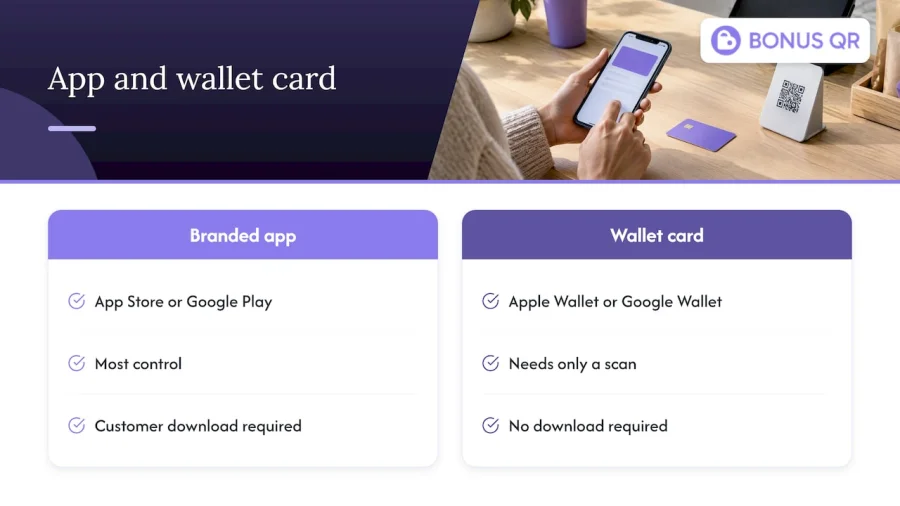
It also helps to separate an app from a wallet card. A branded app in the App Store or Google Play gives you the most control but needs customers to download it. A wallet card lives in Apple Wallet or Google Wallet and needs only a scan. For a coffee shop, salon or gym, the scan-and-add flow tends to remove the biggest friction: nobody wants to download an app for a coffee they buy twice a week.
Three ways to build a loyalty app
| Route | Best for | Time to launch | Cost shape | Trade-off |
|---|---|---|---|---|
| No-code loyalty platform | Cafes, retailers, salons, gyms, single or few locations | Hours to days | Free tier or monthly subscription | Less control over the app’s look in app stores |
| White-label branded app | Growing brands that want their own icon and store listing | Days to weeks | One-off setup plus monthly subscription | Still limited to the platform’s modules |
| Custom development | Unusual logic, deep integration with proprietary systems | Weeks to months | One-off build plus ongoing maintenance | Highest cost and you own the upkeep |
Route 1: A no-code platform
You create an account, choose a loyalty mechanic, brand the card, and give customers a QR code to scan. There is nothing to install on your side and, with a QR-based platform, no POS integration is required. This is the route we recommend to most small and medium-sized businesses, and the one we describe in more depth in our loyalty app builder guide.
Route 2: A white-label app
A white-label app is the platform’s engine wearing your brand: your name, icon, colors and store listing. It suits businesses where the app is part of the brand experience, such as a hotel group, a multi-site restaurant or a growing retail chain. You still avoid writing a ledger or rules engine.
Route 3: Custom development
A custom build gives you any feature you can specify, including bespoke integrations with an existing inventory, booking or e-commerce system. It also means you pay for design, development, testing, store submission and every operating system update afterward. Budget for maintenance from day one, not only for the build.
What to plan before you build anything
Skipping planning is the most common reason small-business loyalty programs stall. Work through these six questions on a single page.
- What behavior do you want more of? More visits, bigger baskets, referrals, reviews? Pick one primary goal.
- What is your purchase frequency? A cafe sees customers weekly. A mattress store sees them once a decade. Frequency decides whether stamps, points or something else fits.
- What can you afford to give away? Work out the margin cost of the reward before you advertise it.
- Where will customers join? At the till, at the table, on the receipt, online. Every extra step loses signups.
- What data do you need? Name and email, or only a phone number? Collect the minimum.
- Who will run it? If nobody owns the program weekly, automation matters more than features.
Our wider guide on how to build customer loyalty covers the strategy behind these answers. If you want a framework for the planning stage itself, the steps to foster customer loyalty outline a similar sequence.
Choose the reward model that fits your business
The model comes before the build. Stripe’s overview of loyalty programs offers a useful rule of thumb: points suit varied purchases, punch cards suit frequent visits such as cafes or salons, tiers suit businesses with high-value customers, and paid memberships suit ongoing perks. It also advises tying earning to purchases or actions and keeping redemption simple, with a first reward reachable within about 30 days.
| Model | How it works | Fits | Watch out for |
|---|---|---|---|
| Stamps | Buy N, get one free | Cafes, bakeries, barbers, car washes | Easy to copy, little data on spend |
| Points | Earn per dollar or action, redeem for rewards | Restaurants, grocery, retail, gas stations | Needs clear value per point |
| Tiers | Higher status unlocks better rewards | Retail, hotels, gyms with varied spend | Tiers too hard to reach demotivate |
| Cashback | Percentage returned as credit | Retail, services | Direct margin cost on every sale |
| Paid membership | Fee for ongoing perks | Businesses with frequent, predictable use | Benefits must clearly exceed the fee |
The tier and paid-membership points come from the same Stripe page: tiers work where purchase levels vary, and a paid membership only works when its benefits clearly exceed the fee. For deeper design detail, see our guides to points reward systems and loyalty program tiers. Restaurant owners will find concrete mechanics in these restaurant loyalty examples.
Do the liability math
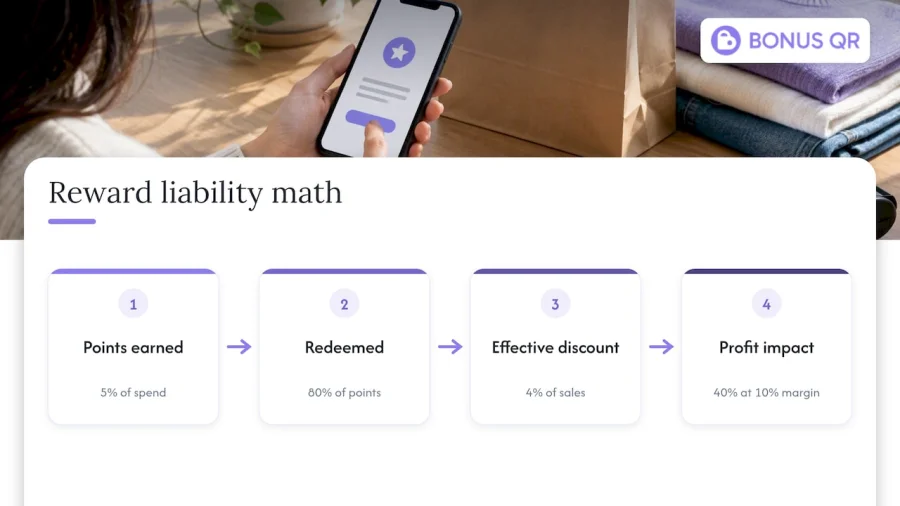
Every reward is a cost you have promised in advance. A simple worked example: if you give back 5% of spend in points and customers redeem 80% of them, your effective discount is 4% of sales (5% × 0.80). If your net margin is 10%, that reward consumes 40% of your profit on those sales unless it brings extra visits. That is the number to compare against the lift you expect. Do not copy a category leader’s structure without checking it against your own margins and purchase frequency.
How to set up and launch with a no-code builder
The steps below describe the typical path with a QR-based platform such as ours. The details differ between products, but the sequence holds.
- Create your account and business profile. Add your name, logo and brand colors so the card looks like you from the first scan.
- Pick the mechanic. Choose stamps, points, tiered cashback or fixed discounts. Start with one. You can add layers once people use it.
- Define earning and redemption. Set how a visit or purchase earns value, and what the first reward is. Make the first reward reachable quickly so new members feel progress.
- Add an onboarding reward. A small welcome bonus gives people a reason to join on the spot.
- Test it yourself. Join with your own phone, earn, redeem and check that staff can complete the flow in seconds.
- Train your team. One sentence at the till does more than any poster: “Scan here and your first stamp is on us.”
- Display the QR code where decisions happen. Counter, table tents, receipts, packaging and your website.
- Switch on automation. Birthday and special-occasion rewards, win-back messages for lapsed members, and review or referral prompts run without further effort.
- Review after 30 days. Compare signups, repeat visits and redemptions to your baseline, then adjust.
Common launch mistakes
- Launching with three mechanics at once, which confuses both staff and customers.
- Setting the first reward so far away that no one reaches it.
- Hiding the QR code or leaving staff unable to explain the program in one sentence.
- Ignoring who can redeem what, and when, which causes disputes at the counter.
Features a loyalty app should include
When comparing builders, check for these capabilities rather than for a long feature list:
- Multiple reward types: stamps, points, cashback, fixed discounts, so you can change model without migrating customers.
- Wallet support: Apple Wallet and Google Wallet cards so customers need no download.
- Automated marketing: push and email notifications triggered by behavior, not sent by hand.
- Referral and review modules: turn happy members into new customers and public reviews.
- Analytics: visits per member, redemption rates, lapsed members, revenue by segment.
- Branding and customization: your colors, logo and terminology.
- Coupon and reward management: the ability to issue, expire and audit rewards.
- Upgrade path: a clear route from a free or basic plan to a branded app without starting over.
If you are comparing products, our guide to rewardoapp.com alternatives shows the criteria we apply, and the cloud-based loyalty platform guide explains what to expect from hosted software.
Privacy and data protection
A loyalty app holds names, contact details and purchase histories. That is personal data, and handling it badly is a business risk as well as a legal one.
If you serve customers in the European Union, the GDPR applies to personal-data processing by mobile apps. France’s data protection authority, in its recommendation on mobile applications, states that users must be informed and must consent before an app reads or writes information on their device, unless a specific exception applies. In the United States there is no single federal privacy law covering this; state laws such as California’s apply depending on where your customers live and how large your business is. If you are unsure which rules apply to you, ask a privacy attorney in your state before you collect data at scale.
Practical safeguards that hold up in any market:
- Collect only what the program needs. A phone number or email is often enough.
- Show a plain-language privacy notice at signup and ask for marketing consent separately from joining.
- Let members see, correct and delete their data, and make unsubscribing from notifications one tap.
- Choose a provider that hosts data securely and tells you where it is stored.
- Limit staff access to what each role needs.
Adding loyalty to an existing app
If you already have a customer app, you do not need a second one. You need to connect three pieces.
- Customer identity. Members must be recognized as the same person across the app, in store and online. Usually this means a shared login or a phone number or email used as the key.
- A transaction source. The loyalty system must learn what was bought. That comes from your POS, your e-commerce platform, your booking system, or, where none of those can be connected, a QR scan at the point of sale.
- A reward ledger. Balances, rewards and expiry rules need one authoritative home, with the app displaying them.
There are two practical ways to do it. You can embed a loyalty module or web view inside your app and let the platform hold the ledger, or you can use an API to push events (purchase, signup, review) to the loyalty engine and read balances back. The first is quicker. The second gives a more native feel but needs developer time. Either way, test the edge cases: refunds, split payments, returned items and customers who change their phone number.
A wallet card can also run alongside your app. Customers who never download it still join, and those who do get app-only extras.
Build, buy or customize: what it costs with us
The prices below are what we publish today. For the current feature split, check the pricing page.
| Option | Price | What it covers |
|---|---|---|
| Free plan | No published price | Start a QR-based program and test it with real customers |
| Basic | €19 per month | More loyalty features for a growing program |
| Premium | €69 per month | Full feature set including automation and analytics |
| White-label setup | €690 one-off | Your branded app on top of the platform |
| White-label monthly subscription | €69 per month | Running the branded app |
| Custom app development | From €1,500 one-off | A bespoke build scoped to your needs |
| Custom app monthly maintenance | From €69 per month | Upkeep and updates |
The logic is to spend in proportion to proof. Start on the free plan, move up when members and redemptions justify it, and commission a branded or custom app when the brand experience itself becomes part of what you sell.
Our perspective
We build BonusQR for owners who run a business first and a loyalty program second. In our experience the biggest obstacle to building a loyalty app is not technology, it is the assumption that you need a developer, a POS integration and a budget before you can learn whether customers care. A QR code and a clear reward answer that question in a day.
So we push the same order of operations: pick one simple reward, launch it where customers already are, let automation handle the follow-up, and read the numbers after a month. Only then decide whether a branded app or a custom build earns its cost. Loyalty is the lifeblood of a small business, but it should not take over your week.
— Michal Palus
Start with a program you can test this week
If you want to see the no-code route in practice, you can start on our free plan and upgrade when your program grows. When your brand needs its own app, our white-label option puts your name on the platform, and custom app development covers requirements no template meets. You can compare plans on the pricing page or explore BonusQR.
How to measure whether your loyalty app works
Measurement starts before launch. Record four baseline numbers for the previous 90 days: repeat purchase rate, average visits per customer per month, average order value and total revenue from returning customers. Without them, any later figure is just a number.
Then track:
- Enrollment rate: members as a share of all transactions or customers. Low enrollment is a counter-flow problem, not a reward problem.
- Active member rate: members who earned or redeemed in the last 60 or 90 days.
- Repeat purchase rate: customers who bought more than once in a period, divided by all customers in that period.
- Visit frequency: members versus similar non-members.
- Redemption rate: too low means the reward is out of reach, too high may mean it is too generous.
- Incremental revenue: member spend above the baseline, minus the cost of the rewards given.
Be careful with comparisons. Your best customers join first, so members will always look better than non-members. The cleaner test is the change in a member’s own visit frequency before and after joining, and the change in total repeat rate across the whole business. Review monthly for the first quarter, change one variable at a time, and give each change a few weeks. Our overview of loyalty marketing and retention goes deeper on the numbers, and these customer incentive ideas give you tests to run.
FAQ
Can I build a loyalty app without coding?
Yes. No-code loyalty platforms let you pick a reward type, brand the card and share a QR code without writing code. Most small businesses never need more than this. Custom development only becomes relevant for unusual logic or deep system integration.
How long does it take to launch?
A QR-based program can go live within a day once you have decided the reward and printed or displayed the code. A branded white-label app takes longer because of store listing and review. Custom builds are typically measured in weeks or months, depending on scope.
Do customers need to download an app?
Not necessarily. Wallet cards for Apple Wallet and Google Wallet let customers join with a scan and keep the card on their phone. A downloadable app is worth it when you want extras such as ordering, booking or an e-shop inside your own branded app.
Which loyalty model should a cafe or small shop choose?
For frequent, low-ticket visits, a stamp card with a reward reachable within a few weeks is the simplest. If purchases vary in size, points are fairer. Work out what the reward costs you in margin before you announce it.
How do I add loyalty to an app I already have?
Connect customer identity, a source of transactions and a reward ledger. You can embed a loyalty module in your app or use an API to send purchase events and read balances. Test refunds and split payments before launch.


