For most small and medium-sized businesses in Central Europe, the fastest path to measurable retention gains is a digital loyalty scheme that combines a simple stamp or points mechanic with Apple/Google Wallet passes and automated re-engagement messaging. Start with a two-week pilot, track three KPIs (enrolment rate, repeat visit rate, redemption rate), and scale what works.
Your action this week:
- Choose a digital stamp card or points model that matches your purchase frequency.
- Sign up for a free trial or book a demo with a platform that supports wallet passes and push notifications.
- Set a baseline for your three pilot KPIs before you launch.
Why digital loyalty schemes increase customer retention and spend
Customers return when returning feels rewarding and effortless. Digital loyalty programmes create that loop by combining habit formation (a visible progress bar toward a free coffee or discount), personalised offers triggered by behaviour, and the convenience of a wallet pass that lives on a customer’s phone without requiring a separate app download.
The numbers support this. Across 24 European markets, 43% of loyalty members say membership makes them more loyal to a brand, 36% are more likely to recommend it, 33% feel more emotionally connected to the brand, and 29% say they spend more as members. Those are not marginal effects. For a café or independent retailer, converting even a fraction of occasional visitors into regular members shifts the economics of the whole business.
Retention is also far cheaper than acquisition. New-customer acquisition can cost 5–7 times more than retaining an existing one, which means every euro spent on a loyalty programme competes against a much larger acquisition budget. Platforms that blend points, tiers, and omnichannel engagement report typical gains in customer retention, purchase frequency, and customer lifetime value for engaged members.
Stat to know: Across 24 European markets, 43% of loyalty members say membership makes them more loyal to a brand, 36% are more likely to recommend it, 33% feel more emotionally connected to the brand, and 29% say they spend more as members.
Use-case examples illustrate the pattern clearly. A Prague café running a digital stamp card sees customers return specifically to complete their card. A Bratislava boutique using a tiered points scheme finds that mid-tier members spend roughly double what non-members spend per visit. A Budapest hotel using automated birthday rewards and wallet passes reports higher direct booking rates from returning guests. The mechanism is consistent: visibility, progress, and timely prompts drive behaviour.
For a deeper look at retail loyalty trends shaping Central European markets in 2026, the picture is one of accelerating adoption among SMBs who previously relied on paper punch cards.
What types of digital rewards schemes suit your business?
Not every loyalty format fits every business. The right model depends on how often customers buy, what your margins allow, and how much complexity your staff can manage.
Digital stamp cards
The simplest format: customers earn a stamp per visit or purchase and redeem a reward after a set number. Low friction, easy to explain, and ideal for high-frequency businesses like cafés, bakeries, and quick-service restaurants. The main limitation is that stamp cards capture little data beyond visit count.

Points and rewards programmes
Customers earn points per pound (or per unit of spend) and redeem them for discounts, free products, or experiences. Points work well for retail and hospitality because they scale with basket size and give you a richer data set. The trade-off is slightly more complexity at the counter.
Tiered membership
Members progress through levels (Bronze, Silver, Gold) as they accumulate spend or visits, unlocking better rewards at each tier. Tiered programmes increase engagement most effectively when higher tiers unlock experiences or exclusive access rather than just bigger discounts. A gym or wellness centre, for example, can offer priority booking or a free guest pass at the top tier. For a practical guide on building tiers that keep customers coming back, the design choices matter more than the number of levels.
Cashback schemes
A percentage of spend is credited back to the customer’s account. Straightforward to communicate and popular in grocery and fuel retail. Margins need to support the cashback rate, so this model suits businesses with higher average order values.
Subscription and membership programmes
Customers pay a recurring fee for guaranteed benefits (free delivery, exclusive pricing, priority service). Works best for businesses with predictable repeat purchase cycles, such as meal-kit services or specialist retailers.
Referral and participation-based rewards
Members earn rewards for bringing in new customers, leaving reviews, or sharing content. Digital platforms increasingly reward non-transactional behaviours such as social shares and reviews, turning existing customers into an acquisition channel. Useful for any business that benefits from word-of-mouth, particularly restaurants and local services.
Choosing the right model: three practical triggers
- High purchase frequency (weekly or more): Start with a stamp card. It is fast to set up, easy for staff, and immediately visible to customers.
- Medium frequency with varied basket sizes (monthly): A points programme captures spend data and rewards higher-value customers proportionally.
- Low frequency, high value (quarterly or less): Tiers or subscription models create a reason to return even when the natural purchase cycle is long.
What features should you demand from a loyalty provider?
A loyalty platform is only as good as the features you actually use. Before you sign up for anything, run through this checklist.
Core mechanics
- Digital stamp card and/or points engine
- Tiered membership with configurable thresholds
- Cashback, fixed discounts, and coupon distribution
- Referral and review reward modules
- Onboarding promotions and special occasion rewards (birthdays, anniversaries)
Delivery and access
- Mobile app and progressive web app (so customers without the app can still participate)
- Apple Wallet and Google Wallet pass support
- QR code enrolment and redemption (no POS integration required for basic setup)
Engagement and automation
- Push notifications, email, and SMS campaigns
- Automated re-engagement triggers (lapsed member, milestone reached, birthday)
- Segmentation by cohort, reward type, or visit frequency
Operations and compliance
- Real-time analytics and ROI reporting
- Multi-language support (critical for Central European markets with Czech, Slovak, Hungarian, Polish, and German-speaking customers)
- GDPR-compliant consent capture and data subject rights management
- Exportable customer data (never accept a contract that locks your data in)
- Transparent pricing with no hidden per-member fees
Pro Tip: If you run a fast-service business such as a café or quick-service restaurant, prioritise wallet pass support and QR enrolment above everything else. Customers who can join in under 30 seconds at the counter are far more likely to actually enrol.
Modern platforms remove the heavy IT dependency that once made loyalty programmes the preserve of large retailers. A well-chosen SaaS platform means your team can configure and launch without needing a developer.
How to launch a digital loyalty programme: pilot to full roll-out
A phased approach reduces risk and gives you real data before you commit to a full launch. Here is a practical timeline.
Phase 1: Define objectives (Days 1–3)
- Set your three pilot KPIs: enrolment rate, repeat visit rate, redemption rate.
- Choose your loyalty model (stamp card is the fastest to launch).
- Select a platform and sign up for a free trial.
- Configure your reward structure: what do customers earn, and what do they redeem?
Phase 2: Pilot (Weeks 1–2)
- Set up your QR code or wallet pass link.
- Brief staff with a two-minute script: “Scan this QR code to join our loyalty programme and earn a free [reward] after [X] visits.”
- Place in-store signage at the counter and on receipts.
- Send an SMS or push notification to any existing customer list.
- Monitor daily enrolment numbers and flag any friction points.
Phase 3: Measure and optimise (Weeks 3–6)
- Review your three KPIs against your baseline.
- Identify the reward that drives the most redemptions.
- Adjust the earning threshold if redemption rate is below 15%.
- Test one automated re-engagement message for customers who enrolled but have not returned.
Phase 4: Full roll-out (Month 2 onwards)
- Expand to all locations or channels.
- Add a second mechanic (points on top of stamps, or a referral module).
- Schedule a monthly review of LTV and average order value (AOV) lift.
- Consider a white-label app if you want a fully branded experience.
Typical costs to expect
- Freemium tier: Free, with limited member counts or features. Good for a pilot.
- Subscription (SMB): Monthly flat fee covering unlimited members and core features.
- White-label app: One-time setup fee plus ongoing subscription.
- Custom development: Project-based fee for bespoke integrations or branded apps.
Rapid pilots and data-led iteration consistently reduce rollout risk. A two-week pilot with 50–100 members tells you more than months of planning.
Enrolment promotion tactics during the pilot
- Counter signage with a clear QR code and a one-line benefit (“Earn a free coffee after 8 visits”)
- Staff verbal prompts at every transaction
- Receipt messaging with the enrolment link
- A single SMS or email to your existing customer list
- A social media post with the wallet pass link
What does the customer journey look like in practice?
Understanding the customer’s experience from enrolment to redemption helps you design a programme that people actually use, and helps your staff support it confidently.
The enrolment step
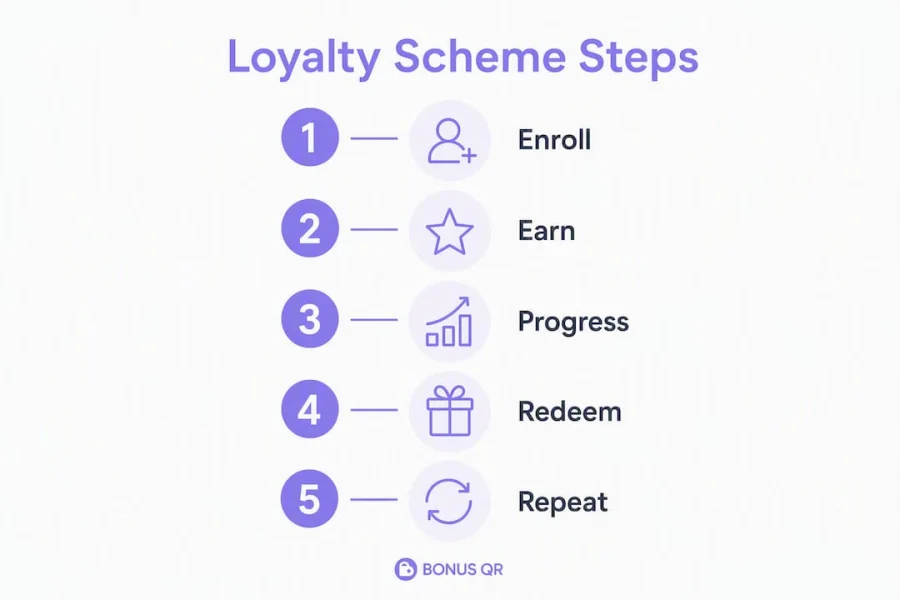
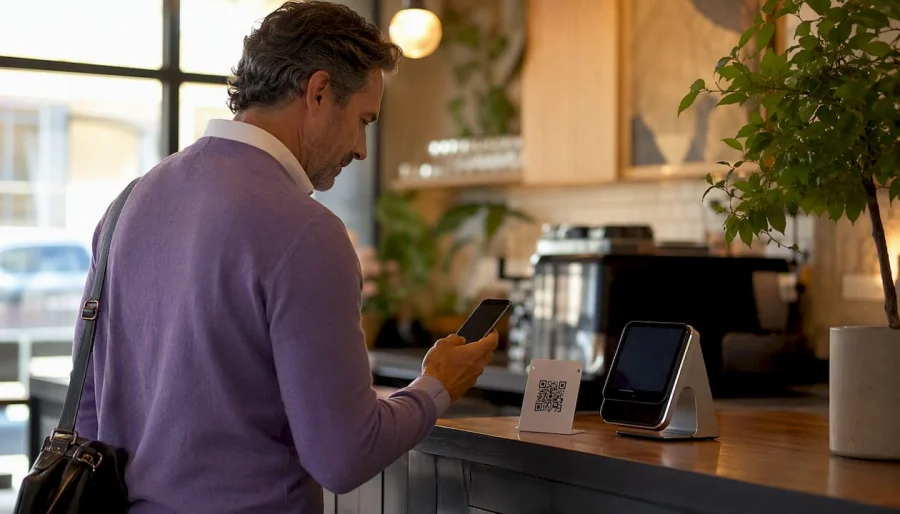
Customers join by scanning a QR code at the counter, clicking a link in a receipt email, or tapping a wallet pass link shared via SMS or social media. The sign-up should ask for a name and email address at most. Every additional field reduces completion rates. Wallet passes are particularly effective because they sit on the customer’s home screen and send lock-screen notifications without requiring a separate app.
Earning and progress
After enrolment, customers earn stamps or points automatically at each qualifying visit or purchase. A visible progress indicator (“7 of 10 stamps collected”) is the single most powerful behavioural nudge in the whole system. Customers who can see they are close to a reward return sooner.
Redemption
When a customer reaches the reward threshold, they receive a notification and a redemption code or QR code. Staff scan or enter the code, the reward is applied, and the card resets. The whole process should take under 20 seconds at the counter.
Staff process and common pitfalls
- Train staff to prompt enrolment at the point of payment, not after.
- Keep the redemption process to a single step (scan a code).
- Avoid programmes that require staff to manually enter points — it slows the queue and introduces errors.
- For restaurant-specific retention tactics, staff scripting and table-side enrolment prompts make a measurable difference.
Pro Tip: Run a five-minute staff briefing before launch day. Show staff the enrolment QR code on their own phone, let them complete the sign-up themselves, and give them the two-sentence script. Staff who have used the programme are far more confident recommending it.
Which KPIs tell you whether your loyalty scheme is working?
Tracking the right metrics from day one means you can iterate quickly rather than waiting months to discover a problem.
| KPI | Definition | Healthy range for SMB pilot |
|---|---|---|
| Enrolment rate | % of customers who join the programme | 15–30% of transactions in first month |
| Repeat visit rate | % of members who return within 30 days | — |
| Redemption rate | % of earned rewards that are redeemed | 15% (below 15% suggests reward is too hard to reach) |
| AOV lift | Average spend of members vs non-members | 10% higher for members |
| Member LTV | Cumulative revenue per member | Compare against non-member baseline |
| Churn rate | % of members with no recent activity | Below 30% is a reasonable target |
How to attribute revenue during a pilot
Compare the average spend and visit frequency of enrolled members against a matched group of non-members over the same period. The difference, minus the cost of rewards redeemed, is your short-term ROI. Keep the calculation simple during the pilot; sophistication comes later.
Reporting cadence
- Weekly: enrolment numbers and redemption count.
- Monthly: repeat visit rate, AOV lift, and lapsed member count.
- Quarterly: LTV trend and full ROI calculation.
Platforms that blend points, tiers, and omnichannel engagement report up to 200% higher customer lifetime value for engaged members, which sets a useful upper benchmark for what a well-run programme can achieve over time.
The single most important metric during a pilot is repeat visit rate. If members are not returning more often than non-members within the first 30 days, the reward threshold or the enrolment experience needs adjustment before you scale.
Common pitfalls and GDPR basics for Central Europe
Even well-designed loyalty programmes fail when the operational details are wrong or the legal foundations are shaky.
Operational pitfalls to avoid
- Overly complex reward rules. If a customer cannot explain how they earn rewards in one sentence, simplify the model. Complexity kills enrolment.
- Poor enrolment UX. A sign-up form that asks for date of birth, phone number, and postal code before giving any reward will lose most customers at the first field.
- Neglecting staff training. Staff who do not understand the programme will not promote it. A five-minute briefing before launch is not optional.
- Ignoring redemption economics. Calculate the cost of your reward before you launch. A free product that costs you €5 to deliver needs to generate at least one additional visit to break even.
- Vendor lock-in. Some contracts prevent you from exporting your customer data. Always confirm you can download a full CSV of your member list before signing.
For a fuller list of loyalty programme mistakes to avoid, the most expensive errors are almost always the ones that happen before launch.
GDPR checklist for Central European loyalty programmes
Loyalty programmes collect personal data (name, email, purchase history, location). Under the GDPR, which applies across Central Europe, you need a lawful basis for that processing, explicit consent for marketing communications, and a clear retention policy. Get this wrong and the fines are real — but getting it right is straightforward with the right platform.
- Lawful basis: Use consent for marketing messages; legitimate interest may cover transactional communications, but document your reasoning.
- Consent capture: Collect opt-in at enrolment, separately for each communication channel (email, SMS, push).
- Purpose limitation: Only use loyalty data for loyalty and related marketing purposes. Do not share it with third parties without explicit consent.
- Retention policy: Define how long you keep inactive member data. Two years of inactivity is a common threshold; delete or anonymise after that.
- Data subject rights: Customers can request access, correction, or deletion of their data. Your platform must support this without requiring manual database queries.
- Data Processing Agreement (DPA): Any platform that processes your customer data on your behalf must sign a DPA. Reputable platforms provide this as standard.
Pro Tip: Ask any vendor you are evaluating to send you their DPA and their GDPR documentation before you sign up. A vendor who cannot produce these quickly is a compliance risk.
Why Bonusqr fits Central European SMBs
Bonusqr is built for exactly the scenario this article describes: a small or medium-sized business that wants to launch a digital loyalty programme quickly, without a developer, and without a long-term contract commitment.
Feature mapping
| Feature | What Bonusqr delivers | SMB benefit |
|---|---|---|
| Digital stamp card | Configurable stamp mechanics with QR redemption | Launch a pilot in hours, no POS required |
| Points engine | Spend-based or visit-based points with custom thresholds | Rewards scale with customer value |
| Tiered membership | Multi-level tiers with configurable unlock rewards | Encourages higher spend and longer retention |
| Cashback and coupons | Fixed discounts, percentage cashback, coupon distribution | Flexible reward types for different margins |
| Wallet passes | Apple Wallet and Google Wallet integration | Appless enrolment, lock-screen visibility |
| Automation | Push, email, and SMS campaigns with behavioural triggers | Re-engages lapsed members without manual effort |
| Analytics | Real-time dashboard with member, visit, and redemption data | Track your three pilot KPIs from day one |
| White-label app | Branded mobile app with custom colours and logo | Full brand experience for growing businesses |
| Multi-language support | Interface and communications in Central European languages | Serves Czech, Slovak, Hungarian, Polish, and German-speaking customers |
| GDPR compliance | Consent capture, DPA available, exportable data | Meets Central European data protection requirements |
Bonusqr’s electronic rewards platform covers the full feature checklist from the procurement section above, including the three features that most reliably predict a successful SMB launch: wallet pass enrolment, a simple earning rule, and automated re-engagement.
Trust signals
- Free tier available to start a pilot with no upfront cost.
- Transparent pricing tiers published on the platform.
- Rapid setup: a basic stamp card programme can be live within a working day.
- Central European language and support availability.
- GDPR-compliant data handling with DPA provision.
Pro Tip: Use Bonusqr’s free tier to run your two-week pilot. Configure a stamp card, set your enrolment QR code, and measure your three KPIs before committing to a paid plan. The data from the pilot will tell you exactly which premium features are worth paying for.
For service businesses, the loyalty application for services page maps Bonusqr’s features to hospitality, wellness, and professional service contexts specifically.
Key takeaways
Digital loyalty schemes deliver measurable retention gains for Central European SMBs when built on a simple earning mechanic, wallet pass enrolment, and automated re-engagement — and a two-week pilot is all you need to validate the approach before scaling.
| Point | Details |
|---|---|
| Start simple | A digital stamp card or basic points model is the fastest path to enrolment and visible results. |
| Pilot before scaling | A two-week pilot with 50–100 members reveals reward economics and enrolment friction before full roll-out. |
| Track three KPIs | Enrolment rate, repeat visit rate, and redemption rate are the only metrics that matter in the first month. |
| GDPR is non-negotiable | Confirm your vendor provides a DPA, supports consent capture, and allows full data export before signing. |
| Bonusqr for Central Europe | Bonusqr covers the full feature checklist with wallet passes, automation, multi-language support, and a free trial to start. |
What we have observed working with Central European SMBs
The gap between a loyalty programme that works and one that quietly fades is almost never the technology. It is the enrolment moment.
Businesses that succeed in Central Europe tend to share one habit: they treat the first 30 seconds of a customer’s enrolment as the most important interaction in the whole programme. A staff member who says “scan this, get a free coffee after eight visits” and waits while the customer actually scans converts at a rate that no amount of email marketing can replicate. Businesses that put up a QR code poster and hope for the best rarely break 5% enrolment.
The second pattern is localisation. Central European customers, particularly in Czech, Slovak, and Hungarian markets, respond better to programmes communicated in their own language. An SMS in English or German from a local café reads as impersonal. Platforms that support local-language push notifications and wallet pass text see meaningfully higher engagement rates.
The third observation is about simplicity. Tiered programmes with three levels and complex earn-and-burn rules consistently underperform simple stamp cards in the first three months, even when the tier programme is objectively more generous. Customers need to understand the reward before they will change their behaviour to earn it. Start simple, prove the habit, then layer in complexity once members are engaged.
Bonusqr’s combination of wallet pass support, multi-language configuration, and a free stamp card module addresses all three of these patterns directly. It is the platform I would recommend to any Central European SMB starting from scratch.
Bonusqr: start your free trial today
Most Central European SMBs that switch from paper punch cards to a digital loyalty programme see enrolment climb within the first week, not because the reward changed, but because the experience did. Bonusqr gives you a complete digital loyalty platform with stamp cards, points, wallet passes, automated messaging, and real-time analytics, all configurable without a developer and available on a free tier to start.
Setup takes hours, not weeks. Your customers enrol by scanning a QR code at the counter. Your staff need a two-minute briefing. And your pilot KPIs are visible on a live dashboard from day one.
Explore Bonusqr’s full feature set and start your free trial to run your first two-week pilot at no cost. If you want to see the platform before committing, a demo is available on request.
Useful sources and further reading
- Understanding Loyalty in Europe — Chillipepper (2023): A 24-market European study on loyalty membership behaviour, emotional connection, and spend impact. The primary source for European member statistics cited in this article.
- Treueprogramme für kleine Unternehmen — Salesforce: Salesforce’s guidance on loyalty programmes for SMBs, covering acquisition cost comparisons, rapid setup, and pilot methodology.
- Do tiered loyalty programmes work? — Mastercard: Analysis of when tiered programmes drive genuine engagement versus when they reduce to discount mechanics.
- Loyalty Platform and Mobile Wallet — Brevo: Platform documentation covering retention uplift benchmarks, wallet pass mechanics, and omnichannel engagement features.
- Electronic reward — Bonusqr: Bonusqr’s core product page covering electronic rewards, integrations, analytics, and SMB-specific features.
- Innovative loyalty schemes that boost retention — Bonusqr: Tactics for continuous improvement and personalisation of loyalty programmes in retail contexts.
- Loyalty programme mistakes to avoid — Bonusqr: A practical guide to the most common operational errors and how to prevent them before launch.


