A digital loyalty card is a mobile or wallet-based replacement for paper stamps that identifies each customer, tracks their visits in real time, and lets a business reward, message, and measure them without a separate app or POS upgrade. In the UK, 41% of consumers use loyalty cards or programmes (Emarsys via SAP Engagement Cloud statistic), and Tesco says more than 24 million Clubcard households were registered in the UK by 2023 (Tesco Clubcard milestone).
That should tell every café owner, salon manager, and indie retailer the same thing: paper punch cards are no longer the main issue, the problem is that most schemes still hide the customer behind the counter. A digital loyalty card gives that customer a name, a pattern, and a reason to come back.
What a Digital Loyalty Card Actually Does for Your Business
Many know the scene. A wallet is stuffed with crumpled punch cards, half of them forgotten, one of them already full, and the rest impossible to tell apart. The merchant side is worse, because the card proves a sale happened, but it tells the business almost nothing useful.
That is the gap a digital loyalty card closes. It stops the loyalty scheme from being a paper token and turns it into a live customer record, so the business can see who visited, what triggered the return, and which offer moved behaviour. For practical loyalty tactics that go beyond theory, the clearest advice is buried in effective loyalty tactics from Cobra DTF, where the focus stays on repeat action rather than shiny features.
The business stops guessing
A paper card cannot tell a café whether the same commuter comes in every Tuesday, or whether a salon client disappeared after three visits. A digital loyalty card does. It links the visit to a customer identity, then keeps building the relationship every time that person returns.
That matters because repeat business is where the money sits. The strongest loyalty programmes are not built to hand out random discounts, they are built to spot patterns early and reward the second, third, and fifth visit before the customer drifts away. For a deeper look at the retention side of the equation, the internal breakdown on how loyalty programs boost repeat visits is worth reading.
Practical rule: if a loyalty scheme cannot tell staff who the customer is, what they earned, and what they should be offered next, it is just a prettier punch card.
The main point is simple. A digital loyalty card is not a decoration on top of the checkout. It is the missing data layer that lets a business treat loyalty as a relationship, not a stamp collection.
How Digital Loyalty Cards Work Behind the Scenes
A proper digital loyalty card has three parts, and none of them is complicated once stripped of the jargon. First comes the customer identity, which is usually a QR code, a login, or a wallet pass. Then comes the live ledger, which records visits, points, tiers, and rewards. Finally, there is the redemption loop, where staff trigger the reward in seconds and the customer sees the result immediately.
The identity layer comes first
In a café, the customer scans a personal QR at the till or opens a wallet pass. That scan is not the reward itself. It is the handoff that tells the system which account to update. The same logic can sit behind a branded app, but the format changes the friction, not the job.
Wallet passes matter because they can be updated live, not left as a static barcode image. That is what makes points balances, tier status, and offer changes visible without making the customer install yet another app. The architecture described in Kaizen Loyalty's digital loyalty card guide is the important bit here, a unique encrypted pass, remote updates, and POS or QR scanning that closes the loop quickly.
The ledger does the heavy lifting
The ledger is the part most owners never see, but it is the part that makes the scheme useful. Every scan adds data, and that data updates what the customer can redeem next. In a well-run system, staff do not have to calculate anything by hand.
The reward then appears at the counter or in the customer's wallet pass. If the customer has hit a threshold, the system marks it as ready. If the business has set a seasonal offer, the pass can refresh without reprinting anything.
That is the mental model to keep in mind. Identity, ledger, redemption. If a vendor cannot explain those three layers clearly, the platform is probably more marketing than machinery.
QR Codes, Apps and Wallet Passes Compared
The format choice matters because small businesses do not buy loyalty tech in a vacuum. They buy under pressure, at the till, with staff waiting and customers impatient. The right format is the one that lowers friction without creating a new operational headache.
QR is the fastest route to launch
QR-on-phone is the bluntest, cheapest option, and that is exactly why it works. There is no app download, no need for custom hardware, and no reason for a customer to leave the counter and come back later. For cafés, quick-service restaurants, and salons, that simplicity is the selling point.
A branded native app is a different decision. It takes more time, it costs more to set up, and it only makes sense if the business wants a long-term owned channel for menus, bookings, reviews, and push messages. Apple and Google wallet passes sit between the two, because they live inside the customer's phone wallet and can refresh dynamically, but they do not give the same branding freedom as a full app.
The best format is not the most advanced one. It is the one the customer will actually use at the counter.
Pick by friction, not by feature count
The rule of thumb is straightforward. If speed and low cost matter most, start with QR. If a business wants a branded digital property and has budget for a longer build, move to an app. If the goal is to keep the loyalty card visible inside a wallet without asking for a full app download, use wallet passes as the supporting layer.
For merchants who already want wallet-based distribution, the BonusQR Apple Wallet integration shows how that middle path works in practice without turning the system into a custom engineering project.
| Format | Setup cost | Customer friction | Best for |
|---|---|---|---|
| QR | Lowest | Very low | Cafés, salons, quick-service counters |
| App | Higher | Medium | Brands that want an owned channel and richer branding |
| Wallet pass | Moderate | Low | Reminder offers, repeat visits, mobile-first customers |
The buyer should not overthink this. Launch with the format that removes the most friction at the till, then upgrade only when the business has enough traffic to justify the extra build.
The Real ROI by Venue Type
The mistake most owners make is asking whether digital loyalty cards work in general. That is the wrong question. The right one is whether the mechanic fits the venue's repeat pattern, because the ROI looks different in a café, a salon, a gym, and a shop.
Cafés and quick-service venues win on frequency
Coffee and breakfast purchases are habit-driven. That is exactly where a digital loyalty card pays back, because the customer already visits often and does not need a long explanation. A simple stamp or point mechanic can pull an occasional buyer into a routine customer without forcing staff into a sales pitch.
The economics matter here. Bain & Company research, as quoted in a 2026 statistics roundup, says a 5% increase in customer retention can raise profits by 25% to 95% (retention economics roundup). For a café, that is not abstract strategy, it is morning trade, pastry add-ons, and the difference between a one-off and a regular.
Salons, gyms and retail need the right trigger
Salons and wellness businesses usually win by filling quiet slots, not by discounting every booking. A birthday offer, a seasonal reminder, or a reactivation message does more for margin than a blanket price cut. Gyms and fitness studios need a habit loop, where tiers, visit streaks, or milestone rewards keep attendance steady.
Retail and grocery benefit when rewards push basket-building instead of cheapening the whole offer. Spend thresholds, category bonuses, and fixed rewards tied to behaviour are better than spraying discounts everywhere. That is also where a digital loyalty card is more useful than a paper stamp card, because it can segment people without extra manual work.
One useful benchmark is completion. A 2026 comparison article says paper cards only reach an 18% to 25% completion rate, while digital loyalty cards reach 65% to 75% (digital vs paper completion comparison). That gap is huge in practice, because a card that gets finished is the one that brings the customer back.
For restaurants, the dining rewards solution is a sensible reference point, because food service lives or dies on repeat frequency, not novelty.
Features Worth Paying For and Red Flags to Avoid
A loyalty platform should do three jobs cleanly. It should make the offer easy to understand, make the customer data useful, and make the merchant's life easier at the till. Anything else is noise.
Pay for mechanics that actually drive repeat visits
The useful features are not glamorous. They are stamps, points, cashback, visit and spend thresholds, fixed discounts, welcome bonuses, birthday and seasonal coupons, and rules that let a business mix offers without rewriting the whole scheme. Customer profiles with visit history matter too, because staff need to see whether a customer is new, regular, or lapsed.
Analytics should not be buried. Merchants need to see top customers, coupon performance, and visit trends without having to export spreadsheets and guess at the story. Automated push and email campaigns are worth paying for if they are tied to actual behaviour, not just broadcast blasts.
Practical rule: if a vendor can't show who redeemed what, who visited again, and which offer caused the return, the platform is not measuring loyalty, it is storing receipts.
Reject anything that creates hidden friction
The biggest red flags are easy to spot. Required POS integration, mandatory hardware purchases, per-transaction fees, long contracts, and opaque data ownership all create drag. If analytics sit behind a higher tier, that is another warning sign, because the merchant ends up paying extra just to understand whether the scheme is working.
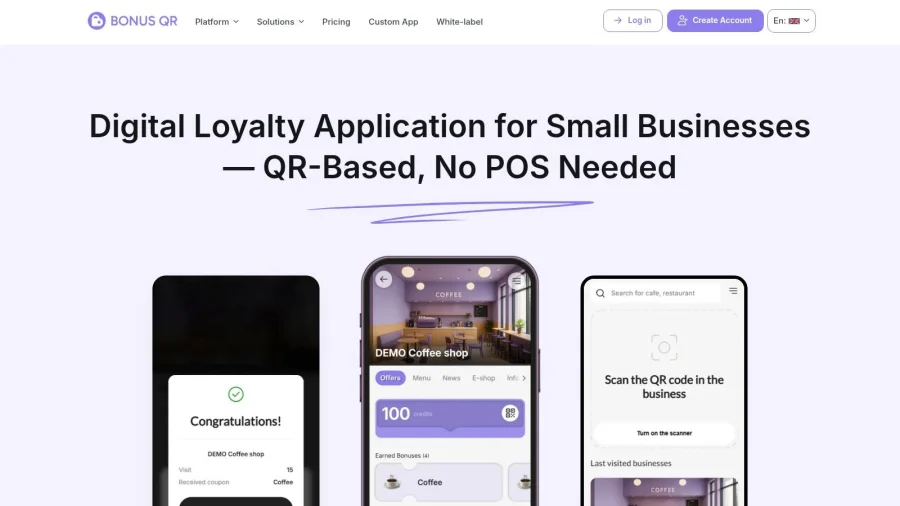
BonusQR is one example of a platform that keeps the structure simple. It offers a free start, an affordable white-label app under the merchant's own icon in about 14 days, and a fully custom app for larger operators who need advanced integrations. It also supports ready-to-print materials and GDPR-safe handling, which matters more than flashy animations.
The rule is blunt. If the platform makes the merchant buy hardware, beg for integrations, or sign a long contract before proving ROI, it is eating the budget that should have gone into the offer itself.
Promoting, Measuring and Avoiding the Common Pitfalls
A loyalty launch does not fail because the card format is wrong. It fails because the team hides the programme in a corner and expects customers to discover it alone. Promotion, staff behaviour, and measurement need to be handled like operations, not marketing theatre.
Launch week should be loud and simple
The strongest launch tools are physical. Table talkers, QR stickers at the till, a short staff script, and one clear launch offer do more than a polished email nobody reads. Staff should ask at payment, not later by email, because the customer is already standing there and already making a decision.
The biggest adoption mistake is making the customer do the work. Let staff scan, let the system confirm, and make the reward obvious before the customer leaves. If the second visit is rewarded faster than the fifth, the programme feels alive instead of distant.
Measure behaviour, not vanity
Track active members, redemption rate, visit frequency uplift, top customers, and coupon performance. Those numbers tell the truth. A large sign-up count with no redemptions means the programme looked good but did nothing.
The common traps are predictable. Too many mechanics at launch, weak GDPR consent handling, dormant segments getting spammed, and staff who never learned how redemption works. When the till side feels awkward, customers notice immediately and stop bothering.
Operational truth: a loyalty scheme is a data engine first and a discount engine second. If the data is not used, the margin gets burned for nothing.
A tight 30-day plan is enough. Print materials in week one, brief every member of staff, launch with one mechanic, check the analytics weekly, and adjust the offer once a month. That is how a loyalty programme stops being a nice idea and starts becoming part of the shop floor.
Frequently Asked Questions About Digital Loyalty Cards
The first question is usually cost. The right answer is simple, start with a free tier or a low monthly fee and avoid per-transaction pricing if margins are tight. That structure keeps the programme from eating the value it is supposed to create.
Setup time is the next concern. A QR-based launch can happen quickly, while a white-label app build usually takes longer, with about 14 days being a reasonable commercial target when the design and content are ready.
Hardware and POS integration worry many owners for no good reason. A scan-based system does not need a new till setup, because staff can redeem from the app and the customer can present a QR or wallet pass. That keeps the rollout practical for smaller teams.
GDPR and data ownership are not side issues. Consent should be clear at signup, marketing preferences should be easy to manage, and the merchant should know who owns the customer record if the platform changes later. Older or less digital audiences can still use the system when staff handle the scan and the phone side stays simple.
If the next step is to test the mechanic without a big commitment, try BonusQR free, look at the live merchant dashboard, and only then decide whether a white-label app is worth the upgrade.


