
 Deutsch
 Español
 Français
 Italiano
 Magyar
 Polski
 Slovenčina
 Čeština
For Central European SMBs, Bonusqr is the recommended digital loyalty card app. It supports Apple and Google Wallet passes, requires no POS integration, delivers push and location-based messaging, and includes GDPR-aware analytics — all accessible from a free tier so you can test before committing budget.
Why Bonusqr fits Central European SMBs right now:
- Wallet passes with no native app required: customers add a pass to Apple or Google Wallet in seconds, and you update balances in real time without them downloading anything.
- No POS needed to launch: a QR code at the counter is enough to start collecting stamps or points on day one.
- Push and location messaging: trigger reminders when customers are near your premises, a tactic that drives walk-in traffic and is still under-used by most small teams.
- Real-time analytics: track repeat visit rates, redemption patterns and campaign performance from a single dashboard.
Start on the free tier or request a demo at Bonusqr.
Key takeaways
A digital loyalty card app delivers its best results when easy enrolment, wallet pass visibility, and automated push messaging work together from day one.
| Point | Details |
|---|---|
| Wallet passes remove the biggest barrier | Customers add a pass to Apple or Google Wallet in seconds, with no app download required. |
| GDPR compliance is non-negotiable | Capture unbundled consent at enrolment, hold a signed DPA with your vendor, and confirm EU data routing before going live. |
| Visibility matters as much as reward value | The EY 2025 study finds over 80% of customers are willing to download a loyalty app; activate location triggers and push automations to keep the programme front of mind. |
| Launch in days, not months | A basic wallet pass programme can be live in 2–4 days using a QR code at the counter and no POS integration. |
| Bonusqr covers the full SMB journey | From a free-tier stamp card to a white-label branded app, Bonusqr supports every stage of growth on one platform. |
How do you choose the right digital loyalty card app?
The decision is not about finding the most feature-rich platform. It is about finding the one that fits your team’s capacity, your customers’ habits, and your legal obligations in Central Europe. Work through this checklist before you sign up for anything.
Must-have capabilities
- Wallet pass support — can the platform issue Apple Wallet and Google Wallet passes without requiring customers to download a separate app?
- Enrolment friction — how many steps does a customer take to join? More than two taps is too many.
- No-POS launch path — can you go live with a QR code alone, without connecting to your till system?
- Real-time balance updates — stamp and points balances must update instantly, not in batches.
- Push and location notifications — can you schedule messages and trigger them by proximity?
- Analytics and segment exports — can you filter customers by visit frequency, last visit date, or spend tier, and export that data?
- GDPR controls — does the platform capture consent at enrolment, support data deletion requests, and let you export a customer’s data on demand?
- Onboarding support — is there a structured setup process, not just a help centre article?
Nice-to-have features
- POS and e-commerce integration (Shopify, WooCommerce, or local Central European payment systems)
- Referral and review modules
- Tiered cashback and coupon mechanics alongside stamp cards
- White-label or custom app option for when you outgrow a shared platform
- Multi-location management from one dashboard
Red flags to watch for
- Opaque pricing: if you cannot see the full price list without speaking to a salesperson, assume the cost is higher than you want.
- No data export: a vendor that cannot give you a CSV of your own customers’ data is a GDPR liability and a business risk.
- Limited localisation: check that the platform supports the languages and currencies your customers use.
- Poor onboarding SLA: if the vendor cannot tell you how long setup takes or who your contact is, that silence reflects the support you will receive post-launch.
Four demo tasks that validate vendor claims
Run these during any trial or demo session:
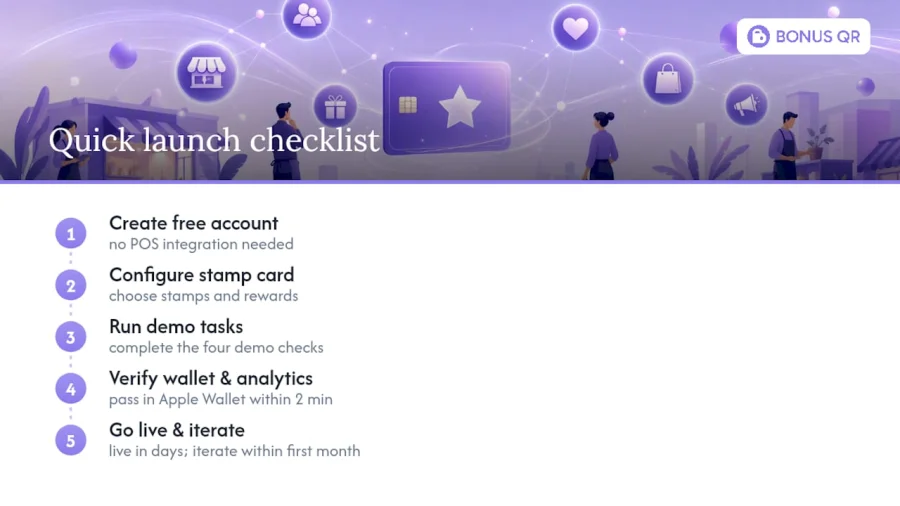
- Add a wallet pass to a real phone and confirm it appears in Apple or Google Wallet within two minutes.
- Simulate a points update and verify the pass refreshes on the phone without any customer action.
- Schedule a push notification and confirm it arrives on the test device at the correct time.
- Export a customer segment as a CSV and check that consent status is included in the data.
As Shopify’s guide for small businesses cautions, free tiers often omit omnichannel features and advanced analytics — so run these tests on the tier you plan to use, not the premium demo environment.
How does a digital stamp card app actually work?
Understanding both sides of the flow — what your customer experiences and what your team manages — helps you set up the programme correctly from the start.
The customer flow
- Discover: a customer sees your QR code on a receipt, counter card, or window sticker.
- Enrol: they scan the code, enter a minimal set of details (name, email or phone), and consent to marketing. The pass lands in their Apple or Google Wallet, or they receive a link to a web-based card.
- Earn: at each visit or purchase, a staff member scans the customer’s pass QR code, or the customer scans a merchant QR. The stamp or points balance updates in real time.
- Receive prompts: the platform sends a push notification when the customer is near the premises, or when they are one stamp away from a reward.
- Redeem: the customer presents their pass, the reward is applied, and the balance resets or continues accumulating.
The business flow
On your side, the daily tasks are light. You issue passes or QR codes once during setup. From then on, staff scan passes at the counter — a process that takes under ten seconds. The dashboard shows you live redemption rates, new enrolments, and which campaigns are driving visits. When you want to run a promotion, you schedule a push message or a double-points period from the dashboard, with no developer involvement.
Pushwoosh documents that wallet passes can be issued without a native app, updated in real time, and used for location and push triggers — meaning a small team can have a working programme live within days via a dashboard alone.
Technical patterns worth knowing
Wallet pass vs native app: a wallet pass lives in the customer’s existing Apple or Google Wallet. There is nothing to download, which removes the biggest barrier to enrolment. A native app gives you more screen real estate and deeper features, but requires the customer to install it. For most Central European SMBs starting out, a wallet pass is the faster and higher-conversion route.
QR-code stamping vs POS integration: QR stamping works with any smartphone and requires no till connection. POS integration automates the earn step at checkout, which reduces staff effort at scale, but adds setup time and cost. Start with QR, then integrate your POS once the programme has proven its value.
Pro Tip: Set up location triggers on your wallet passes from day one. When a customer walks within a defined radius of your premises, the pass surfaces on their lock screen with a short message. This is one of the most effective tactics for driving walk-in traffic, and most small teams never activate it.
What does a loyalty app cost, and what ROI can you expect?
Pricing for mobile loyalty programmes follows a small number of common shapes. Knowing which model a vendor uses tells you quickly whether the cost will scale with your success or stay predictable.
Common pricing models
- Freemium: a free tier with limited members, features, or locations, and paid tiers that unlock analytics, wallet passes, or automation. Good for testing; watch for the feature walls.
- Per-location flat monthly fee: predictable cost regardless of member count. Suits single-site businesses.
- Per-active-member: cost scales with programme success. Can become expensive quickly for high-volume retailers.
- Transaction-based: a small fee per redemption or stamp. Low upfront cost, but harder to budget.
Pricing bands for Central European SMBs
| Tier | Typical monthly cost | What you get | Likely ROI signal |
|---|---|---|---|
| Free / entry | €0 | Basic stamp card, limited members, minimal analytics | Proof of concept; measure enrolment rate |
| Growth | €20–€80 | Wallet passes, push notifications, full analytics, multi-mechanic | Repeat visit uplift, redemption rate |
| Professional | €80 | Multi-location, automation, integrations, white-label options | Average order value lift, retention rate |
Metrics to track
Focusing retention efforts on the right customer segments delivers disproportionately higher profitability than broad acquisition, as HBR’s analysis of customer lifetime value makes clear. That means your ROI metrics should go beyond raw enrolment numbers.
Track these four figures from month one:
- Repeat visit rate: what percentage of enrolled customers return within 30 days?
- Redemption rate: are customers actually reaching and claiming rewards, or dropping off mid-card?
- Average order value (AOV) lift: do loyalty members spend more per visit than non-members?
- Platform cost payback period: divide your monthly platform cost by the incremental revenue from repeat visits to find your payback point.
For further context on the retail retention benefits that justify this spend, the data consistently shows that a modest improvement in retention rate produces a significant uplift in lifetime value.
What GDPR rules apply to loyalty programmes in Central Europe?
Any loyalty programme that collects a customer’s name, email address, phone number, or purchase history is processing personal data under the GDPR. That applies to every Central European SMB running a digital rewards programme, regardless of platform.
The short answer: you need a lawful basis for processing (usually consent or legitimate interest), a clear privacy notice, and a way to honour deletion and portability requests. Your platform must support all three operationally.
Compliance checklist
- Consent at enrolment: the sign-up flow must present a clear, unbundled consent tick-box for marketing communications. Pre-ticked boxes are not valid under GDPR.
- Privacy notice: link to your privacy policy at the point of data collection. It must name you as the data controller and identify the platform as a data processor.
- Data minimisation: collect only what you need. Name and contact detail for communications; purchase data only if you use it for personalisation.
- Data portability: you must be able to export a customer’s data in a machine-readable format on request. Verify this in your demo.
- Deletion requests: the platform must support full customer record deletion within 30 days of a request.
- Retention policy: define how long you keep inactive member data and configure the platform to purge records automatically after that period.
- Data routing: confirm that your vendor stores data within the EU or EEA, or has a valid transfer mechanism (Standard Contractual Clauses) in place for any data leaving the region.
- Processor agreement: ensure you have a signed Data Processing Agreement (DPA) with your platform vendor before going live.
Wallet passes vs native apps
Wallet passes collect less data by default — typically a name and an identifier. Native apps can collect more behavioural data, which increases your compliance obligations. Document what data each mechanic collects and why you need it.
Pro Tip: Keep your marketing segments simple and consent-based. A segment of “customers who visited in the last 60 days and opted in to push notifications” is both lawful and useful. Avoid building segments from inferred data (e.g. estimated income or household size) unless you have explicit consent for that profiling.
How do you launch a digital loyalty programme in days to weeks?
The timeline depends on which launch track you choose. A basic wallet pass programme can be live in two to three days. A full branded app with integrations takes longer, but the core customer experience is available much sooner.
Three launch tracks
Track 1: Quick wallet pass (2–4 days)
- Sign up for a platform account and complete branding (logo, colours, reward name).
- Configure your stamp card or points mechanic and set the reward threshold.
- Generate your merchant QR code and test the full enrolment flow on a personal phone.
- Print or display the QR code at your counter and brief staff on the scan process.
- Send a launch message to your existing customer list with a link to add the pass.
Track 2: Standard app and dashboard (1–3 weeks)
- Complete Track 1 steps, then configure push notification templates and automation rules.
- Set up analytics goals (repeat visit rate, redemption rate).
- Connect POS or e-commerce integration if required.
- Run a one-week internal pilot with staff as test customers.
- Launch to customers with a welcome campaign.
Track 3: White-label or custom app (4–12+ weeks)
- Brief the vendor on brand requirements, feature scope and integration needs.
- Review and approve design mockups.
- Complete UAT (user acceptance testing) across iOS, Android and web.
- Submit to App Store and Google Play (allow 1–2 weeks for review).
- Plan a phased rollout starting with your most loyal existing customers.
First 60 days: marketing checklist
- Welcome campaign: send a push or email to every new enrolment within 24 hours, confirming their starting balance and the reward they are working towards.
- Double-points onboarding period: offer double stamps or points for the first two weeks to accelerate early engagement.
- Receipt QR placement: print the enrolment QR on every receipt, bag sticker, and table card.
- Staff scripts: train every customer-facing team member to mention the programme at checkout. A single sentence (“Would you like to add your loyalty pass?”) is enough.
- Measurement checkpoint at day 30: review enrolment rate, repeat visit rate and redemption rate. Adjust the reward threshold if redemption is too low or too high.
For practical campaign ideas beyond the first 60 days, the mobile promotions guide for existing customers covers re-engagement tactics and seasonal offer structures that work well for Central European SMBs.
What results can Central European SMBs realistically expect?
The following examples draw on publicly documented programme mechanics and outcomes from European markets. They illustrate the types of results that are achievable with the right mechanic and consistent execution.
Retail: independent grocery store
A Central European grocery retailer replaced a paper stamp card with a digital wallet pass. The enrolment QR was placed at the till and on carrier bags. Within the first month, the store saw a measurable increase in weekly return visits from enrolled customers compared to the control group. The mechanic was a simple ten-stamp card redeemable for a fixed discount. Critically, the store used push notifications to alert members to short-term offers, which drove footfall on quieter weekday mornings.
Café: independent coffee shop
A café introduced a points-based programme where every purchase earned points redeemable against drinks. The key operational change was briefing staff to ask every customer at the counter whether they wanted to add the pass. Enrolment reached a meaningful share of regular customers within six weeks. The café then used the analytics dashboard to identify customers who had not visited in 21 days and sent a targeted re-engagement push with a bonus points offer.
Service business: wellness centre
A wellness centre used a tiered cashback mechanic: members earned a percentage of each booking back as credit, with a higher rate at a higher spend tier. The programme created a clear incentive to book more frequently and to upgrade session types. The Mando European loyalty whitepaper documents that dynamic coupons and personalised offers are among the most effective mechanics in European markets, and this centre’s experience aligned with that finding.
The Wise Marketer’s European loyalty research highlights that programmes combining mobile-first mechanics with gamification elements outperform purely transactional models on emotional engagement. For Central European SMBs, that means the combination of a visible digital pass, timely push reminders, and a clear reward path tends to outperform a points balance that customers rarely check.
Bonusqr client case studies and verified results are available on request and will be added to this section as EEAT assets.
Which devices and platforms does a loyalty app support?
For a Central European SMB, device coverage is a practical concern: your customers use a mix of iOS and Android, and some will prefer a web-based option over any app.
iOS (Apple Wallet): wallet passes work on every iPhone running iOS 6 or later, which covers virtually all active iPhones in Central Europe. Push notifications from wallet passes appear on the lock screen without a separate app installed.
Android (Google Wallet): Google Wallet pass support is available on Android 5.0 and above. Coverage is broad across the Central European market, where Android holds a strong share of the smartphone base.
Web app: a web-based loyalty card (accessed via a browser link) covers customers who prefer not to use wallet apps, and works on any smartphone, tablet or desktop. It is the lowest-friction fallback for older devices.
Staff-side tools: most platforms provide a web dashboard for managers and a simple scan interface (often a browser-based QR scanner) for staff at the counter. No dedicated staff hardware is required.
The mobile and web application feature page on Bonusqr’s site details how the platform handles each of these channels, including wallet pass issuance and web app behaviour across devices.
How does customer support quality differ between loyalty platforms?
Support quality is one of the most under-evaluated criteria when choosing a platform, and it matters most in the first four weeks after launch.
The key questions to ask before signing up:
- Is there a dedicated onboarding contact, or does setup support come from a shared ticket queue?
- What is the response time SLA for technical issues during business hours?
- Is support available in your language, or only in English?
- Are there video tutorials, setup guides, and template libraries, or just a generic help centre?
For Central European SMBs, language support is a practical differentiator. A platform that offers onboarding documentation and support in German, Czech, Polish, or Hungarian reduces the time your team spends interpreting instructions.
A red flag worth repeating: if a vendor cannot give you a named onboarding contact and a clear timeline for your first week, that reflects the support culture you will experience throughout the contract. Good platforms treat the first 30 days as a shared responsibility, not a self-service task.
What customisation and branding options do loyalty apps offer?
Your loyalty programme is a customer-facing product, and it should look like your business, not a generic template.
At a minimum, a platform should let you apply your logo, brand colours, and reward name to every customer-facing element: the wallet pass, the web card, push notification templates, and email communications. That level of customisation is available on most growth-tier plans.
Beyond visual branding, the more meaningful customisation is structural: the ability to define your own reward mechanics (stamp count, points ratio, cashback percentage, coupon value), set your own reward names and descriptions, and configure the enrolment flow to match your customer journey. A café that calls its reward a “free flat white” converts better than one that calls it “Reward Item A.”
White-label and custom app options go further: your programme appears under your own brand name in the App Store and Google Play, with no platform branding visible to customers. This is the right choice for businesses where brand consistency is a commercial priority, such as hotel groups or multi-location retail chains. Bonusqr offers both white-label app setup and fully custom-built solutions for businesses at that stage.
Can a loyalty platform grow with your business?
The honest answer is: most platforms can, but the cost of scaling varies significantly between vendors.
At the entry level, a single-location stamp card programme is straightforward on almost any platform. The scalability question becomes relevant when you open a second location, add an e-commerce channel, or want to run differentiated programmes for different customer segments.
Features to confirm before you commit to a platform for the long term:
- Multi-location management: can you manage multiple sites from one account, with location-specific analytics?
- Multiple programme mechanics: can you run a stamp card and a points programme simultaneously for different customer types?
- API access: does the platform offer an API for connecting to your CRM, POS, or e-commerce system as you grow?
- Upgrade path: is there a clear route from the entry tier to a white-label or custom app without migrating your customer data to a new system?
The EY 2025 Loyalty Market Study finds that over 80% of customers expressed willingness to download a loyalty app, which signals that mobile loyalty programmes have real growth headroom. Choosing a platform that can scale from a wallet pass to a full branded app on the same customer database means you do not have to re-enrol your members when you grow.
Bonusqr’s tiered structure covers this path: from a free-tier wallet pass programme through to white-label and custom app development, all on the same platform.
What is actually working in loyalty right now
The conventional wisdom on loyalty programmes is that the reward is the product. Get the points ratio right, set a compelling redemption threshold, and customers will come back. That framing is increasingly incomplete.
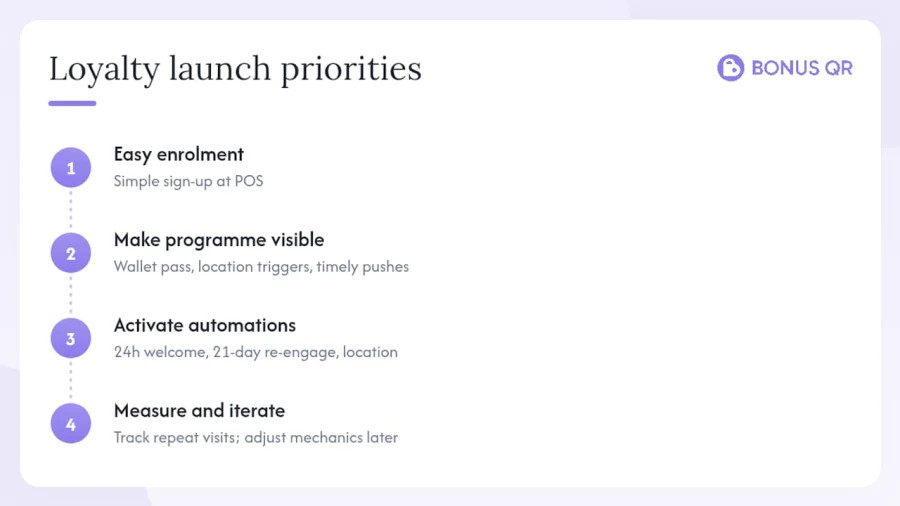
The EY research is clear: visibility has become as important as reward value. A loyalty programme that customers forget about between visits delivers poor results regardless of how generous the rewards are. The programmes that perform well in Central European markets right now combine three things: a wallet pass or app that surfaces on the customer’s phone without them having to open anything, a timely push reminder that arrives at a relevant moment (near the premises, one stamp from a reward, or after a 21-day absence), and a simple earn-and-burn mechanic that customers understand in under ten seconds.
Where SMBs tend to under-invest is in the visibility layer. They configure the reward correctly, then never activate location triggers or set up re-engagement automations. The result is a programme that works for the 20% of customers who remember to show their pass, and does nothing for the other 80%.
The Wise Marketer’s European research supports this: programmes that build emotional connection through consistent, timely communication outperform purely transactional models. For a Central European SMB, that means the first investment after launch should not be in a more complex reward structure. It should be in making the programme visible: location triggers, a 24-hour welcome push, and a 21-day re-engagement automation. Those three automations, running consistently, tend to deliver more measurable impact than any points ratio adjustment.
Start with easy enrolment, then add consistent messaging, then measure. Iterate the mechanics only once you have enough data to know what is actually driving repeat visits.
Bonusqr gives Central European SMBs a practical starting point
Most loyalty platforms ask you to choose between simplicity and capability. Bonusqr is built so you do not have to make that trade-off early. The full feature set covers stamp cards, points, tiered cashback, coupons, push and location notifications, referral modules, and Apple and Google Wallet support — all accessible from a free tier, with no POS integration required to launch.
For Central European SMBs specifically, the combination of wallet pass issuance, GDPR-compliant consent capture, and real-time analytics means you can go live in days and have the data you need to iterate within the first month. Paid tiers add automation, multi-location management, and white-label app options as your programme grows.
The practical next step: create a free account, configure a stamp card, and run the four demo tasks from the checklist above. If the pass lands in Apple Wallet within two minutes and the analytics dashboard shows your test enrolment, the platform is ready for your customers.
Start your free trial at Bonusqr and have a working loyalty pass ready before the end of the week.
EEAT note for the author: insert verified Bonusqr client case studies, testimonials, and author credentials here before publication.
Sources
The following sources informed this guide and are worth reading directly for deeper context:
- 2025 EY Loyalty Market Study
- Loyalty cards for business: The complete guide for small teams
- The value of keeping the right customers
- How To Start a Loyalty Program for Small Businesses (2026) - Shopify
- Understanding Loyalty in Europe 4.0 - The Wise Marketer
- Mando / Understanding loyalty in Europe (whitepaper)
For practical templates, setup guides, and how-to resources specific to Bonusqr, the customer reward tracking guide and the building customer loyalty in the digital age article are good starting points.