Tuesday lunchtime exposes the problem. A regular café customer who once came in twice a week now appears once, perhaps because a cheaper competitor opened nearby, a delivery app absorbed the habit, or the customer has grown tired of explaining who they are every time they reach the counter. Nothing dramatic happened. The relationship stopped being remembered.
That's why customer loyalty management matters for independent cafés, restaurants, salons, gyms, and shops. It records the relationship, rewards the behaviour a business wants, and gives customers a clear reason to return. The UK market is already mature, with 97% of shoppers belonging to at least one supermarket loyalty scheme and an average membership of three supermarket schemes, according to the UK government review of loyalty pricing. Local businesses don't need another complicated enterprise platform. They need a simple loop that works at the till.
Why Repeat Customers Keep Disappearing
A café can lose repeat visits while its regulars still live nearby. One customer switches because a competitor's offer is easier to understand. Another orders through a delivery platform that now owns the reminder, payment, and reward relationship. A third still likes the café, but every visit starts from zero because nobody recognises the customer or remembers the previous reward.
Three pressures create this drift:
- Price-led competition: A nearby business makes switching feel sensible with a visible introductory offer, especially when customers make quick comparisons.
- Delivery platforms: The café may receive the order, but the platform controls discovery, ordering data, notifications, and much of the repeat-purchase habit.
- Counter friction: Customers repeat a phone number, search for a paper card, or explain a previous reward. Small delays give them a reason to skip the visit.
Treat this as a retention problem, not a vague branding problem. A QR-driven loyalty programme can connect a purchase to a customer identifier, show recognition at the next visit, and give that customer a timely reason to return. Staff should not need to remember every detail manually.
Operator's rule: A loyalty programme should make the next visit easier and more valuable, not merely record the last one.
Loyalty also affects pricing. Loyalty-priced grocery products generated over £5 billion in revenue from November 2023 to January 2024, representing about 22% of total grocery revenue among supermarkets offering loyalty price promotions, according to the government's executive summary. An independent café should not copy supermarket pricing. It should use targeted rewards or member prices to protect repeat demand without discounting every transaction.
Enrolment is rarely the main problem for local businesses. The programme must work after sign-up. A customer scans a QR code, earns credit or receives a relevant offer, and sees the benefit without downloading an app or joining a complicated tier structure. That low-friction loop can compete with a delivery platform's convenience while keeping the relationship direct.
For broader context on rewards in marketing, see the ViralRef loyalty guide. The operator's practical question is simple: what will make an existing customer choose the same shop tomorrow?
Capture the relationship, remember useful behaviour, reward a profitable action, and reactivate customers at the right time. A small business can run that loop without enterprise tooling or a large CRM project.
What Customer Loyalty Management Actually Means
Customer loyalty management isn't just a customer relationship management system with a points screen attached. It's the practical process of helping a business recognise customers, understand repeat behaviour, reward it sensibly, and create the next opportunity to buy.
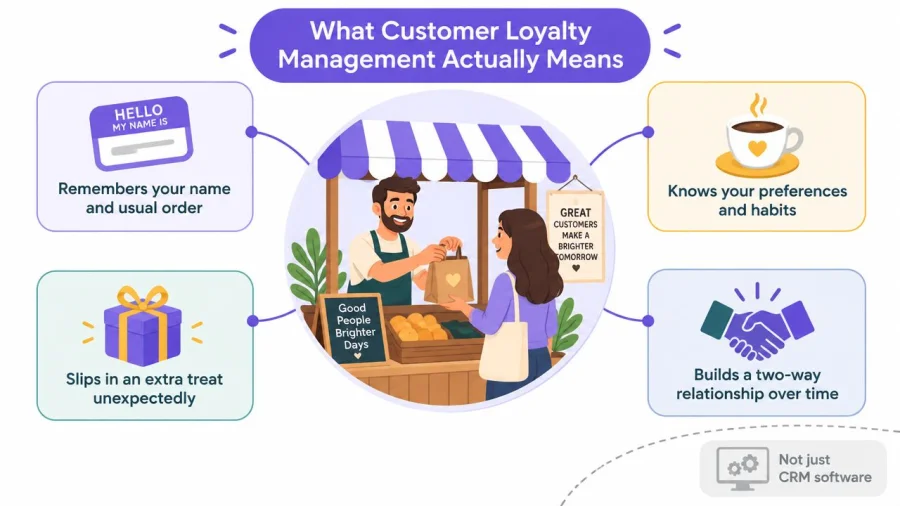
A market-stall holder demonstrates the idea naturally. The stallholder remembers a customer's name, knows the usual order, notices when the customer tries something different, and adds a small extra when the customer asks for a favour. Customer loyalty management systemises that memory for a shop serving dozens of daily customers.
The four jobs the system must do
Identify the buyer. The till, QR code, or checkout prompt captures an identifier such as a name, phone number, or email address. Without that connection, the purchase disappears into anonymous revenue.
Remember useful behaviour. Transaction history shows visit frequency, preferred products, average purchase pattern, and reward usage. The business doesn't need every possible data point. It needs enough information to make the next interaction relevant.
Reward the right action. A programme can reward visits, spend, selected products, referrals, birthdays, or progress towards a threshold. The reward should support the business model rather than train customers to wait for discounts.
Bring the customer back. A balance reminder, birthday offer, seasonal coupon, or reactivation message gives the customer a reason to return. Timing matters. A message sent while the customer still remembers the shop is more useful than a generic campaign sent months later.
The loyalty programme is the visible reward surface. Loyalty management is the operational loop behind it. It includes the rules, staff behaviour, customer data, communications, reporting, and redemption process that determine whether the programme changes purchasing.
What belongs in the local-business model
This approach fits independent retail, cafés, salons, gyms, restaurants, and wellness businesses where customers visit repeatedly and staff can influence the next purchase. A salon may reward completed appointments, a gym may recognise attendance, and a café may issue a reward after a pattern of visits.
It doesn't attempt to solve B2B contract management, airline alliances, or complex enterprise account structures. Those models involve different buying cycles, stakeholders, and commercial rules. A local loyalty operation needs speed, clarity, and a reward customers can understand at the counter.
Loyalty Program Types and How to Choose
The right mechanic depends on buying frequency, basket size, margin, and how much explanation staff can provide. A small café rarely needs an airline-style status architecture. A salon may benefit from a spend-based reward, while a boutique gym may justify a paid membership with meaningful access benefits.
Five mechanics worth considering
Stamp cards work well when visits are frequent and the average ticket is modest. A customer buys nine coffees and receives the tenth free, or completes a set number of visits to earn a reward. The trap is forgetfulness. Paper cards get lost, and digital stamps become pointless if staff don't apply them consistently. This format suits cafés, sandwich shops, and quick-service eateries.
Points on spend return a portion of eligible purchases as points that customers redeem later. This gives retailers and salons more control over product categories, margins, and reward thresholds. The trap is abstraction. If customers can't quickly understand what their points are worth, the balance becomes another ignored account.
Tiered schemes use levels such as Silver, Gold, and Platinum to provide different benefits. They can suit gyms and cafés with a clear base of repeat customers because progression creates a reason to increase visits or spend. The trap is exclusion. Occasional customers may see the programme as designed for someone else, while staff must explain multiple rules.
Paid or VIP memberships charge a recurring fee in exchange for perks, discounts, priority access, or exclusive services. This can fit boutique gyms and salons where customers value continuity and recognition. The trap is weak perceived value. If members don't use the benefits often enough, the fee becomes a source of resentment.
Cashback returns credit for a future purchase. It makes value visible and helps price-sensitive shops compete without reducing every transaction immediately. The trap is margin control. A business must set an earning and redemption rule that encourages another purchase without turning every sale into a delayed discount.
| Program Type | Best For | Key Strength | Watch Out For |
|---|---|---|---|
| Stamp card | Cafés and sandwich shops | Simple visit-based reward | Customers forget cards or staff miss scans |
| Points on spend | Retail and salons | Flexible value by basket size | Customers may not understand the value |
| Tiered | Gyms and frequent-visit cafés | Encourages progression | Rules can feel complicated or exclusionary |
| Paid or VIP | Boutique gyms and salons | Creates an exclusive relationship | Benefits may not justify the fee |
| Cashback | Price-competitive retail | Immediate, visible future value | Poor rules can erode margin |
A practical decision lens is blunt. If a business serves under 200 customers a week and has no app in place, it should start with stamps or cashback rather than tiers. A simple QR-based programme can replace paper without forcing customers through a long registration process. Businesses comparing formats can find further loyalty program ideas for retailers.
For local operators, BonusQR is one option that supports QR-based stamps, points, cashback, visit thresholds, spend thresholds, fixed discounts, and digital customer profiles without requiring POS integration or extra hardware. The important decision isn't the number of available features. It's choosing one reward rule customers and staff can apply without hesitation.
The Loyalty Workflow From Sign-up to Redemption
A loyalty programme fails at the seams, not in the marketing copy. The customer may like the reward, but the process breaks if the QR code isn't visible, the Wi-Fi slows at lunch, or the balance takes too long to update.
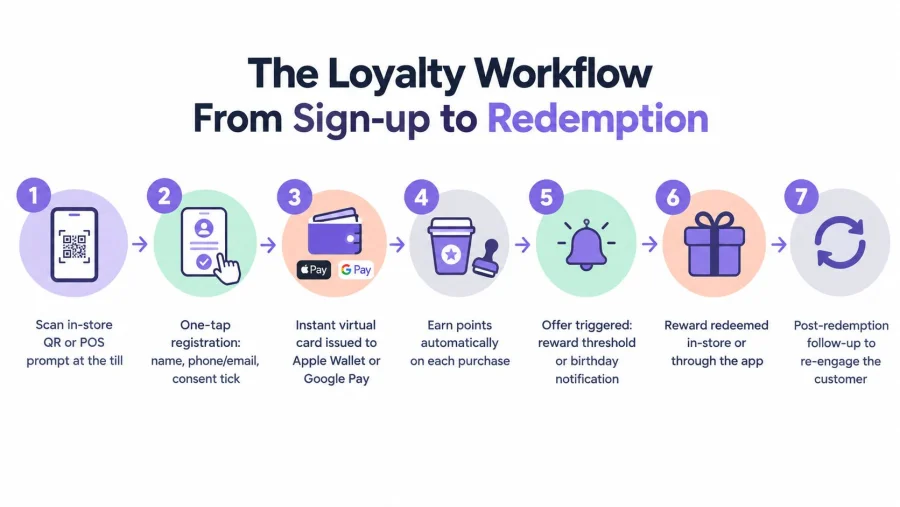
A reliable workflow contains seven touchpoints.
- The till prompt: Place an in-store QR code or POS prompt where the customer can see it before payment finishes.
- The registration: Keep sign-up short. Capture a name, phone number or email address, and the relevant consent choice.
- The digital card: Issue a virtual card that customers can keep in Apple Wallet or Google Wallet.
- The earning event: Trigger points, stamps, or visit credit from a purchase or completed visit.
- The visible balance: Show progress on the receipt, in the app, or on the customer's profile.
- The reminder: Send a useful nudge as the customer approaches a reward threshold, including progress at 60%, 80%, and 100% where the programme uses those thresholds.
- The redemption: Staff scan the customer's code, apply the reward, and reverse the points or stamps at the counter.
Audit the points where staff and customers struggle
A launch checklist should test the environment, not a quiet office.
- Visibility: Does the printed receipt, counter sign, menu, and checkout screen show the QR code?
- Staff action: Can a new team member explain the scan and redemption process in one sentence?
- Connectivity: Does the workflow still function during the busiest service period?
- Speed: Does the customer see the updated balance within two seconds?
- Error handling: Can staff correct a missed scan without creating duplicate rewards?
- Redemption clarity: Does the staff screen show exactly what to reverse and what remains?
- Customer control: Can the customer view rewards, history, privacy choices, and contact preferences?
A business should test the journey with a staff member using an unfamiliar phone, then repeat the test at the counter during normal service. The workflow for loyalty program success should be documented beside the till, because memory fails when queues build.
The most effective programme is often the one with fewer steps. Customers shouldn't need a special explanation, a physical card, or a separate payment process. A QR scan, a visible balance, and a clear reward create enough structure for most local businesses.
Metrics That Show Whether Loyalty Is Working
Enrolment is an easy number to celebrate and a poor number to manage. A large database can contain customers who joined once, never scanned again, and don't remember the programme exists. UK loyalty participation is already saturated, with 90% of Britons belonging to at least one loyalty scheme, according to the 2026 UK consumer report. The commercial task is active engagement.
The five numbers that deserve a weekly review
| Metric | Formula | Target Band | Action Trigger |
|---|---|---|---|
| Active member share of transactions | Paid orders linked to an active loyalty ID in the trailing 30 days, divided by paid orders | Set a baseline first | If it falls, improve counter prompts and scan visibility |
| Redemption rate | Rewards claimed divided by points or stamps issued | Set a margin-safe range | If issuance rises but redemption stays low, simplify rewards |
| Repeat visit lift | Member transaction frequency compared with a matched non-member cohort | Compare like with like | If there is no difference, change the offer or activation message |
| Tier progression rate | Members advancing to the next tier per quarter divided by members eligible to progress | Calibrate against observed behaviour | If progression is rare, lower complexity or adjust thresholds |
| Cost of loyalty as a percentage of revenue | Rewards, discounts, and administration cost divided by turnover | Keep within a 3% to 5% ceiling | If it exceeds the ceiling, tighten reward economics |
Each metric needs an owner and a response. A café manager can review active member share on a Monday, inspect redemption and cost midweek, then examine cohort behaviour at the end of the week. The report should lead to a decision, not a dashboard tour.
Read the pattern, not one isolated result
High enrolment with weak active member share usually indicates poor visibility, an awkward scan, or an offer customers don't value. High issuance with low redemption can mean the reward is unclear, too distant, or difficult to claim. Strong redemption with rising loyalty cost may show that the offer works but the economics don't.
UK revenue concentration makes this focus more important. A 2025 Collinson benchmark found that 61% of registered members made a purchase in the last 12 months, and those active members generated 52% of total UK sales revenue. The retention metrics explained approach is more useful than counting every registered profile.
The owner should record the weekly figures, note the operational change made, and compare the following reading. That simple rhythm turns customer loyalty management into a revenue discipline.
Data, Privacy and GDPR Without the Headache
A loyalty programme enters UK GDPR territory as soon as a business collects identifying information. A name, email address, or phone number counts as personal data, so the owner needs a clear purpose, a suitable lawful basis, and an understandable privacy notice. Practical UK GDPR loyalty guidance also highlights data minimisation, platform agreements, and customer rights inside the app.
Match each use to a lawful basis
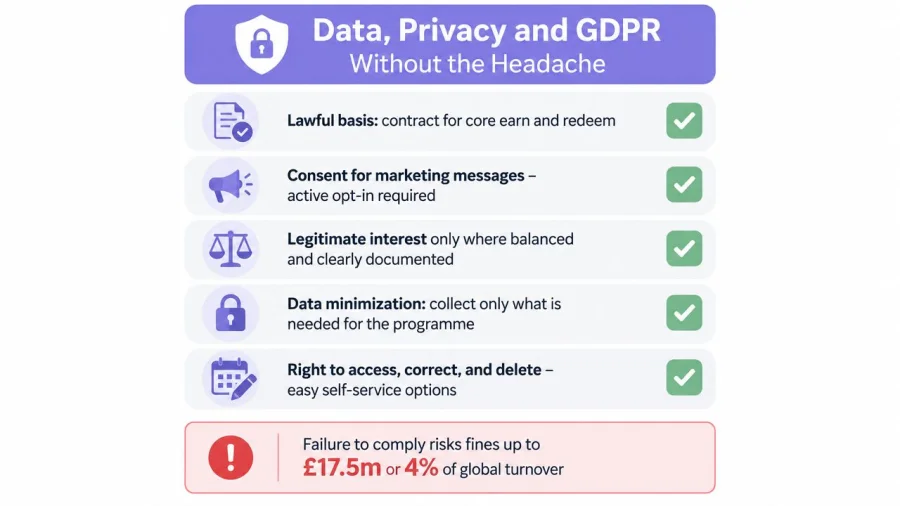
Core earn and redeem activity will usually rely on contract, because the business needs to process the customer's account to provide the promised reward. Marketing messages need an active, specific consent choice. Legitimate interest can apply only where the business has balanced its purpose against the customer's rights and documented the reasoning.
Purchase history plus a phone number or email creates a customer profile. A light data protection impact assessment helps the owner record what the programme collects, why it collects it, who can access it, and what could go wrong.
The business should collect only what the reward requires. A café offering visit stamps probably doesn't need detailed demographic information. A salon may need appointment history, but that doesn't justify collecting unrelated personal details.
Set retention and rights procedures before launch
Personal purchase records shouldn't be retained beyond 24 months unless the business has a clear reason. The retention rule should be written down and applied consistently, rather than decided when someone asks a difficult question.
Subject access requests often arrive informally. A customer may send a screenshot and ask what information the business holds. Staff should know where to route the request, and the operator should set an internal two-week response target even where the legal process allows more time.
Erasure also needs operational care. When a customer asks for deletion, the business should remove the personal profile while retaining a suppression flag where necessary, so a deleted customer isn't accidentally re-enrolled by another cashier.
Privacy rule: Customers should understand what they receive, what the business stores, and how they can leave.
Before connecting a third-party loyalty platform to the till or customer workflow, the owner should check:
- Data roles: The agreement identifies controller and processor responsibilities.
- Processing terms: A data processing agreement covers the platform's handling of customer information.
- Access controls: Staff access is limited to the actions each role requires.
- Export and deletion: The business can retrieve, correct, and delete customer records.
- Consent controls: Marketing opt-ins remain separate from core programme membership.
- Security response: The vendor explains how incidents and support requests are handled.
Transparency protects trust and prevents a reward programme from looking like a hidden data-collection exercise.
Habits That Make Loyalty Programmes Last
Feature growth is not the same as programme maturity. Owners often add tiers, partner offers, badges, seasonal rules, and extra notifications before fixing the missed scan at the till. Customers don't reward complexity. They reward a programme that works every time.
Five operating habits keep the system useful.
Review the four jobs every month
The owner should spend less than an hour checking whether the programme still identifies customers, remembers useful behaviour, rewards the intended action, and reactivates people who have gone quiet. If one job has stalled, the next change should address that job directly.
Remove rules customers ask about twice
A question from one customer may expose a wording problem. The same question from another customer exposes a rule problem. Rewrite or remove the rule. Staff shouldn't need a policy manual to explain when a reward applies.
Put the next action in front of staff
At redemption, the screen should show the reward available, the points to reverse, and the customer's next useful step. Staff can then mention the next visit naturally instead of searching through a separate system while a queue forms.
Treat lapsed customers as a segment
A customer who has stopped visiting needs a different message from an active member. The owner can organise a 30-day, 60-day, and 90-day win-back cadence, with each message offering a clear reason to return rather than repeating the same discount.
Run one controlled experiment each quarter
Before changing the reward, write the revenue hypothesis. For example, the owner may expect a visit-based offer to increase weekday return behaviour without changing the weekend offer. After the test, compare the relevant member activity, redemption, and cost measures.
A simple monthly review also gives owners a place to use customer feedback. For businesses developing turning social insights into advocates, reviews, comments, and direct conversations can reveal which rewards feel useful and which rules create frustration.
The durable programme is a weekly operating habit, not a marketing trophy.
UK customers increasingly question whether loyalty schemes deliver fair value. Research cited by Antavo's UK loyalty statistics overview reports that 62% of non-members doubt the value of loyalty schemes and 64% feel excluded by membership pricing. A local business should show savings clearly, avoid making ordinary customers feel punished, and keep the reward economics easy to explain.
For an independent café, salon, gym, restaurant, or shop, the practical next step is a short loyalty audit. Identify the repeat behaviour worth rewarding, choose one mechanic, map the QR sign-up and redemption journey, define the data you need, and select a platform that staff can operate during the busiest shift. Businesses can start with BonusQR to create a QR-based loyalty experience with digital cards, rewards, customer profiles, analytics, and campaign tools, then test whether active visits and redemptions improve before adding more complexity.


