Cross-channel loyalty is defined as the practice of coordinating reward and engagement experiences across multiple customer touchpoints so that each interaction reinforces the last. Brands that master this approach sustain a 91.3% customer retention rate compared to just 29.8% for single-channel brands. That gap is not a rounding error. It represents the difference between customers who return repeatedly and customers who drift to a competitor after a single poor experience. Platforms like Bonusqr and data strategies built around permissioned, verified customer information are making coordinated loyalty programmes accessible to businesses of every size in 2026.
What impact does cross-channel loyalty have on customer retention?
Cross-channel loyalty is the single most measurable driver of long-term customer value available to marketers today. The numbers are unambiguous: multi-channel customers have 30% higher lifetime value and purchase 250% more often than customers who engage through a single channel. That means a customer who interacts with your brand via email, a mobile app, and in-store is not just more loyal in sentiment. They are materially more profitable.

The mechanism behind this is straightforward. When a customer earns points in-store and redeems them through your app without friction, they experience your brand as a single coherent entity rather than a collection of disconnected touchpoints. That coherence builds trust, and trust drives repeat purchase. 74% of customers are more likely to return to brands with well-integrated loyalty programmes featuring personalised offers and seamless redemption. Personalisation and ease of redemption are not optional extras. They are the baseline expectation.
For small and medium businesses, the practical implication is this: you do not need to be a global retailer to benefit from cross-channel loyalty. You need a clear view of your customer across every channel you operate, and a rewards structure that travels with them. Understanding your customer retention workflow is the first step towards building that view systematically.
Key stat: Brands with fully integrated cross-channel strategies retain 91.3% of customers versus 29.8% for single-channel brands. That 61-percentage-point gap represents compounding revenue over every subsequent trading year.
Pro Tip: Track customer lifetime value by channel segment, not just by total programme membership. Customers who engage across three or more channels will almost always outperform those who engage through one. Use that data to prioritise where you invest in new channel integrations.
What are the main challenges in implementing cross-channel loyalty programmes?
The biggest obstacle to cross-channel loyalty is not technology. It is fragmented data. 91% of organisations face barriers when trying to leverage loyalty data effectively, and 68% report only partial integration across their systems. That means the majority of businesses are sitting on customer behaviour data they cannot act on in real time because it lives in disconnected silos.
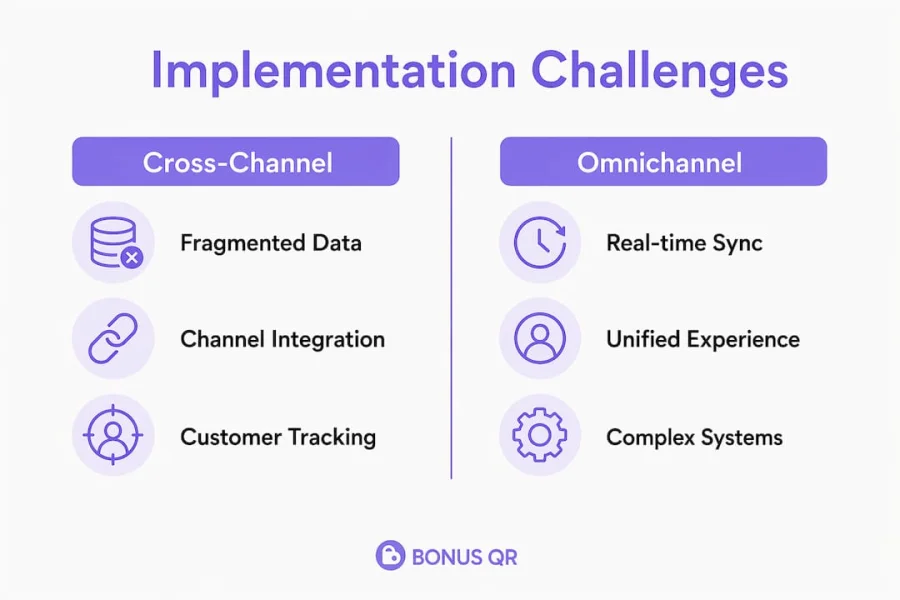
The consequences of fragmentation are visible to customers. A member who redeems a voucher in-store may still receive that same voucher offer via email the following morning. A customer who opts out of SMS communications may still receive a push notification repeating the same message. These inconsistencies erode trust faster than any competitor promotion. As Braze and SAP research confirms, coordination of customer touchpoints with a shared profile is what prevents conflicting messages and the customer churn that follows.
The common barriers businesses encounter include:
- Siloed technology stacks: Point-of-sale systems, e-commerce platforms, and email tools that do not share data in real time.
- Partial data integration: Loyalty programme data captured at one touchpoint that never reaches the CRM or personalisation engine.
- Organisational silos: Marketing, retail operations, and digital teams managing loyalty independently without a shared strategy.
- Lack of real-time activation: Batch data processing that delays personalised responses by hours or days, making offers irrelevant by the time they arrive.
The encouraging news is that 92% of organisations plan to invest in centralised data and AI-driven personalisation. That investment signals a market-wide recognition that loyalty data is a strategic asset, not just a reporting metric. The businesses that act first will hold a significant advantage.
Pro Tip: You do not need to solve every integration challenge at once. Start with one high-traffic channel, build a clean data feed from it into your loyalty platform, and prove the model before expanding. Incremental progress beats paralysis.
How does cross-channel loyalty compare with omnichannel loyalty?
Cross-channel loyalty and omnichannel loyalty are related but distinct concepts, and confusing them leads to misaligned strategy. Understanding the difference is genuinely useful for any business planning a loyalty investment.
Cross-channel loyalty focuses on coordinating loyalty rewards and communications across multiple channels so that the customer experience is consistent and context carries over. If a customer browses a product online and then visits your shop, cross-channel loyalty means your in-store staff can see that browsing history and offer a relevant reward. The channels are connected, but they may still operate with some degree of independence.
Omnichannel loyalty, when defining omnichannel loyalty precisely, goes a step further. It requires that every interaction across every channel, whether online, in-app, in-store, or via SMS, is fully unified under a single customer profile with real-time data flow in all directions. Omnichannel customer engagement requires coordinating every interaction so context and behaviour carry across devices and locations, with message suppression and frequency caps applied consistently. The customer experience feels genuinely continuous rather than merely coordinated.
The table below summarises the practical differences:
| Feature | Cross-channel loyalty | Omnichannel loyalty |
|---|---|---|
| Channel coordination | Channels share data and rewards | All channels unified under one real-time profile |
| Customer profile | Shared but may have sync delays | Single live profile updated instantly across all touchpoints |
| Message consistency | Coordinated, with some risk of overlap | Fully suppressed conflicts via orchestration layer |
| Implementation complexity | Moderate, achievable for SMBs | High, typically requires enterprise-level infrastructure |
| Best suited for | Growing businesses expanding channel presence | Large retailers with mature tech stacks |
For most small and medium businesses, cross-channel loyalty is the right starting point. It delivers the majority of the retention and lifetime value benefits without requiring the full infrastructure investment of a true omnichannel system. You can explore how retail loyalty programmes are applying both approaches in practice to find the model that fits your current stage.
What practical steps can businesses take to build cross-channel loyalty?
Building a cross-channel loyalty programme that actually works requires a sequential approach. Rushing to add channels before your data foundation is solid creates exactly the fragmentation problems described above. The following steps reflect what the most effective programmes have in common.
- Make enrolment frictionless across every channel. A customer should be able to join your loyalty programme in-store via a QR code, through your website, or via your mobile app with equal ease. Every additional step in enrolment reduces sign-up rates significantly.
- Ensure rewards are redeemable everywhere you operate. A loyalty point earned online must be spendable in-store and vice versa. Restrictions on redemption are the fastest way to make a programme feel punitive rather than rewarding.
- Build a unified customer profile from day one. Every interaction, whether a purchase, a visit, a coupon redemption, or a referral, should feed into a single customer record. This is the foundation on which personalisation is built.
- Collect permissioned data at every touchpoint. More than 50% of consumers are reluctant to share personal data without a clear value exchange. Permissioned data, where customers actively consent and understand what they receive in return, enables personalised, trust-based loyalty that scales without legal or reputational risk.
- Use your CRM and loyalty platform for real-time orchestration. CRM platforms consolidate customer data into unified profiles that enable personalised engagement and predictive analytics. Bonusqr’s platform, for example, supports real-time analytics and automated campaign triggers that respond to customer behaviour as it happens rather than the following week.
- Sequence your channel communications deliberately. Leading brands coordinate email, SMS, push notifications, in-app messaging, and physical touchpoints so that each channel plays a distinct, reinforcing role. Email might introduce an offer, push notification reminds at the point of decision, and in-store staff confirm the reward. That sequence is intentional, not accidental.
- Review and refine using real data, not assumptions. Set a monthly review cadence for your loyalty programme metrics. Look at redemption rates by channel, enrolment sources, and repeat purchase frequency. The data will tell you where the programme is working and where customers are dropping off.
Pro Tip: Verified customer segments, such as those built using community affiliation or purchase history, allow you to tailor offers with precision. A customer who has visited your store four times in 90 days deserves a different offer than a customer who joined your programme six months ago and has never returned. Segmentation turns a generic programme into one that feels personal.
You can find detailed guidance on building a loyalty ecosystem for SMBs that covers the full architecture from enrolment through to retention.
What tools and technologies support cross-channel loyalty management?
The technology behind effective cross-channel loyalty has matured considerably. You no longer need a bespoke enterprise system to run a coordinated programme. The key is choosing tools that share data cleanly and respond to customer behaviour in real time.
The most capable loyalty platforms in 2026 share several technical characteristics. When evaluating any solution, look for:
- Unified customer data management: A single database that captures interactions across all channels and updates in real time, eliminating the sync delays that cause conflicting messages.
- AI-driven personalisation: The ability to analyse customer behaviour patterns and surface the right offer at the right moment, without manual segmentation for every campaign.
- Multi-channel communication tools: Native support for push notifications, email, SMS, and in-app messaging from within the same platform, so you are not stitching together five separate tools.
- Gamification and engagement mechanics: Features like stamp cards, points multipliers, milestone rewards, and coupon management that give customers reasons to engage beyond the transactional moment.
- Real-time analytics and reporting: Dashboards that show you redemption rates, enrolment trends, and channel performance as they happen, not in a weekly export.
- No POS integration requirement: For smaller businesses especially, the ability to run a loyalty programme without modifying your point-of-sale system removes a significant barrier to launch.
Bonusqr’s loyalty platform includes customer loyalty cards, coupon management, and loyalty gamification features designed to support multi-channel reward programmes with real-time analytics built in. For businesses that want to understand how real-time analytics can directly improve engagement outcomes, the practical applications are well documented.
The broader principle is this: your loyalty technology stack should make it easier to act on customer data, not harder. If your current tools require manual exports, batch processing, or separate logins for each channel, you are working against yourself.
Key takeaways
Cross-channel loyalty works because coordinated, data-driven engagement across multiple touchpoints produces measurably higher retention rates, purchase frequency, and customer lifetime value than any single-channel approach.
| Point | Details |
|---|---|
| Retention advantage is significant | Brands with integrated cross-channel strategies retain 91.3% of customers versus 29.8% for single-channel brands. |
| Data fragmentation is the core problem | 91% of organisations struggle to activate loyalty data; solving this unlocks real-time personalisation. |
| Cross-channel and omnichannel are distinct | Cross-channel coordinates channels; omnichannel unifies them fully. Most SMBs should start with cross-channel. |
| Permissioned data builds trust at scale | Over 50% of consumers resist sharing data without a clear value exchange. Consent-based data outperforms purchased lists. |
| Sequential channel communication drives results | Deliberate sequencing of email, push, SMS, and in-store touchpoints creates reinforcing journeys, not noise. |
Why I think most businesses are still thinking about loyalty the wrong way
Most loyalty programmes I encounter are built around transactions. Spend £10, earn a point. Collect ten points, get a reward. That model made sense when the only data you had was a till receipt. It does not make sense in 2026, when you can know that a customer browsed your winter collection three times, opened your last two emails, and visited your shop on a Tuesday afternoon.
The shift that matters is from transactional rewards to value exchange. SheerID’s research on lifecycle marketing makes this explicit: moving beyond transactional rewards to genuine value exchange and trust is what defines modern cross-channel loyalty success. That means giving customers something they actually want in return for their data and their attention, not just a discount on their next purchase.
I have also seen too many businesses treat loyalty as a marketing department problem. It is not. Loyalty data, when treated as a foundational layer across the full customer journey rather than a retention tool, informs product decisions, stock management, and even store layout. The businesses that understand this are building loyalty ecosystems, not loyalty campaigns. The difference in long-term performance is substantial.
My honest advice: stop asking “how do we get more sign-ups?” and start asking “what does a customer get from being loyal to us that they cannot get anywhere else?” Answer that question clearly, build your channels around it, and the data will follow.
— Michal
How Bonusqr makes cross-channel loyalty practical for your business
If the strategies above feel complex to implement from scratch, Bonusqr is built to make the process manageable. The Bonusqr loyalty platform gives you customer loyalty cards, coupon management, gamification mechanics, and real-time analytics in one place, with no POS integration required to get started. You can launch a coordinated programme across your web presence, mobile app, and physical locations quickly, then use the built-in analytics to refine your approach as customer data accumulates. For businesses ready to move from a single-channel rewards scheme to a genuinely coordinated loyalty programme, Bonusqr provides the infrastructure without the enterprise price tag. Explore customer loyalty cards and the full platform to see which features match your current needs.
FAQ
What is cross-channel loyalty in simple terms?
Cross-channel loyalty is the practice of rewarding and engaging customers consistently across multiple platforms, such as in-store, online, and via mobile, so that their experience feels unified regardless of where they interact with your brand.
How does cross-channel loyalty improve customer retention?
Brands with fully integrated cross-channel strategies retain 91.3% of customers compared to 29.8% for single-channel brands, because consistent, personalised engagement across touchpoints builds trust and repeat purchase behaviour.
What is the difference between cross-channel and omnichannel loyalty?
Cross-channel loyalty coordinates rewards and communications across multiple channels with a shared customer profile, while omnichannel loyalty fully unifies every interaction in real time under a single live profile. Omnichannel requires more infrastructure and is typically suited to larger businesses.
Why is permissioned data important for cross-channel loyalty?
Over 50% of consumers are reluctant to share personal data without a clear benefit in return. Permissioned data, collected with explicit customer consent, enables personalised offers that customers trust and respond to, reducing churn and improving programme engagement.
How can a small business start building cross-channel loyalty?
Start with frictionless enrolment across your existing channels, build a single customer record from every interaction, and use a loyalty platform like Bonusqr that supports customer engagement in retail without requiring complex POS integration. Expand channels incrementally as your data foundation matures.


