If you run a cafe, shop, gym or salon and you are looking for a replacement for CandyBar, you are choosing between three kinds of tools: digital stamp-card apps, points-and-rewards platforms that plug into your POS or e-commerce store, and enterprise marketing suites. For most small businesses, the first two are the realistic options, and the deciding factors are setup effort, POS dependence, automation and price. BonusQR is our entry in this group: a QR-based loyalty platform that works without a POS integration, with a free plan and paid plans from 19 EUR per month.
This guide explains what CandyBar is, which names show up as alternatives, how to compare them on the criteria that matter to a small operator, and how to move your customers without losing their progress.
Key Takeaways
- CandyBar is an in-store digital loyalty product, so the closest alternatives are other stamp, points and cashback tools built for merchants, not large marketing suites.
- Buyers comparing CandyBar usually meet Smile.io, Kangaroo, Boomerangme, Guusto, RepeatMD and enterprise platforms such as Salesforce Marketing Cloud and impact.com on review sites.
- Judge any option on five things: how customers join, whether it needs a POS, which reward types it supports, how much marketing it automates, and the total monthly cost.
- BonusQR needs no POS, offers stamps, points, tiered cashback and fixed discounts, and starts free, with Basic at 19 EUR per month and Premium at 69 EUR per month.
- Write down your current reward rules before you switch, so you can rebuild them one-to-one and tell your customers what happens to their balances.
What CandyBar is and who it suits
CandyBar is described by one of its payment partners as an in-store digital loyalty solution that helps merchants retain customers and increase customer value, according to Gravity Payments’ partnership announcement. That puts it squarely in the small-merchant space: counter-service businesses where a customer walks in often, and a reward for the fifth or tenth visit makes the difference between a regular and a one-time buyer.
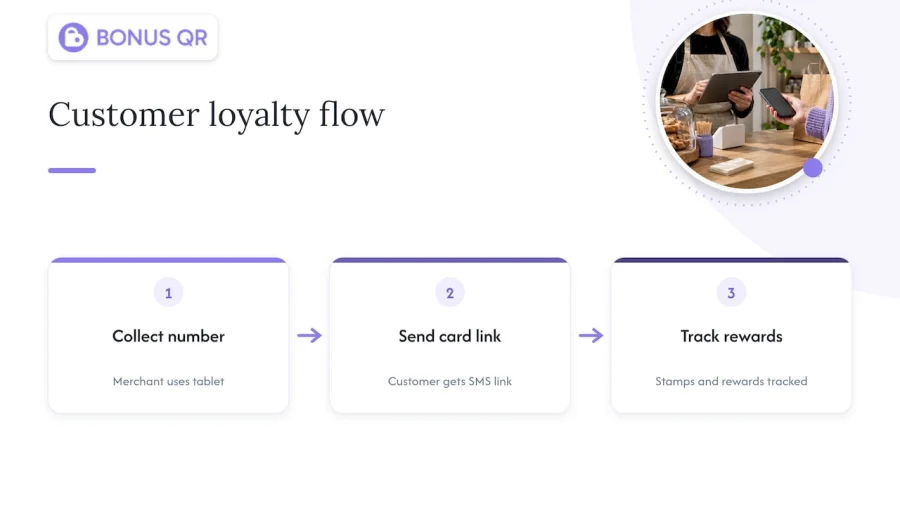
A 2017 customer write-up from Singapore shows what the typical flow looked like for cafes and food-and-beverage outlets: the merchant collected a mobile number on a tablet, the customer received an SMS link to a digital card, and stamps and rewards were tracked from there (a Singapore customer report). Details of the product will have changed since then, so treat that as an illustration of the model rather than a current feature list.
That model explains why people look for alternatives. Some want a tool that does not depend on a tablet at the counter. Some want cashback or tiers, not only stamps. Some want email and push campaigns built in. Others simply want a clear, published price.
Who shows up as a CandyBar alternative
The comparison pages that rank for this search give a consistent shortlist. G2’s CandyBar alternatives page names Smile.io, Salesforce Marketing Cloud and impact.com among the best-known options. Software Advice’s alternatives list puts five names at the top: Guusto, RepeatMD, Kangaroo, Smile.io and Boomerangme.
Those names are not interchangeable. Grouped by what they are built for, the list looks like this:
| Option | Best understood as | Typical buyer |
|---|---|---|
| Smile.io | Rewards program for online stores | E-commerce shops |
| Kangaroo | Loyalty and rewards for merchants | Retail and restaurants |
| Boomerangme | Wallet-based loyalty cards | Cafes, salons, small retail |
| Guusto | Digital gifting and rewards | Businesses rewarding staff or clients with gifts |
| RepeatMD | Patient and client retention | Medical spas and aesthetic clinics |
| Salesforce Marketing Cloud | Enterprise marketing platform | Large teams with dedicated marketers |
| impact.com | Partnership and affiliate management | Brands running partner programs |
| BonusQR | QR-based stamps, points and cashback with no POS needed | Small and mid-sized local businesses |
The table groups products by their general category, not by a verified feature audit, so confirm current features and pricing on each vendor’s own page before you commit. The practical point: if you are a neighborhood business, the last two enterprise-style entries are rarely the right shape, and a specialist tool will serve you faster.
How to compare loyalty apps: five criteria that matter
Feature checklists are long and mostly identical on paper. These five questions separate the tools in daily use.
1. How do customers join and check in?
Friction at the counter is the enemy of any loyalty program. If joining takes more than about half a minute, staff stop offering it during busy periods. Compare whether customers scan a QR code with their own phone, whether you must collect their number on a device, and whether they must download an app or can use a web card or a Wallet pass.
BonusQR is built around a QR code. The customer scans, joins and collects without you buying extra hardware, and we support mobile and web apps as well as Apple and Google Wallet.
2. Does it need a POS integration?
Integration is helpful when it is available and a blocker when it is not. Many small businesses run a basic register, a card terminal or even a notebook. A tool that only works through your POS leaves them out. A tool that works independently can be live in an afternoon, and can sit next to any POS you add later.
BonusQR requires no POS. Staff award stamps, points or cashback through the platform, and the system handles the rest.
3. Which reward mechanics can you run?
Stamps are simple and well understood: buy nine coffees, get the tenth free. Points suit businesses with different price levels, such as a salon with services from $20 to $200. Cashback and tiers suit retailers, grocers and fuel stations, where basket size varies and you want to reward your best customers progressively.
With BonusQR you can use digital stamp cards, points, tiered cashback and fixed discounts, and add onboarding promos and special-occasion rewards such as birthdays. You can switch mechanics later without starting over from scratch.
4. How much of the marketing runs itself?
A loyalty program that depends on you remembering to send a message will go quiet within a month. Look for automated triggers: a welcome reward for new members, a nudge when a customer is one stamp away, a birthday offer, a win-back message after a lapse. Check whether push and email are included, and whether referral and review features are part of the plan.
BonusQR automates reward distribution and promotional push and email notifications, and includes referral and review modules so a happy regular can bring in a friend or leave a review.
5. What will you actually pay?
Compare total monthly cost at your size, not the headline entry price. Ask whether the price rises with the number of members, locations or messages, whether an app or branded version costs extra, and whether there is a free tier you can run for real before paying. Also record the date you saw each price, since vendors change them.
BonusQR as a CandyBar alternative
We built BonusQR for owners who want a working loyalty program without technical work or a POS project. Here is what that looks like in practice.
Setup. You create your program, customize it with your brand, print or display your QR code, and start. There is no hardware to buy and no integration to schedule.
Reward modules. Digital stamp cards, points systems, tiered cashback, fixed discounts, coupons and reward management sit in one platform, so the same account can run a coffee-style stamp card in one location and a points scheme in another business line.
Automation. Rewards are distributed automatically. Marketing automation, push and email notifications, referral and review modules work in the background so your team can focus on service.
Analytics. The platform tracks customer behavior so you can see who returns, who has lapsed and how rewards relate to sales, then adjust offers on evidence.
Customization and growth. You can customize the brand and app experience. For larger businesses, we offer a white-label app and custom app development, including e-shop and booking widget features.
BonusQR pricing at a glance
These are the prices published on our site as of September 2026.
| Plan | Price | Page |
|---|---|---|
| Free | No published price | Pricing |
| Basic | 19 EUR per month | Pricing |
| Premium | 69 EUR per month | Pricing |
| White-label Setup | 690 EUR one-off | White-label |
| White-label Monthly Subscription | 69 EUR per month | White-label |
| Custom App Development | From 1500 EUR one-off | Custom app |
| Custom app Monthly Maintenance | From 69 EUR per month | Custom app |
For a closer look at how stamp card costs break down for small shops, see our guide to digital stamp cards pricing.
Which option fits which business
The right choice follows from how your customers buy.
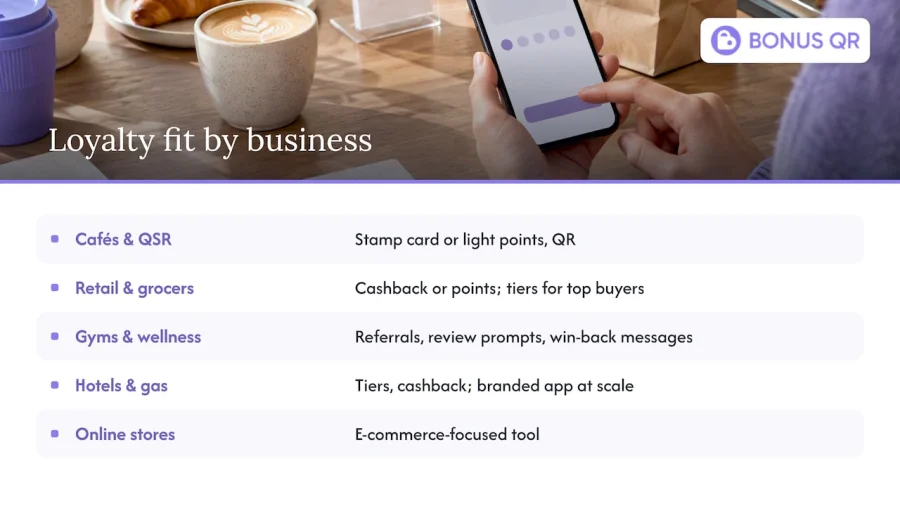
Cafes, bakeries and quick-service restaurants. Visits are frequent and tickets are small, so speed and simplicity win. A stamp card or a light points scheme with a QR join is usually enough. Our comparisons of restaurant rewards systems and restaurant loyalty software go deeper on this segment.
Retail shops and grocers. Basket sizes vary, so cashback or points reward spend as well as visits. Tiers give your top customers a reason to consolidate their purchases with you. See our overview of reward systems for small retail stores.
Gyms, salons and wellness centers. Appointments are predictable, so referral rewards, review prompts and win-back messages for lapsed members matter more than the stamp mechanic itself.
Hotels and gas stations. These businesses benefit from tiers and cashback, and from a branded app once volume justifies it. That is where the white-label option comes in.
Online-only stores. If nearly all your sales happen online, a tool designed around e-commerce platforms may fit better than a QR-first, in-person tool. Be honest about where your customers actually buy.
A switching plan that keeps your customers
Moving from one loyalty tool to another is mostly a communication task. A sensible sequence:
- Write down your current rules. Record what earns a reward, what it is worth, when it expires and how many active members you have.
- Rebuild the program in the new tool. Match the mechanic one-to-one first. Improve it afterward, not during the move.
- Run both for a short overlap. Let existing members finish cards in progress, and offer new sign-ups only on the new system.
- Honor open balances. Give customers a welcome bonus equal to their old progress, such as pre-filled stamps, so nobody feels they lost something.
- Announce it at the counter. A small sign with the QR code and a one-line offer does more than an email blast. Train staff to mention it at the till.
- Review after 30 days. Look at sign-up rate, repeat visits and reward redemption. Adjust the threshold if rewards are claimed too quickly or never.
If you are building or rebuilding a program from the ground up, the step-by-step approach to foster customer loyalty is a helpful framework for the strategy behind the tool. Our own digital loyalty card guide covers the mechanics in more detail.
Mistakes to avoid when choosing
- Setting the first reward too far away. A customer who needs 15 visits for a first reward often quits at visit three. Make the first milestone reachable within two or three visits, or give a welcome stamp.
- Choosing for features you will not use. A small business rarely needs enterprise attribution. It needs reliable awarding, clear reporting and a fast counter experience.
- Ignoring staff. If awarding a stamp takes several taps, your team will skip it when the line is long.
- Forgetting the reward cost. Model the margin. A free coffee costs you the ingredients, not the menu price, but a 10% cashback on every sale comes straight off revenue. Set rules you can sustain.
- Not measuring. Pick two numbers before launch, such as repeat-visit rate and share of sales from members, and check them monthly.
Perspective
We hear the same story from owners of small businesses. They know repeat customers are the lifeblood of the business, but they have no time for a loyalty project. A tool that needs a POS integration, a tablet at the counter and a long onboarding call is a project, and projects get postponed.
That is why we built BonusQR around a QR code and automation. The customer scans, the system awards, and your team keeps serving. We think a loyalty program should be something you switch on in an afternoon, improve over time with real data, and grow into a branded app only when your volume justifies it.
When you compare alternatives to CandyBar, we would ask you to weigh the work after launch as heavily as the features on the page. The program that earns its place is the one your staff actually use on a busy Saturday, and the one that keeps sending the right message when nobody is watching.
Michal Palus
Start with a free plan
If you want to see how a no-POS, QR-based program feels in your own business, you can start on our Free plan and move to Basic at 19 EUR per month or Premium at 69 EUR per month when you need more features. Businesses that want their own branded app can look at the white-label option with a 690 EUR one-off setup, or at custom app development, from 1500 EUR one-off. You can also explore the platform on bonusqr.com.
FAQ
What is the best alternative to CandyBar for a small business?
It depends on how your customers buy. For in-person businesses that want stamps, points or cashback without a POS, BonusQR is built for that case and has a free plan to start. Online-first stores may prefer a tool designed around their e-commerce platform.
Are there free CandyBar alternatives?
Yes. BonusQR has a Free plan, and paid plans start at 19 EUR per month for Basic. Other vendors have their own plans, and prices change, so confirm current pricing on each vendor’s own page before you decide.
Do I need a POS system to run a digital loyalty program?
Not necessarily. Some tools depend on POS integration, while others work independently. BonusQR requires no POS, so you can launch with a QR code and award rewards through the platform.
Can I keep my customers’ progress when I switch?
Yes, in practice. Record each member’s balance, rebuild the same rules in the new tool, and give existing members a welcome bonus equal to their old progress, such as pre-filled stamps. Announce the change at the counter so nobody is surprised.
How much should a small business spend on loyalty software?
Start from the margin on your repeat customers and your monthly volume, not from the feature list. Many small businesses can begin on a free or entry plan and upgrade once the program proves itself. Our Basic plan is 19 EUR per month and Premium is 69 EUR per month.


