For most Central European retailers in 2026, the highest-ROI starting point is a mobile-first, privacy-conscious hybrid: a QR-based stamp card combined with measured points accrual and at least one experiential reward tier. Launch that within 30–90 days, track repeat purchase frequency from week one, and you will have a measurable retention engine before your competitors finish debating which platform to use.
- Improved retention and incremental margin: Retailers who move from no programme to an active one typically see meaningful lifts in repeat visit frequency and average basket size, with data-driven loyalty recovering up to 50% of wasted promotional budgets by targeting only customers with genuine incremental potential.
- Quick timeline: A QR/stamp-card MVP is achievable in 30 days; a full points-plus-tier system with analytics typically lands in 60–90 days.
- One metric to track first: Repeat purchase frequency among enrolled members versus non-members. Everything else follows from that delta.
Pro Tip: Set a hard cap on push notifications from day one. Notification overload is the single biggest driver of loyalty app churn. Limit broadcasts to event-triggered messages (a reward earned, a birthday offer, a near-expiry nudge) and never send more than two generic messages per month.
Which loyalty programmes are best for retail? A quick comparison
The table below maps nine well-known programmes and one platform example against the criteria that matter most to retail owners: programme type, best use case, channels, personalisation depth, implementation complexity, GDPR posture, and typical measurable impact.
| Programme | Type | Best for / use case | Channels | Personalisation & data use | Implementation complexity / cost shape | GDPR / privacy | Typical measurable impact |
|---|---|---|---|---|---|---|---|
| IKEA Family | Free membership + perks | Large-format home retail; high basket, low frequency | App, web, in-store card | Purchase history, personalised offers, member pricing | High (enterprise CRM + POS integration) | Consent-led, preference centre | Increased basket size; member-exclusive pricing drives enrolment |
| H&M Member | Points + tiered | Fashion; mid-frequency, omnichannel shoppers | App, web, in-store | Tier-based personalisation, style preferences | High (global CRM, omnichannel stack) | GDPR-compliant consent flows | Higher repeat purchase rate among tier-2+ members |
| adidas adiClub | Points + experiential tiers | Sports/lifestyle; community-driven, younger shoppers | App, web, in-store | Activity data, personalised challenges | High (app-first, global infrastructure) | Consent and data minimisation | Strong emotional engagement; community participation lifts CLV |
| Nike Membership | Free membership + content | Sports/lifestyle; brand community, Gen Z | App, web, in-store | Personalised content, product drops, activity | High (app ecosystem, Nike+) | Consent-led, data-minimised | High app engagement; product-drop exclusivity drives urgency |
| LEGO VIP | Points + experiential | Speciality/collectibles; high-spend, passionate community | App, web, in-store | Purchase history, event invites, early access | Medium-high (e-commerce + in-store) | Consent-led | Strong repeat purchase; community events deepen emotional loyalty |
| Lidl Plus | App-based cashback + coupons | Grocery/discount; price-sensitive, high-frequency | App only | Personalised coupons, purchase data | Medium (app + POS integration) | GDPR-compliant, minimal data ask | High adoption in CEE; measurable basket uplift via targeted coupons |
| Starbucks Rewards | Points (Stars) + tiered | Café/food-service; high-frequency, mobile-first | App, web, in-store | Highly personalised offers, gamified challenges | High (proprietary app + POS) | Consent-led, preference centre | Industry-leading redemption rates; strong emotional connection |
| Revolut RevPoints | Spend-based points | Financial/retail crossover; digitally native shoppers | App, web | Transaction data, partner offers | Low for end user; embedded in payment | GDPR-compliant, financial-grade | Broad adoption; points on everyday spend increase card usage |
| Bonusqr | Modular: stamp card, points, cashback, tiers, referral | SMEs to mid-market retailers across all sectors in Central Europe | App, web, QR, Apple/Google Wallet | Configurable personalisation, push/email, analytics | Low-medium (no POS integration required; rapid setup) | GDPR tools built in; consent and preference management | Measurable repeat visit lift; configurable KPI tracking from day one |
Pro Tip: Choose a single-brand programme when you want full data ownership and tight brand control. A coalition model broadens appeal and speeds up perceived value for members, but you share customer data with partners and lose some control over the reward experience. For most Central European SMEs, a proprietary QR or app-based programme with a clean consent flow is the better starting point.
What types of loyalty programmes work best for retailers?
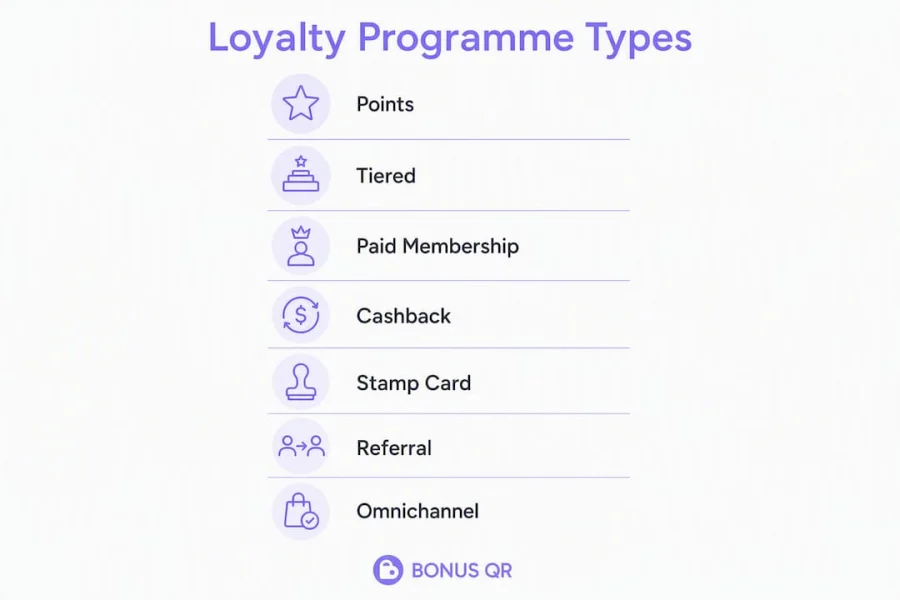
Understanding the model before you build saves months of rework. Each programme type suits a different purchase frequency, margin profile, and operational capacity.
Points programmes
Members earn points per purchase and redeem them for rewards or discounts. Points work well for mid-to-high-frequency retailers (fashion, beauty, electronics) where there are enough transactions to make accumulation feel rewarding. Implementation complexity is medium; you need a points engine, redemption rules, and ideally a mobile interface. Cost shape: moderate ongoing platform fee.
Tiered programmes
Spending unlocks status levels (Silver, Gold, Platinum) with escalating benefits. Tiers are powerful for fashion, sportswear, and speciality retail because status creates aspiration. They require more design work upfront (benefit architecture, tier thresholds) and a CRM capable of tracking spend history. Complexity: medium-high. Cost: higher, especially if tier benefits include experiential perks.
Paid membership programmes
Members pay a fee for guaranteed benefits (free delivery, exclusive pricing, early access). This model suits retailers with a loyal, high-frequency base willing to pay for convenience. The upside is predictable revenue and a self-selected engaged cohort. Complexity: medium. Cost: moderate, but requires strong value proposition to justify the fee.
Cashback programmes
A percentage of spend is returned as credit. Cashback is the clearest value exchange and resonates strongly in price-sensitive markets. In Poland, exclusive pricing ranked first among loyalty motivators for 40.31% of respondents, making cashback and discount-led models particularly effective in Central Europe. Complexity: low-medium. Cost: low platform cost, but margin impact needs careful modelling.
Stamp-card programmes
Customers collect a stamp per visit or purchase and earn a reward at a set threshold (e.g., buy 9, get the 10th free). Stamp cards are the fastest MVP for SMEs: low friction, no app required if run via QR code or mobile wallet, and immediately understandable to customers. Mobile wallet and QR flows remove friction and increase adoption, making them the recommended fast-launch route for independent retailers. Complexity: low. Cost: lowest of all models.
Referral programmes
Existing members earn rewards for bringing in new customers. Referral works best as a layer on top of an existing programme rather than a standalone model. It amplifies acquisition without paid media spend. Complexity: low-medium. Cost: variable (reward cost per referral).
Omnichannel and coalition programmes
Omnichannel programmes unify in-store, online, and app touchpoints under one member identity. Coalition programmes let members earn across multiple brands. Both models deliver scale but require more integration work and, in the coalition case, shared data governance. Complexity: high. Cost: high.
| Programme type | High-frequency grocery | Fashion / apparel | Speciality / e-commerce | Low-frequency big-ticket |
|---|---|---|---|---|
| Stamp card | ✓ Best fit | ✓ Good fit | ✓ Good fit | ✗ Too slow to reward |
| Points | ✓ Good fit | ✓ Best fit | ✓ Best fit | ✓ Good fit |
| Cashback | ✓ Best fit | ✓ Good fit | ✓ Good fit | ✓ Good fit |
| Tiered | ✗ Low differentiation | ✓ Best fit | ✓ Best fit | ✓ Good fit |
| Paid membership | ✓ Good fit | ✗ Hard sell | ✓ Good fit | ✗ Hard sell |
| Referral | ✓ Good fit | ✓ Good fit | ✓ Best fit | ✓ Good fit |
| Coalition | ✓ Best fit | ✓ Good fit | ✗ Complex | ✗ Complex |
Pro Tip: For most Central European SMEs, a QR-based stamp card or mobile wallet pass is the fastest path to launch. You can layer points and tiers on top once you have baseline engagement data. Starting with a complex tiered system before you understand your customers’ redemption behaviour is one of the most common and costly mistakes in loyalty programme design.
Deep dives into top retail loyalty programmes: features to copy and why they work
IKEA Family
IKEA Family is a free membership programme offering member-exclusive pricing, birthday gifts, free hot drinks in-store, and insurance on purchases. It operates across app, web, and in-store card. The programme succeeds in Central Europe because it ties tangible, immediate benefits (a free coffee, a price discount visible at the shelf) to the membership moment, reducing the perceived risk of joining. For retailers to replicate: offer at least one instant, visible benefit at sign-up; use purchase history to personalise follow-up offers; and make the member price clearly visible at the point of decision.
H&M Member
H&M’s programme combines points accrual with tiered status (Member, Plus, Premium) and links rewards to sustainability actions such as garment recycling. Channels span app, web, and in-store. The tier architecture creates aspiration, and the sustainability angle adds emotional resonance beyond pure transaction. Three things to copy: a clear points-to-reward conversion rate that members can calculate in their heads; a tier benefit that is genuinely aspirational (early access, free alterations); and a values-aligned action that earns bonus points.

adidas adiClub
adiClub awards points not just for purchases but for physical activity tracked via the adidas Running and Training apps. Members unlock four tiers with experiential rewards including event invitations and product co-creation opportunities. This is a textbook example of bridging functional utility and emotional connection, the leading challenge in loyalty design in 2026. For retailers: consider awarding points for non-purchase actions (writing a review, attending an in-store event, completing a profile) to deepen engagement beyond the transaction.
Stat callout: Only 33.3% of European loyalty programme members report feeling more emotionally connected to a brand through membership, while average membership across Europe is 63.3%. Programmes like adiClub that combine transactional and experiential rewards are specifically designed to close the engagement gap.
Nike Membership
Nike’s free membership model centres on product-drop exclusivity, personalised content, and community. Members get early access to limited releases, training plans, and local run-club events. The programme is app-first and skews towards younger shoppers. Gen Z use loyalty apps less than older cohorts but respond strongly to authenticity and mobile-first experiences. Nike’s approach shows that content and community can be as powerful a retention driver as discounts, particularly for lifestyle and sportswear retailers.
LEGO VIP
LEGO VIP rewards purchase points redeemable against future orders, but the programme’s real strength is community: early access to new sets, exclusive events, and member-only products. It works because LEGO’s customer base is passionate and collectible-driven, meaning experiential rewards (early access, behind-the-scenes content) carry high perceived value at low cost to the brand. Speciality retailers with a passionate niche audience should prioritise experiential rewards over pure cashback.
Lidl Plus
Lidl Plus is an app-only programme delivering personalised digital coupons, cashback on selected products, and scratch-card games. It has achieved strong adoption across Central and Eastern Europe, where price sensitivity is high and smartphone penetration is growing. The programme’s success rests on three mechanics: personalised coupons that feel relevant rather than generic, a gamification layer (scratch cards) that adds entertainment value, and a frictionless QR scan at checkout. Grocery and discount retailers should note that personalised coupons consistently outperform blanket promotions on margin efficiency.

Starbucks Rewards
Starbucks Rewards is widely cited as one of the best loyalty programmes in the world for a reason: it combines a clear points currency (Stars), a gamified challenge mechanic (Double Star Days, personalised offers), and a mobile ordering integration that makes the programme part of the purchase habit rather than an add-on. The app handles ordering, payment, and loyalty in one flow. For food-service and café operators, the lesson is that embedding loyalty into the payment moment, rather than asking for a separate scan, dramatically increases participation rates.
Revolut RevPoints
RevPoints rewards cardholders with points on everyday spending, redeemable against travel, retail, and partner offers. It sits at the intersection of fintech and retail loyalty, reaching digitally native shoppers who may not engage with traditional card-based programmes. For retailers, the relevance is in the partnership model: appearing as a RevPoints redemption partner gives access to a large, digitally engaged audience without building a programme from scratch. It is a coalition-adjacent approach worth considering for e-commerce retailers targeting younger, urban demographics in Central Europe.
Bonusqr as a deployment example
A Central European independent retailer using Bonusqr can replicate the core mechanics of the programmes above without enterprise-level infrastructure. A coffee shop can run a Starbucks-style stamp card via QR code; a fashion boutique can deploy a points-plus-tier system with push notifications for tier upgrades; a grocery store can issue personalised digital coupons. Bonusqr’s no-POS-integration requirement means a retailer can be live in days rather than months. For loyalty campaign ideas that translate directly to these mechanics, the platform’s resource library is a practical starting point.
How do you design and launch a loyalty programme in Central Europe?
Build vs buy: the key decision
For most SMEs and mid-market retailers, buying a configurable SaaS platform is the right call. Building a custom programme from scratch requires a development team, ongoing maintenance, and a significantly longer time to market.
Buy (SaaS platform) suits you when:
- You need to launch within 30–90 days.
- You lack in-house development resource.
- Your programme requirements fit standard models (stamp card, points, cashback, tiers).
- You want built-in GDPR tools and analytics without custom development.
Build (custom) suits you when:
- You have highly specific integration requirements (proprietary POS, bespoke CRM, complex coalition rules).
- You operate at enterprise scale with a dedicated loyalty technology team.
- You need a white-label experience with no visible third-party branding.
GDPR and data handling checklist for Central Europe
GDPR applies across the EU and EEA, and Central European data protection authorities (in Poland, the Czech Republic, Hungary, Slovakia, and Austria) actively enforce it. Privacy transparency around consent and granular preference centres is now a competitive advantage, not just a compliance requirement.
- Explicit consent at enrolment: Collect consent for marketing communications separately from programme terms. Pre-ticked boxes are not valid.
- Preference centre: Give members control over communication frequency and channel (email, push, SMS) from day one.
- Data minimisation: Collect only what you need to run the programme. Name, email, and purchase history are sufficient for most SME programmes.
- Retention policy: Define how long you hold member data and delete or anonymise inactive records on schedule.
- Vendor contracts: Ensure your platform provider signs a Data Processing Agreement (DPA) and can demonstrate EU data residency or adequate safeguards.
- Children’s data: If your programme could attract under-16s, apply stricter consent rules per local law.
MVP launch timeline: 30–90 days
- Days 1–10: Define programme model, reward structure, and KPIs. Agree GDPR consent flow and data fields. Select platform.
- Days 11–20: Configure platform, set up branding, build enrolment flow. Draft consent language with legal review.
- Days 21–30: Soft-launch to staff and a small pilot cohort (50–100 customers). Test QR scan, reward accrual, and notification flows.
- Days 31–60: Full launch with in-store and digital promotion. Monitor participation rate and redemption rate weekly.
- Days 61–90: First data review. Adjust reward thresholds, notification timing, and offer personalisation based on real behaviour.
Retailers can progress from a basic setup to a more advanced, data-driven system within six to twelve months when they prioritise a data audit and a focused business case from the outset.
Cost shape: A QR/mobile wallet stamp card via a SaaS platform typically costs a fraction of a custom app build. Custom or white-label apps carry a one-time setup fee plus ongoing subscription. The biggest saving comes from avoiding POS integration: a QR-scan flow requires no hardware change and no IT project.
Pro Tip: Run a 30-day pilot with a single store or product category before rolling out chain-wide. The data you collect in that window will reshape your reward thresholds, notification cadence, and tier design in ways no amount of planning can anticipate.
Which KPIs matter for loyalty programmes, and how do you measure ROI?
Tracking the right metrics separates a programme that genuinely drives profit from one that just accumulates members.
Essential KPIs:
- Participation rate: Enrolled members as a percentage of total customers. A low rate signals enrolment friction or poor awareness.
- Active member rate: Members who have transacted at least once in the past 90 days. This is the real health metric; high enrolment with low activity is a warning sign.
- Redemption rate: Percentage of earned rewards actually redeemed. Too low means rewards feel unattainable; too high can squeeze margin.
- Repeat purchase frequency: Average transactions per member per period versus non-members. The primary ROI signal.
- Incremental purchase lift: The spend uplift attributable to the programme, net of what members would have spent anyway.
- Customer lifetime value (CLV): Total projected revenue from a member over their relationship with your brand.
- Retention delta: Churn rate among members versus non-members.
- Cost per incremental sale: Total programme cost divided by the number of sales that would not have occurred without the programme.
A simple 12-week cohort test
- At launch, randomly assign a sample of customers to a “member” group and a matched “control” group (similar purchase history, demographics).
- Enrol only the member group in the programme for 12 weeks.
- At week 12, compare repeat purchase frequency, average basket size, and total spend between the two groups.
- Incremental revenue = (member group average spend minus control group average spend) × number of members.
- Subtract total programme cost (platform fee + reward cost) to get net incremental profit.
This approach keeps measurement GDPR-safe because you are comparing aggregated cohort behaviour, not tracking individual non-members without consent.
| KPI | Typical range (European retail) | What a weak result tells you |
|---|---|---|
| Participation rate | 63.3% on average in Europe (higher in Great Britain and Finland) | Enrolment is too complex or poorly promoted if below average |
| Active member rate | 40%–60% of enrolled members | Rewards feel too distant or communications are irrelevant |
| Redemption rate | 15% | Below 15%: rewards are too hard to reach; above 40%: margin risk |
| Repeat purchase frequency lift | +10%–+30% vs non-members | Below 10%: programme is not changing behaviour |
| Retention delta | Members churn 20%–40% less | Minimal delta: programme has no emotional or functional hook |
What does the research say about emotional loyalty and privacy in Central Europe?
The data from European loyalty research paints a clear picture for Central European retailers: membership is growing, but engagement is the hard part.
Stat callout: European loyalty programme membership averages 63.3% across markets, with Poland showing strong appetite (69.3% of Polish consumers agree loyalty programmes are a good way for brands to reward customers). Yet only 41.9% of members say membership makes them more loyal to a brand, and just 33.3% report a stronger emotional connection.
The gap between enrolment and genuine engagement is the defining challenge of 2026. Programmes that combine measurable points with experiential, personalised rewards consistently outperform purely transactional systems. The Kobie 2026 Heart of Loyalty Report found that 77% of consumers want some form of recognition from loyalty programmes, yet only 55% feel seen as individuals. Surprise rewards, birthday offers, and loyalty-anniversary recognition ranked among the most memorable experiences, and they cost far less than blanket discounts.
Privacy is the other structural shift. The Kobie research also found that 81% of consumers are unlikely to share data if they feel they are being asked for too much at once, reinforcing the case for progressive data collection: ask for the minimum at enrolment, then earn the right to more data by demonstrating value.
Regional notes for Central Europe:
- Poland: Price sensitivity is high. Exclusive pricing and cashback are the strongest motivators. Gamification (scratch cards, challenges) adds engagement without additional discount cost.
- Czech Republic and Slovakia: Promotions remain a key purchase driver, but effectiveness varies by category. Personalised, category-relevant offers outperform generic discounts.
- Hungary: Store choice is driven by a mix of convenience, price, and quality. Loyalty programmes that address all three (member pricing, fast checkout, quality guarantees) perform better than single-dimension reward schemes.
- Croatia and Romania: Loyalty is becoming a more important driver of retailer success than shopper reach alone, with retailers strengthening programmes to defend growth against discounters.
- Gen Z across the region: Younger shoppers use loyalty apps less than older cohorts but respond to authenticity and mobile-first UX. Earning points for non-purchase actions (social sharing, reviews, sustainability choices) is more effective with this group than pure spend-based accrual.
Pro Tip: Structure your consent journey as a two-step process: collect name and email at enrolment (minimum viable), then invite members to complete their preference centre after their first reward is earned. This progressive approach, backed by GDPR-aware design, consistently improves both data quality and member trust.
What is the right loyalty programme for your retailer profile?
Small independent shop (single location, under 500 active customers)
Start with a QR-based stamp card. It requires no POS integration, costs very little, and can be live within a week. Your first KPI is repeat visit frequency: are enrolled customers coming back more often than before? Once you have 90 days of data, add a simple points layer or a referral incentive. Do not invest in a custom app at this stage; a mobile wallet pass or web-based loyalty page is sufficient.
Multi-store mid-market retailer (2–20 locations, omnichannel presence)
A points-plus-tier system with a branded app or mobile wallet integration is the right model. You need unified member identity across locations, which means a platform with multi-store support and a central analytics dashboard. Prioritise the active member rate as your primary KPI: if members are enrolling but not engaging, the reward structure or communication cadence needs adjustment. Plan for a 60–90 day launch and budget for staff training across locations.
Pureplay e-commerce retailer
Points and referral are your strongest tools. Every transaction is already digital, so data capture is frictionless. Focus on personalised post-purchase communications (points earned, next reward progress, personalised product recommendations) and a referral mechanic that rewards both the referrer and the new customer. Your primary KPI is CLV: are members spending more over their lifetime than non-members? Scale to a full customer data platform once you have 12 months of programme data.
Large banner or franchise retailer
You likely need a custom or white-label solution with deep POS integration, coalition capability, and advanced segmentation. The six-to-twelve-month upgrade timeline to a fully data-driven system is realistic when you start with a data audit. Your primary KPI is cost per incremental sale: at scale, even a small improvement in targeting efficiency translates to significant margin recovery. Consider coalition partnerships to accelerate perceived value for members in the early months.
Bonusqr makes it straightforward to launch a loyalty programme in Central Europe
Most Central European retailers do not need a six-figure custom build to run a programme that rivals the best loyalty programmes in the world at their scale. Bonusqr gives you the same core mechanics — stamp cards, points, tiered cashback, digital coupons, referral rewards, push notifications, and real-time analytics — without requiring POS integration or a development team.
A small fashion boutique can go live with a stamp card programme in under a week. A mid-market grocery chain can configure a points-plus-cashback system with GDPR-compliant consent flows and a branded mobile experience. A multi-location retailer can use Bonusqr’s white-label or custom app option to deliver a fully branded programme with Apple and Google Wallet support.
The platform’s built-in analytics track the KPIs that matter: repeat visit frequency, active member rate, redemption rate, and incremental spend. You can run a 30-day pilot on a single store, review the cohort data, and scale with confidence. For retailers ready to move beyond discounting and build a programme that earns genuine customer loyalty, the practical next step is to explore Bonusqr’s electronic reward platform and configure a starter programme matched to your retail profile.
Key takeaways
The single most important action for Central European retailers in 2026 is to launch a mobile-first, privacy-conscious loyalty programme within 90 days and measure repeat purchase frequency from week one, before optimising anything else.
| Point | Details |
|---|---|
| Start with a QR/stamp-card MVP | A QR-based stamp card is the fastest, lowest-cost launch route for most SMEs, achievable in 30 days with no POS integration. |
| Track repeat purchase frequency first | Compare enrolled members versus non-members on repeat visits; this single metric tells you whether the programme is changing behaviour. |
| Close the emotional loyalty gap | Only 33.3% of European loyalty programme members feel emotionally connected, while average membership is 63.3%; add experiential rewards and personalised recognition to outperform purely transactional schemes. |
| GDPR is a competitive advantage | Progressive data collection and a clear preference centre improve both member trust and data quality across Central European markets. |
| Bonusqr for rapid deployment | Bonusqr supports stamp cards, points, tiers, cashback, and analytics with no POS integration required, making it a practical starting point for Central European retailers at any scale. |
What actually separates a hobby programme from one that scales?
The programmes that stall are almost always the ones that were designed around the launch, not around the data. A retailer sets up a stamp card, sends a few push notifications, and then checks the dashboard six months later wondering why active membership has dropped by half. The mechanics were fine. The discipline was not.
Three red flags I see repeatedly:
- Notification fatigue: Sending weekly generic broadcasts because “we should stay top of mind.” Members mute the app or unsubscribe, and you lose the channel entirely. Event-triggered messages (a reward earned, a tier upgrade, a near-expiry alert) consistently outperform scheduled blasts.
- Ignoring the data audit: Programmes that run for 12 months without a single cohort analysis are essentially discounting programmes with extra steps. The incremental profit question (“are members spending more than they would have anyway?”) never gets asked, and the programme quietly costs more than it earns.
- Poor redemption design: If members cannot easily see how close they are to a reward, or if the reward threshold is set too high, redemption rates collapse. A redemption rate below 15% is not a sign that members are “saving up.” It is a sign that the programme has lost their attention.
Pro Tip: Run a quarterly “programme health check”: pull active member rate, redemption rate, and repeat purchase frequency, and compare them to the previous quarter. If any metric is declining, fix that one thing before adding new features. Complexity added on top of a broken foundation makes the problem harder to diagnose, not easier.
Useful sources for deeper reading
The sources below are worth bookmarking for benchmarking, GDPR guidance, and building an internal business case for your loyalty programme.
- Understanding Loyalty in Europe 4.0 (Mando / YouGov): The most comprehensive European benchmark for membership penetration, emotional vs functional loyalty, and market-by-market detail. Use it to set realistic KPI targets and to justify investment to your CFO.
- Mobile Customer Loyalty Report 2026 (Droids On Roids & Apadmi): Essential reading on notification fatigue, Gen Z behaviour, and mobile UX expectations. Use it to design your communication cadence and app experience.
- Data-Driven Loyalty Programmes in European E-Commerce (YourCX): Covers coalition vs proprietary trade-offs, QR/mobile wallet adoption, and GDPR-aware design. Use it for the build-vs-buy decision and consent flow design.
- Loyalty Point: Data-Driven Programmes and Wasted Promotion Budgets (The Diplomat): The business case for moving from blanket discounting to targeted, data-driven loyalty. Use it to model ROI and set the agenda for your first data audit.
- Kobie 2026 Heart of Loyalty Report: Covers AI adoption, data sharing willingness, recognition preferences, and the gap between brand assumptions and consumer expectations. Use it for strategic planning and to prioritise personalisation investment.
- YouGov CEE Shopper Panel Data: Real purchase behaviour and retailer evaluations across Central and Eastern European markets. Use it to calibrate reward structures and pricing strategies for specific country markets.
- Poland Loyalty Market Databook Q2 2026 (PayNXT360): Detailed segmentation of Poland’s loyalty market by programme type, channel, and sector. Use it for market-sizing and to benchmark your programme against the broader Polish loyalty ecosystem.
- Bonusqr loyalty programme resources: Practical examples, campaign ideas, and implementation guides tailored to Central European SMEs. Use these as your starting point for programme design and pilot campaign mechanics.


