Best Grocery Loyalty Software: How to Choose in 2026
The best grocery loyalty software depends on one question: do you run a regional chain with a legacy POS, or an independent store, a small group or a specialty grocer that needs rewards running quickly? Chains with hundreds of stores buy enterprise engines. Small and mid-sized grocers are better served by a QR-based platform such as BonusQR, which runs points, stamps and cashback without any additional POS system, starting on a free plan.
This guide explains what grocery loyalty software does, how the main kinds of platform differ, what to check before you sign, and how a small grocer can get a program live without a technical project.
Key Takeaways
- Grocery loyalty software links each purchase to a customer account, applies rewards, and gives you data on shopping behavior and a channel for direct marketing.
- Enterprise platforms suit large co-ops and chains. Independents and small groups need fast setup, no POS dependency and a predictable monthly cost.
- Software alone does not create loyalty. Official research points to reward design, thresholds and personalization as what drives results in grocery.
- BonusQR offers a Free plan, Basic at 19 EUR per month and Premium at 69 EUR per month, with white-label apps available for larger operations.
What grocery loyalty software actually does
A shopper sees a loyalty program as free membership, digital coupons, points and rewards. Jewel-Osco’s forU program is a typical consumer-side example: members get personalized deals and points on eligible purchases, redeemable for grocery discounts or fuel savings, and they identify themselves with a registered phone number or an app member card.
The software behind such a program does the retailer’s side of the work. It matches a purchase to a customer account, calculates and applies the reward, stores the customer data you use for marketing, and reports on what people buy. Norway’s SIFO, a government-commissioned consumer research institute, describes the retailer’s gain in its January 2026 report on grocery customer programs: the programs give retailers customer insight and a direct marketing channel, and they capture when, where, how often and what customers buy. That information can inform assortment, pricing and store concepts.
For a grocery owner this translates into four practical jobs:
- Recognize the customer at the till, by card, phone number, app or QR code.
- Reward the visit with points, stamps, cashback or a fixed discount.
- Bring the customer back with push or email messages, birthday rewards and offers.
- Show what works through analytics on visit frequency, redemptions and repeat behavior.
If you want a broader primer on building a program before choosing a tool, this walkthrough on customer loyalty step by step covers the general approach.
Why software choice is only half of the result
Grocery is a high-frequency, low-margin business, and that shapes what a loyalty program can realistically do. SIFO’s literature review reports generally moderate effects on loyalty and buying behavior in such markets, and says that design matters: the rewards, the thresholds customers must reach, and how personalized the offers are.
For you, that means the best software is the one that lets you design and adjust those three things easily. A platform that supports several reward types, lets you set a threshold that fits your average basket, and lets you send targeted messages gives you room to tune the program over time. Our guide to discount strategies for grocery loyalty goes deeper on how to set those levels.
Three kinds of grocery loyalty platform
The market splits into groups that serve very different buyers. Knowing which group you belong to removes most of the shortlist.
Enterprise loyalty engines for large chains
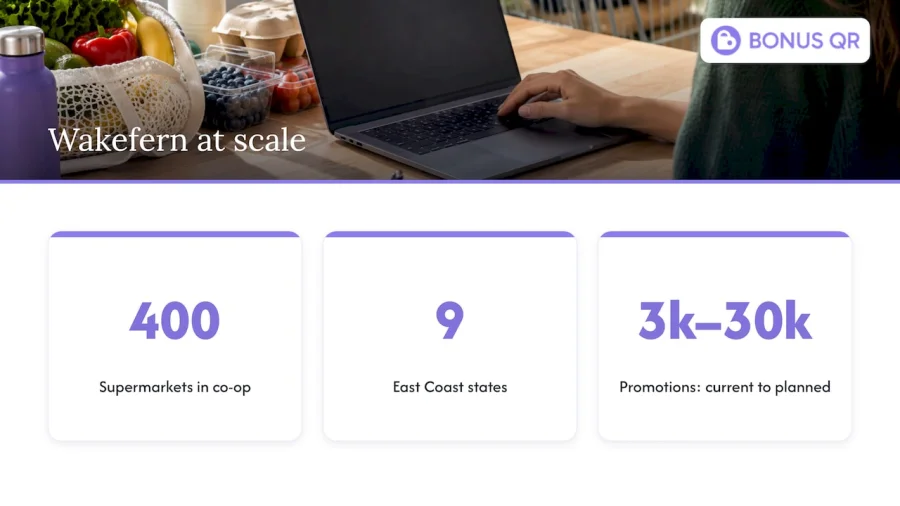
These are built for retailers with hundreds of stores and a central data team. A recent example: Grocery Dive reported in February 2026 that Wakefern, a co-op of about 400 supermarkets across nine East Coast states, selected Eagle Eye to replace a legacy POS-led loyalty approach. The priorities were centralized data and flexibility across different banners. Wakefern also wanted to scale promotions from about 3,000 to 30,000 without straining its legacy POS, so the new platform was expected to process loyalty data and promotions separately.
That is the right trade for a co-op of that size. It is also a project measured in months, with integration work, banner-level configuration and enterprise contracts. A single store or a group of a few locations does not have that problem to solve.
Phone-number and card-based programs tied to the register
Some platforms enroll shoppers by phone number at checkout and rely on the register to apply rewards. This is familiar to shoppers, since large chains use the same identification method. The trade is that the loyalty logic usually lives close to the POS, so what you can launch depends on what your POS supports.
QR-based loyalty platforms for independents and small groups
Here the customer scans a QR code, and the program runs in the platform instead of inside the register. BonusQR belongs to this group. It is a QR-based digital loyalty platform designed for small businesses: customers earn points, stamps or cashback without any additional POS system, and the platform automates reward distribution, customer insights and promotional notifications.
For a grocer this has a plain advantage: you do not wait on a POS vendor, a custom integration or an IT contractor. The cashier or the customer scans the code, the reward is recorded, and the owner sees the results in analytics.
How the options compare for a grocery business
| Criterion | Enterprise engine (large chains) | Register-linked phone-number programs | BonusQR |
|---|---|---|---|
| Best fit | Hundreds of stores, central data team | Stores whose POS already supports loyalty | Independent grocers, small and mid-sized groups, specialty food stores |
| Setup path | Integration project with POS and banners | Depends on POS capabilities | Rapid setup, no POS required |
| Reward types | Highly configurable, built per banner | Typically what the POS can apply | Points, stamps, tiered cashback, fixed discounts, onboarding promos, special occasion rewards |
| Marketing tools | Enterprise personalization | Varies by POS vendor | Automated marketing, push and email notifications, referral and review modules |
| Customer app | Retailer-branded, built with the vendor | Usually a card or phone number | Mobile and web app, Apple and Google Wallet support, optional white-label or custom app |
| Starting cost | Enterprise contract | Tied to POS | Free plan; Basic 19 EUR per month; Premium 69 EUR per month |
The criteria worth weighing are the ones in the left column. Rewards flexibility, automation, analytics and customer-facing tools matter more day to day than any single headline feature.
What BonusQR gives a grocery store
BonusQR’s modules map onto how grocery shoppers actually behave: frequent, small to mid-sized baskets and strong price awareness.
- Points and tiered cashback. Reward spending directly, and let regular shoppers move to better tiers as they spend more.
- Digital stamp cards. Useful for category promotions, such as a bakery counter, a deli or a coffee corner inside the store.
- Fixed discounts and coupons. Run a simple offer without arithmetic at the till, with coupon and reward management in one place.
- Onboarding promos. Give new members a reason to join on the first visit.
- Special occasion rewards. Birthday and similar rewards keep the relationship going between shopping trips.
- Referral and review modules. Ask happy shoppers to bring neighbors and to leave reviews.
- Automated marketing. Push and email notifications that the system sends, so you are not writing every message by hand.
- Analytics. Track customer behavior and see what your offers produce in sales and repeat visits.
- Apple and Google Wallet. Members keep the loyalty card on the phone they already carry.
For cashback ideas aimed at grocers specifically, see our overview of cashback rewards tools for grocery retailers. If your store sells beyond groceries, our comparison of reward systems for small retail stores covers the wider options.
Costs: what you pay and when
Price transparency is a real selection criterion, because a loyalty program has to pay for itself through repeat visits. BonusQR publishes its plans:
| Plan | Price | Who it suits |
|---|---|---|
| Free | No published price | A single store testing a first program |
| Basic | 19 EUR per month | A store running a regular program |
| Premium | 69 EUR per month | Stores wanting the full feature set |
| White-label Setup | 690 EUR one-off | A branded app under your own name |
| White-label Monthly Subscription | 69 EUR per month | Ongoing access to the branded app |
| Custom App Development | From 1500 EUR one-off | Bespoke app requirements |
| Custom app Monthly Maintenance | From 69 EUR per month | Ongoing upkeep of the custom app |
Current details are on the pricing page, the white-label page and the custom app page.
Whatever platform you consider, ask for the full monthly cost in writing, including any setup or professional-services fee, before you compare. A low subscription with a large implementation bill is a different product from a flat monthly plan.
Integration checklist before you choose
The Retail Exec, a professional publication on retail technology, advises confirming system and version compatibility for POS, payment and loyalty tools, and checking whether integrations are prebuilt or need APIs or custom work. Turn that into questions for your own store:
- POS. Does the program need to be built into your register, or does it run alongside it?
- Payments. Will the reward calculation depend on the payment terminal?
- E-commerce and ordering. If you sell online, can the same member account work in both places?
- Customer data. Can you see and use purchase and visit data for marketing without exports and spreadsheets?
- Staff time. How many steps does a cashier perform per transaction at peak hour?
With BonusQR the first question is simple: no POS is required, so the program does not depend on what your register can do. The platform also supports mobile and web app integration, and the custom app route includes e-shop and booking widget features for operations that want them.
Fit for one store or several
How large you are changes what you should ask a vendor.
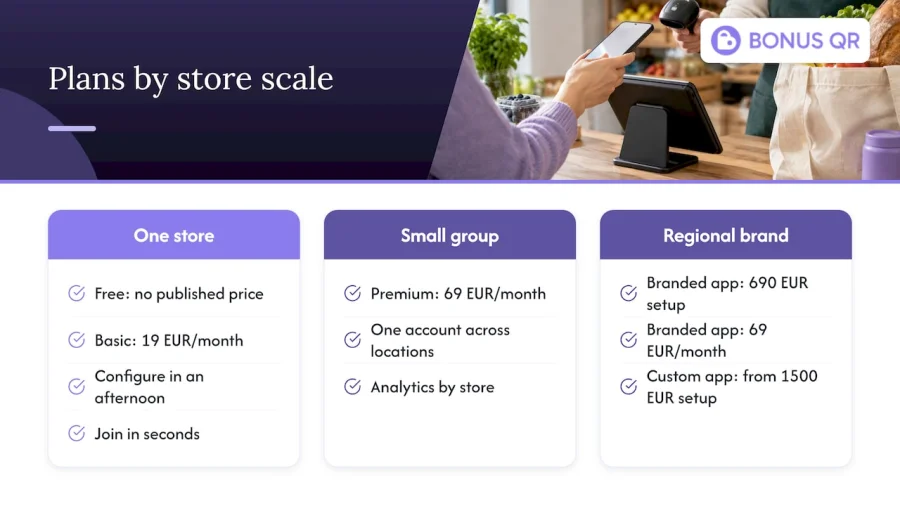
One store. Prioritize speed and low monthly cost. You want a program that a manager can configure in an afternoon and a customer can join in seconds. The Free plan lets a single store start with no published subscription price, and Basic at 19 EUR per month adds room to grow.
A small group of stores. Look for one member account that works across locations, plus analytics that show each store. Premium at 69 EUR per month is the plan to review here.
A growing regional brand. When customers should see your own name and logo on the app, the white-label option provides a branded app for a 690 EUR one-off setup and 69 EUR per month. If the requirements go beyond that, custom app development starts from 1500 EUR one-off.
Wakefern’s decision shows what scale demands: banner-specific flexibility and the ability to run huge promotion volumes. If you are not at that scale, those are not your selection criteria, and paying for them is waste. Our guide on choosing loyalty platforms for growth helps you match the platform to your stage.
A worked example: a neighborhood grocer
Take a neighborhood grocery with one location and a regular base of shoppers who stop in several times a week. A realistic launch looks like this:
- Pick one simple mechanic, for example cashback that grows by tier as a member spends more.
- Add an onboarding promo so new members get a reward on the first scan.
- Place the QR code at the checkout counter and on the shopping bags.
- Turn on automated notifications for birthdays and for members who have not visited recently.
- After a few weeks, read the analytics: which offers were redeemed, how often members return, and which tier most members sit in.
- Adjust the threshold and reward size based on what you see.
This follows the design logic SIFO points to: rewards, thresholds and personalization are the levers. Because the system handles reward distribution and notifications, the owner spends time on the store instead of on spreadsheets.
Friction decides adoption
A program only works if shoppers actually use it. Every extra step at the checkout lowers enrollment. Jewel-Osco’s program lets shoppers identify themselves with just a phone number or app card, which shows how much large chains care about quick identification. A QR code reduces that friction further for a small store, because it needs no card to carry or form to fill. We cover the topic in more detail in our piece on frictionless loyalty options.
Our perspective
Small grocers are told that loyalty software is a big-chain tool: a heavy integration, a long contract, a data team. We built BonusQR on the opposite idea. A neighborhood store has the same need as a supermarket banner, which is to give regular shoppers a reason to come back, but it has no time for a technical project.
That is why we designed the platform around QR codes and no POS requirement. Points, stamps, cashback, coupons, referral and review modules, and automated notifications sit in one place, so the owner decides the reward and the system takes care of delivering it.
Our advice is to start with one reward that is easy to understand, put the QR code where customers already stand, and let the analytics tell you what to change. When the program is working and you want your own name on the app, the white-label and custom app options are there to grow into, without switching platforms.
Michal Palus
Start with the plan that fits your store
If you run a grocery store, a small group or a specialty food shop, BonusQR lets you launch a QR-based loyalty program with no POS integration. Begin on the Free plan, move to Basic at 19 EUR per month when you want a regular program, or choose Premium at 69 EUR per month for the full feature set. See the plans and pricing or explore the BonusQR loyalty platform, which runs in more than 15 languages.
FAQ
What is the best loyalty software for a small grocery store?
The best option is one you can launch quickly, afford monthly and adjust without technical help. BonusQR fits that profile: it needs no POS, offers points, stamps and cashback, and starts with a Free plan. Basic is 19 EUR per month and Premium is 69 EUR per month.
Do I need to change my POS to run a loyalty program?
Not with BonusQR. It is a QR-based platform that lets customers earn rewards without any additional POS system, so your existing register stays as it is. That removes the integration project that larger platforms often require.
How is grocery loyalty software different from a store rewards card?
The rewards card is what the shopper holds. The software is the system behind it, which links purchases to accounts, applies rewards, stores customer data for marketing and reports on shopping behavior. For a small grocer, it is also the tool that sends reminders and offers automatically.
Does loyalty software guarantee repeat customers?
No software alone does. Research summarized by SIFO shows that program design, meaning the rewards, thresholds and personalization, shapes the outcome in grocery. Choose a platform that lets you adjust those levers, then use analytics to refine them.
Can I put my own brand on the loyalty app?
Yes. BonusQR offers a white-label app with a 690 EUR one-off setup and a 69 EUR monthly subscription. For more specific needs, custom app development starts from 1500 EUR one-off, with monthly maintenance from 69 EUR.


