
 Deutsch
 Español
 Français
 Italiano
 Magyar
 Polski
 Slovenčina
 Čeština
Winning loyalty schemes combine a simple earn mechanic, fast gratification and personalisation, rather than a complicated points chart nobody reads. Study four models first: points-based, tiered, paid subscription and experiential hybrid. Below, you will find each mapped to a real brand example, the exact mechanic behind it, and a takeaway you can adapt this quarter.
TL;DR:
- Loyalty programs should focus on immediate reward visibility and personalized engagement to maintain customer motivation and foster loyalty.
- Matching the loyalty model to customer purchase frequency, margin, and digital habits is crucial for maximizing program effectiveness and profitability.
- Successful schemes often rely on unified customer data, real-time updates, and automated rewards to enhance user experience and program scalability.
- Early engagement indicators such as active member rates and redemption patterns within 30 to 60 days are strong predictors of long-term success.
- Poor implementation, including siloed data and complicated redemption, can quickly kill program interest and should be addressed with simple, transparent mechanics.
The main types of loyalty programmes (and when each one fits)
Before you copy a brand’s tactic, you need to know which category it belongs to. Loyalty programme ideas generally sort into seven models, and the right one depends on how often your customers buy, your margins, and what you are actually selling.
- Points-based. Customers earn points per purchase and redeem them for discounts or products. This suits businesses with frequent, moderate-value purchases, cafes, salons, grocery stores, where a visible running balance keeps people coming back.
- Tiered or VIP. Spending unlocks status levels, each with better perks. This works best for brands with a wide range of spend levels and genuine aspirational value, think beauty, travel, or fashion retail, where climbing a tier feels like an achievement.
- Paid or subscription. Customers pay upfront for guaranteed benefits like free shipping or exclusive pricing. This model succeeds when the membership bundles clear, recurring utility rather than abstract perks, and it fits businesses where customers already buy regularly enough to justify a fee.
- Cashback or store credit. A percentage of spend returns as usable credit. Simple to explain, this suits retailers and service businesses where customers understand cash value more intuitively than points.
- Referral-based. Existing customers earn rewards for bringing in new ones. This is powerful for subscription services and any business where word of mouth already drives sales, because it turns advocacy into a measurable, repeatable behaviour.
- Gamified. Badges, streaks, challenges and surprise rewards add a game layer on top of another mechanic. It works well for younger audiences and businesses wanting more frequent app engagement between purchases.
- Hybrid. Most successful programmes blend two or three of the above, points plus tiers, or subscription plus cashback, rather than relying on a single lever.
A grocery chain with thin margins and weekly visits needs a points or cashback model that rewards frequency without eroding profit. A skincare brand with a handful of high-value repeat buyers benefits more from tiers, where status, not just savings, drives the next purchase. Match the model to the buying pattern first; the branding comes second.
12 loyalty scheme examples worth studying
These loyalty rewards examples are grouped by mechanic, not by brand size, because the mechanic is what you can actually copy. Each includes what customers earn, how redemption works, and one tactical takeaway.
Points and gamification examples
-
Starbucks Rewards. Customers earn stars per dollar spent, redeemable for free drinks and food at set star thresholds. The mechanic layers in gamified “double star days” and challenges that push short bursts of extra spend. It works because the reward ladder is visible inside the app at every visit, so the gap between “now” and “next reward” never feels abstract. Takeaway: show customers exactly how many points stand between them and their next reward, not just a running total.
-
Nike Membership. Members earn access to member-only product drops, workouts, and early releases rather than a traditional points balance. The mechanic rewards engagement with the brand ecosystem, not just purchases. It works because it turns loyalty into identity: members feel like insiders, not just discount hunters. Takeaway: reward attention and engagement, not only transactions, especially if your product has a lifestyle angle.
-
Chipotle Rewards. Customers earn points per dollar, redeemable for free food, with regular limited-time challenges (bonus points for trying a new item, for example). The redemption path is short and food-based, so the reward feels immediate and personally relevant. Takeaway: keep the earn-to-redeem gap short for lower-margin, high-frequency businesses; long redemption windows kill engagement.
-
LEGO Insiders. Points (called VIP points historically, now Insiders points) are earned per purchase and redeemable for exclusive sets, early access, and double-points events tied to product launches. The programme layers gamification onto a collector mindset that already exists among LEGO buyers. Takeaway: if your customers already collect or complete sets, build the reward mechanic around that instinct rather than inventing a new one.
Pro Tip: If you are running a gamified mechanic, cap the “distance” to any reward at three to five actions. Beyond that, most customers disengage before the first redemption, which kills the habit loop before it forms.
Tiered and aspirational examples
-
Sephora Beauty Insider. Three tiers (Insider, VIP, Rouge) unlock progressively better perks: birthday gifts, early access to sales, exclusive events, and higher earn rates. The mechanic works because status is visible and semi-public, customers know which tier they are in and what separates them from the next one up. Takeaway: make tier status visible at checkout and in-app, not buried in an account settings page.
-
IKEA Family. Membership is free and tiered loosely by engagement rather than spend, offering discounts, a free coffee or tea in-store, extended warranties, and workshop access. It works because the rewards are practical and tied to the actual shopping experience, not abstract points. Takeaway: for low-frequency, high-consideration purchases, reward the browsing and planning behaviour, not just the transaction.
-
Costco membership. This is technically a paid tier rather than a free loyalty layer, but it functions as an aspirational gate: members get access to lower prices, exclusive product lines, and services unavailable to non-members. The mechanic rewards commitment upfront rather than accumulation over time. Takeaway: a paid tier signals seriousness and filters for your most valuable customers from day one.
Paid and subscription utility examples
-
Amazon Prime. Customers pay an annual or monthly fee for bundled, recurring utility: free fast shipping, streaming content, and exclusive deals. It succeeds because every benefit is used often enough to justify the fee in the customer’s mind, shipping speed alone is used weekly by most members. Takeaway: a paid tier only works if at least one benefit gets used often enough that customers feel the fee “pay for itself” within weeks, not months.
-
A wellness studio subscription model. Many gyms and studios now sell monthly membership tiers bundling class credits, priority booking, and merchandise discounts rather than pay-per-visit pricing. The mechanic converts occasional visitors into predictable recurring revenue. Takeaway: if your customers already visit regularly, test a paid tier that simply bundles what they already buy at a slight discount.
Cashback and store-credit examples
-
A cashback-based retail loyalty scheme. Rather than points, a flat percentage of every purchase returns as store credit, automatically applied to the next order. This mechanic removes the mental maths customers otherwise do to work out what a point is “worth.” Takeaway: if your customers struggle to understand your points value, switch to a direct cashback percentage; it removes an entire layer of confusion.
-
Tiered cashback for repeat spenders. Some retailers increase the cashback percentage as customers cross annual spend thresholds, effectively merging the tiered and cashback models. This rewards your highest-value customers with a rate that keeps improving, which strengthens retention exactly where it matters most. Businesses exploring this can look at tiered cashback loyalty models to see how the earn rate structure typically scales. Takeaway: reserve your best cashback rate for your top 20% of customers by spend, not everyone equally.
Referral and experiential examples
- A referral-driven loyalty add-on. Layering a referral reward, credit or points for both the referrer and the new customer, onto an existing points or tiered programme consistently produces some of the highest-quality new customers, because they arrive pre-vetted by someone who already trusts the brand. Takeaway: pair every referral reward with an equally strong incentive for the new customer, not just the person doing the referring; one-sided referral rewards convert poorly.
For a deeper look at how these mechanics play out across different retail categories, see this roundup of innovative loyalty programme examples.
Why these examples actually work
Every example above leans on a small set of behavioural and technical levers, and understanding which lever does the work is more useful than admiring the brand.
On the behavioural side, four drivers repeat across almost all successful examples of loyalty programmes:
- Immediate reward visibility. Starbucks and Chipotle both show the customer exactly how close they are to their next reward, which keeps the loop active between visits.
- Status signalling. Sephora’s tier names and Costco’s membership card both convert spend into a visible identity marker, not just a discount.
- Habit loops. Gamified challenges and streaks (LEGO’s double-points events, Nike’s early-access drops) create a reason to check the app even when there is nothing to buy yet.
- Social proof and advocacy. Referral mechanics work because a recommendation from a known person carries more weight than any advert, and rewarding that behaviour scales it deliberately rather than leaving it to chance.
Netguru’s analysis of underperforming programmes found that more than half fail because they stay narrowly transactional, rewarding only purchases while ignoring reviews, referrals, and social engagement that correlate with stronger long-term retention. That single finding explains why LEGO and Nike outperform simple points schemes: they reward attention and identity, not just spend.
On the technical side, three enablers separate the schemes that scale from the ones that stall:
- Unified customer identity. Points and status only feel real if they persist whether the customer buys online, in-store, or through an app, which requires one customer record, not three disconnected ones.
- Real-time point or credit updates. A delay between purchase and visible reward, even a few hours, measurably softens the immediate gratification these schemes depend on.
- Campaign automation. Birthday rewards, tier upgrade notifications, and lapsed-customer nudges only work at scale if they trigger automatically rather than relying on someone remembering to send them.
Loyalty schemes with clear earning mechanics measurably shift buying decisions: a Bain-sponsored survey cited by Harvard Business Review found that 63% of US consumers make buying decisions based on programmes they participate in. That is not a marginal influence, it is a majority of the customer base actively factoring programme membership into where they spend. Separately, Antavo’s industry research points to rising satisfaction scores and broader adoption of AI-driven personalisation as the current drivers behind programmes that outperform their predecessors. Programmes that treat personalisation as a checkbox feature, rather than the mechanism that makes rewards feel relevant, tend to sit behind that curve rather than ahead of it.
If you want a deeper dive into the gamified layer specifically, this piece on gamified loyalty programmes breaks down streaks and challenge mechanics in more detail.
How to choose the right mechanics for your business
Picking a mechanic before understanding your own numbers is the single most common mistake business owners make when they set out to build a loyalty scheme. Work through these criteria in order.
- Purchase cadence. How often does a typical customer buy? Weekly or more suggests points or cashback; a few times a year suggests tiers, subscription, or a hybrid built around fewer, bigger moments.
- Margin per transaction. Thin margins mean your reward budget is tight, so cashback percentages and points values need to be modest and clearly costed before launch, not adjusted after customers already expect a certain rate.
- Average order value (AOV). Higher AOV businesses can afford richer rewards per transaction; lower AOV businesses need higher-frequency, lower-cost mechanics like stamp cards or small cashback percentages.
- Digital maturity of your customer base. If most of your customers already use a mobile wallet or app for other brands, wallet-based digital cards will outperform a physical punch card; if not, a hybrid approach eases the transition.
Watch for three red flags once a programme is live, because each one quietly kills engagement long before churn numbers show it:
- Siloed data. If your online and in-store systems do not share customer records, points and tiers will feel broken to any customer who shops both ways.
- Long time-to-reward. If it takes months of typical spend to reach the first redemption, most customers disengage before they ever get there.
- Poor fulfilment. A reward that is hard to redeem, out of stock, or requires a phone call defeats the entire purpose of automating loyalty in the first place.
Before signing with any provider, or greenlighting an internal build, ask these exact questions:
- Does the system integrate with our point-of-sale and e-commerce platform without custom development work?
- Can customers see live point or credit balances in real time, or is there a sync delay?
- Who owns the customer data, and can we export it if we switch providers later?
- What reporting exists out of the box for redemption rate, active member rate, and repeat purchase uplift?
- Does the platform support Apple Wallet and Google Wallet passes, or only an in-app balance?
Pro Tip: Ask any vendor to show you their real-time analytics dashboard live, not a screenshot, during the sales call. If they cannot demonstrate it working with sample data on the spot, assume the reporting is thinner than the pitch suggests.
If your business sits in beauty or wellness specifically, this guide on retention strategies for beauty and wellness businesses covers membership models tailored to that category’s booking cycles.
What to measure and how fast results actually show up
Four metrics matter more than any others when judging whether a loyalty scheme is working: active member rate, redemption rate, incremental repeat purchase rate, and customer lifetime value (CLV) uplift among enrolled members versus non-members.
Full programme ROI typically takes twelve to fourteen months to materialise, but you do not need to wait that long for a signal. Active member rate and early redemption patterns are visible within the first 30 to 60 days, and they are strong predictors of whether the programme is heading toward success or stalling. Programmes offering an immediate onboarding reward with a short, clear redemption path show stronger early activation than programmes that make new members wait weeks for their first meaningful reward.
A simple forecasting exercise helps set expectations before launch. The table below illustrates a hypothetical points scheme for a small retailer, showing how reward cost compares to the incremental margin it needs to generate to break even.
The point of this exercise is not the exact numbers, which vary by business, but the discipline of costing rewards against a realistic incremental order count before launch rather than after. Programme owners who review this data monthly and adjust promotions accordingly consistently see stronger engagement than those who set the mechanic once and leave it alone.
Common pitfalls when building a loyalty programme, and practical fixes
Most loyalty schemes that underperform fail for a handful of repeatable reasons, and each one has a fairly direct fix.
- Low engagement after signup. Fix it by front-loading an immediate, easy-to-claim welcome reward rather than making the first redemption feel distant; this single change is one of the strongest predictors of early activation.
- Poor programme economics. Fix it by piloting a narrow mechanic first, rewarding one high-value behaviour like weekly repeat visits or referrals, and measuring incremental margin before expanding to a broader points structure.
- Data silos between online and in-store systems. Fix it by unifying customer identity first, before adding tiers, gamification, or campaign automation on top; every other technical improvement depends on this foundation.
- Slow or clunky fulfilment. Fix it by testing the actual redemption path yourself, as a customer would, before launch; if it takes more than two taps or a phone call, simplify it.
- Staff who cannot explain the programme. Fix it with a short training session covering the earn rate, redemption steps, and where to send customers with questions; this matters more than any app feature.
Run these three experiments in the first month rather than trying to overhaul everything at once: launch a welcome reward that is claimable within the first visit, confirm that customer records match correctly whether someone shops online or in-store, and run a one-month bonus campaign (double points on a specific day, for example) to see how quickly engagement responds.
Pro Tip: Track redemption rate weekly for the first eight weeks, not monthly. Early weekly data reveals fulfilment problems while they are still cheap to fix, rather than after two months of customer frustration has already accumulated.
For campaign ideas you can steal directly, this roundup of loyalty campaigns you can adapt for a small business covers seasonal and limited-time promotions that pair well with an ongoing points or tier structure.
Legal and privacy considerations when implementing loyalty programmes
Collecting customer data for a loyalty scheme puts you squarely inside consumer privacy rules, and the requirements scale with how much data you collect and where your customers live. If you operate in the United States, several states now have their own consumer privacy laws (California’s CCPA being the best known), which typically require clear disclosure of what data you collect, why, and how customers can request deletion or opt out of certain uses. If any of your members are based in the EU or UK, GDPR applies regardless of where your business is headquartered, and it carries stricter consent and data portability requirements than most US state laws.
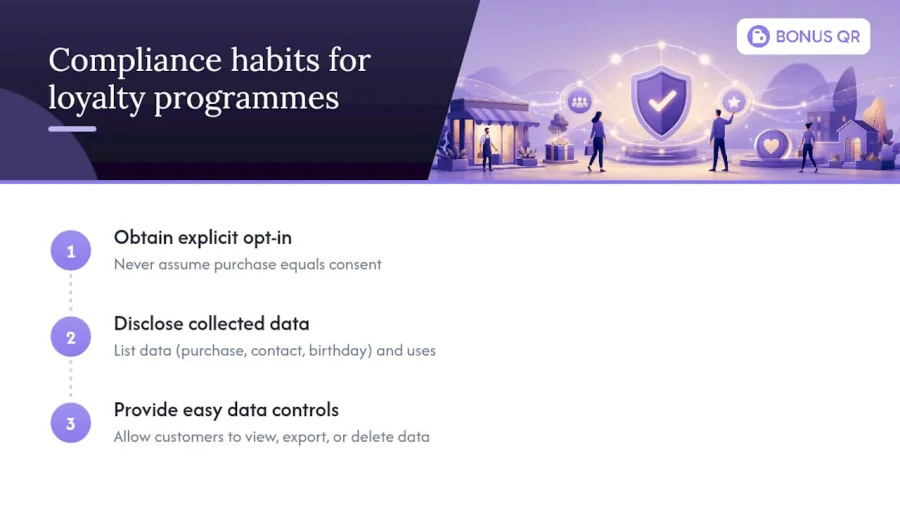
Practically, three habits keep a loyalty programme on the right side of these rules. First, get explicit opt-in consent before enrolling anyone, never assume a purchase implies consent to marketing communications. Second, state clearly in your programme terms what data you collect (purchase history, contact details, birthday) and what you use it for, particularly if you plan to personalise offers using that data. Third, give customers an easy way to view, export, or delete their data on request, since regulators increasingly treat a difficult opt-out process as a compliance failure in itself.
None of this should discourage you from personalising your programme. It simply means building consent and transparency into the sign-up flow from day one, rather than retrofitting it after a complaint or an audit forces the issue.
Loyalty scheme examples across other industries
Points, tiers, and cashback are not retail-exclusive tools. The same mechanics, adapted, work across sectors that rarely get mentioned in loyalty case studies.
Grocery and fuel. Grocery chains and petrol stations commonly combine a cashback or points mechanic with fuel discounts, rewarding the highest-frequency purchase category most businesses have. The mechanic works because the reward threshold is reached within days, not months, which keeps the loop tight.
Hospitality and hotels. Hotel groups typically run tiered programmes where status unlocks room upgrades, late checkout, and lounge access rather than cash-equivalent rewards. The aspirational tier mechanic works particularly well here because travel frequency naturally varies widely between customers, making status a meaningful differentiator.
Healthcare and wellness. Gyms, spas, and wellness centres increasingly use stamp-card or visit-based mechanics, rewarding a tenth visit or a monthly streak, because the goal is building a habit, not just capturing spend. A wellness-focused loyalty setup typically leans on visit frequency and class attendance rather than transaction value alone.

Financial services. Some banks and fintech apps reward specific behaviours, like setting up a direct deposit or maintaining a savings streak, with cashback or fee waivers, applying the referral and gamification logic from retail to entirely different actions.
The mechanic transfers across industries far more easily than the branding does. What earns and how fast it pays off matters more than what sector you sell into.
A strategist’s take on what actually moves the needle
If you take one thing from every example in this article, it should be this: prioritise immediate value and unified customer data over clever mechanics. A beautifully designed tier structure means nothing if a customer’s points vanish between an online order and an in-store visit because two systems do not talk to each other. Fix the plumbing before you fix the branding.
The operational caveat nobody likes hearing: your fulfilment process will get tested on day one, and if redemption is clunky, slow, or requires a phone call, the mechanic itself stops mattering. I have seen well-designed points structures fail purely because claiming a reward took four steps instead of one.
Here is the experiment worth running in the next 30 days. Launch a simple welcome bonus for new sign-ups, pair it with one targeted push notification a week later reminding lapsed browsers what they have unlocked, and measure the retention uplift against a control group who received neither. You will learn more from that single test than from another month of researching mechanics.
— Michal
How BonusQR supports these mechanics
Every mechanic covered in this article, points, stamp cards, tiers, cashback, referrals, has a direct equivalent inside BonusQR’s loyalty platform, built specifically for small and medium-sized businesses that do not want to hire a development team to launch a scheme. Rather than piecing together a custom build, you get points collection, tiered cashback, digital coupons, and Apple and Google Wallet integration in one setup that goes live without needing point-of-sale integration first.
The platform is built for speed of launch rather than months of configuration, with free and paid tiers depending on how much automation and branding you need, plus white-label app options for businesses that want a fully branded experience later. If any example in this article gave you an idea worth testing, the fastest way to find out if it works for your customers is to set up your first programme and run the 30-day experiment above yourself.
Sources
The claims and benchmarks in this article draw on a handful of sources worth reading directly if you want to dig deeper. Harvard Business Review’s analysis of why loyalty programmes fail covers the Bain-sponsored survey on purchase influence and realistic ROI timelines. Netguru’s breakdown of underperforming programmes explains why transactional-only mechanics lose to programmes rewarding broader engagement. Antavo’s Global Customer Loyalty Report 2026 supplies the current data on satisfaction, AI personalisation, and monthly optimisation habits among programme owners. Statista’s dataset on valued loyalty features is useful if you need to prioritise which features to build first. Finally, this roundup of successful loyalty programmes offers additional detail on the brand mechanics referenced throughout.