
TL;DR:
- White-label apps enable rapid, cost-effective branded digital experiences for small and medium-sized businesses.
- They significantly improve customer retention, engagement, and re-engagement through structured loyalty features.
- Suitable for standardized industries, white-label apps are ideal for initial loyalty programs before considering custom development.
White-label apps are no longer reserved for enterprise budgets or Fortune 500 brands. For small and medium-sized businesses, they represent one of the most practical ways to launch a branded digital experience without months of development time or six-figure costs. Loyalty apps show 15-30% engagement uplifts alongside churn reductions as significant as 5 to 7 percent, and those results are now within reach for businesses of every size. This guide explains exactly how white-label apps work, what they can do for your customer retention, and how to choose the right solution for your specific business needs.
Key Takeaways
| Point | Details |
|---|---|
| Rapid deployment | White-label apps launch quickly compared to custom solutions, saving time and money. |
| Proven loyalty impact | These apps can increase client retention rates to over 90% and drive stronger engagement. |
| Best for common features | White-label works best when your app needs are standard, like loyalty programs or customer rewards. |
| Lower risk for SMEs | Choosing white-label lowers technical risk and avoids costly development detours for smaller businesses. |
What is a white-label app?
A white-label app is a ready-made software product built by a third-party developer that you can rebrand and sell or offer as your own. Think of it like buying a product wholesale and putting your own label on it. The core functionality is already built and tested. Your job is to apply your brand colors, logo, and business-specific settings, then launch it to your customers.
This approach contrasts sharply with custom app development, where every feature is built from scratch according to your specifications. Custom development gives you full control, but it comes at a significant cost. You are typically looking at months of planning, design, development, and testing before anything goes live. White-label apps skip most of that process entirely. The result is a faster launch, lower upfront investment, and far less risk for your business.
Some of the most common industries using white-label apps right now include:
- Retail and food service for digital loyalty cards and point-of-sale promotions
- Fitness and wellness for class bookings, membership tracking, and rewards
- Healthcare and clinics for appointment management and patient engagement
- Logistics and delivery for shipment tracking and client communication
- Home services for job scheduling and customer re-engagement
The breadth of industries shows how flexible these platforms can be. One case study in freight logistics found that a company using white-label software grew new clients by 27 percent and achieved 93 percent customer retention, with quote turnaround times dropping to under 30 minutes. Results like this are not limited to logistics. They reflect what happens when businesses remove friction from customer interactions by using purpose-built tools.
That said, white-label apps are best suited for standardized experiences. If your business has a highly unique workflow that does not fit common industry patterns, you may eventually outgrow the platform. Understanding the benefits and trade-offs of custom web development helps you recognize where white-label solutions end and custom development begins. For most SMEs starting a loyalty program, white-label is the right first move. You can also review strategies for customizing white-label rewards to understand how much flexibility you actually have within these platforms before assuming you need something built from scratch.
Pro Tip: Before requesting a custom quote for app development, test a white-label solution for 90 days. Most SMEs find that the standard feature set covers 80 to 90 percent of what they actually need, and they save significant time and money in the process.
How do white-label apps drive loyalty and retention?
Once you understand what a white-label app is, the next logical question is: what kind of results can you actually expect? The data is encouraging, and it goes well beyond anecdotal reports.

Here is a summary of real-world benchmarks from businesses that switched to white-label app platforms:
| Business type | Key result | Metric |
|---|---|---|
| Freight company | New client growth | +27% |
| Freight company | Customer retention | 93% |
| Healthcare clinic | Technology spend reduction | 60% |
| Healthcare clinic | Patient satisfaction increase | +20% |
| Loyalty app programs | Engagement/completion uplift | 15 to 30% |
| Loyalty app programs | Churn reduction | 5 to 7% |
| Home services | Customer re-engagement rate | 30x improvement |
These numbers reflect the measurable business impact that structured, app-based loyalty programs deliver across industries. The most consistent result across all categories is improved customer retention, which directly affects your revenue without requiring additional marketing spend.
Why do white-label apps drive these outcomes? There are three primary drivers worth understanding.
Rapid deployment creates early momentum. When a loyalty program launches quickly, your team can market it before customer interest fades. Long development cycles often mean a program launches cold, with no buzz. White-label apps let you go live fast and start gathering data and feedback almost immediately.
Familiar mobile experiences reduce friction. Customers are already comfortable with app-based loyalty programs. Digital stamp cards, points trackers, and push notifications are intuitive because they mirror what major brands already do. Your customers do not need to learn a new behavior; they just need to download your app.
Structured reward programs increase visit frequency. The loyalty features built into white-label platforms, including digital stamps, tiered rewards, cashback offers, and exclusive push promotions, are designed specifically to bring customers back more often. These are not generic engagement tools. They are conversion-tested features built for exactly this purpose.
“The goal of a loyalty app is not to reward customers for what they were already going to do. It is to change the behavior of borderline customers who might otherwise choose a competitor.”
Some of the most impactful loyalty features for SMBs include:
- Digital stamp cards that replicate the familiar coffee-shop punch card in app form
- Push notification offers sent at the right time to re-engage inactive customers
- Points and rewards tracking that gives customers a visible reason to return
- Milestone rewards tied to visits or spending thresholds, which increase average transaction value
Learning from branded loyalty app strategies that work in your industry will help you configure these features for maximum impact. You can also explore specific tactics to boost retention with smart rewards once your app is live and you’re ready to optimize.
Building customer loyalty and trust takes consistency, and the right app structure makes that consistency easier to maintain at scale.
White-label vs. custom app development: which is right for your SME?
Understanding the benefits of white-label apps is one thing. Knowing whether they fit your specific situation is another. This comparison gives you a clear, side-by-side look at how white-label and custom development stack up across the factors that matter most to SMEs.
| Factor | White-label app | Custom-built app |
|---|---|---|
| Launch speed | Days to weeks | 3 to 12 months |
| Upfront cost | Low to moderate | High |
| Ongoing maintenance | Managed by vendor | Managed by your team |
| Feature flexibility | Standardized modules | Fully customizable |
| Scalability | Good for growth | Excellent for scale |
| Competitive differentiation | Moderate | High |
| Technical risk | Low | Moderate to high |
The pattern is clear. White-label wins on speed, cost, and simplicity. Custom wins on differentiation and long-term strategic value. According to research on white-label versus custom development, white-label apps offer a short-term speed and cost advantage for standardized verticals like delivery, fitness, and loyalty, while custom development becomes more defensible over time when you need features that create a genuine competitive moat.
For most SMEs, here is how to think through the decision:
- What stage is your business at? If you are building your first loyalty program, white-label eliminates the risk of building something no customer wants.
- How specialized is your customer journey? If your workflow looks similar to other businesses in your industry, white-label will cover your needs well.
- What is your 12-month budget? Custom development often costs between $30,000 and $150,000 or more. White-label platforms typically run $50 to $500 per month.
- How fast do you need results? If you are running a promotion or need your app live before a busy season, white-label is the only realistic option.
- Do you have internal technical resources? Custom development requires ongoing developer support. Most small business owners do not have that in-house.
The benefits of branded loyalty programs for SMBs are substantial and well-documented, and white-label is the fastest way to capture those benefits without building from scratch.
For context, consider the comparison of custom versus platform-based ecommerce approaches in retail. The same logic applies: platforms win on speed and cost, while custom wins when differentiation is the strategic priority.
Pro Tip: Choose white-label if you are launching a loyalty program for the first time or operating in a standardized industry. Revisit the custom option once your app has real usage data and you can clearly define the features you need that the platform does not offer.
How to choose and implement your white-label app
With your decision made in favor of a white-label solution, the focus shifts to execution. A strong implementation plan prevents the most common mistakes SMEs make when launching a new app.
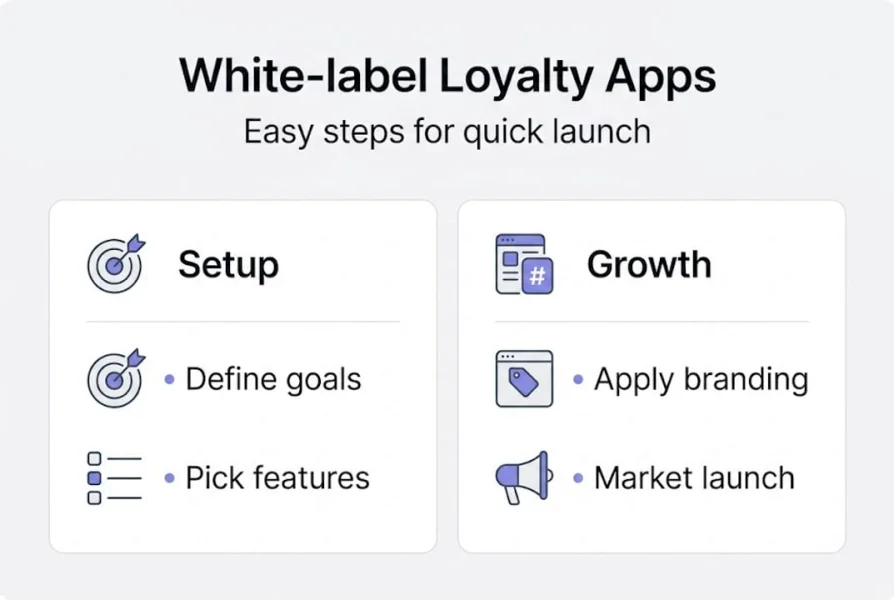
Step 1: Define your core objectives. Start by identifying what you want the app to accomplish. Do you want to reduce churn, increase visit frequency, drive referrals, or collect customer data? Your objectives will shape which features you prioritize.
Step 2: Shortlist vendors based on feature fit. Not all white-label platforms offer the same modules. Look for platforms that include the specific features your business needs, such as digital stamp cards, cashback programs, push notifications, or tiered rewards. Avoid paying for modules you will not use.
Step 3: Evaluate key criteria before committing. When assessing vendors, pay close attention to:
- Feature set and whether it covers your loyalty model
- User experience on both mobile and web versions
- Integration flexibility with your existing tools, including no-POS-required options
- Customer support quality and availability
- Pricing structure including free tiers, trial periods, and upgrade paths
Step 4: Apply your branding properly. Logo, color palette, typography, and tone of voice should all be consistent with your existing brand. A loyalty app that looks disconnected from your main brand identity creates confusion for customers.
Step 5: Train your staff before launch. One of the most overlooked steps. Your team needs to know how to explain the app to customers, how to troubleshoot common questions, and how to actively promote enrollment at the point of sale.
Step 6: Market the launch actively. An app that no one knows about delivers no results. Use email, social media, in-store signage, and your existing customer list to drive downloads and first-time enrollments.
Step 7: Track your KPIs from day one. The case study showing 93% retention and 27% new client growth did not happen by accident. It came from measuring what worked. Key metrics to track include app download rate, active user percentage, redemption rate, and month-over-month retention.
Common pitfalls to avoid:
- Over-customizing early on. Start with the default configuration and optimize based on data, not assumptions.
- Neglecting staff training. Customers will not adopt the app if your team cannot explain it confidently.
- Skipping the marketing phase. The app will not promote itself. Budget time and money to drive adoption.
Businesses that are building customer loyalty using digital apps successfully treat the launch as a campaign, not just a technical rollout. There are also practical ecommerce scalability insights that apply here: the best platforms grow with your business rather than creating ceiling effects.
Our take: white-label apps as smart growth accelerators, but not a silver bullet
We work with a wide range of SMEs, and the pattern we see most often is this: business owners either underestimate how quickly a white-label app can deliver ROI, or they overestimate what the app alone will do for their business.
White-label loyalty apps give your customers a reason to choose you over a competitor when the difference is small. That is genuinely powerful. A customer who is 50/50 between your café and the one next door will pick you if they are three stamps away from a free drink. That kind of behavioral nudge has real financial impact, and effective customer engagement strategies amplify it further.
Where SMEs go wrong is treating the app as a differentiator rather than a foundation. The app is infrastructure. The differentiator is your service, your team, and the experience you deliver. Chasing unique app features adds cost and complexity that lean teams cannot sustain. The businesses that see the best retention results use a straightforward white-label platform and invest their real energy into marketing the program and building genuine relationships with customers. Start lean, measure everything, and add features only when the data tells you to.
Take the next step with a white-label loyalty app
If you’re ready to put these insights into action, bonusqr.com gives you a direct path to launching your own branded loyalty program without the cost or delay of custom development. You can explore loyalty app features to see exactly what modules are available, from digital stamps to push notifications and cashback rewards. If you operate in a service-based business, the service industry loyalty app page walks through specific use cases for your sector. You can also see electronic rewards in action to understand how digital rewards work for your customers in practice. The platform supports rapid setup, no POS integration required, and free-tier options to get started.
Frequently asked questions
How fast can I launch a white-label app for my business?
Most white-label apps can be launched within days or a few weeks, thanks to pre-built templates and simple branding tools. Platforms designed for loyalty programs are built for rapid setup, with some businesses going live in under 30 minutes for their initial configuration, as shown in freight case studies.
What are the main limitations of white-label apps?
White-label apps offer limited customization compared to fully custom-built solutions, making them best suited for standard, well-defined use cases. As noted in white-label vs. custom development research, custom development creates a stronger competitive moat over time but at significantly higher cost and complexity.
Do white-label apps work for all industries or just retail?
White-label apps are used successfully across clinics, logistics companies, fitness businesses, home services, and more, not just retail. Documented results include a 60 percent technology cost reduction for a healthcare clinic and a 30x customer re-engagement improvement in home services.
How do white-label apps affect customer retention?
White-label loyalty apps consistently improve customer retention, with documented rates reaching 93% in some industries alongside engagement uplifts of 15 to 30 percent. The key is configuring loyalty features that give customers a clear, ongoing reason to return.


