Surprise and delight rewards are small, unannounced gifts or gestures that reach a customer when they don’t expect them: a free pastry on a rainy Tuesday, an upgrade for a regular, a thank-you after the tenth visit. They work because the customer didn’t see them coming. For a small business, the practical recipe is simple: decide who deserves a surprise, set a modest budget, trigger it from real behavior, and keep it unannounced. This guide covers the psychology, a dozen examples that fit cafes, shops, gyms and hotels, a first-visit reward approach, and the mistakes that turn a gift into a grievance.
Key takeaways
- Surprise is the active ingredient, not price. In a 1997 study cited by Loyalty & Reward Co, people rated a surprise $5 reward as more enjoyable than an expected $9 one.
- Delight amplifies satisfaction; it doesn’t repair a bad experience. McKinsey’s research frames it that way, so fix the basics first.
- A reward you announce in advance, such as a published birthday offer, is a standard promotion. It can still be worthwhile, but it isn’t a surprise.
- Protect your regulars. Handing out unearned perks can irritate loyal members, so recognize them too.
- You don’t need a big budget or a manual process. Triggers based on visits, spend or milestones can be automated.
What surprise and delight actually means
McKinsey describes delight as the point where customer joy meets surprise. Satisfaction happens when you meet expectations. Delight happens when you exceed them in a way the customer didn’t predict.
That distinction matters for how you design rewards. A standard loyalty program is a promise: collect ten stamps, get a coffee. The customer knows the rule, so the reward is earned and expected. A surprise and delight reward breaks the pattern. The customer gets something the rules never mentioned.
Both have a job. Earned rewards give customers a reason to return and a clear goal. Surprises give them a story to tell and a warmer feeling about you. The strongest programs use both: a predictable core with occasional unscripted extras on top.
Why a small surprise beats a bigger expected reward
There are two layers of evidence worth knowing.
Behavioral. Decision affect theory suggests an unexpected positive outcome produces more emotion than the same outcome anticipated. The $5 versus $9 experiment above is the standard illustration: the smaller surprise won on enjoyment. The lesson for you is that a free cookie delivered unprompted can do more emotional work than a 10% coupon the customer has been waiting for.
Neurological. Loyalty & Reward Co also summarizes neuropsychological work, including Pagnoni et al. (2002), indicating that unanticipated positive events stimulate the brain’s reward circuitry more strongly than predictable ones. You don’t need the neuroscience to run a campaign, but it explains why customers remember the surprise and forget the routine discount.
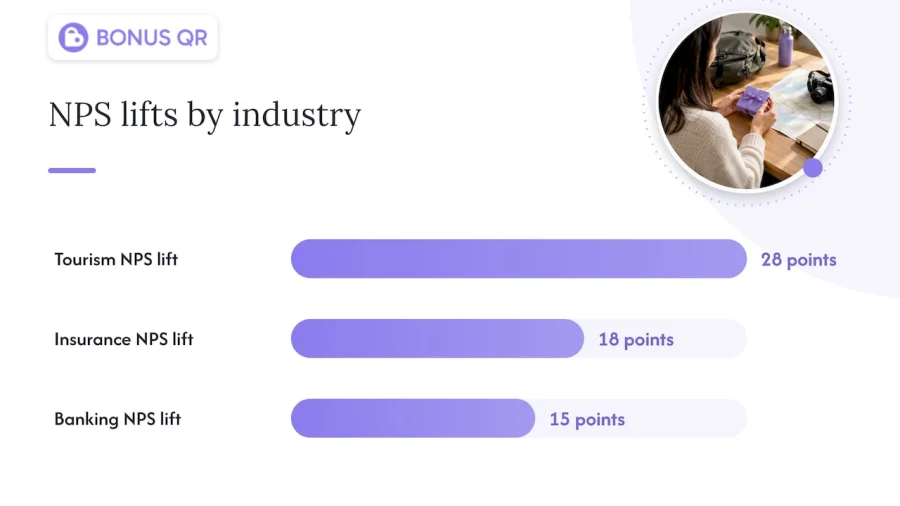
Commercial. In McKinsey’s analysis of 25,000 customers, delighting already satisfied customers lifted Net Promoter Score by 28 points in tourism, 18 in insurance and 15 in banking. Delighted customers also showed higher intent to come back: up to 19 percentage points more revisit intention in travel. Those are large companies in specific industries, so treat them as direction, not a forecast for your corner shop.
When delight pays off, and when it doesn’t
Two caveats keep you from wasting money.
Fix the basics first. Delight works as an amplifier of existing satisfaction. If your coffee is cold, your wait times are long or your staff are rude, a free gift won’t rescue the relationship. Spend the first dollar on the core experience.
Target the right moment. The same McKinsey piece suggests surprise rewards help most when satisfaction is low or uncertain, since they work as a recovery and engagement tool. For customers who are already thrilled, the extra lift is smaller. In practice, that points you toward two groups: customers who are drifting (a gap since the last visit, a complaint, a mixed review) and customers at meaningful milestones. Your most devoted regulars still deserve recognition, but the payoff there is more about status than about a jolt of surprise.
12 surprise and delight ideas for small businesses
The best examples cost little and rely on attention rather than money. Here are twelve, grouped by trigger.
Triggered by behavior
- The unannounced tenth visit. Don’t advertise it. When a customer’s tenth visit lands, hand over a free item with a handwritten note. The key is that no sign promises it.
- The comeback gift. If a regular hasn’t visited in six weeks, send a message with a small, unexpected offer: a free add-on, not a percentage off. It tells them you noticed.
- The spend-threshold upgrade. A hotel can upgrade a room, a salon can add a scalp treatment, a grocery store can slip in a sample of a new product when a basket crosses a certain amount.
- The surprise double. Without warning, double the points or stamps for one visit. The customer discovers it at the till.
Triggered by moments
- Anniversary of the first visit. “A year ago today you walked in for the first time.” Few businesses do this, so it stands out.
- Birthdays, with a catch. As the research notes, a birthday reward that is announced in advance is a normal promotion, not a surprise. If you want a surprise, don’t publicize it: send it on the day with no prior mention. If you do advertise it, that’s fine, just count it as a promo.
- Life events and weather. A free hot drink on the first freezing morning. A free umbrella-day pastry. These are cheap and memorable.
- Local milestones. Your shop’s anniversary, a team win, a neighborhood festival: give something to whoever happens to be in that day.
Triggered by relationship
- Personal notes. A Network Solutions roundup of surprise and delight examples points to personal gestures, such as handwritten notes or remembering a pet’s name, as the kind of thing no discount code replicates.
- Reviewer thank-yous. When someone leaves a thoughtful review, reply and send a small unannounced thank-you. Don’t make it a trade, or it becomes a transaction.
- Referral gratitude. When a customer brings a friend, surprise the friend with a welcome treat and the referrer with a thank-you they didn’t know about.
- Staff discretion. Give your front-line team a small monthly allowance to delight someone on the spot. It’s the cheapest, most human version of the tactic.
Famous examples, scaled down
Big brands show the principle at scale. According to CMSWire, Kleenex’s “Feel Good” campaign watched social media for people who said they were ill and sent them care kits, generating over 650,000 impressions and 1,800 direct interactions. Mastercard’s “Priceless Surprises” had reached nearly 100,000 cardholders across 25 countries as of 2022. The common thread is attention: both found a person at the right moment. A neighborhood business does the same thing with a Tuesday regular, no media budget required.
The same Network Solutions roundup recounts the Ritz-Carlton story of a vacationing toy giraffe, where staff went out of their way for a child’s imagination. You may not have a luxury hotel’s staff, but you can copy the empowerment: let your team act.
The first visit reward: a special case
Many owners search for a first visit reward and wonder if it counts as surprise and delight. It depends on how you present it.
As an announced welcome offer, it’s an onboarding promotion: “Join and get a free drink.” That’s effective for sign-ups, and it gives you a way to start the relationship. It isn’t a surprise, and that’s fine.
As an unannounced gesture, it is closer to the real thing. A new customer who pays and finds an extra cookie in the bag with a note saying “glad you found us” has had an experience nobody advertised.
A practical middle path combines both:
- Offer a clear, modest welcome reward for joining your loyalty program, such as a pre-filled first stamp.
- Keep a second, unannounced gesture for the second or third visit, when the habit is still forming.
- Track who comes back, so you can see whether the gesture shifts behavior.
The second visit is the one that matters most for small businesses, because a customer who returns once is far more likely to return again. Put your reward effort there rather than only at the door.
How to run surprise rewards without upsetting your regulars
The academic evidence has a warning. A study in the Journal of Hospitality & Tourism Research examined how loyalty program customers react to unearned preferential treatment given to non-members. Loyal customers who see others get perks “for free” can feel their effort is devalued, so surprise rewards can backfire if they dilute status.
Here is how to avoid that.
- Surprise members first. Give your unannounced extras primarily to people in your program, so effort is recognized rather than bypassed.
- Keep surprises small and varied. A modest gift for a newcomer won’t offend a regular who has received three of them.
- Never replace the core promise. If customers have earned a reward, they get it. Surprises sit on top.
- Don’t make surprises a pattern. If every tenth visit brings a gift, it’s now a rule. Vary the trigger and the gift.
- Watch the budget. Set a ceiling, such as a small percentage of monthly revenue, and review it quarterly.
Budget and expected returns
There is no universal return figure for surprise rewards, and be wary of anyone who quotes one. Instead, set a test you can measure in your own business:
| Step | What to do | What to watch |
|---|---|---|
| 1. Pick a segment | Customers with one visit in the last 60 days | Number in the group |
| 2. Choose a gesture | A free add-on that costs you little | Cost per gift |
| 3. Hold back a control group | Leave a similar group untouched | Return rate difference |
| 4. Measure after 30 to 60 days | Compare visits and spend | Cost versus extra revenue |
If the group that got the gesture comes back noticeably more often, expand. If not, change the gesture or the timing rather than the budget.
For guidance on tracking retention effects with tools, this overview of customer retention strategies covers the measurement side.
Our perspective
We build a loyalty platform for small businesses, and we see the same pattern in how owners approach this topic. They treat surprise and delight as a creative stunt: a big idea, a lot of effort, a one-off result. The ones who benefit treat it as a system.
The obstacle isn’t imagination. Owners know a free coffee would please a regular. The obstacle is memory and time. Nobody remembers who has visited nine times, who hasn’t come back since August, or whose anniversary falls this week. So the surprises either don’t happen or they go to whoever is standing at the counter.
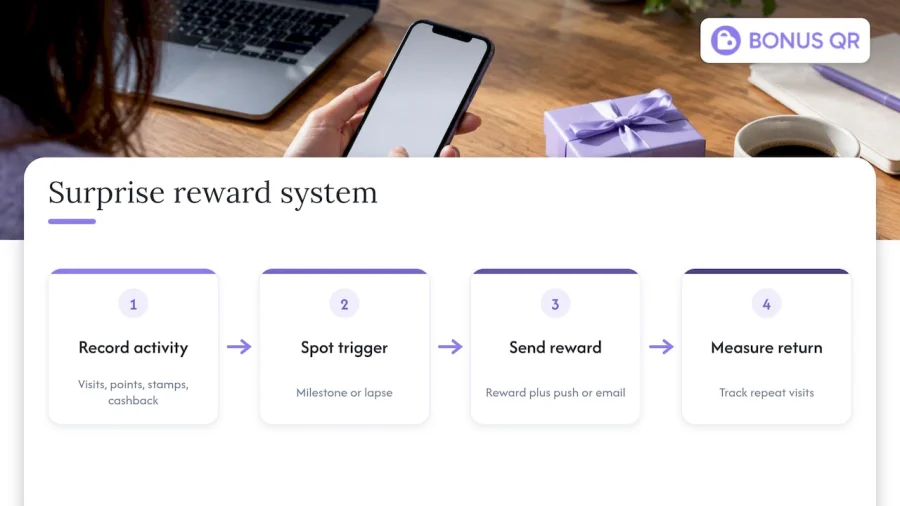
That’s why we think the work belongs in the loyalty engine. Once visits, points, stamps and cashback are recorded, the data to spot a milestone or a lapse already exists. Automated rewards and push or email notifications can then deliver a surprise at the right moment without anyone keeping a list. The surprise stays a surprise to the customer; it’s simply no longer an accident for you.
Our advice is to keep the structure predictable and the extras unpredictable. Let customers earn stamps or points by clear rules, and use special-occasion rewards and unannounced gestures as the layer on top. And measure it, because loyalty is the lifeblood of a small business, and anything that costs money should show up in repeat visits.
— Michal Palus
Setting up surprise rewards with BonusQR
If you’d like to run this without spreadsheets, BonusQR is a QR-based digital loyalty platform that works without a POS system. You can build stamp cards, points, tiered cashback and fixed discounts, add onboarding promos and special occasion rewards, and send push or email notifications to customers.
Plans start with a Free option, then Basic at €19 per month and Premium at €69 per month. See the pricing page for what each includes. If you want a branded app, there is also a white-label option.
For more on the mechanics, read our guides on how to automate loyalty campaigns, building a rewards program and our fuller surprise and delight guide. Restaurant owners may also like our customer retention strategies for restaurants and our list of customer incentive ideas.
A 30-day plan to start
You don’t need a full campaign. Try this sequence.
- Week 1: set your baseline. Note how many customers return within 30 days. Fix any obvious service problems first.
- Week 2: build the core. Launch a simple stamp card or points scheme, with a modest welcome reward on the first visit.
- Week 3: add two surprise triggers. For example, an unannounced gift on the fifth visit and a comeback message after a six-week gap.
- Week 4: review. Count gifts sent, cost, and how many recipients returned. Adjust.
Keep a short note on what you tried. After two months you’ll know which gestures work for your customers, which is worth more than any list of examples.
FAQ
What is a surprise and delight reward?
It is an unexpected gift, perk or gesture given to a customer outside the normal rules of your loyalty program. The surprise is what creates the emotional effect. If the customer knew about it in advance, it counts as a regular promotion.
How do you delight a customer on a small budget?
Use attention rather than cash: a handwritten note, a small free add-on, or remembering a regular’s usual order. Research summarized by Loyalty & Reward Co shows that a small surprise can please more than a larger expected reward. Aim for thoughtful, not expensive.
Is a first visit reward a surprise and delight tactic?
Only if the customer doesn’t expect it. A published welcome offer is an onboarding promotion, which is useful but predictable. An unannounced extra on the first or second visit is closer to genuine surprise and delight.
Can surprise rewards annoy loyal customers?
Yes. Research on unearned preferential treatment found that loyal members may resent perks given freely to non-members. Reward your program members first, and keep surprises varied and modest.
Sources
- Fueling growth through moments of customer delight, McKinsey
- Loyalty Psychology Series: Customer Delight, Loyalty & Reward Co
- 5 Successful Surprise and Delight Marketing Campaigns, CMSWire
- I Earn It, But They Just Get It: unearned preferential treatment, SAGE Journals
- The best surprise and delight examples, Network Solutions
- How to increase customer retention: 5 proven strategies


