A step by step cashback programme is a structured loyalty initiative that rewards customers with a percentage of their purchase value back as credit or cash, motivating repeat business and increasing customer lifetime value (CLV). For small and medium-sized businesses, this approach turns one-time buyers into regular customers without relying on blanket discounts that erode margins. The key is structure: a well-sequenced cashback rewards guide covers prerequisites, a phased launch, and ongoing automation. Bonusqr’s loyalty platform is built precisely for this kind of phased rollout, giving SMBs the tools to launch, measure, and refine a cashback programme without complex POS integration.
What do you need before launching a cashback programme?
Preparation separates a cashback programme that builds loyalty from one that quietly drains your margins. Before you configure a single reward, you need three things: baseline data, the right tools, and a trained team.
Measure your baseline metrics first
A repeat purchase rate below 20% signals a loyalty problem, not an acquisition problem. That distinction matters because cashback programmes solve loyalty problems, not traffic problems. Alongside repeat purchase rate, track CLV and average purchase frequency. These three numbers tell you where your programme needs to move the needle.
| Metric | What it tells you | Target before launch |
|---|---|---|
| Repeat purchase rate | How many customers return | Above 20% is healthy |
| Customer lifetime value | Total revenue per customer | Rising quarter on quarter |
| Purchase frequency | How often customers buy | Benchmark for reward triggers |
Tools and integrations you need
Your cashback programme will fail if your sales data and marketing tools do not talk to each other. Synchronised data across email, SMS, and on-site offers enables timely reward progress updates and prevents the programme from becoming an isolated silo. At minimum, you need a CRM or loyalty platform, a way to capture purchase data, and a marketing automation tool for sending reward communications.
- Loyalty platform: Handles reward calculation, customer balances, and redemption. Bonusqr covers all three without requiring POS integration.
- CRM or customer database: Stores purchase history and contact details for personalised reward triggers.
- Email and SMS tool: Sends reward progress updates, win-back campaigns, and cashback balance nudges.
- Analytics dashboard: Tracks repeat purchase rate, CLV, and programme ROI in real time.
Pro Tip: Connect your loyalty platform to your email tool before launch day. Sending a reward confirmation email within one hour of a purchase increases the chance of a second visit significantly.
Train your team before customers arrive
Your staff are the first point of contact for any customer question about the programme. Brief them on how cashback is earned, how it is redeemed, and what to say when a customer asks why their balance has not updated. A short internal FAQ document and a 30-minute briefing session are enough for most small teams.
What are the weekly steps to launch a cashback programme?
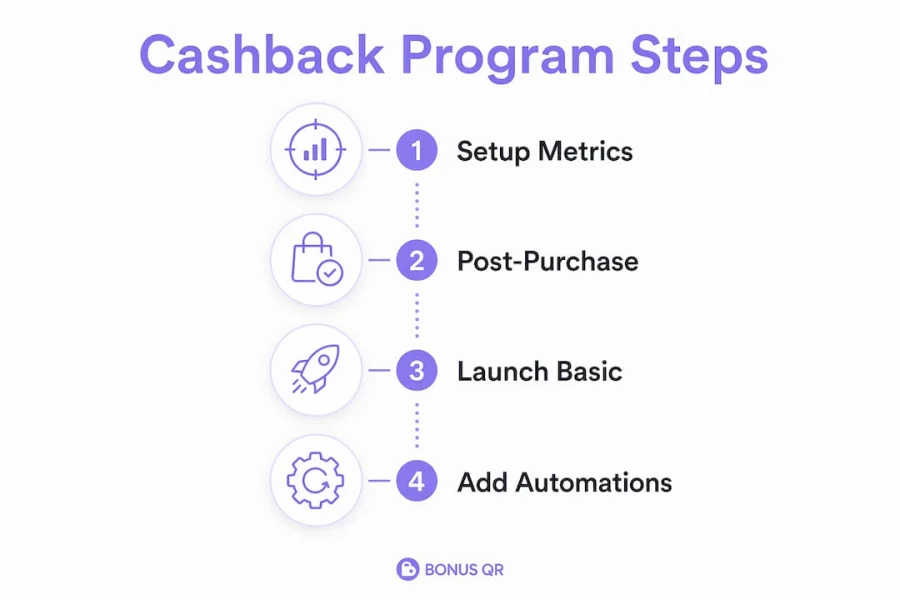
An effective cashback programme can be launched over four weeks with specific milestones for each stage. This phased approach lets you test and adjust before the programme reaches its full audience.
Week 1: Set up your metrics and tracking
Spend the first week establishing your baseline. Pull your repeat purchase rate, CLV, and purchase frequency from your existing sales records. If you do not have this data, set up tracking now so you have a clean starting point. Configure your loyalty platform with your cashback rate, minimum spend threshold, and reward expiry rules.
- Export the last 12 months of customer purchase data.
- Calculate repeat purchase rate: divide returning customers by total customers.
- Set your cashback percentage based on your average margin (a common starting point for margin-sensitive categories is 3–5%).
- Configure your loyalty platform with these parameters.
- Test the reward calculation with five dummy transactions before going live.
Pro Tip: Keep your cashback rate fixed for the first 90 days. Changing it too early confuses customers and makes it harder to measure the programme’s true impact.
Week 2: Improve your post-purchase communication

Most SMBs underestimate the power of the period immediately after a sale. Week 2 is about building a communication sequence that confirms the purchase, updates the customer on their cashback balance, and sets expectations for the next reward.
| Timing | Purpose | |
|---|---|---|
| Purchase confirmation | Immediately | Confirm transaction and cashback earned |
| Cashback balance update | 24 hours later | Show current balance and next reward milestone |
| Onboarding welcome | Day 3 | Explain how to redeem and what to expect |
A simple three-email sequence is enough to start. Each message should be short, clear, and focused on one action. Customers who understand how close they are to the next reward tier spend more to reach it. That behavioural nudge costs you nothing extra to deliver.
Week 3: Launch your basic cashback model to existing customers
Do not launch to the general public first. Start with your existing customer base. These customers already trust you, which means they are more likely to engage with the programme and give you honest feedback. Send a dedicated launch email explaining the cashback rate, how to check their balance, and how to redeem rewards.
Simple cashback reward models work best for margin-sensitive product categories because customers understand them immediately. Avoid complex point-to-cash conversion ratios in the first month. A clear message like “Earn 4% back on every purchase, redeemable from £10” outperforms a complicated points table every time.
- Send a launch email to your existing customer list.
- Include a clear explanation of the cashback rate and redemption rules.
- Add a link to a FAQ page or a short explainer video.
- Monitor open rates and redemption requests in the first 48 hours.
- Respond personally to any customer queries about the programme in the first week.
Week 4: Add automations and win-back campaigns
By week 4, you have real data. Use it. Set up automated triggers based on customer behaviour: a reward progress nudge when a customer is within 20% of their next cashback threshold, and a win-back campaign for customers who have not purchased in 60 days.
Automating loyalty emails and SMS campaigns can increase repeat purchases by approximately 20–27%. That is a material gain for any SMB operating on thin margins. The automation does not need to be complex. Three triggers cover most scenarios: a progress nudge, a win-back message, and a reward expiry reminder.
Pro Tip: Set your win-back campaign to fire at 60 days of inactivity, not 90. Most customers who return after a lapse do so within the first two months. Waiting too long reduces the chance of recovery.
What mistakes should you avoid with cashback programmes?
Cashback programmes carry real risks when they are poorly designed or communicated. Understanding these pitfalls before launch protects both your margins and your brand reputation.
Do not make cashback the main reason to buy
Retail experts warn that positioning cashback as the primary purchase motivator leads to excessive consumption patterns that damage long-term profitability and customer loyalty. Customers who only buy because of a cashback offer are not loyal customers. They are deal-seekers who will leave the moment a better offer appears elsewhere.
“Cashback should be a bonus for behaviour your customers were already planning, not a bribe to change their behaviour entirely. When it becomes the main reason to buy, you have created a discount programme with extra steps, and your margins will reflect that.”
Position cashback as a thank-you for repeat business, not as a discount on the current purchase. The framing changes how customers perceive the programme and how it affects your brand.
Avoid discount dependency and margin erosion
- Flat discounts teach customers to wait. Too frequent or high discounts condition customers to delay purchases until a promotion appears, which harms both revenue predictability and brand perception.
- Cashback rate creep is a real risk. Increasing your cashback rate to drive short-term sales creates an expectation that is hard to walk back without disappointing customers.
- Tiered cashback protects margins better. A tiered cashback model rewards higher spenders with better rates, which means your most generous rewards go to your most valuable customers.
- Overuse dilutes the reward’s perceived value. If every transaction earns cashback regardless of size or frequency, the reward feels ordinary rather than earned.
Pro Tip: Review your cashback programme’s margin impact monthly for the first quarter. Calculate the total cashback issued against the incremental revenue generated by returning customers. If the ratio is unfavourable, adjust the minimum spend threshold before changing the cashback rate.
Keep the programme simple and transparent
Complexity kills cashback programmes. If a customer cannot explain how the programme works in two sentences, the communication has failed. Avoid expiry rules that are hard to track, conversion ratios that require a calculator, and redemption processes that involve multiple steps. Clarity builds trust, and trust drives repeat visits.
Good customer retention strategies consistently show that simplicity is the single biggest factor in whether customers engage with a loyalty programme or ignore it. Keep the rules short, the rewards visible, and the redemption process frictionless.
How do you automate and optimise your cashback programme?
Automation turns a manually managed cashback programme into a system that works while you focus on running your business. The goal is to link loyalty data with purchase behaviour so that the right message reaches the right customer at the right moment.
Connect your data sources
Your loyalty platform and your sales system need to share data in real time. Integration dissolves loyalty programme silos and enables coordinated, personalised customer communication across email, SMS, and in-store touchpoints. Without this connection, you end up sending generic messages that customers ignore.
- Link your loyalty platform to your sales or e-commerce system so cashback balances update automatically after each purchase.
- Connect your CRM to your email tool so customer segments update based on purchase behaviour, not manual lists.
- Set up a real-time analytics dashboard that shows repeat purchase rate, cashback redemption rate, and programme ROI in one place.
Build three core automations
Three automations cover the majority of SMB cashback programme needs. Each one targets a specific customer behaviour and requires minimal ongoing maintenance once configured.
- Progress nudge: Triggered when a customer reaches 80% of the spend needed for their next cashback reward. The message shows their current balance and the amount remaining. This single automation drives a measurable uplift in average order value.
- Win-back campaign: Triggered at 60 days of customer inactivity. The message reminds the customer of their unused cashback balance and offers a time-limited bonus for returning. Loyalty email automation consistently shows strong results for re-engaging lapsed customers.
- Reward expiry reminder: Triggered 14 days before a cashback balance expires. Urgency is a proven motivator, and this message converts a significant proportion of customers who would otherwise let their balance lapse.
Pro Tip: Test your automations with a small segment of customers before rolling them out to your full list. Send to 10% of your list first, check open rates and click-through rates, then adjust the subject line or timing before the full send.
Monitor and adjust regularly
Set a monthly review date for your programme metrics. Track repeat purchase rate, cashback redemption rate, and the ratio of cashback issued to incremental revenue. If redemption rates are low, the problem is usually communication, not the reward itself. If margins are tightening, the problem is usually the cashback rate or the minimum spend threshold. Adjust one variable at a time so you can isolate the cause of any change. Relationship marketing principles confirm that consistent measurement and small, frequent adjustments outperform large, infrequent overhauls every time.
Key takeaways
A step by step cashback programme succeeds when it is built on accurate baseline data, launched in phases, and automated with behaviour-triggered communications that protect margins while rewarding genuine loyalty.
| Point | Details |
|---|---|
| Measure before you launch | Track repeat purchase rate, CLV, and purchase frequency to set meaningful reward thresholds. |
| Phase the rollout over four weeks | Use weekly milestones to test, adjust, and scale before opening the programme to all customers. |
| Keep the model simple | A clear cashback rate and straightforward redemption rules drive higher engagement than complex point systems. |
| Automate three core triggers | Progress nudges, win-back campaigns, and expiry reminders cover most SMB retention needs with minimal effort. |
| Protect your margins | Position cashback as a reward for planned behaviour, not a discount, and review the margin impact monthly. |
Why simplicity is the most underrated cashback strategy
Most SMB owners I speak with assume a cashback programme needs to be sophisticated to be effective. They picture tiered structures, dynamic rates, and complex segmentation before they have even sent their first reward email. That instinct is understandable, but it is almost always wrong.
The businesses I have seen get the best results from cashback programmes are the ones that start with one rate, one redemption rule, and one automated email. They measure what happens, then add complexity only where the data tells them to. A café that offers 5% back on every purchase and sends a balance update after each visit will outperform a retailer with a six-tier points system that customers cannot explain.
The other lesson that consistently surprises SMB owners is how much the framing matters. Customers who receive a cashback balance update feel rewarded. Customers who receive a discount code feel like they caught a sale. The first group comes back because they feel valued. The second group comes back only when the next code arrives. That distinction is worth more than any percentage point of cashback rate.
Start with the four-week plan. Measure honestly. Adjust one thing at a time. The businesses that build lasting loyalty through cashback are not the ones with the most sophisticated programmes. They are the ones that stayed consistent, kept it simple, and let the data guide every change.
— Michal
How Bonusqr supports your cashback programme from day one
Bonusqr is built for exactly the kind of phased, data-driven cashback rollout described in this article. The platform links sales data with marketing tools, so your cashback balances update automatically and your reward emails go out without manual intervention. You can configure a basic cashback model in under an hour, then add tiered rewards and win-back automations as your programme matures. Customers access their balance through a mobile or web app, which keeps engagement high without requiring a physical card. The loyalty platform features include push notifications, real-time analytics, and full branding customisation, giving you everything needed to run a professional programme from a single dashboard. No POS integration is required to get started.
FAQ
What is a step by step cashback programme?
A step by step cashback programme is a phased loyalty initiative that rewards customers with a percentage of their purchase value back as credit, launched in structured weekly stages to allow testing and adjustment before full rollout.
How do I calculate the right cashback rate for my business?
Base your cashback rate on your average product margin. A starting rate of 3–5% works for most margin-sensitive retail categories and is low enough to protect profitability while still motivating repeat purchases.
Is a cashback programme worth it for a small business?
A cashback programme is worth it when your repeat purchase rate is below 20%, as this signals a loyalty gap that cashback rewards are designed to close. The programme pays for itself when returning customers spend more than the cashback cost.
How do I avoid losing money on a cashback programme?
Set a minimum spend threshold for cashback redemption, review your margin impact monthly, and position cashback as a reward for planned purchases rather than a discount. Tiered cashback models protect margins better than flat discount structures.
How long does it take to see results from a cashback programme?
Most SMBs see measurable changes in repeat purchase rate within 60–90 days of launch. Win-back automations typically show results within the first 30 days of activation, as lapsed customers respond quickly to balance reminder messages.


