
 Deutsch
 Español
 Français
 Italiano
 Magyar
 Polski
 Slovenčina
 Čeština

TL;DR:
- Automating loyalty emails significantly reduces operational costs and boosts customer retention.
- Proper setup, segmentation, and ongoing optimization are essential for successful loyalty automation.
- Small businesses can achieve substantial growth and savings through strategic, personalized loyalty email campaigns.
Automating loyalty emails is no longer a luxury for large retailers. Businesses that still manage loyalty campaigns manually are spending hours on tasks that software can handle in seconds, and they are paying for it in lost revenue and customer churn. [RetailCo saved $250k per year](https://www.emailserv icebusiness.com/blog/email-automation-cost-savings-case-study/) while cutting costs in half and doubling their email list. Ana Luisa doubled credit redemptions. StickyDigital saw a 23% repeat purchase rate boost. These results are not accidents. They come from building smart, automated loyalty email systems that deliver the right message at the right moment, every time.
Key Takeaways
| Point | Details |
|---|---|
| Automate for efficiency | Automating loyalty emails saves time, cuts costs, and boosts repeat purchases. |
| Prepare your data | A clean, segmented email list is crucial for effective automation. |
| Personalization is key | Tailored messages drive engagement and lift redemption rates. |
| Measure and optimize | Track results and adjust your campaigns for continuous improvement. |
Understanding the value of automating loyalty emails
Automation removes the manual work from loyalty email management. Instead of someone manually sending birthday offers or points reminders, triggers fire automatically based on customer behavior. That means your team focuses on strategy while the system handles execution.
The benefits of automating loyalty campaigns go well beyond saving time. Real-world data shows the financial impact is significant. RetailCo cut email costs by 50% and doubled their subscriber list after switching to automation. Ana Luisa saw twice as many credit redemptions. These are not outliers. They reflect what happens when loyalty messaging becomes consistent, timely, and personalized.
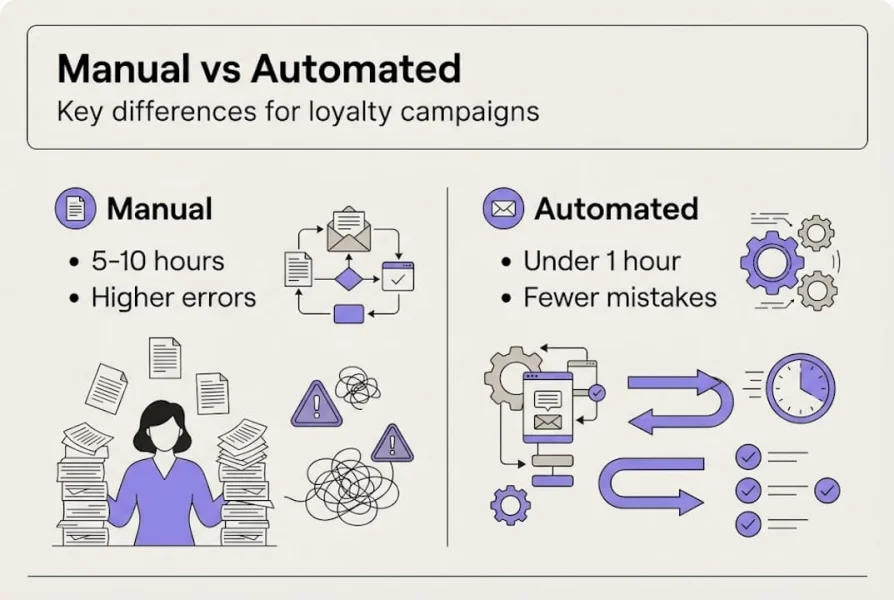
Here is a quick comparison of manual versus automated loyalty email management:
| Factor | Manual management | Automated management |
|---|---|---|
| Time per campaign | 5-10 hours | Under 1 hour (setup only) |
| Personalization scale | Limited | Unlimited with segmentation |
| Trigger accuracy | Human error risk | Behavior-based, precise |
| Cost over 12 months | High (staff time) | Lower after initial setup |
| Retention impact | Inconsistent | Measurable and repeatable |
The customer retention impact of automation is hard to overstate. When customers receive relevant offers at the right moment, they buy again. When they do not hear from you, they forget you exist.
Key benefits of automating your loyalty emails include:
- Increased repeat purchases through timely, triggered messaging
- Higher list growth because automated welcome sequences convert sign-ups faster
- Measurable ROI with clear data on open rates, redemptions, and revenue
- Reduced operational costs once workflows are built and running
- Consistent brand experience across every customer touchpoint
“Businesses that fail to automate loyalty communications risk falling behind competitors who are already delivering personalized, timely experiences at scale.”
If you are still sending loyalty emails manually, you are not just losing time. You are losing customers to businesses that communicate better.
Setting up your loyalty email automation: Tools and requirements
Understanding value is critical, but first, you need the right tools and setup. Choosing the wrong platform or skipping data preparation will cost you more time than it saves.

Start by selecting an email automation platform that integrates with your loyalty program. Popular options include Klaviyo, Mailchimp, ActiveCampaign, and HubSpot. Each offers trigger-based workflows, segmentation, and analytics. Your loyalty platform should connect via API or native integration so customer actions, like earning points or reaching a reward tier, automatically trigger the right email.
Companies that optimized their tools saw measurable list growth and stronger retention outcomes. The platform matters, but so does how you prepare your data before flipping the switch.
Here is a comparison of common automation platforms for SMBs:
| Platform | Best for | Starting cost | Loyalty integration |
|---|---|---|---|
| Klaviyo | E-commerce brands | ~$20/month | Strong via API |
| Mailchimp | General SMBs | Free tier available | Moderate |
| ActiveCampaign | Advanced segmentation | ~$29/month | Strong |
| HubSpot | CRM-first businesses | Free tier available | Moderate |
Before you connect anything, make sure you have these in place:
- Clean customer data: Remove duplicates, fix email errors, and verify consent
- Segmented lists: Group customers by purchase history, loyalty tier, or engagement level
- Permission records: Confirm you have opt-in documentation for all contacts
- Loyalty trigger map: Know exactly which customer actions should fire which emails
- Brand assets ready: Logos, colors, and approved copy for your email templates
Pro Tip: Run a data audit before connecting your loyalty platform to your email tool. Even a 10% error rate in your contact list can significantly reduce deliverability and skew your performance data.
For most SMBs, initial setup takes between 10 and 30 hours depending on list size and workflow complexity. Budget for that time upfront. You can explore methods to automate loyalty emails that fit your specific business model and customer base.
Step-by-step: Automating your first loyalty campaign
With the tools ready, now it is time to automate your first campaign, step by step.
-
Map your customer journey. Identify every point where a customer interacts with your loyalty program. Sign-up, first purchase, point milestone, reward redemption, and lapse are all key moments. Each one is a potential trigger for an automated email.
-
Define your triggers. Decide which customer actions automatically start an email sequence. For example, earning 100 points triggers a “You’re almost at a reward” email. A 60-day purchase gap triggers a win-back offer.
-
Write your email copy. Keep subject lines short and benefit-focused. Body copy should be direct, personalized with the customer’s name and loyalty status, and include one clear call to action. Avoid sending walls of text.
-
Design your templates. Use your brand colors and keep layouts simple. Mobile-first design is essential since most loyalty emails are opened on phones.
-
Set your schedule and delays. Decide how long after a trigger an email should send. A welcome email should go out immediately. A points reminder might wait 48 hours after a purchase.
-
Segment your audience. Do not send the same email to everyone. New members need different messaging than loyal regulars. Reward automation strategies work best when they reflect where each customer is in their journey.
-
Test before you launch. Send test emails to internal accounts. Check every link, every personalization tag, and every trigger condition. One broken link can undermine an entire campaign.
StickyDigital saw a 23% repeat rate boost, and Curate increased retention by 27% after implementing automations. Both results came from disciplined setup and ongoing refinement, not just turning on a tool.
Pro Tip: Start with just two or three core sequences: a welcome series, a points milestone alert, and a lapse win-back. Master those before adding complexity. You can always increase customer lifetime value by layering in more triggers over time.
Troubleshooting, optimizing, and measuring results
Setting up automation is just the start. Ensuring it works and delivers results takes ongoing attention.
The most common mistakes businesses make after launch include:
- Missed triggers: A workflow condition is too narrow, so many customers never receive the email
- Outdated lists: Contacts who have unsubscribed or changed emails still sit in active segments
- No personalization: Emails address customers generically, reducing relevance and open rates
- Regulatory gaps: Missing unsubscribe links or non-compliant data handling creates legal risk
- Ignoring mobile: Templates that look great on desktop break on phones, where most emails are read
A/B testing is your most reliable tool for improvement. Test one variable at a time: subject line, send time, offer type, or call-to-action wording. Run each test for at least two weeks before drawing conclusions. Small changes often produce significant results.
“Optimization is not a one-time event. The businesses that win at loyalty automation treat it as an ongoing practice, not a setup task.”
Track these metrics consistently:
- Repeat purchase rate: Are customers coming back more often after receiving loyalty emails?
- Redemption rate: What percentage of customers act on reward offers?
- List growth rate: Is your subscriber base expanding month over month?
- Email open and click rates: Are your subject lines and content resonating?
- Customer lifetime value (CLV): Is automation translating into long-term revenue?
Ana Luisa doubled redemption rates, and StickyDigital reported a 14 to 18% boost in CLV after optimization. Those numbers came from consistent measurement and willingness to adjust. Review your great loyalty campaign ideas regularly and explore different types of loyalty rewards to keep your offers fresh and relevant.
Set a monthly review cadence. Look at what is working, what is not, and make one or two targeted changes each cycle. That steady improvement compounds over time.
Why most small businesses fail at loyalty automation (and how to win)
Most small businesses underestimate how much work goes into the setup phase. They install a tool, create one welcome email, and expect results. When the numbers disappoint, they assume automation does not work for their size or industry. That conclusion is wrong.
The real problem is treating automation as a one-time project rather than an active retention strategy. The businesses that win are the ones that build feedback loops, review their data monthly, and keep their offers relevant to what customers actually want.
Personalization is the other major gap. Generic loyalty emails get ignored. Emails that reference a customer’s actual points balance, favorite product category, or reward tier get opened and acted on. Achieving that level of relevance requires clean data and thoughtful segmentation from day one.
If you want to build customer engagement on a budget, loyalty automation done right is one of the highest-return investments available to an SMB. But it requires commitment, not just configuration.
Take your loyalty automation further with BonusQR
If you are ready to take the next step in loyalty automation, BonusQR can help make it seamless. The platform brings together the advanced loyalty platform features you need, including points collection, stamp cards, cashback, and coupon distribution, all in one place. You can connect it directly to mobile loyalty applications so customers engage with your program wherever they are. For businesses looking to reward consistent spending, tiered cashback rewards offer a proven way to increase average order value and repeat visits. BonusQR is built for SMBs that want real results without complex integrations or long setup timelines. Explore the platform and see how quickly you can launch.
Frequently asked questions
What are the first steps to automate loyalty emails?
Start by selecting an automation tool that integrates with your loyalty program, organizing your customer data into clean segments, and defining the key loyalty triggers that will fire your email sequences.
How do I measure the success of loyalty email automation?
Track repeat purchase rate, customer retention, and redemption rates as your primary indicators. Benchmarks like StickyDigital’s 23% repeat rate boost and Curate’s 27% retention lift give you realistic targets to aim for.
What common mistakes should I avoid with loyalty automation?
Avoid inaccurate triggers, outdated contact lists, and generic messaging without personalization. These three issues are responsible for most underperforming loyalty automation programs.
Is loyalty email automation suitable for small businesses?
Absolutely. RetailCo saved $250k per year and Curate achieved a 27% retention lift, both demonstrating that automation delivers strong results regardless of business size when set up with care.