A digital stamp card combined with a simple points engine is the fastest, most cost-effective loyalty programme a small business in Central Europe can launch right now. Bonusqr is the platform to trial first: it requires no POS integration, supports multiple Central European languages, and its freemium tier means you can test the concept before spending a single euro.
Why this approach works:
- Speed to market. A digital stamp card can be live within a week using Bonusqr’s modular setup, with no hardware changes to your till or counter.
- Low setup cost. The freemium plan covers the basics; paid tiers scale as your member base grows, keeping early costs predictable.
- Central Europe ready. Bonusqr’s platform handles GDPR-compliant data collection and supports the languages your customers actually speak, from Czech and Polish to Slovak and Hungarian.
Your first step: sign up for a free Bonusqr trial and configure a six-stamp digital card with a free product or discount as the reward. That single action puts you ahead of most independent shops in your area—research from a leading loyalty association shows that most brands already run a formal loyalty programme.
Key takeaways
A digital stamp card combined with a points engine is the fastest and most cost-effective loyalty programme a small business in Central Europe can launch, with Bonusqr offering a freemium entry point that requires no POS integration.
| Point | Details |
|---|---|
| Start with one mechanic | Launch a digital stamp card first; add points or referral modules after 90 days once behaviour is proven. |
| Four-to-eight week rollout | Plan, configure, train staff, soft-launch, then full launch; reward economics work best at a six-stamp threshold. |
| Track four KPIs | Monitor retention rate, repeat frequency, average order value, and CLV from month one. |
| Central Europe requires localisation | Multi-language support and GDPR compliance are non-negotiable for any programme operating in the Czech Republic, Poland, Slovakia, or Hungary. |
| Bonusqr fits the brief | Bonusqr’s modular platform covers stamps, points, referrals, messaging, and analytics with a freemium entry and no POS dependency. |
What types of loyalty programme suit a small business?
Not every programme model fits every shop. The right choice depends on how often customers visit, how much they spend per transaction, and how much operational complexity you can absorb at launch.
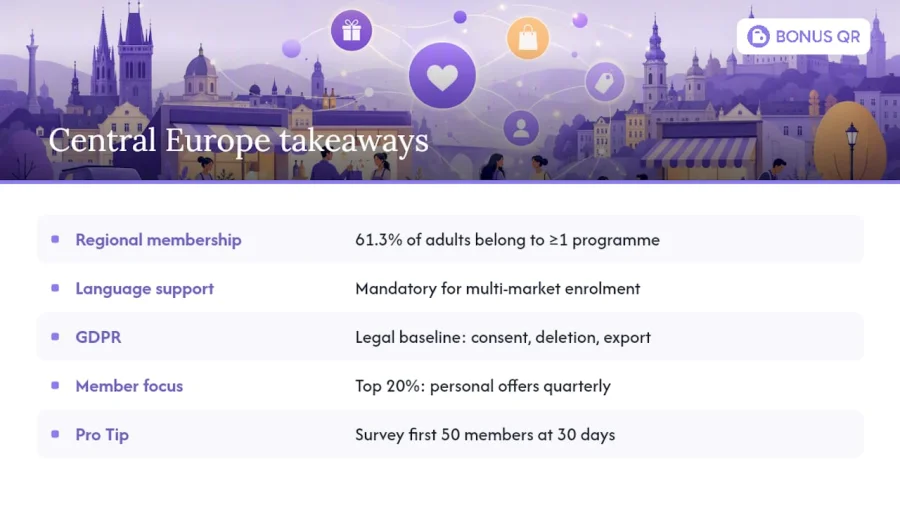
Across 24 European markets, 61.3% of adults are members of at least one loyalty programme, yet the mechanics they engage with vary considerably by sector and country. Understanding the main programme types helps you pick the one that matches your business rather than copying what a larger retailer does.
| Programme type | Best sector fit | Setup complexity | Typical cost shape | Member friction |
|---|---|---|---|---|
| Digital stamp/punch card | Cafés, bakeries, barbers | Low | Low fixed monthly fee | Very low |
| Points on spend | Retail, grocery, pharmacy | Medium | Monthly fee + reward budget | Low |
| Tiered membership | Gyms, wellness, hotels | Medium–high | Monthly fee + tier management | Medium |
| Cashback/membership | Fuel, grocery, multi-visit retail | High | Higher platform + cashback float | Low |
| Referral programme | Any sector | Low | Reward cost per referral | Low |
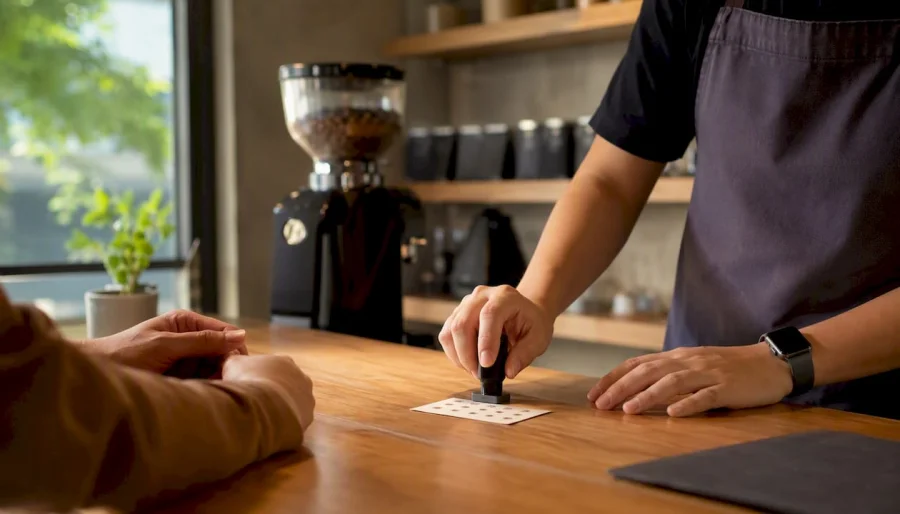
Digital stamp cards are the natural starting point for cafés, bakeries, and personal-service businesses. Customers collect a stamp per visit or purchase and redeem a reward after a set number. The mechanic is instantly understood, requires no app download when delivered via QR code or web link, and generates repeat visits reliably.
Points on spend suit retailers where basket sizes vary. Customers earn points proportional to what they spend, which encourages larger purchases. The trade-off is slightly more complexity at the counter: staff need to know how to validate a transaction.
Tiered programmes work well for gyms, wellness centres, and hotels where a customer’s annual value differs sharply between casual and committed members. Tiers create aspiration, but they demand more data and more communication to keep members engaged with their status.
Cashback and membership models are common in fuel retail and grocery, where margins and volumes support a percentage-back mechanic. They tend to require more sophisticated platform features and a cashback float, making them a better fit once you have proven the concept with a simpler model.
Referral programmes are the most capital-efficient customer acquisition tool available to a small business. You reward an existing customer for bringing in a new one, so the cost only triggers when a real acquisition happens. They work in almost every sector and pair naturally with any of the other programme types. For loyalty card ideas that work in practice, combining a stamp card with a referral incentive is a particularly effective early combination.
Pro Tip: Start with one programme type only. Running a stamp card and a points scheme simultaneously from day one confuses staff and customers alike. Add a second mechanic after your first 90 days, once you know which customer behaviours you are actually seeing.
Which features does your loyalty platform actually need?
Research from LoyaltyLion found that 88% of brands believe loyalty programmes increase revenue, yet setup complexity is one of the most commonly cited barriers to getting started. The solution is to prioritise ruthlessly: get the essentials right first and defer everything else.
Must-have features at launch
- Stamp or points tracking. The core mechanic must work reliably every time, whether via QR code scan, a PIN, or a manual entry. Validation errors at the counter destroy customer trust faster than any other issue.
- Flexible validation methods. Your staff should be able to validate a transaction in under ten seconds. QR code scanning via a phone camera is the lowest-friction option for most small businesses.
- Rewards catalogue. Even a simple catalogue of two or three rewards (a free coffee, a 10% discount, a free product) gives customers a clear goal to work towards.
- Customer messaging. Push notifications, email, or SMS to remind inactive members they have uncollected stamps or points. A single well-timed message can recover a lapsing customer.
- Basic analytics. You need to see, at minimum: total active members, redemption rate, and which reward is most popular. Anything beyond that is useful but not urgent.
Features to defer until after launch
Advanced personalisation, complex partner reward networks, full CRM integration, and multi-tier management all add value eventually. None of them should delay your launch. The G2 loyalty management category lists dozens of features across vendors; most small businesses use fewer than a third of them in their first year.
Pro Tip: Choose a platform where you can activate features incrementally. Start with digital stamp plus basic points, then add tiers or referral modules after month three. A platform that forces you to configure everything upfront is a platform that will delay your launch by weeks.
How do you choose the right loyalty platform?
The vendor market is crowded. A structured checklist and a short list of direct questions will help you assess any platform in a single demo call.
Vendor checklist
- POS integration (or lack of requirement). Does the platform require a POS connection, or can it operate independently via QR code or web link? For most small businesses, POS-independent operation is faster and cheaper to launch.
- Multi-language support. If your customers speak Czech, Polish, Slovak, or Hungarian, your loyalty interface must work in those languages. A programme that displays in English only will see lower adoption.
- GDPR and data portability. Can you export your full customer list at any time? Who owns the data? These are not optional questions in the EU.
- Ease of onboarding. Ask for a sample onboarding timeline. A credible vendor should be able to get a small business live within one to two weeks.
- White-label options. If you want the programme to carry your brand rather than the platform’s, confirm whether white-labelling is available and at what cost.
- Pricing model. Understand the total cost: platform fee, reward fulfilment costs, and any per-transaction or per-member charges. The headline monthly fee is rarely the full picture.
Questions to ask in a demo
- What is your standard onboarding timeline for a business of my size?
- How do customers enrol: do they need to download an app, or can they join via a QR code or web link?
- Can I export my full member list, including contact data and transaction history, at any time?
- How does the platform handle GDPR consent capture and data deletion requests?
- What reporting is available out of the box, and can I export data to a spreadsheet?
- Do you have references from similar small businesses in Central Europe?
- What happens to my customer data if I cancel my subscription?
Red flags to watch for
- Pricing that is not publicly listed and requires a sales call to obtain even a ballpark figure.
- No ability to export customer data in a standard format (CSV, Excel).
- No references or case studies from businesses comparable to yours in size or sector.
- No support for Central European languages in the customer-facing interface.
- Long minimum contract terms with no monthly billing option.
YouGov’s analysis of CEE shopper panels confirms that loyalty programme strength is now a factor in how shoppers evaluate retailers in the region. A platform that cannot serve your customers in their own language is a competitive disadvantage from day one.
Step-by-step launch plan with realistic costs
A four-to-eight week rollout is achievable for most small businesses. The table below maps the key tasks across that window.
| Week | Focus | Key tasks |
|---|---|---|
| 1–2 | Planning and setup | Choose programme type; configure platform; set reward thresholds; upload branding |
| 3 | Creative and training | Design in-store signage; write staff script; brief team on validation process |
| 4 | Soft launch | Invite existing customers by email or SMS; test validation flow with real transactions |
| 5–6 | Full launch | In-store promotion; local social media posts; window signage live |
| 7–8 | Review and iterate | Check enrolment rate, redemption rate; adjust reward threshold if needed |
Sample budget bands
Low budget (under €50/month): Freemium or entry-level platform subscription; rewards funded from existing margin (e.g. a free coffee costs you €0.30–0.50 in goods); staff time for setup approximately four to six hours; printed A5 signage from a local printer.
Medium budget (€50–150/month): Paid platform tier with messaging and analytics; small paid social campaign at launch (€100–200 one-off); branded digital assets; occasional SMS campaign.
High budget (€150–400/month): Premium platform subscription or white-label app; ongoing SMS and push notification campaigns; loyalty-specific landing page; staff incentive for enrolments.
Hidden costs to plan for: reward fulfilment (the actual cost of free products or discounts), staff time for ongoing programme management (typically two to four hours per month), and any per-member fees that activate once your list grows past a threshold.
Pre-launch and launch marketing checklist
- Place a QR code enrolment prompt at the till and on tables or counters.
- Brief every staff member on a two-sentence enrolment script: “We have a loyalty programme — scan this code and get your first stamp today.”
- Send an email to your existing customer list announcing the programme and the welcome reward.
- Post once on each active social channel with a clear explanation of the reward.
- Consider a time-limited double-stamp offer for the first two weeks to accelerate early enrolment.
On reward economics: set your reward threshold so that the average customer reaches it within four to six visits. A threshold that takes twelve visits to reach will not change behaviour. A threshold of three visits is so easy it costs you margin without creating habit. Four to six is the practical sweet spot for most cafés and retail shops. For a broader set of customer retention strategies that complement your programme launch, Bonusqr’s resource library covers the full picture.
How do you measure whether your loyalty programme is working?
Measurement does not need to be complex. Four KPIs cover most of what a small business needs to know in the first six months.
- Retention rate: the percentage of customers who return within a defined period (typically 90 days). A programme that is working will show this number rising over the first three months.
- Repeat purchase frequency: how often an active member visits compared to a non-member. If members visit 30% more often than non-members, the programme is changing behaviour.
- Average order value (AOV): members who are working towards a reward often spend slightly more per visit. Track this separately for members and non-members.
- Customer lifetime value (CLV): the total revenue a customer generates over their relationship with your business. Even a modest increase in retention compounds into a significant CLV improvement over twelve months.
Worked ROI example
Suppose your café has 200 active loyalty members. Each visits an average of twice per month, spending €8 per visit. Without the programme, you estimate they would visit 1.5 times per month.
- Incremental visits per month: 200 members × 0.5 extra visits = 100 additional visits.
- Incremental revenue per month: 100 × €8 = €800.
- Reward cost: assume 10% of members redeem a free coffee (value €2.50) each month = 20 redemptions × €0.40 net cost = €8 in goods cost.
- Platform cost: €30/month (entry-level paid tier).
- Net monthly gain: €800 minus €38 = €762 incremental margin contribution before other variable costs.
That is a simplified model, but it illustrates the core logic: the reward cost is almost always small relative to the incremental revenue from more frequent visits.
Benchmark note: ELA’s practitioner survey found that 58% of brands cite commercial accountability as the primary driver for loyalty decisions, which means most serious operators are already tracking ROI this way. Measure at 30, 60, and 90 days and adjust your reward threshold if redemption rates are below 15% or above 40%.
What do Central Europe trends mean for your programme in 2026?
Central Europe is one of the more active loyalty markets in the region. YouGov’s CEE shopper panel data shows that loyalty programme strength now sits alongside price and convenience as a factor in retailer choice, which means a well-run programme is a genuine competitive differentiator, not just a nice addition.
Regional membership: 61.3% of European adults belong to at least one loyalty programme, with Great Britain and Poland showing the highest levels of appeal and active engagement. Markets like the Netherlands and Denmark show lower enthusiasm, suggesting that programme design needs to match local consumer expectations rather than copying a single European template.
For small businesses operating across more than one Central European market, language support is not optional. A programme that displays in Czech for a Prague café but switches to English for a Bratislava branch will see measurably lower enrolment in the second location. Multi-language configuration should be confirmed before you sign any platform contract.
GDPR compliance is a legal baseline across all EU markets, including the Czech Republic, Poland, Slovakia, and Hungary. Your platform must capture explicit consent at enrolment, support data deletion requests, and allow you to export member data on demand. This is not a differentiator; it is a minimum requirement.
The ELA’s 2026 ebook highlights that the most effective loyalty teams in Europe are balancing data-driven personalisation with genuinely human experiences. For a small business, that translates practically: use your analytics to identify your top 20% of members and send them a personal thank-you message or an exclusive offer once a quarter. The technology enables it; the human touch is what makes it memorable.
CX Network’s 2026 analysis makes the point that emotional connection and a clear, simple experience are becoming more important than points accumulation alone. Customers in Central Europe, as elsewhere, are members of multiple programmes simultaneously. The ones they actually use are the ones that feel effortless and deliver rewards they genuinely want.
Pro Tip: Survey your first 50 enrolled members after 30 days. Ask one question: “What reward would make you visit us more often?” The answers will tell you more than any benchmark report.
Why does Bonusqr fit small businesses in Central Europe?
Bonusqr’s modular architecture maps directly to the feature priorities a small business actually needs, without forcing you to pay for capabilities you will not use in year one.
Feature mapping
| Must-have feature | Bonusqr module |
|---|---|
| Digital stamp tracking | Digital stamp card module |
| Flexible validation (QR/PIN/manual) | QR code scan, PIN entry, or staff-side validation |
| Points engine | Points on spend module |
| Rewards catalogue | Configurable reward tiers and coupon management |
| Customer messaging | Push notifications, email, and SMS campaigns |
| Basic analytics | Real-time dashboard with member and redemption data |
| Referral programme | Referral and review module |
| Multi-language support | Localisation settings for Central European languages |
| GDPR compliance | Consent capture, data export, and deletion tools |
| White-label option | Branded app with one-time setup fee |
Bonusqr’s customer loyalty card platform covers all of the above in a single subscription, with no POS integration required. You validate transactions via QR code on a phone or tablet, which means setup involves no hardware procurement and no IT project.
Pricing shape
- Freemium: core stamp and points features, limited member count; suitable for testing the concept before committing.
- Paid subscription tiers: unlock messaging, advanced analytics, and higher member limits; monthly billing with no long minimum contract.
- White-label app: a one-time setup fee for a fully branded mobile app carrying your logo and colours, with ongoing subscription for platform access.
Exact pricing is available on the Bonusqr website and varies by plan tier and member volume. The freemium entry point means you can validate the concept with real customers before any significant spend.
Mini case example
A café operator in Central Europe with two locations configured a six-stamp digital card on Bonusqr in under three days. Staff validated transactions via QR code on a shared tablet at the counter. Within 60 days, the operator had enrolled over 300 members and observed that enrolled customers visited an average of 2.3 times per month compared to 1.6 times for non-enrolled regulars. The reward (a free drink on the sixth stamp) cost approximately €0.45 in goods per redemption. The programme required no POS changes and ran entirely through the Bonusqr web interface.
Explore the full range of loyalty programme types available through Bonusqr to find the mechanic that fits your sector and customer profile.
What I would do if I ran a small shop in Prague, Bratislava, or Kraków
If I were opening a café or independent retail shop in any of those cities today, I would launch a six-stamp digital card on day one and add a referral incentive in month two. The stamp card is the fastest way to change visit frequency; the referral module is the cheapest way to grow the member list once the core mechanic is proven.
My personal tips for the first 90 days:
- Script your staff. Write a single sentence for them to say at every transaction: “Scan this code and get your first stamp free.” Consistency at the counter is what drives enrolment, not marketing spend.
- Set the reward threshold at six stamps, not ten. Customers need to feel progress quickly. Six visits is achievable within a month for a regular café customer.
- Check your redemption rate weekly. If fewer than 10% of members are redeeming, your reward is not compelling enough or your threshold is too high. Adjust before month two.
- Send one push notification per month to inactive members. A simple “You have three stamps waiting — come in this week for a double stamp” message recovers lapsing customers at near-zero cost.
My prioritised next step: configure your programme today, run a soft launch with your ten most loyal existing customers, and use their feedback to adjust the reward before you promote it publicly. Real feedback from real customers in the first week is worth more than any amount of planning.
Bonusqr gives you a clear starting point
Most brands already run a formal loyalty programme, and 60% operate omni-channel programmes; the gap between those businesses and the ones that do not is widening. Bonusqr is built for small businesses that want to close that gap without a long IT project or a large upfront investment.
The free tier lets you configure a digital stamp card, enrol your first members, and validate real transactions before you spend anything. When you are ready to add messaging, analytics, or a referral module, the paid tiers unlock those features on a monthly basis with no long-term lock-in.
What you can achieve in your first 30 days on Bonusqr:
- A live digital stamp card, configured and validated with real customers.
- Your first 50 enrolled members, acquired through in-store QR codes and a single email to your existing list.
- A baseline redemption rate and visit frequency figure to measure against in month two.
- GDPR-compliant consent capture for every member, with data you own and can export at any time.
Start your free Bonusqr trial and have your first loyalty card live within a week. If you want a fully branded experience from the outset, the white-label app option puts your logo and colours on a dedicated mobile app with a one-time setup fee.


